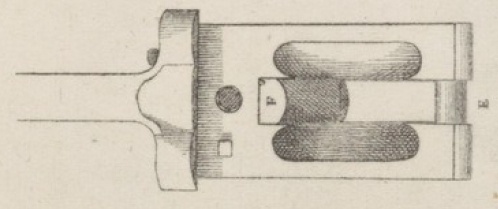
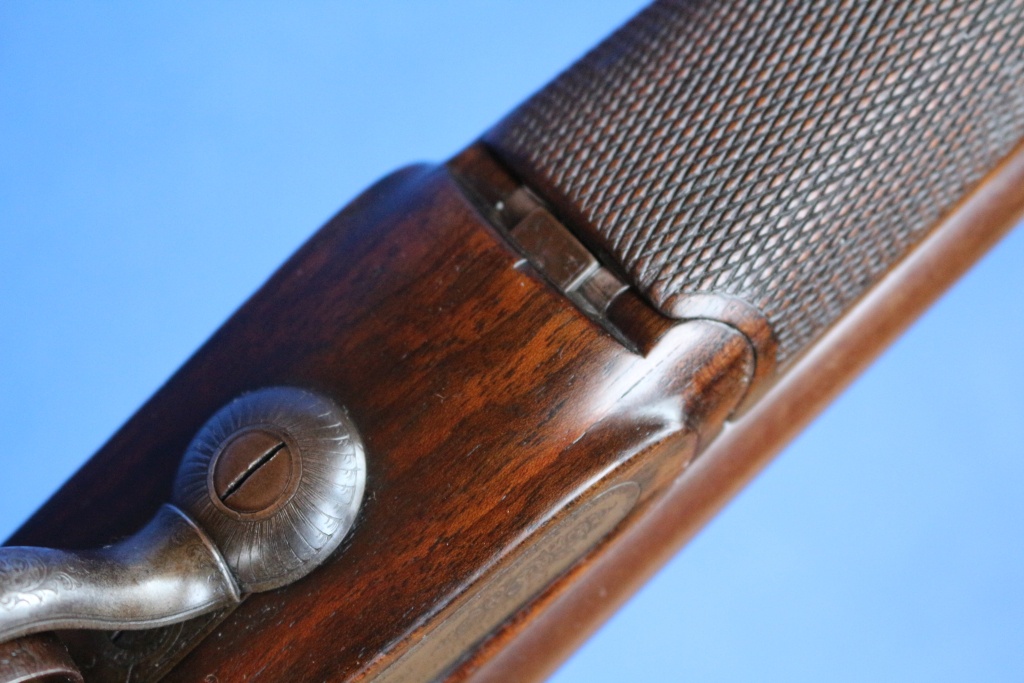
The allure of the British gun

Brybenn, I totally agree, it would be good to test the effect of modern barrel boring on patterns and recoil. In inches, what passes for 12 gauge is nominally at .729, but can be as large as .740 (12/1 in British proofs) and still count as a 12. As you point out, 12-gauge barrel diameters can also be constricted (.719, or 13/1; and .710, or 13) and still be chambered for 12-gauge cartridges. For those using the European measurements for 12 gauge, it can range from 18.2 to 18.9 millimetres (18.5 being nominal). This variation presumably has an impact, though it seems no one can tell us just how. We have a pretty good idea of what we think is happening in the chamber and barrel when the primer lights the main powder charge, and the charge with its wadding or shot cup passes through the forcing cone and travels down the barrel. Upon exiting the barrel, science tells us a lot for certain, because of high-speed cameras and the time-honoured method of shooting at paper or sheet metal targets.

Maybe the differences between brands of powder, and between shapes and composition of wadding and plastic cups, are too slight to be meaningful. Add to this hardness of shot and length of forcing cones, and you already have a large set of variables, which may or may not be significant. Then add the variance in bore size above or below the nominal. I have no doubt that the main gun and cartridge manufacturers have tested all of these a great deal and put their statisticians to work on the results. Unfortunately, all we get is the hype from the marketing departments, in their desire for our dollars. If everything marketing folks tell us is true, by now I should be slim, healthy, handsome and prosperous. And a dead-eye shot, to boot. Reality, as they say, is a b___h.

On the subject of narrowing bores, I would be remiss in not mentioning the ‘Vena Contracta’ gun, which was a double gun which had a 12-gauge chamber, a 6-inch forcing cone, and 20-gauge barrel tubes. Possibly first introduced by Joseph Lang, but patented by Horatio F. Phillips in 1893 and built by Webley, it was meant to lighten the barrel weight and, curiously, to reduce recoil, though some describe it as increasing recoil. It was not a commercial success, and I've never seen one. At the time, Phillips was the shooting editor at The Field newspaper. It also goes to show that the discussion about the relationship between bore size and recoil has been going on a long time, without a final conclusion.

I find it interesting that The Field trials of the 1850s and 1860s were done without questioning point-of-aim, as obviously no gunmaker would allow a gun to leave their shop that didn’t shoot where it was pointed, and that the pattern remained centred at 40, 50 and 60 yards and therefore comparable across makers/types. I wonder if modern guns, across brands and models, could claim the same.

I also wonder to myself if, considering our obsession with personal freedom, we would react badly if any given manufacturer of guns, cartridges and chokes would say that we must only use, say, Challenger ammunition of a certain load and shot size, or Federal ammunition of a different shot size, or any other specific combination, etc., if we want to have performance anywhere close to what is claimed. Sort of like optimum octane levels for certain car engines, if you want to match the performance specs. Or, as the apt expression says, ‘your mileage may vary.’ I would add the unspoken part, ‘and you might not like the results.’
 
Last edited:
Ready for more?

OK, let’s stick to the subject of public trials for a bit longer, as it really did set Britain apart, and did much to popularize some of the guns and ammunition we still shoot today. The Field trials of 1858 and 1859 that I’ve already covered put to bed the widely held belief that muzzle-loaders were inherently better guns than the newfangled breech-loaders. By a technical loss that was pretty much a draw, the still-improving breech-loaders were on par with the most highly evolved muzzle-loaders. From 1860 onwards, the pin-fire breech-loader was the ‘it’ gun, while the muzzle-loader was yesterday’s gun, though still widely used and manufactured. Creativity and invention flourished around the breech-loader, leading to improved actions and advances in overall design and performance. The pin-fire also had to contend with growing competition from the central-fire system, which seemed to have all of the advantages of breech-loading, with less of the annoyances the pin-fire system brought with it. These expressed petty niggles included having to carefully line up the cartridge pins with the holes at the breech in order to close the gun; sometimes clumsy split-cartridge extraction; and the protruding cartridge pins making holes in one’s shooting jacket pockets (I kid you not). While the central-fire cartridge could be chambered without concern, the gun needed an extractor, which meant extra work for the gunmaker. The central-fire also took away the convenience of always knowing if one’s gun was loaded, due to the protruding pins (this led to the later invention of loading indicators, popular on Continental guns).

In the 27 January 1866 issue of The Field, the Editor John Henry Walsh, wrote:

“There are few things upon which more differences of opinion exist upon sportsmen than upon the relative value of the different breeds of sporting dogs, and the various kinds of guns and rifles used with them. From time to time we have lent our aid to arrive at some definite conclusion when a controversy has waxed unusually warm; and for our open trials of the French breech-loader against the old muzzle-loader we may claim the merit of having first settled the respective value of each…” and “… Let us now calmly consider what remains unsettled in these much-vexed questions, and how far we can assist in their solution.”

“Since our last “Field” trial of shot-guns, though the breech-loader has almost entirely superseded the muzzle-loader, yet the varieties of the former are so numerous that the intending purchaser of a gun is lost in attempting to investigate their relative merits. “Single” and “double grips,” “snap actions,” “lockfasts,” and “wedge-bolts,” “central-fires” and “pin cartridges,” are only leading divisions, or captains of companies, each numbering many privates in its ranks. Week after week we are asked by our correspondents for guidance; but though we can give an answer which is perhaps better than none, we cannot satisfy ourselves. A public trial may be made to show which of the guns shot is the best performer there and then; but on the questions of durability and safety it says nothing. If any great good is to be done, some conclusion must be attempted on all three of these points; and not only upon them, but also on the relative value of gunpowder and gun-cotton, and of the many cartridge cases, and machines for filling them, which are weekly advertised in our columns. Then how is this to be done so as to give general satisfaction to our readers?”

The rules for the new trial were simplified over previous trials. Powder charge (for 12-gauge) was limited to 3 drachms, but the size of charge was left to the exhibitor, target distance was limited to 40 yards only, and 12-bores could not exceed seven and one-quarter pounds in weight. There was also an interest in testing cartridge loading machines, and testing gun-cotton (nitro-cellulose powder), which was becoming available. (The subject of smokeless powders in early breech-loaders is complex and worthy of a separate series of posts for this thread, which I will cover another day.) Another area of development that sportsmen wanted tested was the composition of barrels. Simple twist barrels were forgotten and damascus steel was the norm, but its supremacy was being challenged by laminated steel barrels, and even newer drawn steel barrels.

In addition to the pattern and penetration testing, a committee of five eminent sportsmen was chosen by readers of The Field to give their comments and opinions on the various gun and action types being tested. Perhaps to preclude the disappointment of readers about the reluctance of top London makers to take part in the trial, Walsh wrote in the 19 May issue:

“We need not remark that it is neither our wish nor that of our subscribers to test the guns of our chief London makers. All sportsmen know that they have only to write a cheque, with three figures in the left-hand corner, to obtain a pair of guns equal to to any the world can produce. Messrs Purdey, Boss, Lancaster, Moore, or Lang would have everything to lose and nothing to gain by competing, and they very wisely abstain from doing so. But there are hundreds—nay, thousands—of thorough sportsmen who do not like to pay this high price even with three years’ credit, and it is for their benefit that we wish to ascertain how nearly the gunmakers who rank second in point of reputation to the above firms approach them in their work. Hence we adopt the most severe test used in the London trade, which indeed is rarely fully passed by the best guns; for we unhesitatingly assert, from an extensive trial, that there are few barrels sent out, either from Oxford-street, St. James’s-street, Bond-street, or Cockspur-street which will drive No. 6 shot through forty sheets of the paper we use at 40 yards. The feat, however, has been done on more than one occasion; but thirty-five sheets may be taken as a good standard of excellence, all beyond which must be regarded as indicating more than an average power of shooting. Coupled with this there must be a pattern of between 100 to 130 hits within the circle of 30 inches diameter; and if we can show such a combination of good qualities in a gun finished in a style to pass the critical eyes of the committee of sportsmen enumerated above, and at a reduced cost, we think we shall have done considerable service to our readers. At all events, they can judge whether the difference in shooting and workmanship between the guns exhibited and those sold by the fashionable makers is sufficient to warrant them in straining their purse-strings.”

The trial was conducted over two days during the week of the 21st of May, 1866, and reported in the 2 June 1866 issue of The Field. Unfortunately, due to supply problems, the much-anticipated testing of gun-cotton versus black powder did not take place.

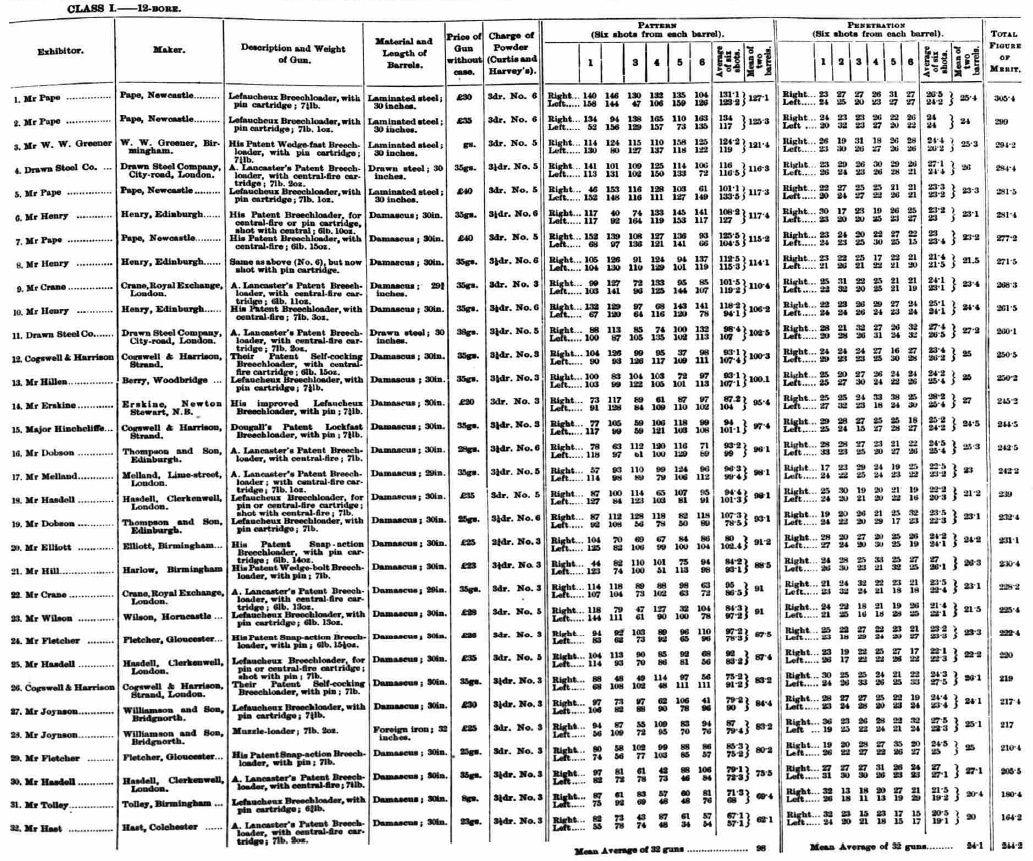
To keep things succinct, I will only summarize the 12-bore results. There were thirty-one 12-bore guns shot as 32 separate entries (one dual-fire gun was shot with both pin and central fire cartridges, counting as two entries). Of these, there were fifteen pin-fires and two dual-fire guns firing pin-fire cartridges. The pin-fires were built by William Rochester Pape, William Wellington Greener, Sharman West Berry, James Erskine, Cogswell & Harrison (with a Lockfast action), Thompson & Son, Henry Elliot, Edward and John Tertius Harlow, Edwin Wilson, Thomas Fletcher, and James and William Tolley. The dual-fire guns were by Alexander Henry of Edinburgh, and Thomas Robert Hasdell of Clerkenwell, London). There were eleven central-fire guns, and the same two dual-fire guns by Henry and Hasdell. Of the central-fire guns, there were eight guns based on the Charles Lancaster patent, by Harris Holland, John Henry Crane, Thompson & Son of Edinburgh, George S Melland, Philip Hast of Colchester, and Hasdell. The other central-fires were by Pape, Henry, and Cogswell & Harrison. The single muzzle-loader in the competition was by Thomas Williamson & Sons of Bridgenorth.

The top-scoring guns were pin-fires with laminated steel barrels by Pape (1st, 2nd and 5th place) and Greener (3rd); 4th place was a Holland central-fire on the Lancaster patent with drawn-steel barrels; 6th was a Henry dual-fire with central-fire cartridges and damascus barrels; 7th was a Pape central-fire with damascus barrels; 8th was the Henry dual-fire with pin-fire cartridges; 9th was another Lancaster patent central-fire, by Crane, with damascus barrels; and 10th was a Henry central-fire, with damascus barrels. In fact, all guns performed reasonably well, with little difference between the pin-fire and central-fire cartridges overall. Of note, the muzzle-loader ranked 28th out of 32 entries. The top 13 guns all achieved 100 hits within the 30-inch circle at 40 yards, and most pierced 25 sheets of brown paper. Most of the top-scoring guns were in the £37-40 range, though the winning gun by Pape cost £30. The least expensive gun in the trial was an 8-Guinea pin-fire by Tolley of Birmingham, which scored a disappointing 31st out of 32 entries. Probably the best value, which would not have gone unnoticed, was an “improved Lefaucheux Breechloader” by James Erskine of Newton Stewart, for £20, which ranked 14th (more on him later).

sTgIYQk.jpg


In the 9 June issue of The Field, Walsh corrected some possible misunderstandings in the table. Guns listed under the name 'Drawn Steel Company' were built, bored and regulated by Harris Holland, with the Drawn Steel Company having provided him the raw barrels. Guns listed as being of the “A. Lancaster” type were of the Charles William Lancaster design, and not Alfred Lancaster’s.
 
The Field trial of 1866, continued.

In the end, The Field Committee was composed of Mr. William George Tyssen-Amherst Of Didlington Hall, Norfolk, Captain George Fearnley Whittingstall, Mr. Irwin Edward Bainbridge Cox (later owner of The Field), Mr. William Lort, Jun, and the Rev. Thomas Pearce of Morden Vicarage as Chairman (known by the pseudonym “Idstone”). They met and reviewed/tested the loading machines, and examined gun actions by Greener, Crane (on the Lancaster principle), George Melland (on the Lancaster principle), Thompson & Son, William Powell & Son, Wilson, Elliot, Hasdell, Harlow Brothers, Henry, Pape, Fletcher, Cogswell & Harrison, and Erskine. Lord Ranelagh (Lieutenant-Colonel Thomas Heron Jones, 7th Viscount Ranelagh), originally suggested as Chairman, did not provide his individual opinions, he agreed with the findings of the Committee, which complimented the makers for the quality of their guns and the ingeniousness of their designs. The Committee singled out the William Powell & Son lifter (push-up) snap-action as the best gun for the price (£25).

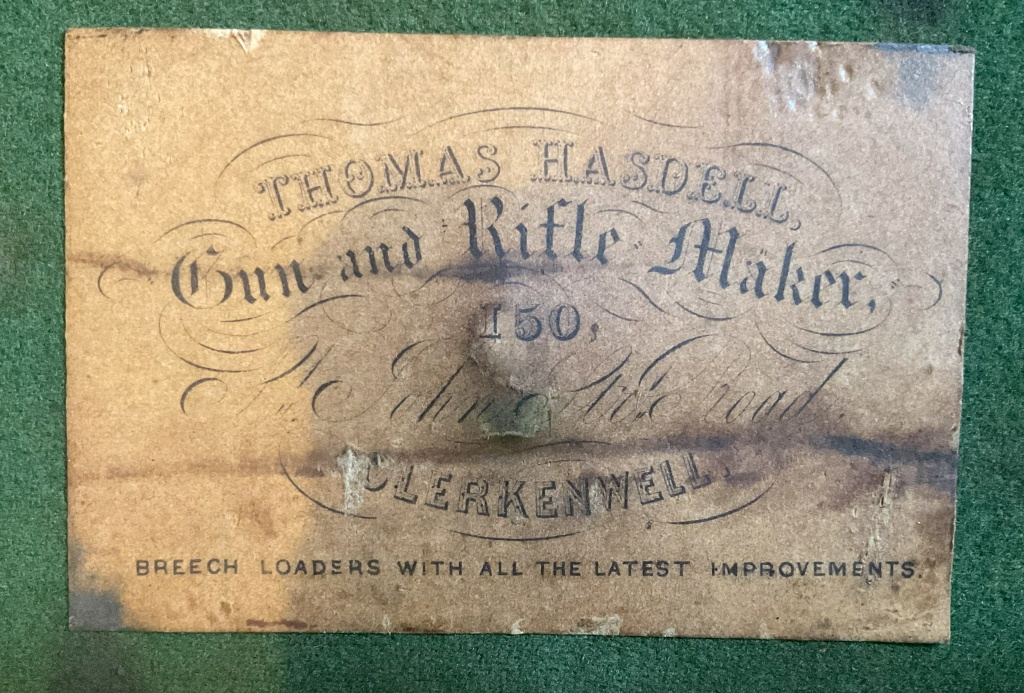
To my embarrassment, I do not (yet) have examples of some of the guns that participated in the 1866 trial. I have never seen a Greener Wedge Fast pin-fire gun, a Elliott pin-fire snap-action, a Harlow Wedge Bolt pin-fire, or a Fletcher snap-action pin-fire. I have also never seen any gun by Thomas Williamson & Sons, but I can’t say I spend much time researching or scouring auction listings for muzzle-loaders. I do have examples of the types of guns exhibited by Pape, Erskine, and Cogswell & Harrison, and I will cover these next. As to Mr. Hasdell, all I have is one of his cases, missing the gun, with the following label:

hsjbmAj.jpg


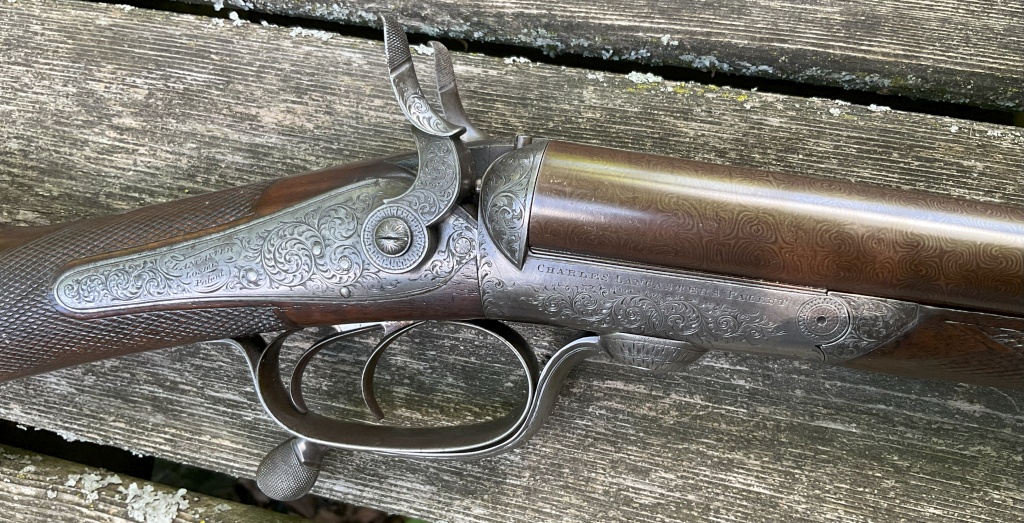
Here is the Charles Lancaster action, on one of his own guns:
hiR26rU.jpg


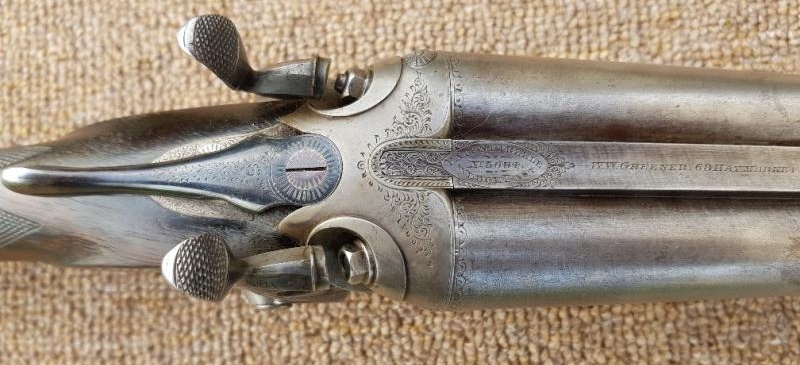
Here is a Greener Wedge Fast hammer gun (the photo is from the Vintage Guns (UK) website):
HpUgtf7.jpg


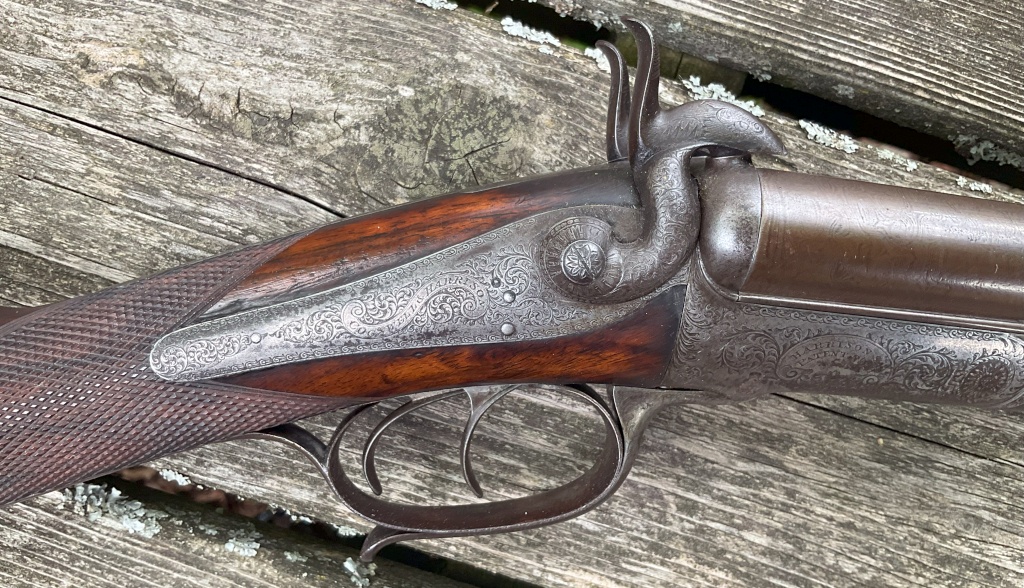
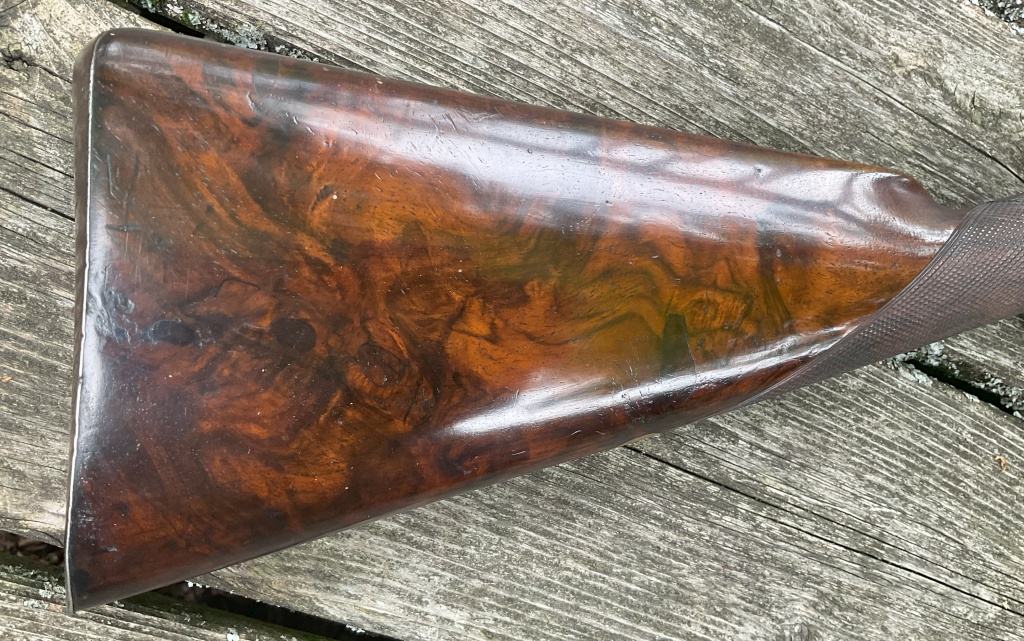
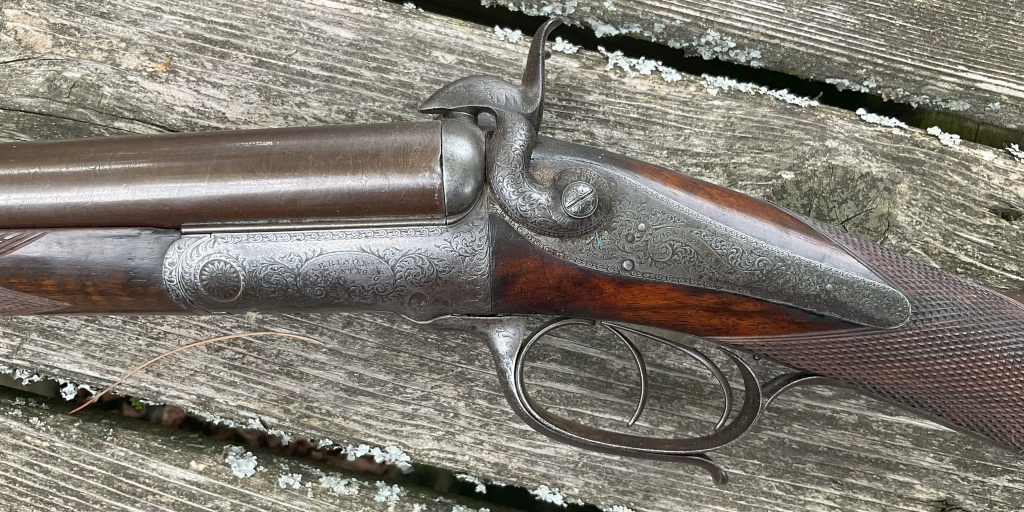
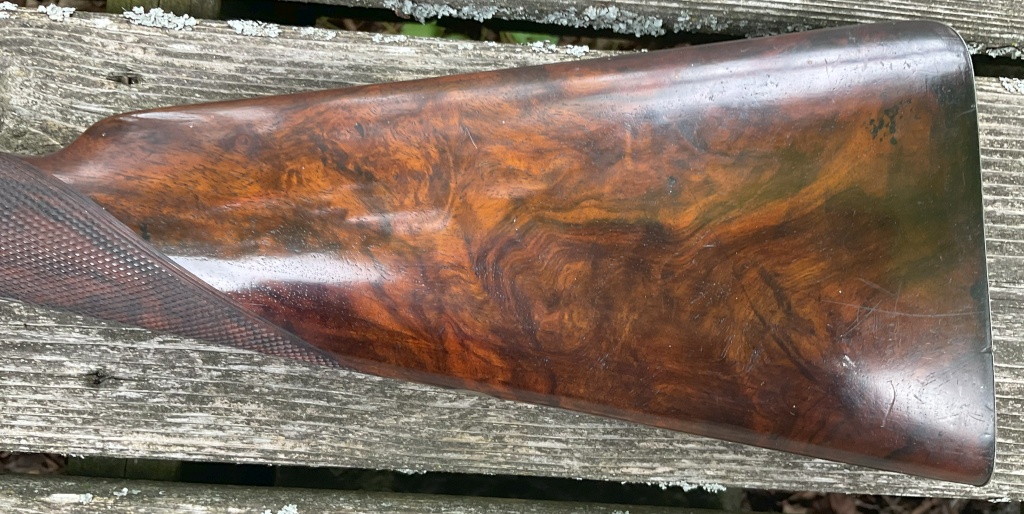
The Pape and Erskine guns are quite special, and I will cover them in more detail later in the week. Here is the Cogswell & Harrison “Self Cocking Breechloader” as entered in the 1866 trial. This particular gun is the 26th that C&H made on this pattern, so it probably dates from 1865. Barrels by Amos Elvins for C&H. It still has mirror bores, and weighs 6 lb 13 oz. The stock is one of the most gorgeous pieces of walnut I’ve ever seen on a pin-fire game gun.

Dc3rokI.jpg

cvKkGde.jpg

uLpKq71.jpg

6Wx5jH7.jpg


The Field trials held in 1875 (to test choke boring) and 1878 (to test smokeless powders) will be covered in future posts, if the interest is there.
 
Last edited:
The 1866 Field trial was a showcase of ideas and creativity, and pure technology. It demonstrated there was really nothing to choose performance-wise between the pin-fire and the central-fire (spoiler alert, the central-fire, what we now call centrefire, won the long game). It also showed that different barrel construction methods, namely damascus-, laminated-, and drawn-steel, were all good (three years later, Sir Joseph Whitworth would patent his compressed fluid steel method for making gun barrels, and fluid steel by various methods eventually displaced all others in the 20th century). The trial validated the various gun actions competing on the market, leaving room for personal preference, buoyed by the knowledge that they were all strong and up to the task. Publishing the cost of the guns in the Field trial results was also notable, as it provided a comparison table of performance and cost (not dissimilar to the kind of table one can create on online shopping sites today). Not being able to test gun-cotton (smokeless and semi-smokeless powders) against black powder, as originally envisaged, was a disappointment to many, and might have contributed to the delay in the adoption of the new propellants. It wasn’t before 1896, thirty years later, that the Proof House regulations finally caught up with the use of gun-cotton and smokeless (nitrocellulose) powders in sporting guns, a subject I will cover soon.

The clear winner of the two-day event was the Newcastle gunmaker William Rochester Pape, with his 1st, 2nd, 5th and 7th place finishes in the 12-bore class. He entered four guns, of which three were listed as “Lefaucheux Breechloader with pin cartridges,” and a central-fire version of his new patent action. I have to presume the first three guns were of the typical pin-fire construction of the day, probably double-bite actions with rear-facing under-levers (popularly known as ‘Jones under-levers,’ though he didn’t invent them). The fourth gun would have been his newly patented snap-action design with a small thumb-lever release (some called it a ‘tap’ or ‘butterfly’ lever). This patent, registered on 29 May 1866 and designated No. 1501, is also the patent that included choke-boring for the first time.

William Rochester Pape was born on 1 August 1832 in Amble, near Newcastle upon Tyne, Northumberland, in the north of England. His father, James, was a game dealer and had a business making fishing rods, flies, and tackle. William is believed to have apprenticed under the gunmaker William Davison, though the 1851 census lists him as a game dealer, working with his father. In 1857, William established his own business as a gun, fishing rod and tackle maker at 44 Westgate Street, Newcastle. He did well, as his guns (muzzle-loaders) achieved top honours in the Field trials of 1858 and 1859. Between 1859 and 1862, William moved his business to 29 Collingwood Street in Newcastle, in premises that were formerly occupied by William Greener (W. W. Greener’s father). Unusual for a gunmaker in those days, the 1861 census records that Pape did not live above his workshop, but had a separate home address (7 Westmorland Terrace). Pape’s gun business at the time employed nine men and four boys.

The Pape snap-action consisted of two bolts on a vertical spindle, operated by a small thumb lever to the right of and just in front of the trigger guard, under spring tension. The bottom bolt engages with a slot in the barrel lump, and the upper bolt engages with an extension above the barrels. Pape claimed that the action was self-tightening so that even after wear and tear, it would remain tight. This was advantageous as becoming loose over time was one of the biggest fears of the snap actions at the time. On 3 September 1867, Pape was granted patent No. 2488, for an improved design incorporating his thumb lever, and this latter patent is the one which is most frequently seen on Pape’s central-fire guns today, as he continued making them for some years. It can be distinguished from the first patent by the angle of the thumb lever, which lies at more of a right angle to the gun. Pape could not have sold many guns of the first patent in the short 14-month period between the two designs.

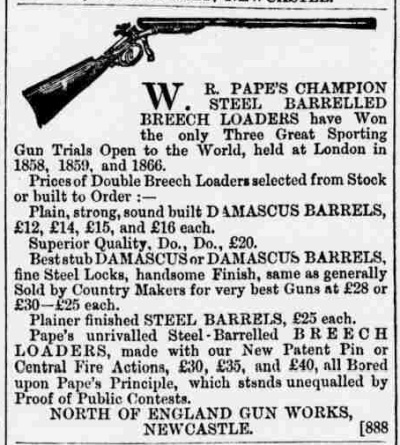
Pape was known for having guns built for him in Birmingham, while also producing them in his Newcastle workshop; whether Pape himself made guns is an open question. He aggressively and tirelessly promoted his business, such as participating in the trials and advertising widely in the sporting and general press. Of his 1866 patent gun, which he sold for £40, he announced it in The Field, the English Mechanic and Mirror of Science, and local papers, including the Derby Mercury, the Gateshead Observer, the Kelso Chronicle, the Leicester Mail, the Lincolnshire Chronicle, the Newcastle Courant, the Newcastle Daily Chronicle, the Newcastle Guardian and Tyne Mercury, the Newcastle Journal, and the Shields Daily News. This rush of advertising was more self-promotion than an expectation of business, as few could afford his most expensive gun. In his adverts, Pape could claim with some hubris to have “Won the only three great Sporting Gun Trials Open to the World,” and offering “...unrivalled Steel-Barreled BREECH LOADERS made with our New Patent Pin or Central Fire Actions… all Bored upon Pape’s Principle, which stands unequalled by proof of Public Contests.”

6ipQr1n.jpg


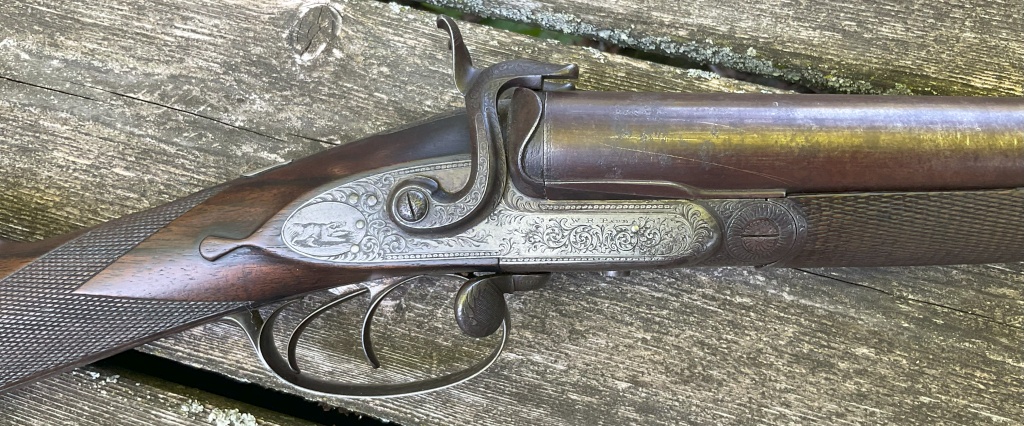
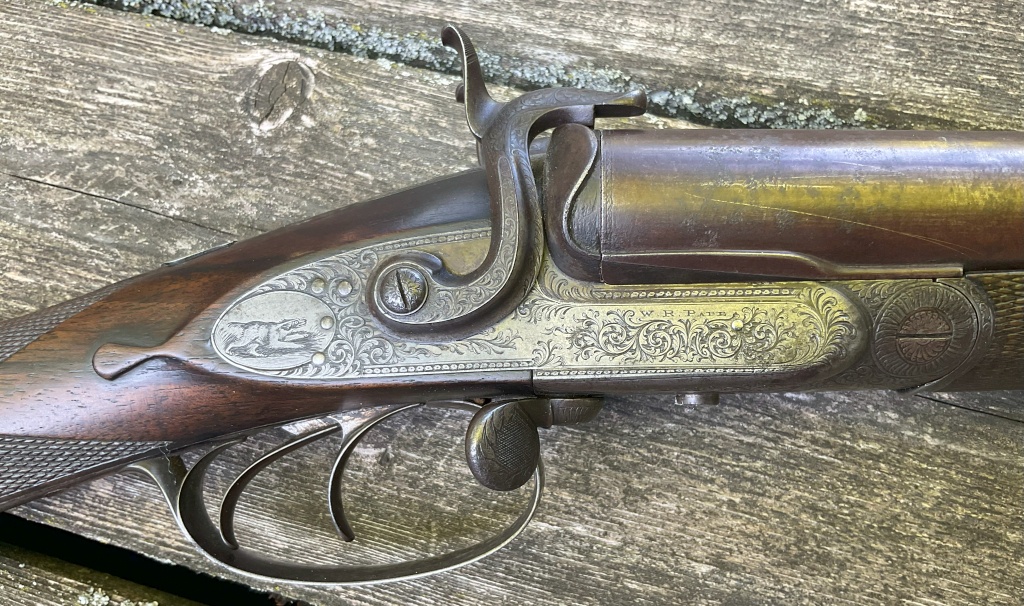
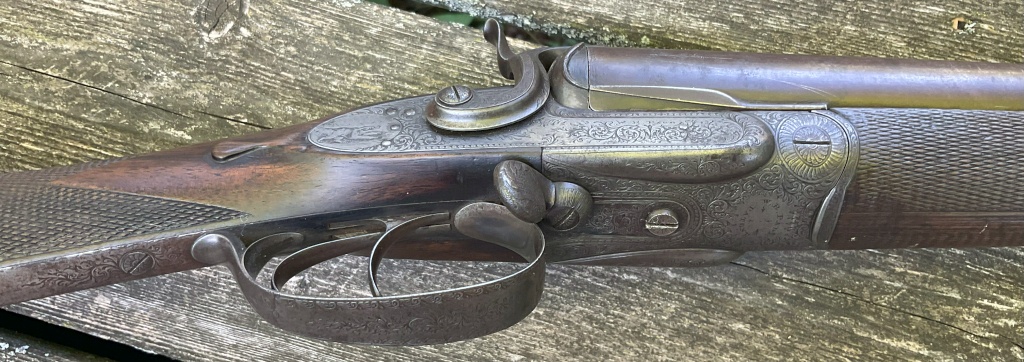
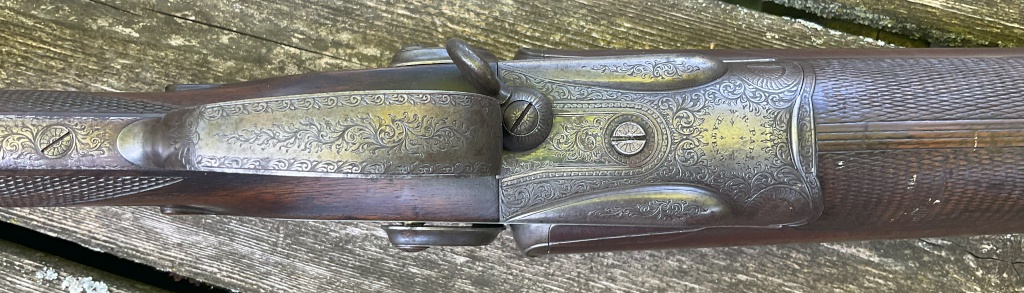
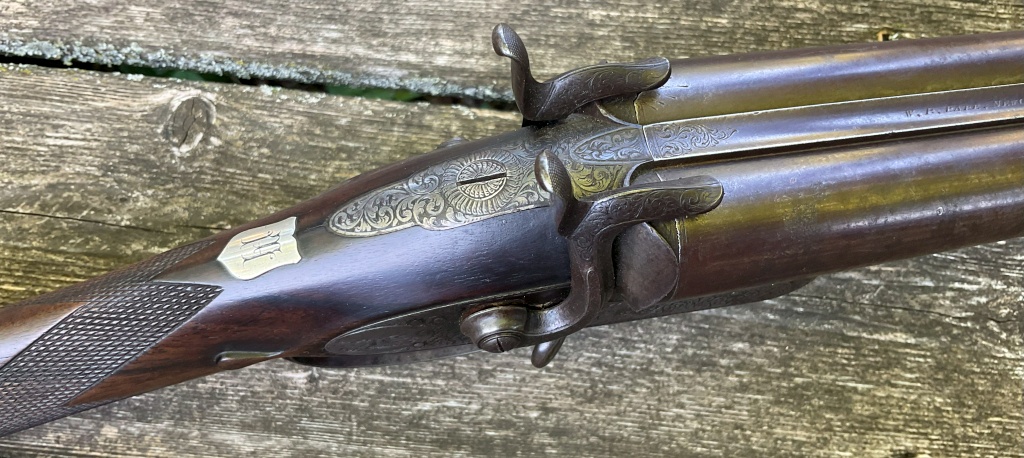
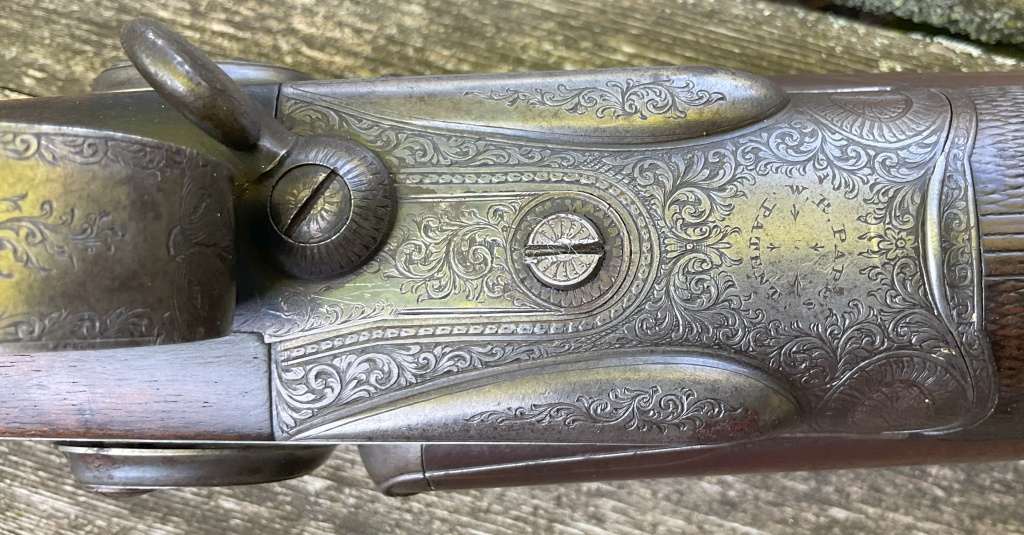
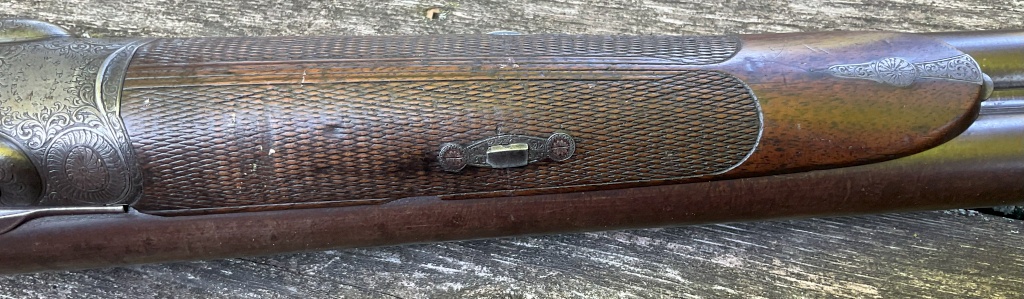
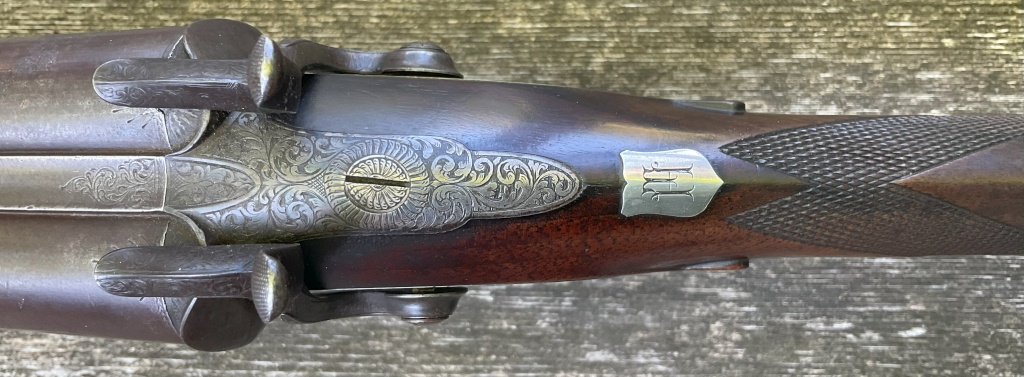
Here is the 13th gun Pape built to his first patent (No. 1501). It is a best-grade 12-bore made in 1868, number 1366. The top rib is signed “W. R. Pape Newcastle on Tyne Winner of the London Gun Trials 1858, 1859, & 1866 Patent no. 13.” The 30” barrels are damascus steel. The barrels are initialled “WRP,” so I’m presuming the gun was made in Pape’s workshop, and not by ‘the trade.’ From the rib inscription, we know the gun was built after June 1866. The bar locks are marked “W. R. Pape,” and the action body is fluted in shape and engraved “W. R. Pape’s Patent.” The gun is decorated in best foliate engraving with dogs in ovals. The hammers are well sculpted, and the forearm has ornate chequering borders, both characteristics of the maker. The gun weighs a hefty 7 lb 14 oz, suggesting it was built as a live-pigeon gun.

RboHV1p.jpg

WrZdVUF.jpg

J1LkDrl.jpg

4e5cOM5.jpg

k4zD78a.jpg

suzRAV4.jpg

K8aonKL.jpg

ZAcQE6z.jpg


The escutcheon has the intertwined initials “TH,” which, unfortunately, is not enough to identify the owner with certainty. If I were called to speculate, my best guess would be Sir Thomas Hesketh, 5th Baronet (1825-1872), an English Conservative politician who sat in the House of Commons from 1862 to 1872, representing Preston, and who was a competitive pigeon shot and was frequently mentioned in reports on pigeon shooting events in The Field. While he was known to shoot a Purdey muzzle-loader, he might have been sufficiently swayed by the results of the trial to order himself a new Pape snap-action breech-loading pigeon gun! If he did so, he did not compete with it; he used a Purdey muzzle-loader in the Derby Handicap, reported on 2 June 1866, and the Summer Handicap, 29 June 1867. By the time of the Champion Sweepstakes, reported on 20 June 1868, Hesketh was shooting with a Purdey breech-loader, but in 1870 and later, he was back to using a Purdey muzzle-loader.

There’s more to the Pape story, including reports of his cheating in a trial and a falling-out with the Editor of The Field. But that’s for another day.
 
Last edited:
Not British, but related to my 4 July post (on page 13 of this thread) on extractors. The Pauly/Roux cartridge and gun are the beginning of every cartridge development story, sowing the germ of an idea that later resulted in the pin-fire system, of which I am very partial. It is enjoyable when early historical guns and concepts are discussed by YouTube influencers like Ian McCallum.

I see new members sign up to CGN all the time, and views to this thread steadily creep along, but very few join the discussion. Is the subject of gun history, and sporting guns as historical objects, only of interest to a few die-hards here?

To those who do regularly drop in, I am delighted by your interest in these posts!
 
One last post on the 1866 Field trial, this time on a variation of the double-bite under-lever action.

One reason for the allure of the British gun is the intense creativity behind its evolution. The British gun business was not interested in just putting out a single pattern in quantity. For one thing, the shooting public, that is, the people who had the time and money for country pursuits, numbered relatively few, compared to the present day. We can buy reliable, affordable guns and are free to hunt on crown land on our days off at minimal expense, or shoot clays at clubs that welcome all sorts. The elements of society in Victorian Britain with equivalent freedoms and opportunities were limited to the higher strata of society, and it is these potential clients that gunmakers sought to attract, with ever-improving designs and inventions.

The Field Committee mentioned previously, meeting at the Lillie Arms public house, Brompton, London, reviewed a number of breech-loading actions, as part of the 1866 Field trial. One of guns examined was by James Erskine, of Newton Stewart, Scotland: “made on the Lefaucheux system, but decidedly stronger and better, and altogether most creditable to him as a thinking and practical man. As he has not patented this improvement, we must decline at present to say more of his valuable invention.”

Erskine did submit a patent application a week later on 9 June 1866, for which he received a provisional patent. In it, he claimed to improve upon the French system, which he said depended on the hinge to absorb recoil forces. His improvement was to ensure the two surfaces that absorbed the recoil, on the barrel lugs, were at right angles to the axis of the barrels. With the action secured, the hinge pin, or fulcrum, did not absorb the forces of recoil, and the hinge pin could be removed before firing the gun, to no ill effect. He also distanced the hinge pin farther away from the breech face, and placed the hinge higher up, closer to the axis of the barrels.

In response to the Committee’s comments, the Editor of The Field, John Henry Walsh, commented: “Another action selected by the committee is the invention of Mr Erskine, gunmaker, of Newton Stewart, and though only a slight modification of the Lefaucheux double grip action, it is a very considerable improvement on it, but we are very doubtful whether it is new in principle, and whether Mr Erskine can sustain his patent. With this, however, we have nothing to do at present, and have simply to remark that the improvement consists in throwing the hinge forward and nearer to the barrels, by which the recoil-bearing surfaces on the lump at are more nearly at right angles to the long axis of the barrels, and, therefore more capable of receiving the recoil. In other respects the action differs little from the double grip.”

This resulted in a response from Erskine the following week, in a vigorous defence of his modification. One Birmingham breech-loading action filer remarked that Erskine’s improvements were the same as those presented in a Henry Jones’s patent filed five years previously. Erskine responded angrily that it was Jones who copied him, not the other way around. The matter disappeared from the letter columns of The Field, and Erskine never did obtain a full patent, meaning he either didn’t provide authorities with additional information other than what was in the provisional patent, or it was refused.

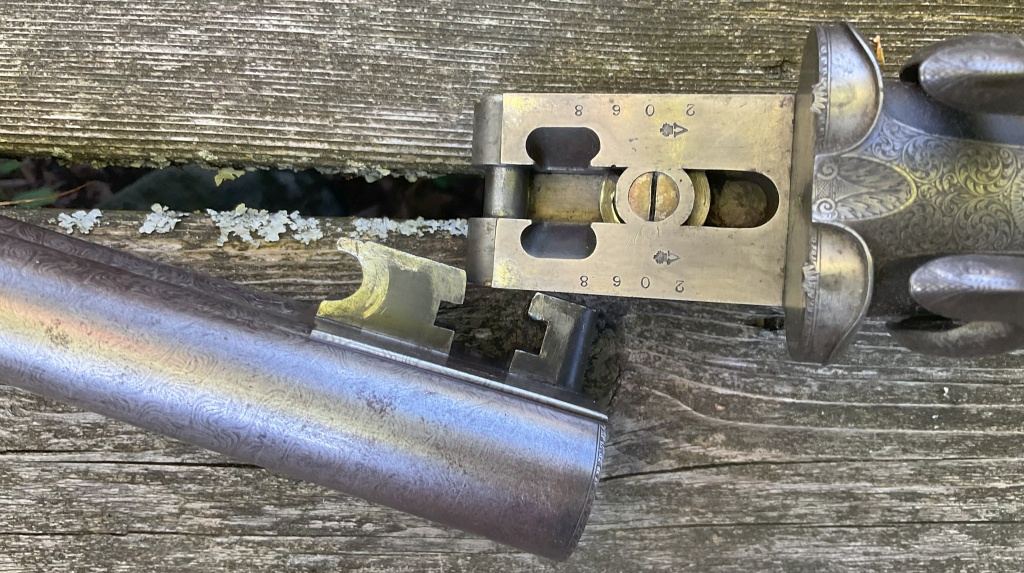
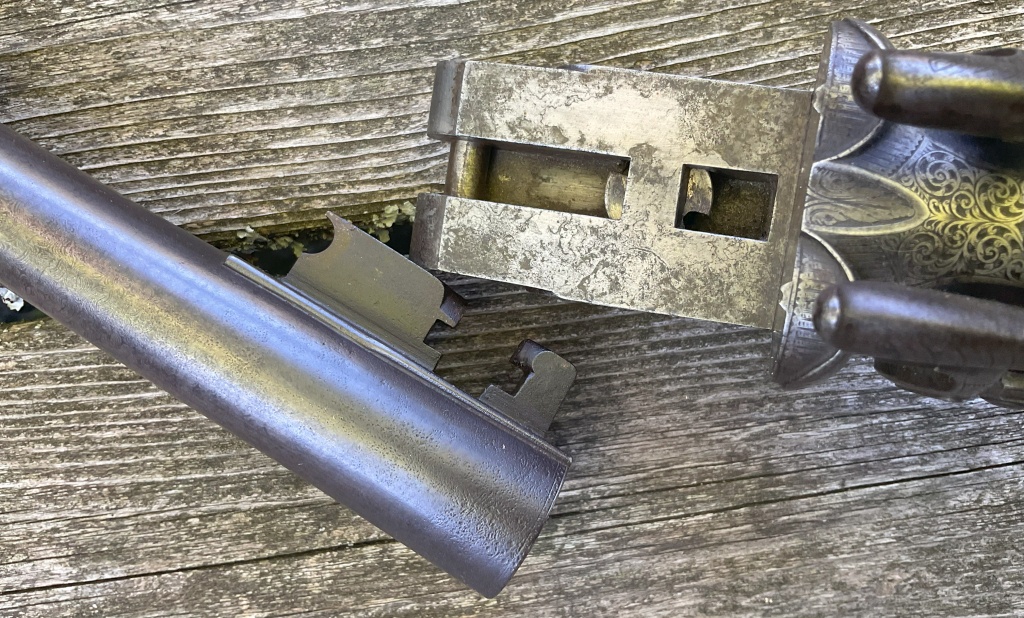
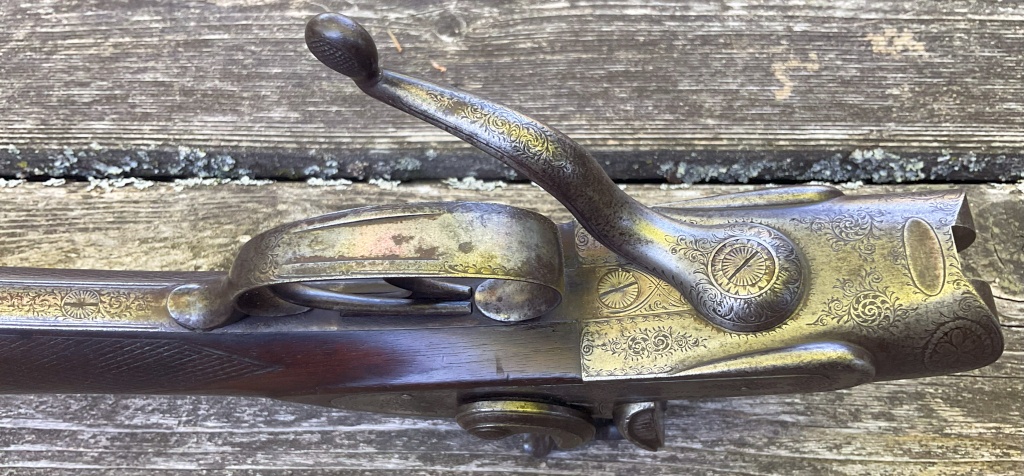
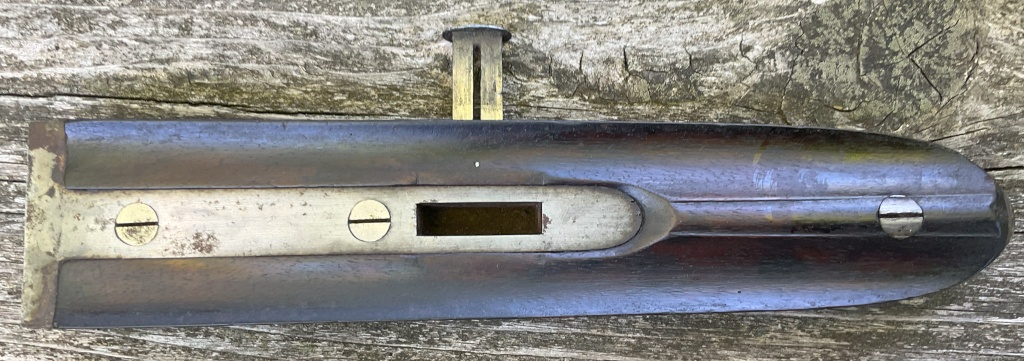
Erskine’s modifications were indeed subtle, and they weren’t at all apparent to me until I placed the Erskine action beside a typical double-bite action common at the time of the trial. He did place the hinge pin farther away from the breech face than what was typically done, which would have somewhat lessened the flexing strain on the action bar. The hinge pin is smaller in diameter, and the cuts on the barrel lugs are slightly closer to the barrel tubes. As to Erskine stating the hinge pin could be removed without weakening the action once the barrels are secured, the same could be said of any properly fitted Jones-type double-bite action – the barrels aren’t going to move, and the secured barrel lugs take the strain, not the hinge.

Here is a typical post-Jones patent double-bite action, this one filed by Edwin Charles Hodges, for Boss & Co., in 1864. This is as good as craftsmanship gets, in a hand-filed gun.

Dt1RVuV.jpg


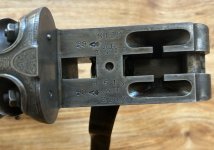
Here is the Erskine action. As records have not survived, I have no way of knowing if this fully or only partly corresponds to his provisional patent. The action bar is longer and the hinge farther away from the breech-face; the barrel under-lugs are shaped differently, and the hinge diameter is smaller. The cuts on the lugs are slightly closer to the barrel axis.

137DaDk.jpg


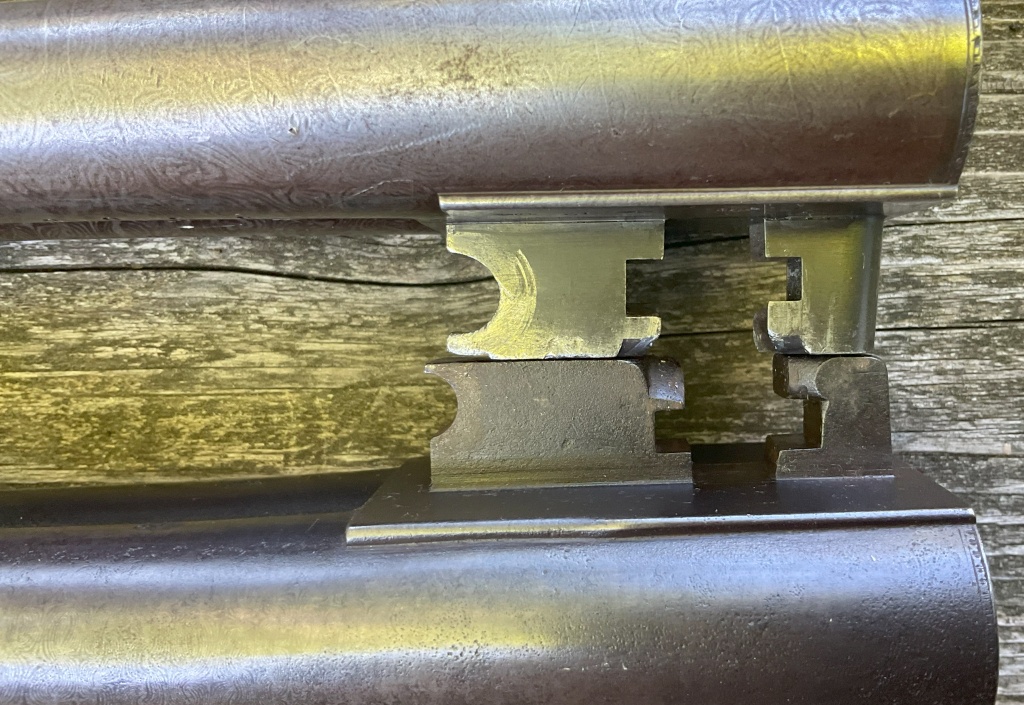
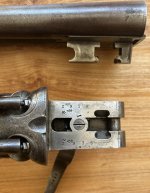
While Erskine claimed the action was much improved, I can also see the argument that differences are slight, and might offer no practical benefit. Here are the two barrel sets of the above guns, side by side for comparison (Boss upper, Erskine lower).

CBe9wNt.jpg


The gun, a 12-bore, is well made, as one would expect from a Scottish maker. James Erskine was born in 1812 near Newton Stewart in Scotland. Newton Stewart was a small community with cotton mills and a wool market, with a population at the time of about 3,000. Erskine worked as a gun finisher for Williams & Powell of Liverpool before returning to Newton Stewart. He exhibited at the Great Exhibition in 1851 and was awarded a Bronze Medal, so his guns were highly regarded. In 1859 he obtained a patent for a slide-and-drop breech-loading action, where the barrels moved forward an inch before tilting, driven by a cog-like system operated by a forward under-lever, and the hammer noses extracted the spent shell casings like the Bastin Brothers system. I have never seen one, or a picture of one; it might not have been a commercial success.

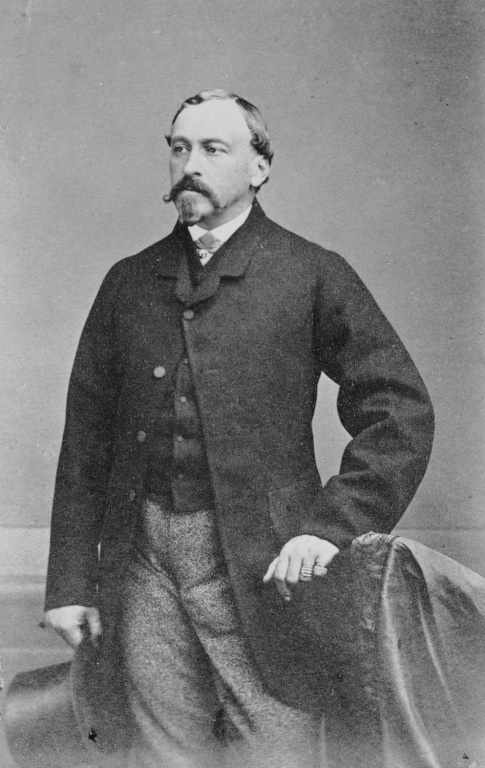
Soon after achieving attention at the 1866 Field trial, Erskine was appointed Gun Maker to Ernest II, Duke of Saxe-Coburg and Gotha (the elder brother of Albert, Queen Victoria's consort), and to an Austrian prince.

Ernest II, Duke of Saxe-Coburg and Gotha
K8pzP2u.jpg


As with many guns at the time, it is not numbered. The top rib is signed “J. Erskine Newton Stewart.” The 29 1/16" damascus barrels have only a London provisional proof mark, no definitive proofs, and no bore stamp. The action bar is also lacking the usual proofs. However, it is a good medium-quality gun made with attention to detail and styling, with a sculptured action body, shaped hammers, fluted fences, and a well-figured stock with heel and toe plates. As is often the case with guns of this period, it is all about the unnecessary details – such as the dimple in the action to accept the raised edge of the fore-end iron when the gun is opened. I wish I knew more about the history of this gun, whether it was made pre- or post-1866 trial, and the reasons why it escaped normal proofing. It weighs 7 lb 4 oz.

El1ihrF.jpg

KPWW3Gs.jpg

QUFLAgk.jpg

3m55vWB.jpg

Cjlrh9P.jpg


The fore-end is not up to 'Best' standard, as this is a second-quality gun. However, note the detailed shaping of the finial fastening screw to fit the grooved wood:
qibaycs.jpg
 

Not British, but related to my 4 July post (on page 13 of this thread) on extractors. The Pauly/Roux cartridge and gun are the beginning of every cartridge development story, sowing the germ of an idea that later resulted in the pin-fire system, of which I am very partial. It is enjoyable when early historical guns and concepts are discussed by YouTube influencers like Ian McCallum.

I see new members sign up to CGN all the time, and views to this thread steadily creep along, but very few join the discussion. Is the subject of gun history, and sporting guns as historical objects, only of interest to a few die-hards here?

To those who do regularly drop in, I am delighted by your interest in these posts!

Just a thought in regard to your questioning regarding the lack of actual back and forth discussion. I don't believe it's a lack of interest. Lots of unique views.....even more of people following along. I think you would agree that you have a knowledge base on the origins and development of cartridge fired shotguns that may almost be unmatched. Especially here in NA. One thing I have noticed myself, and I think I have a reasonable amount of knowledge on the subject of vintage shotguns, is that your posts are so thorough, so well written, that if I am patient enough to wait for your next post or three as you delve into different subjects......all my questions get answered.

Conversely, if I was trying to write a thread like this, I know enough to get it going but the holes would be big enough that others would be compelled to chime in, ask for clarification, add some of their knowledge etc.

Steve......you're just too good! :p
 
Pinfire:

Thank you for continuing with these excellent and informative posts!
With respect to the Hodges-filed Boss gun you show in the above post, is there a mark or stamp on the action that confirms his work?

I wonder whether the slanted oblong cuts into the action flats are giveaways to his craftsmanship?

Here are a couple of 1870s guns with similar features, but no marks indicating that Hodges worked on them.

Boss 12 bore:
IMG_0597.jpeg

Stephen Grant 500 BPE (barrels/action bought in from Alexander Henry):

IMG_0598.jpeg
 
Pinfire:

Thank you for continuing with these excellent and informative posts!
With respect to the Hodges-filed Boss gun you show in the above post, is there a mark or stamp on the action that confirms his work?

I wonder whether the slanted oblong cuts into the action flats are giveaways to his craftsmanship?

Here are a couple of 1870s guns with similar features, but no marks indicating that Hodges worked on them.

Boss 12 bore:
View attachment 1000147

Stephen Grant 500 BPE (barrels/action bought in from Alexander Henry):

View attachment 1000148
Mbatten and Canvasback, thanks for the feedback. I shall continue.

As to your welcome question, Mbatten, E.C. Hodges did occasionally sign his work. His name might appear visible on the action bar, near the breech face, and perhaps more commonly he is known to have signed some actions behind the breech; the only way to see that is to remove the stock, something that is not often advisable on these old guns, to avoid damaging the pins. Here is Hodges's stamp on a Frederick Niebour gun:

Esp35jm.jpg


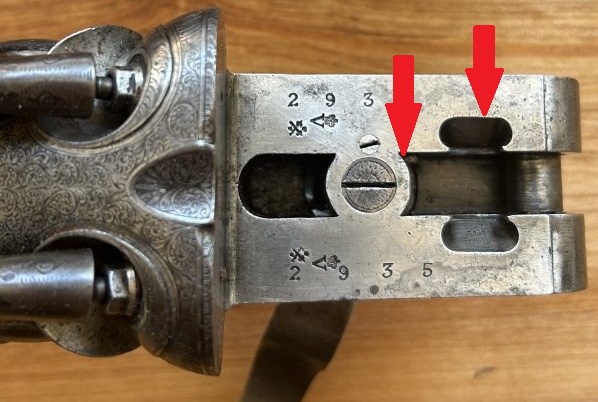
In my experience, there are other clues that suggest his hand in the work. The first of these, as you correctly point out, is the two cuts in the action bar to lighten the action. He did not invent this idea, he 'borrowed' it from the Parisian gunmaker Beatus Beringer. However, all of his actions appear to have these cuts, while most? other action filers did not go to the trouble of making such perfect cuts with hand tools. That said, I expect this feature would have eventually been copied by others. The second clue is the cut curve around the central pivot point and knurl/underlever attachment screw. For double-bite actions, it means two curved surfaces; in single-bite action, only one curve is cut around the pivot. As far as I know, for now, only Hodges went to this extra trouble, instead of just filing right-angled cuts (like your Grant). If you don't mind, I added two arrows to your photo of the Boss action, to point out the lightening cuts, and the curve around the central pivot point, which is different from your Grant (great guns, by the way!). Not enough light right now to take some more pictures, but I'll try taking some shots later in the week to show differences side-by-side. I consider the combination of the bar cuts and the curved shaping around the pivot as Hodges's 'signature'; for bar-lock guns, just the curved shaping around the pivot is enough for me. Hodges was the top actioner, so I'm not surprised he put in a little extra to quietly identify his work, especially on top-quality guns where the maker didn't want to share the glory with a name other than their own.

RRyglg1.jpg


Now, the extra cuts into the action bar seem to have only been made on guns with back-action locks. Guns with bar locks, if I'm not mistaken, don't have these cuts as metal is already removed to fit the forward ends of the bar locks, and further cuts would weaken the action.

Here is a clip from a Beringer patent drawing, dated 1837, showing his action bar cuts:
fqJSD5c.jpg


I learned of Hodges's involvement in Boss pin-fire guns from the Boss & Co. ledger entries, which listed Hodges as the actioner. However, Boss & Co. did not seem to be consistent in writing such detailed information about outworkers in their ledgers, which, though annoying, was for their benefit, not ours!

Further findings might prove my theory wrong, but so far I haven't found any evidence to disprove it. Of course, anything is possible in British gunmaking, and stating absolutes is asking for trouble...
 
On the matter of weight, Mbatten, those few grams were awfully important to them, even if it makes little sense to us. Extra weight was one of the arguments against the breech-loader, as muzzle-loaders didn't have the additional weight of a steel action to contend with. The early years of The Field were full of letters denouncing those additional grams. This led to gunmakers shaving off every bit they could, where they could, on standard game guns (as opposed to live-pigeon guns and waterfowling guns). Losing weight was the impetus for the thinner barrels compared to many Continental guns, and, where possible, the seemingly fragile bar-in-wood actions with reduced action bars.

Yeah, all that extra work. But at least we can stop to appreciate it, in this day and age of cutting corners and companies run by bean-counters...

OCWsoPi.jpg
 
Pinfire, I can’t add much if anything to this thread in terms of knowledge as I’ve only started my venture into British doubles.

I did recently pick up a W R Pape, I found it interesting that on the trigger gaurd there is what appears to be a Pinfire SXS engraving, I wonder if it happens to be one of the champion guns from the field trials.
 

Attachments

  • IMG_6588.jpeg
    IMG_6588.jpeg
    120.7 KB · Views: 21
  • IMG_6589.jpeg
    IMG_6589.jpeg
    111 KB · Views: 21
  • IMG_6591.jpeg
    IMG_6591.jpeg
    113.9 KB · Views: 20
  • IMG_6592.jpeg
    IMG_6592.jpeg
    120.2 KB · Views: 20
  • IMG_6594.jpeg
    IMG_6594.jpeg
    110 KB · Views: 20
Last edited:
Pinfire, I can’t add much if anything to this thread in terms of knowledge as I’ve only just started my venture into British doubles.

I did just recently pick up a W R Pape, I found it interesting that on the trigger gaurd there is what appears to be a Pinfire SXS engraving, I wonder if it happens to be one of the champion guns from the field trials.
Gorgeous boxlock, with very stylish fences! Great condition, too. As to the engraving on the guard, that's a new one on me, I've never seen the like. I wouldn't be surprised if this was another way for the Pape firm to brag about their many historic wins. Yes, it does look like one of his winning patent guns. Quite remarkable.

Do you have any history on your gun?
 
Unfortunately I do not have any history on it. The oval appears to be engraved with W A F. The serial number dates it to around 1910. It functions beautifully, the ejectors are perfectly timed, the ejected shells land touching each other.
Upland season is 3 weeks away here in Sask, I’m looking forward to getting this one out in the field. It always helps having a good looking gun to admire on those long walks back to the truck.
 
Apologies for starting the week with a deep dive into the weeds, but so much of our understanding of our favourite pastime is never questioned. OK, I admit that I spend way too much time thinking about a cartridge system that was already old and out of date when it disappeared well over 100 years ago. But even thinking about the cartridges we use today, in our most modern of guns, have you ever stopped to wonder where primers came from? Just a different flavour of percussion cap, you might think, and you wouldn’t be far wrong. And before the percussion cap?

It is true, the French can claim an unusually large number of ‘firsts’ when it comes to gun technology. British gunmakers often started from behind on the invention curve, though in time they would catch up, before the race would reset and start all over again. When I look at a typical British gun of the 1860s, I see a multitude of French inventions, engineering designs, and decorative inspirations. But so successful over time were British gunmakers in achieving perfection, that even the French occasionally thought French inventions, like the double-bite locking system, was actually British and named it as such (the clé Anglaise). But at the core of any post-flint gun is a very British discovery, that can be credited to Edward Charles Howard, a name we should remember. It was Howard who gave us the primer, be it in percussion caps, pin-fire and needle-fire cartridges, and the rimfire and centrefire of today. Chemical ignition in guns, unsurprisingly in hindsight, came from the inquisitive mind of a chemist.

The change from the flintlock to the percussion lock, or, more precisely, the switch from friction-based ignition to chemical-based ignition, was a significant milestone in the history of firearms, perhaps the greatest since the invention of gunpowder. The violently explosive properties of metal fulminates had been known for some time. For instance, Samuel Pepys’s diary entry for 11 November 1663 refers to the explosive qualities of ‘Aurum fulminans,’ or fulminating gold. The discovery of this highly volatile substance, gold hydrazide, is attributed to Johann Thölde, writing under the pseudonym Basilius Valentinus, published in 1599. In 1786, the French chemist Claude Louis Berthollet was the first to produce potassium chlorate, or Berthollet’s Salt, while researching dyes and bleaches. In 1788, Berthollet was also the first to produce fulminating silver, or silver nitride. Then, the British chemist Edward Charles Howard came along, and he discovered mercury fulminate and the idea to apply this substance to the gun world.

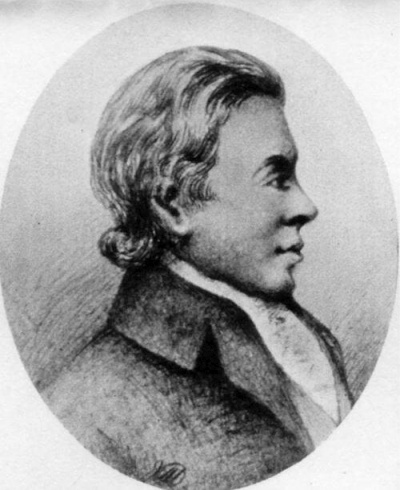
Edward Charles Howard
n7a9BIw.jpg


Howard published his discoveries concerning mercury fulminate in the Philosophical Transactions of the Royal Society of London on 1 January 1800, the year after being elected a Fellow of the Society. For his work, he was awarded the prestigious Copley medal (this medal is no small deal; contemporary winners included Benjamin Franklin, James Cook, William Herschel and Alessandro Volta, and later winners included Charles Darwin, Louis Pasteur, and Albert Einstein). Howard found that when mercury was treated with nitric acid and alcohol, it produced a whitish crystallized powder with properties similar to gunpowder, which could be detonated with a sharp blow or an electric current.

In his paper, Howard described testing the fulminate in a hand-held device used to test the strength of gunpowder. Satisfied his ‘mercurial powder’ had promise, Howard continued his testing. He loaded a flintlock gun barrel with 17 grains of the fulminate and a lead bullet and fired at a block of wood some twenty feet distant. Howard didn’t notice much of a bang or recoil. From the resulting dent in the wood, the effect was similar to what would have been achieved with half a typical charge of gunpowder (about 68 grains). Howard reloaded the gun with 34 grains of fulminate but was met with a different result: the patent breech was torn open, the gold touch-hole driven out, and the barrel had a three-inch crack from the breech. Howard surmised: “...it was pretty plain that no gun could confine a quantity of the mercurial powder sufficient to project a bullet, with a greater force than an ordinary charge of gunpowder.” In a final relevant test, Howard was permitted by the Right Honourable Lord William Howe, Lieutenant General of the Ordnance, to test the ‘mercurial powder’ at the Royal Laboratory of the Royal Arsenal at Woolwich. This testing resulted in the destruction of several cannon, with Howard concluding: “...any piece of ordnance might be destroyed, by employing a quantity of the mercurial powder equal in weight to one half of the service charge of gunpowder.”
While using fulminates as the main propellant was clearly out of the question, using fulminates to ignite a charge of gunpowder was considered another option. However, the Royal Laboratory observed that the fulminate burned so quickly that it would not light the gunpowder. Howard repeated the experiment, writing: “...we spread a mixture of coarse and fine grained gunpowder upon a parcel of mercurial powder; and, after the inflammation of the latter, we collected most, if not all, of the grains of gunpowder.” Howard wondered if the combustion of the fulminate was too rapid or if it did not generate enough heat to ignite the gunpowder. In any case, Howard did not continue the research into fulminates of mercury and its application to firearms, but another curious inventor did.

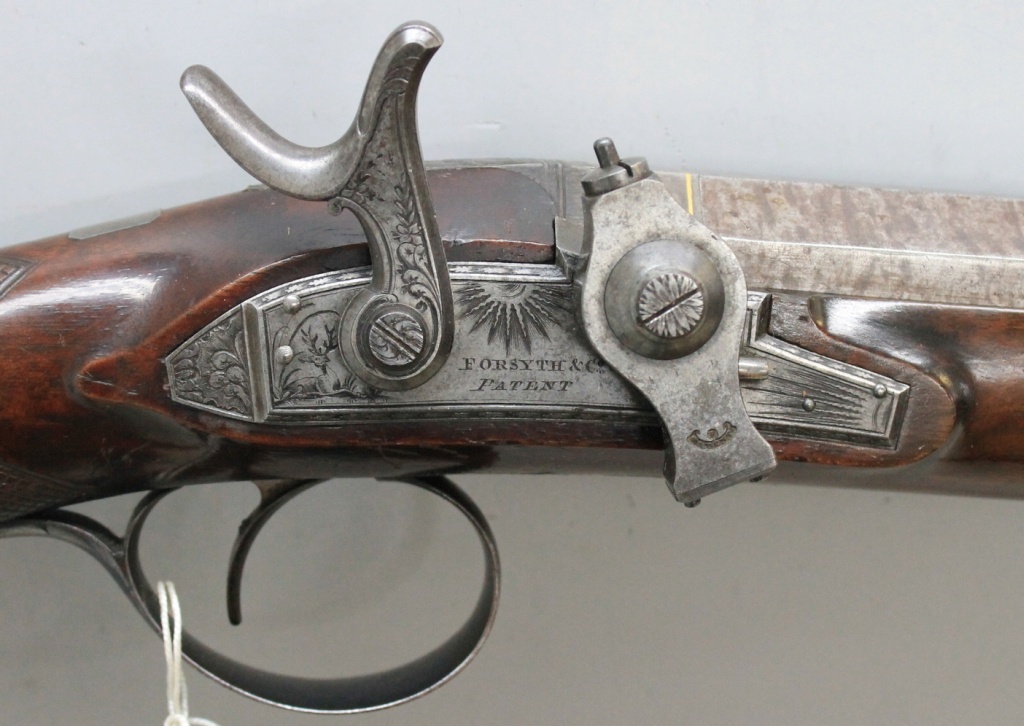
Based on Howard’s discoveries and convinced he could harness the desirable properties of mercury fulminate, the Reverend Alexander John Forsyth of Belhelvie, Aberdeenshire, Scotland, pursued his research and eventually developed a detonating gun lock in 1805. It had a priming system that dispensed a mixture of mercury fulminate, potassium chlorate, sulphur and charcoal into a pan. By combining the fulminate with other materials, it had the effect of ‘taming’ the harsh qualities of the mercury compound, allowing the mixture to light gunpowder. The hammer struck the mixture, and the resultant flame connected to the main charge via a touch-hole. The characteristic shape of the fulminate-mixture dispenser earned the lock its name, ‘Forsyth’s Scent-bottle,’ and it was patented in 1807.

A Forsyth 3rd Model scent-bottle lock, photo from Ellwood Epps. (I can’t afford this beauty.)
Yx4NqdC.jpg


Eventually, numerous gun locks were developed that made use of fulminates in a variety of forms: as crystals or in ball form, in pellets or pastilles, and covered in wax, varnish, lead, or copper to prevent the absorption of moisture and reduce the corrosive effects of potassium chlorate on metal parts. It was such a mixture, ignited by a fire-piston, that ignited the charge in the Pauly/Roux pistols in the Forgotten Weapons YouTube video posted earlier. The French gunmaker Beatus Beringer went so far as to build pistols that employed the priming mixtures as the main propellant, foregoing gunpowder altogether. While clever up to a point, Beringer’s design did not supplant the general adoption of primer/gunpowder systems.

Among the more successful variants, the London maker Joseph Manton’s pill- or pellet-lock was patented in 1816. Manton also patented a tube lock in 1818, which confined the fulminate to a copper tube crushed by a hammer. The tube lock became popular with waterfowlers for its strong ignition in wet conditions. Forsyth’s patent expired in 1821, and by then, the percussion cap, a soft copper (or iron) ‘top hat’ containing a small amount of fulminate and which was placed on a nipple, had started to appear.

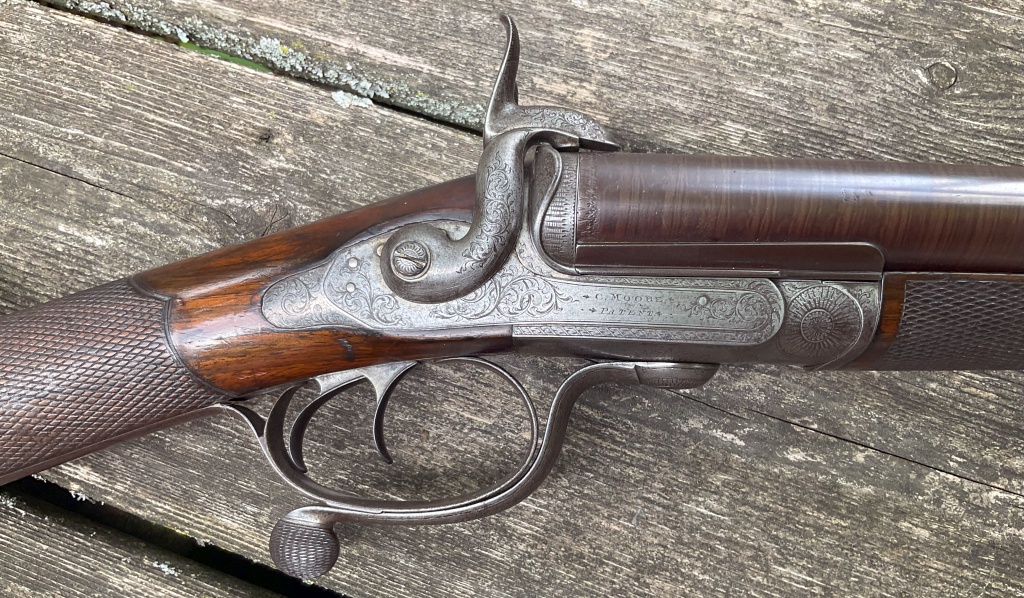
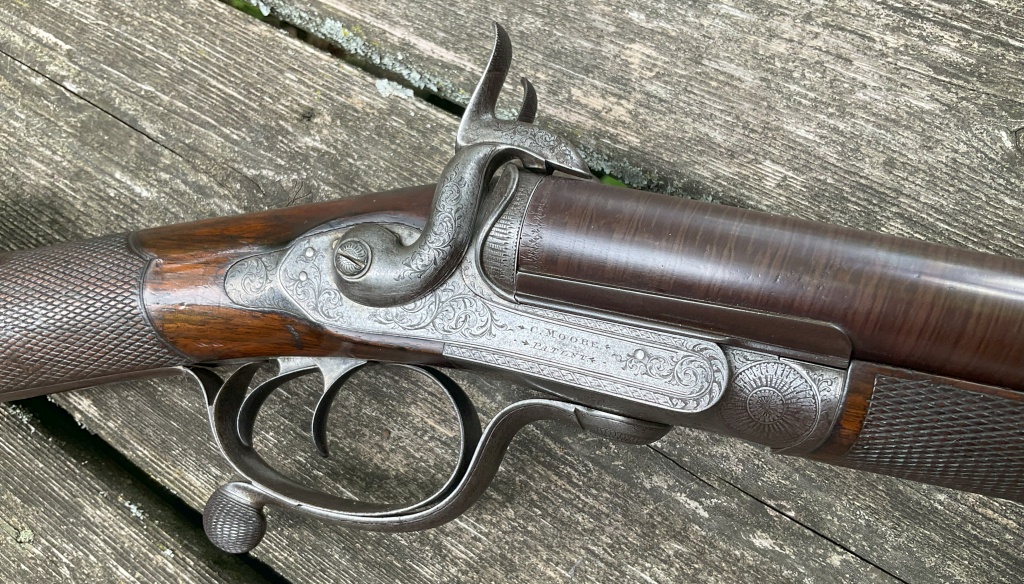
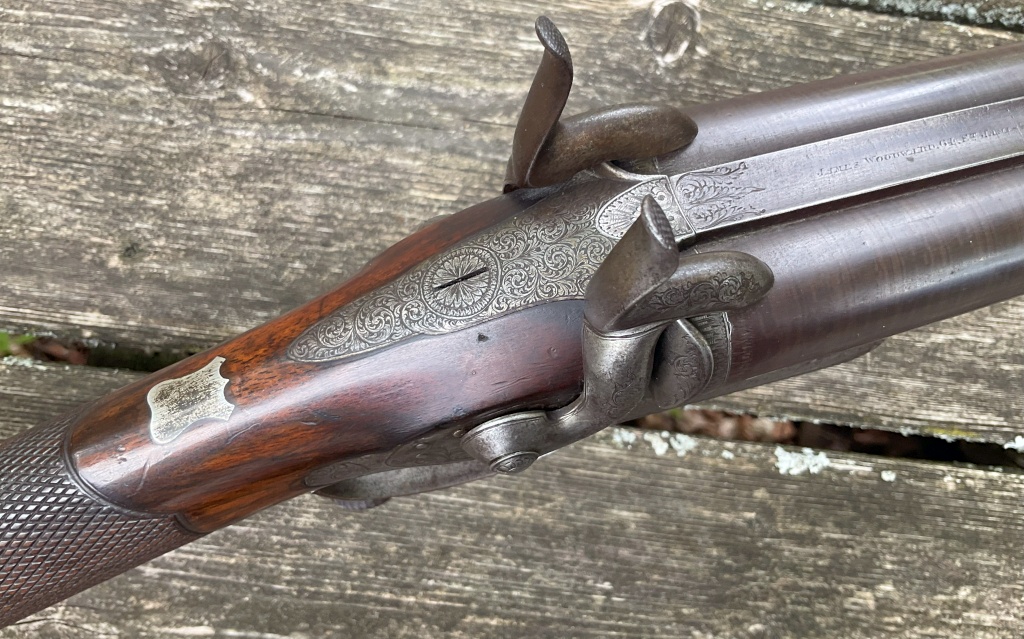
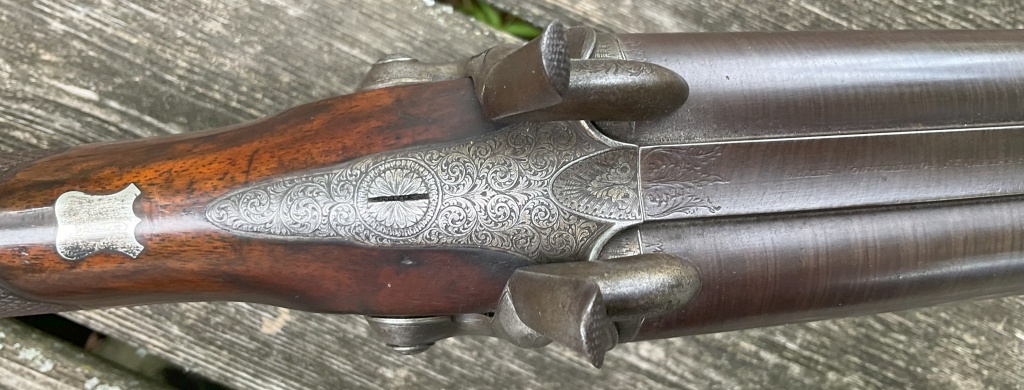
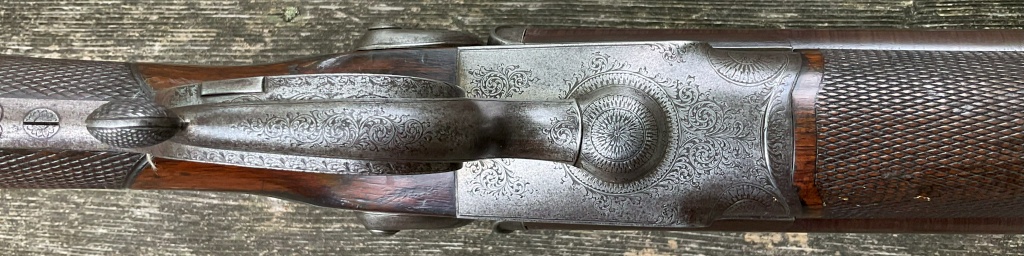
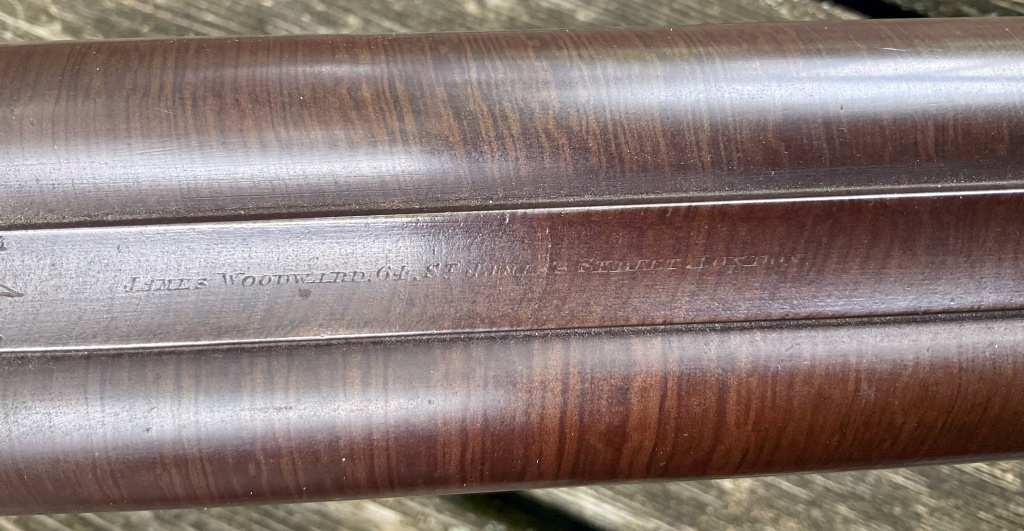
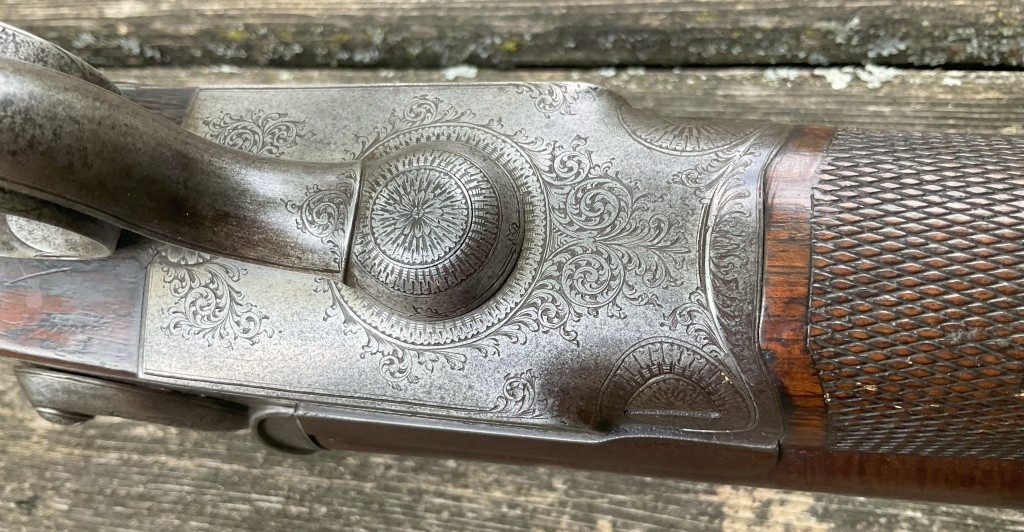
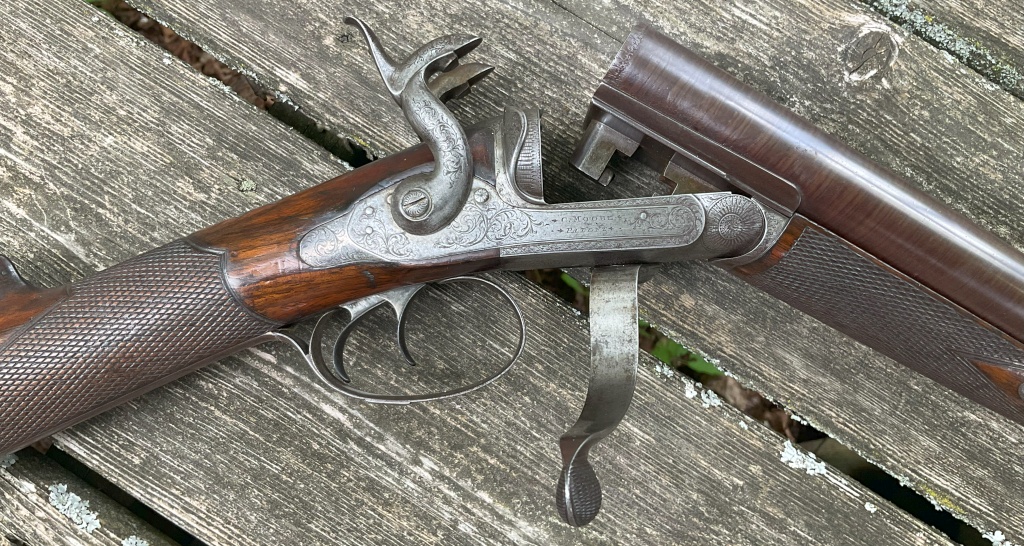
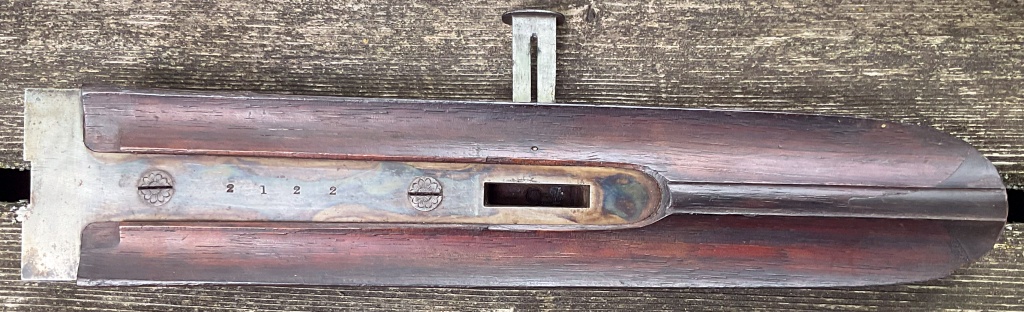
Not surprisingly, early pellet- and tube-locks were candidates for conversion into later systems. Here is one of these, an 8 lb 3 oz 10-bore double-bite screw-grip pin-fire game gun from James Woodward, made with salvaged parts from a Charles Moore percussion pellet-lock. Charles Moore was appointed furbisher to St. James Palace and Hampton Court in 1829, and as gunmaker to William IV in 1836. Earlier, in 1827, Charles Moore promoted the “isolated” or “bar-in-wood” lock. Such locks are found on his pellet-lock guns, which pre-date the copper percussion cap. It appears this particular gun was built by Woodward using Moore isolated locks fitted and adapted to a double-grip breech-loading action, with barrels and parts taken from unsold Moore stock or a gun returned to the makers. The wide top rib is signed “James Woodward 64 St. James's Street London,” and the duck's head-style bar-action locks are signed “C. Moore Patent.” Charles Moore and James Woodward were partners at 64 St. James’s Street between 1843 and 1848, the latter being the year Moore died. In 1851, the firm's name was changed to James Woodward, becoming James Woodward & Sons in 1872. The 30 11/16” twist barrels (not damascus) suggest an early date and may have been salvaged from the Moore pellet-lock gun. Another clue to the mixed origins of the gun is that the style of engraving on the lock-plates is different, with a more open foliate design, rather than the tighter scroll elsewhere on the gun. The barrels have mostly mirror bores, with a bit of localized pitting. The fore-end iron still displays its case hardening. The gun was converted after 1862, as it has an unmarked Henry Jones-type double-bite screw grip.

6Vdx5yg.jpg

X8CdLOX.jpg

a5urBhh.jpg

886uToD.jpg

76fVMMB.jpg

am0Js5v.jpg

P3mZAU3.jpg

NJOtPDW.jpg

vhBX0Tj.jpg
 
Side Note: To those with an interest in history with Canadian connections, it was Lord Howe who was chosen by General James Wolfe to lead the ascent from the Saint Lawrence River up to the Plains of Abraham that led to the British victory in the Battle of the Plains of Abraham on 13 September 1759. Incidentally, it was also Howe who captured New York and Philadelphia during the American War of Independence.
 
Brybenn, I totally agree, it would be good to test the effect of modern barrel boring on patterns and recoil. In inches, what passes for 12 gauge is nominally at .729, but can be as large as .740 (12/1 in British proofs) and still count as a 12. As you point out, 12-gauge barrel diameters can also be constricted (.719, or 13/1; and .710, or 13) and still be chambered for 12-gauge cartridges. For those using the European measurements for 12 gauge, it can range from 18.2 to 18.9 millimetres (18.5 being nominal). This variation presumably has an impact, though it seems no one can tell us just how. We have a pretty good idea of what we think is happening in the chamber and barrel when the primer lights the main powder charge, and the charge with its wadding or shot cup passes through the forcing cone and travels down the barrel. Upon exiting the barrel, science tells us a lot for certain, because of high-speed cameras and the time-honoured method of shooting at paper or sheet metal targets.

Maybe the differences between brands of powder, and between shapes and composition of wadding and plastic cups, are too slight to be meaningful. Add to this hardness of shot and length of forcing cones, and you already have a large set of variables, which may or may not be significant. Then add the variance in bore size above or below the nominal. I have no doubt that the main gun and cartridge manufacturers have tested all of these a great deal and put their statisticians to work on the results. Unfortunately, all we get is the hype from the marketing departments, in their desire for our dollars. If everything marketing folks tell us is true, by now I should be slim, healthy, handsome and prosperous. And a dead-eye shot, to boot. Reality, as they say, is a b___h.

On the subject of narrowing bores, I would be remiss in not mentioning the ‘Vena Contracta’ gun, which was a double gun which had a 12-gauge chamber, a 6-inch forcing cone, and 20-gauge barrel tubes. Possibly first introduced by Joseph Lang, but patented by Horatio F. Phillips in 1893 and built by Webley, it was meant to lighten the barrel weight and, curiously, to reduce recoil, though some describe it as increasing recoil. It was not a commercial success, and I've never seen one. At the time, Phillips was the shooting editor at The Field newspaper. It also goes to show that the discussion about the relationship between bore size and recoil has been going on a long time, without a final conclusion.

I find it interesting that The Field trials of the 1850s and 1860s were done without questioning point-of-aim, as obviously no gunmaker would allow a gun to leave their shop that didn’t shoot where it was pointed, and that the pattern remained centred at 40, 50 and 60 yards and therefore comparable across makers/types. I wonder if modern guns, across brands and models, could claim the same.

I also wonder to myself if, considering our obsession with personal freedom, we would react badly if any given manufacturer of guns, cartridges and chokes would say that we must only use, say, Challenger ammunition of a certain load and shot size, or Federal ammunition of a different shot size, or any other specific combination, etc., if we want to have performance anywhere close to what is claimed. Sort of like optimum octane levels for certain car engines, if you want to match the performance specs. Or, as the apt expression says, ‘your mileage may vary.’ I would add the unspoken part, ‘and you might not like the results.’
Certain rifle manufacturers make the claim using certain brands of ammo.
Never heard of a shotgun manufacturer doing it though
 
We expect an artist to sign their work. Many craftspeople also sign their work. Signatures can take many forms, and in some cases, simply the style is enough to identify who is behind the effort. It is no different in the British gunmaking world.

Consider the name on the top rib as identifying the brand, rather than the creator. Though in some cases, the name on the rib is indeed the person who made it, or at least part of it. The final test for being admitted to the gunmakers’ guild (The Worshipful Company of Gunmakers, a livery company of the City of London established by Royal Charter in 1637) involved the presentation of a gun built by the applicant, termed a 'masterpiece,' to be judged by the guild (this is the origin of the word masterpiece). If successful, the applicant could call themselves a master gunmaker and be entitled to take on apprentices. Therefore, anyone claiming to be a master gunmaker had the knowledge and ability to create an entire gun, not just certain components. In practical terms, the gunmaker would employ workmen to undertake specific tasks, and apprentices to perform basic work and learn their craft, depending on the amount of business the gunmaker could attract. In the very decentralized world of gunmaking, many outworkers doing piecework created the many parts or took on the various tasks required to build a gun. The workers employed by the gunmaker, and the outworkers hired for their skills, often had a reason to sign their work in one way or another. It was also not unusual for established gunmakers to build entire guns on behalf of other gunmakers. Work was work.

In my last post, I showed a photo of a Forsyth ‘scent-bottle’ gun. What I didn’t mention is that at the time that gun was made, chances are good that James Purdey shaped the stock or filed the lock, as he was working for the Forsyth Patent Gun Co. at the time, either as a workman or when he was shop foreman. Everyone has to start somewhere.

We are all aware of proof marks and what they signify; decoding them is one of the many pleasures of owning a British gun, or those of Continental make. But guns often carry other markings, and these can be very cryptic in their meaning and purpose. We’re accustomed to seeing serial numbers, and I’ve written about how these have different meanings and intentions depending on the gunmaker, with many opting to avoid the practice altogether. Different parts of the gun may have their own serial number, number, or identifying mark, applied by the craftsman making that part, or performing a process.

In some cases, the person or firm making barrel tubes might mark each tube. More commonly, the mark is from the barrel maker who soldered or brazed the tubes and ribs together and added the lumps, ready for the next stage of production. Locks are another area where skilled craftsmanship was required, and lock filers regularly signed their work. Like the barrel marks, these are usually hidden and can’t be seen unless the gun is disassembled. As one would expect, some work was better than the rest, and that person’s skills would be in high demand and could command the highest price for their work. The reason there is so little difference between the output of the top-tier gunmakers is that they often employed the same outworkers to do the same tasks at the same level of quality, working with the best materials available. This is why a ‘best’ gun shouldn’t be better than any other of the same grade, and why we shouldn’t obsess over the name on the rib. To be sure, there are differences between makers, in details and style, prompting why one is chosen over another. But it also explains why provincial gunmakers could achieve the high accolade of royal patronage, with work equal to any London maker.

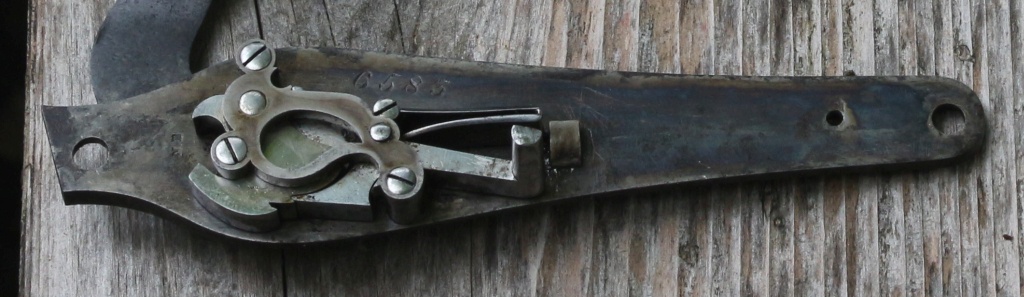
Doing a bit of detective work to decipher these markings is one of the pleasures of studying British guns. Often, only initials are found, and from census data, we know a lot about the various workers in the gunmaking trade. Initials and a good library can sometimes be enough to pin down the craftsman. For example, here is a lock (minus its mainspring) that bears the initials ‘N.B.’ on the inside plate. The lock can therefore be traced to Noah Butler of Darlaston Road, Wednesbury, Staffordshire (or 4 King's Hill, Wednesbury). Butler was born in 1827 or 1828, and his trade was common in Wednesbury and nearby Wolverhampton, both sources of the best gun locks. This is a quality lock with a nicely shaped bridle, still displaying its case colours, found on a gun by Samuel & Charles Smith, made around 1866 (of note, the Smith brothers had been appointed Gun Makers to His Majesty (William IV) and the Duke of Gloucester, and their guns were highly prized).

cXWOoPM.jpg


With the arrival of the breech-loader, the role of the actioner came into play. Starting with a rough forging, he cut, chiselled, sculpted and filed the steel into something recognizable, fitted the hinge and barrel lumps, and filed the mechanism to secure the barrels. Some of these mechanisms were simple enough, while others were complex with a number of moving parts. Inert actions could be immensely strong, while slow to operate, like the Jones double screw-grip or the Dougall Lockfast. Spring-powered snap-actions were much easier and faster to use, but often sacrificed strength, relying on limited friction surfaces. Whatever the case, the actioner and his work were at the very core of building breech-loaders, and the best actioners were highly sought after.

Arguably, the first actioner in the British breech-loading gun trade was Edwin Charles Hodges, usually known as E. C. Hodges. It was he who teamed up with Joseph Lang of Cockspur-street, London, to produce the very first British pin-fire gun, and the Lang guns that followed. Until the factory production of gun actions in Birmingham that appeared some decades later, actioning was hand work, using hand tools. By the end of the 1860s the work might have involved a treadle lathe, before the appearance of steam- and electric-driven tools. Making the action might involve hand drills for some operations, but it was mostly file work. Lots and lots of file work. Nowadays we have CNC machines and laser cutters which, if we’re lucky, produce work close to what Victorian action filers did with their hand tools.

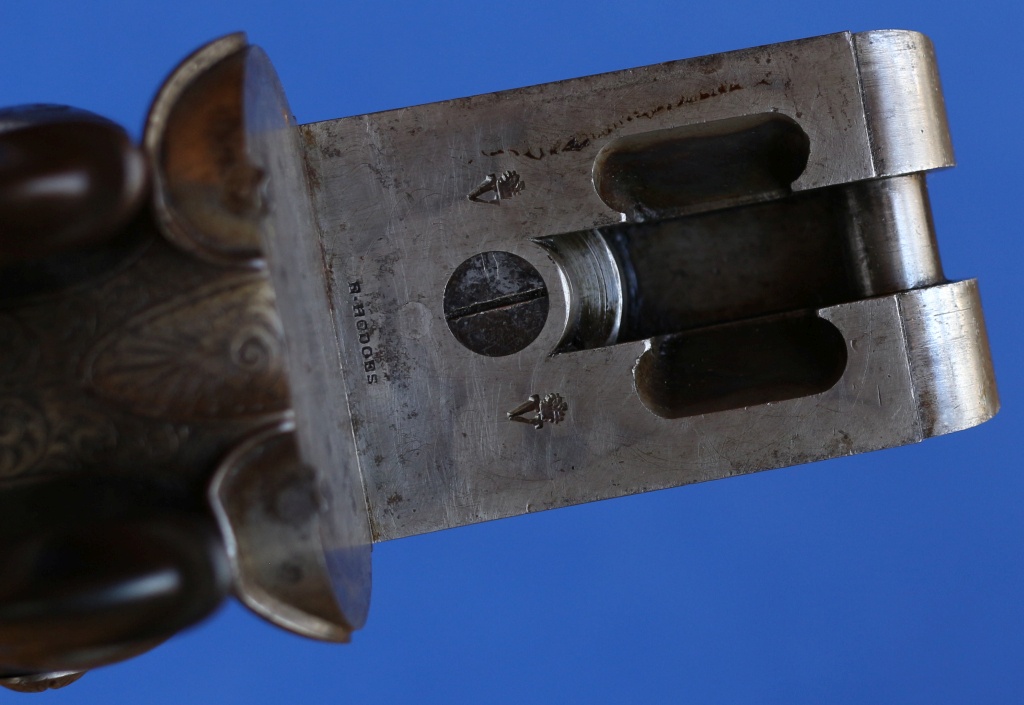
Hodges actioned Boss & Co.’s first breech-loader in 1858, and became their principal actioner. Hodges also made actions for John Blanch, John Blissett, Parker, Field & Sons, Alfred Lancaster, Charles Frederick Niebour, and Edward Michael Reilly, among others. These were at first single-bite actions, but Hodges built the Henry Jones double-bite action when the patent protection on that design lapsed in late 1862. When Stephen Grant left Boss & Co. in 1867, Hodges actioned most of his best guns. How Hodges identified his work is varied, with some signed and numbered behind the action, or signed on the action bar, and some probably not signed at all. His signature style included the diagonal cuts into the action bar to reduce weight, and the cylindrical bridge between the slots in the action bar in support of the lever. This circular shape was much more difficult to make than the square cut.

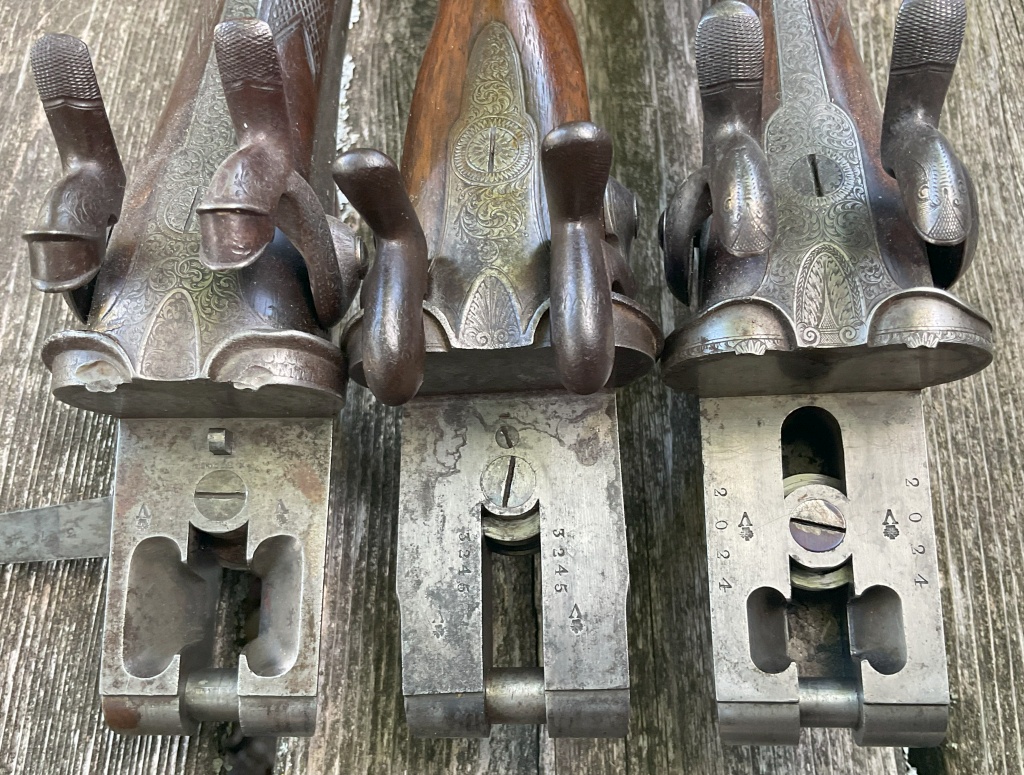
Here are three Hodges actions, displaying the circular cuts around the bridge between the action bar slots. The action without the diagonal cuts is for a gun with bar locks, as it already has metal removed from the action bar to fit the locks. The guns are by John Blissett (left), Joseph Lang (centre), and Boss & Co. (right):

xxc3bu3.jpg


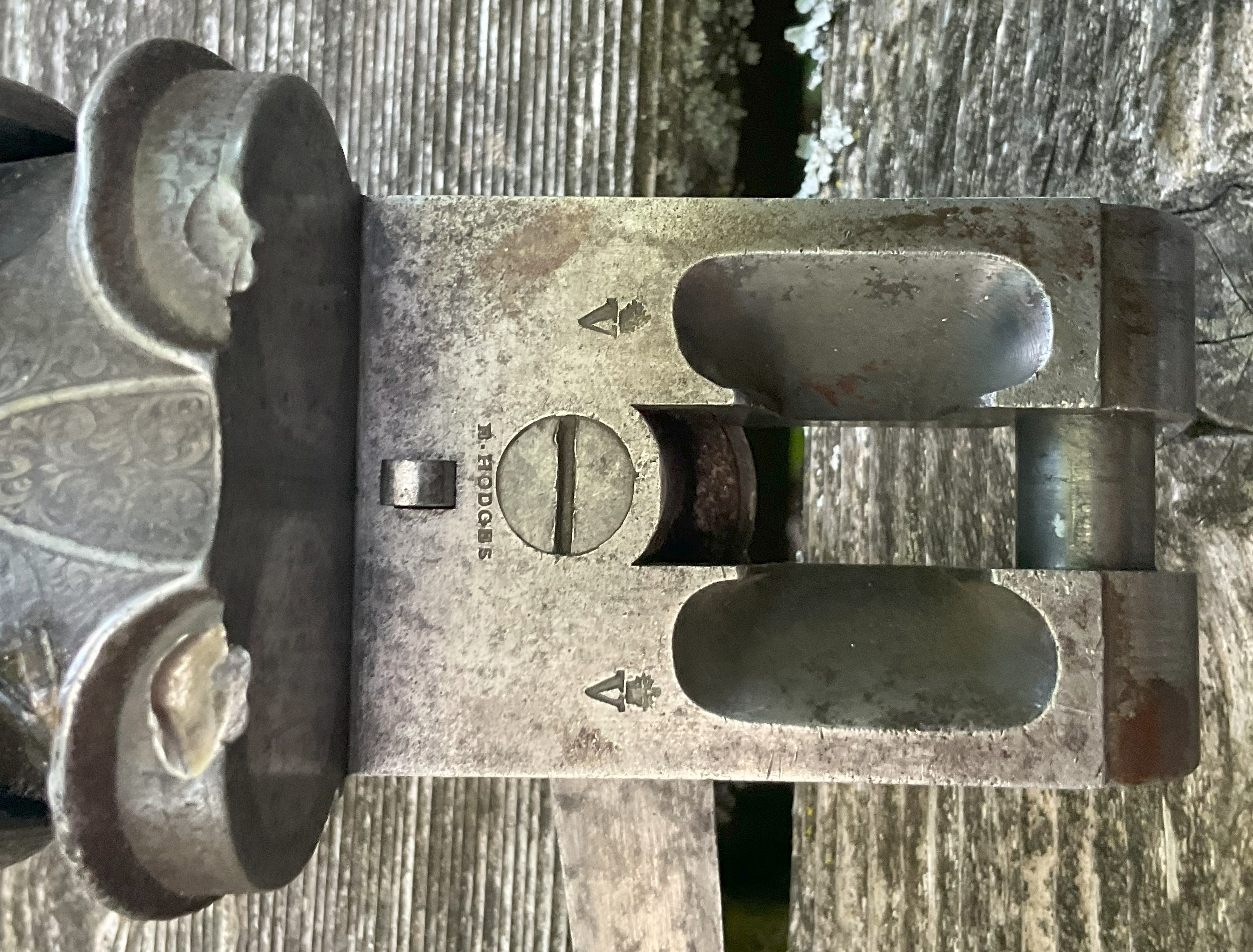
Close-up of the Blissett, showing Hodges’s signature:

10CcLxI.jpg


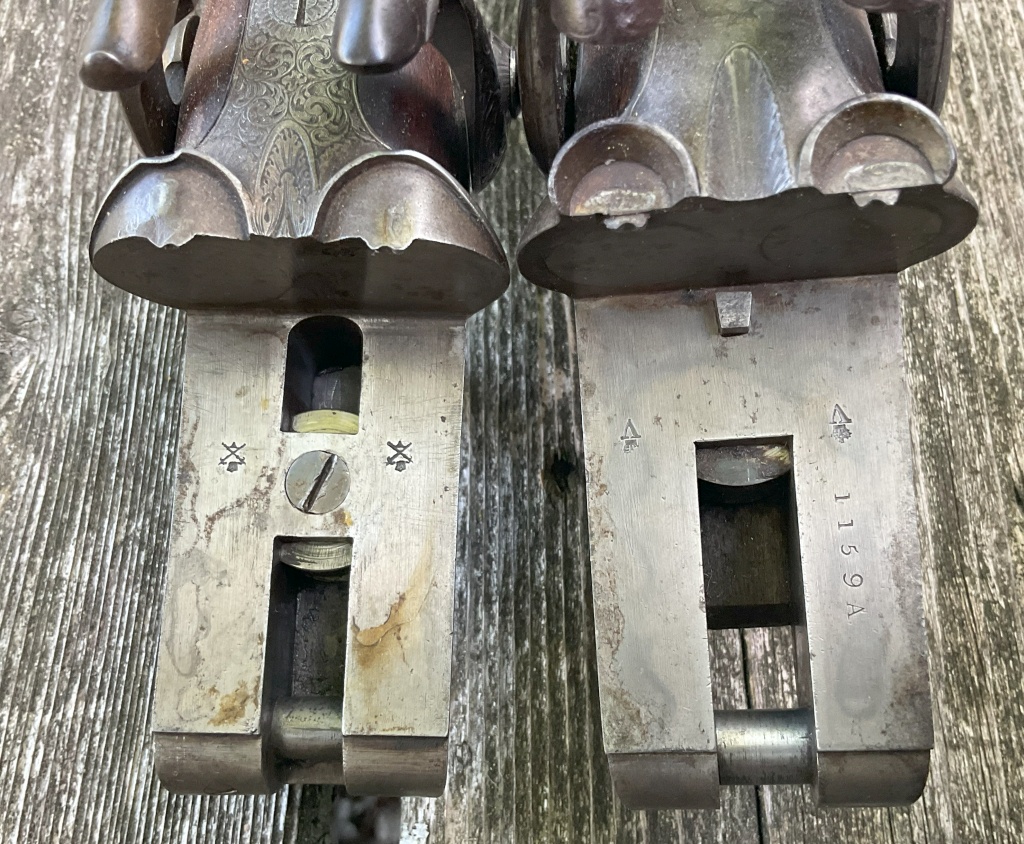
Compare them with two actions by other filers, which have square cuts across the action bar slots. The guns are by Robert Watmough (left) and William Moore & Co. (right):

V4PrVt8.jpg


The size of Hodges’s early workshop operation is not known to me, but in the 1871 census he is recorded as employing nine men and three boys (apprentices), and from the data from his numbered actions, he was producing about four actions a week. Hodges also sold guns under his own name initially from his 8 Florence Street, Islington address, but from 1876 to 1881, he had an address at 95 Mount Street in Mayfair (if you remember from an earlier post, Edward Paton had a shop at 108 Mont Street). Other Hodges connections to the gunmaking world included apprenticeships under him. These included John Wilkes, who went on to work for James Dalziel Dougall before setting off on his own, and Ernest Lawrence, who moved on to James Woodward, then to James Purdey, where he was the factory manager for many years.
 
Back
Top Bottom