The allure of the British gun

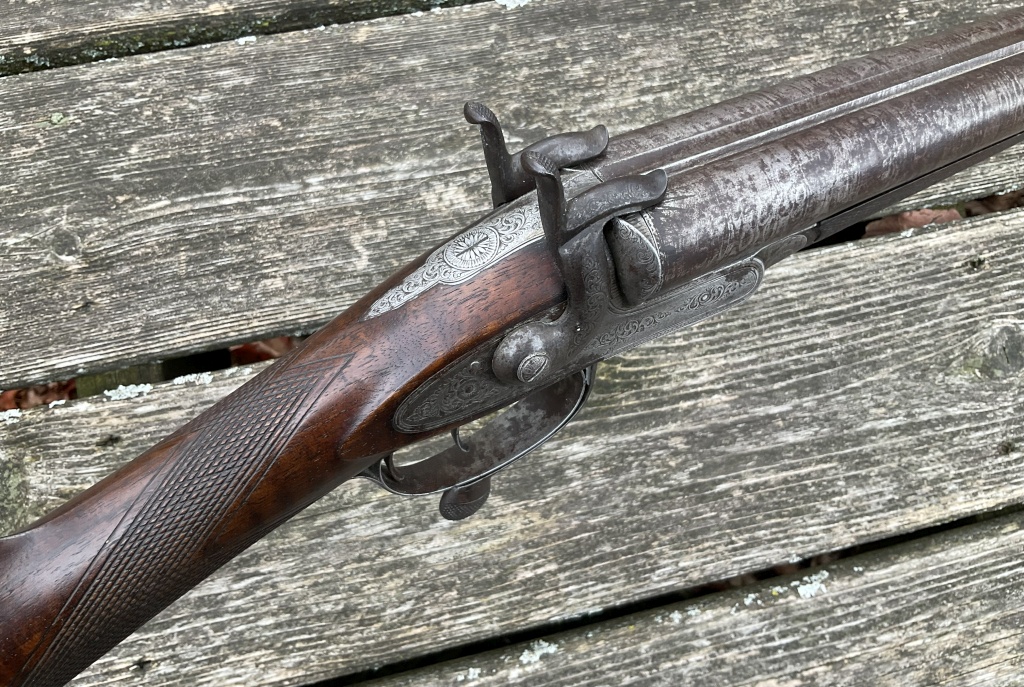
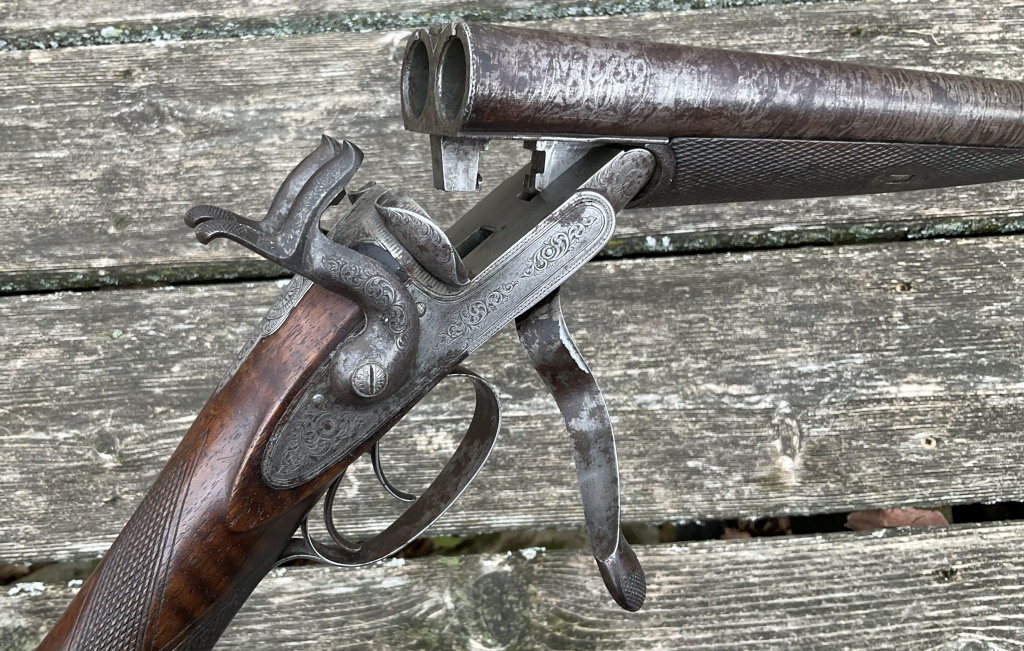
Generally speaking, British guns provide us with varying levels of information, which can greatly add to their allure. The maker/retailer is usually identifiable, and the gun may provide further clues as to who made the locks and barrels, as well as who actioned the gun, if you look closely enough. That does not cover all the hands that were instrumental in its manufacture, but it provides a good starting point. From there, information might exist as to who first ordered/purchased the gun, from either the maker’s records if they have survived (no thanks to the Luftwaffe), or identifying initials or family crests engraved on the stock escutcheon. Readers of this thread have so far seen quite a few examples that are rich in provenance, from their build to their treasured ownership. But occasionally a gun surfaces that resists all efforts to extract information, leaving us curious as to the backstory. Today’s gun is one of these. It is a mid-1860s gun, very worn and hard-used, as many pin-fires were. It came out of a Birmingham workbench, of that I am certain, one of the over 500 firms operating in the Gun Quarter at the time, a fact that hardly narrows it down. Unlike on the Continent, where producing guns without attribution is common (often mislabelled ‘guild guns’), British guns usually at least have the retailer’s mark, even if only from a general merchant, an ironmonger (hardware store), or a jeweller/pawnbroker or second-hand dealer. The British gun trade was based on reputation, and sport shooting was a class affair where guns conferred discreet bragging rights. Guns destined for the lowest social rank of gamekeeper would still typically carry a name (though few gamekeepers would have the privilege of shooting a breech-loader, at least in the 1860s). So, a gun without information is mysterious and worth a closer look.

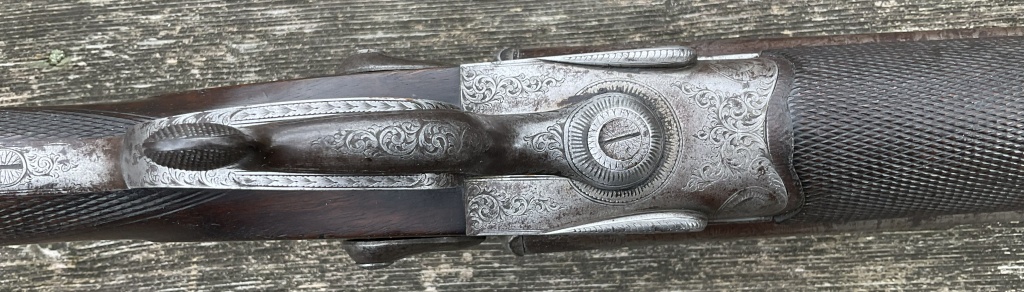
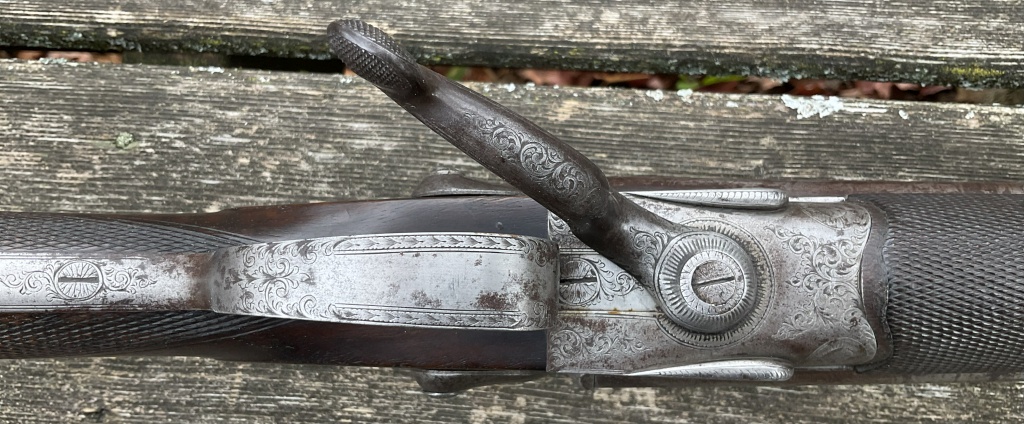
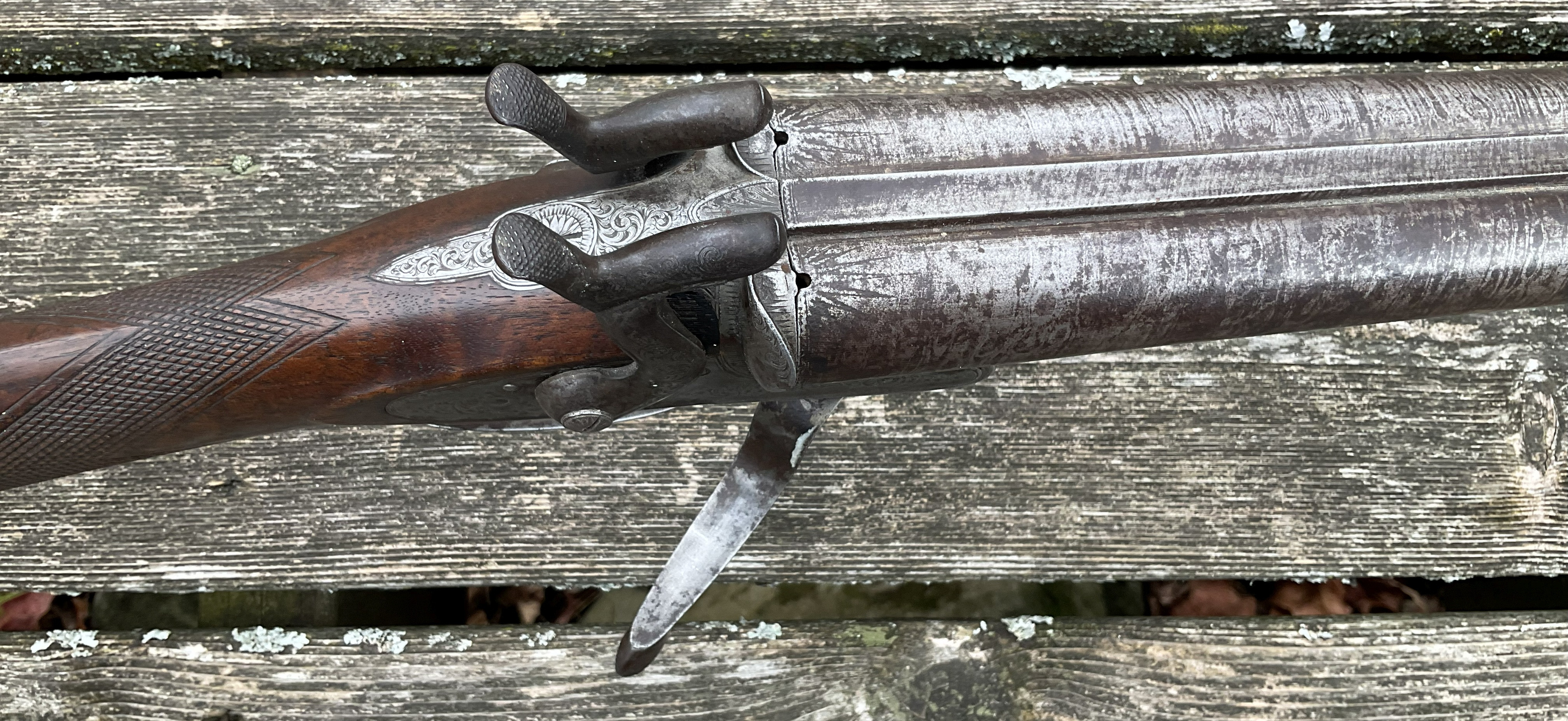
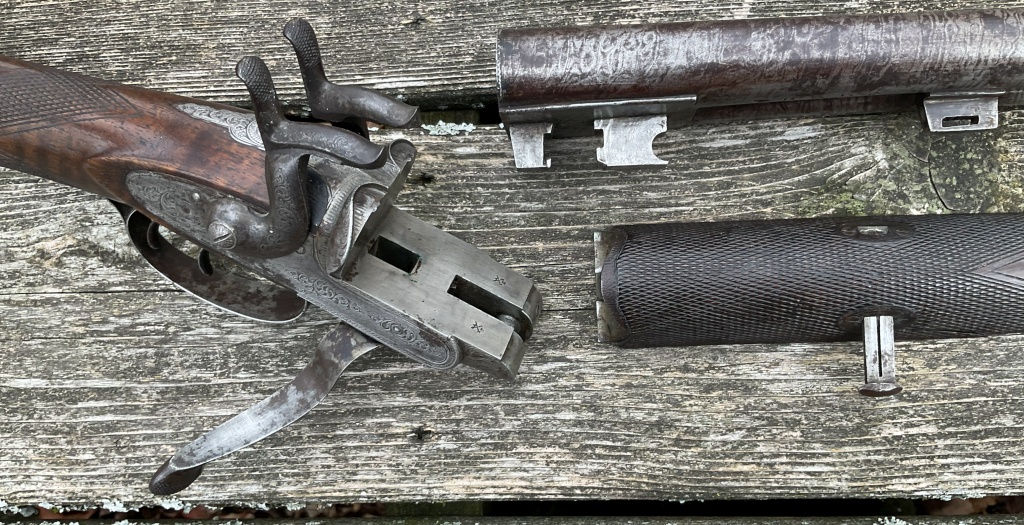
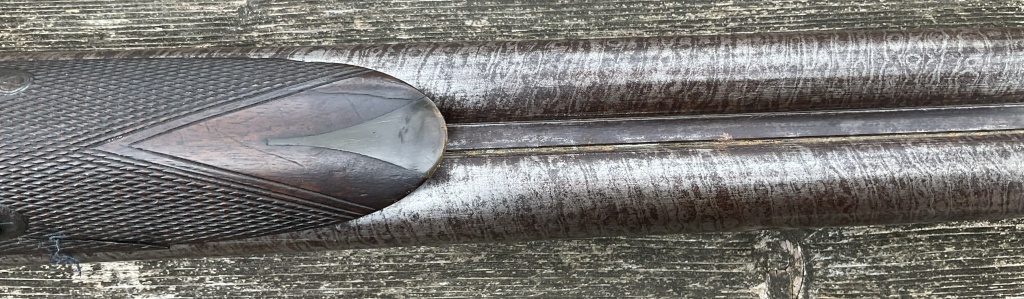
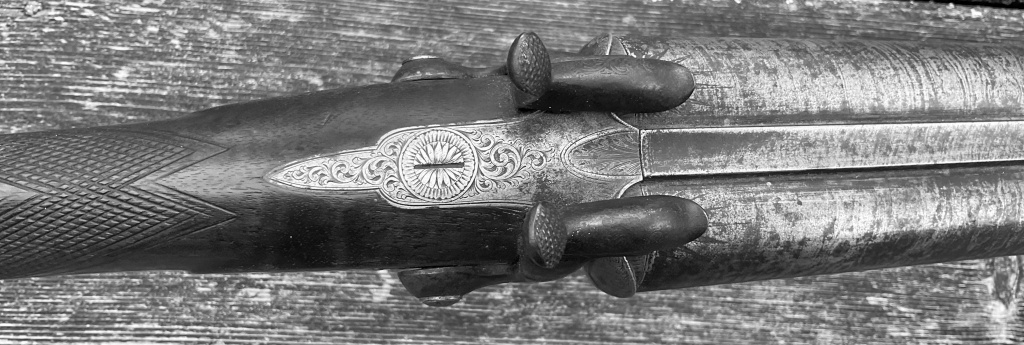
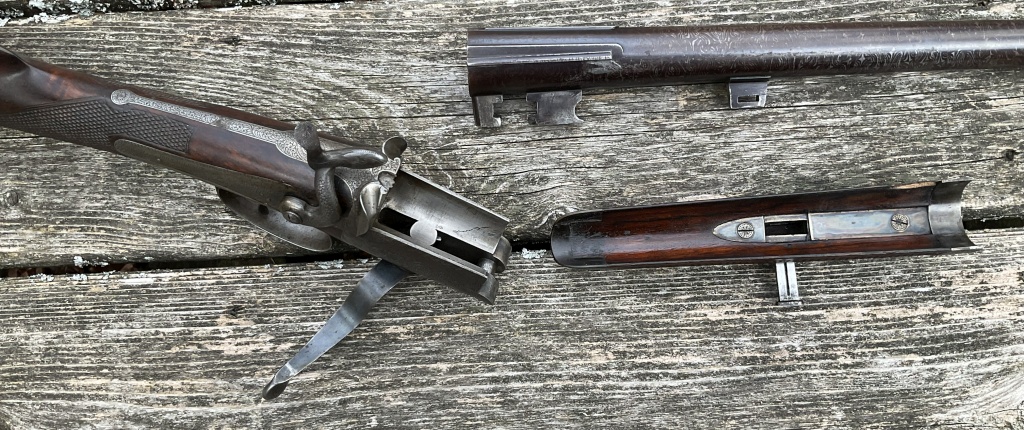
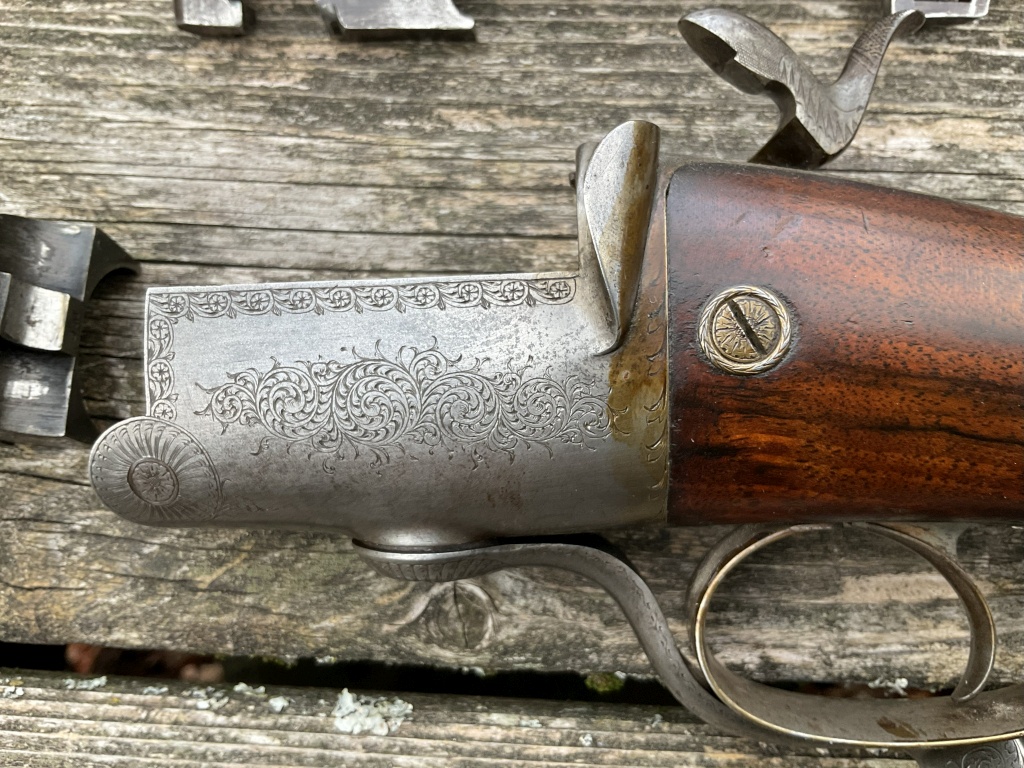
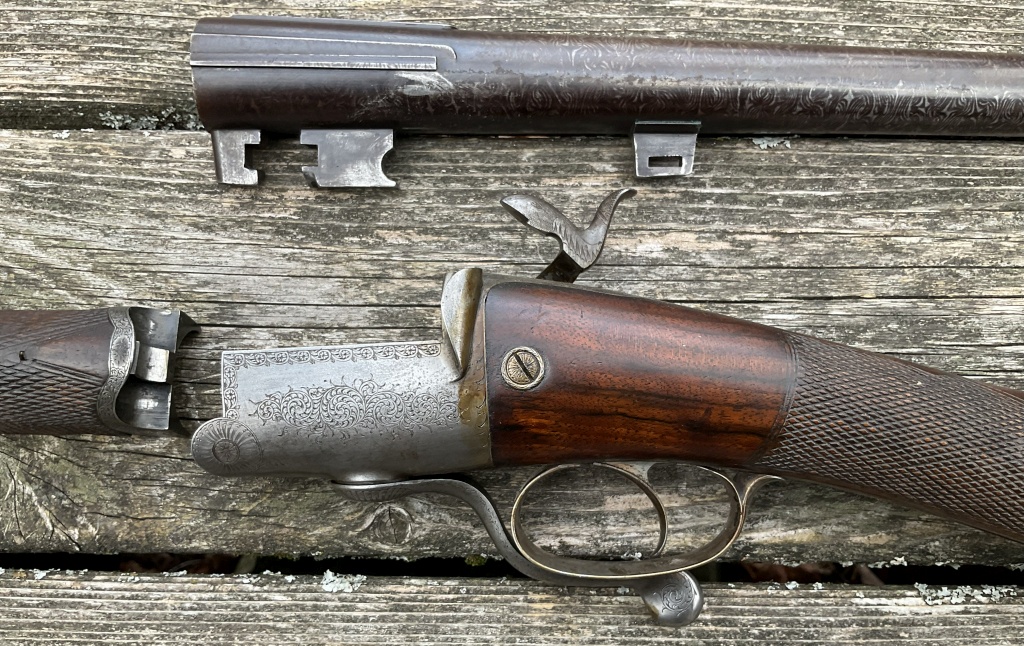
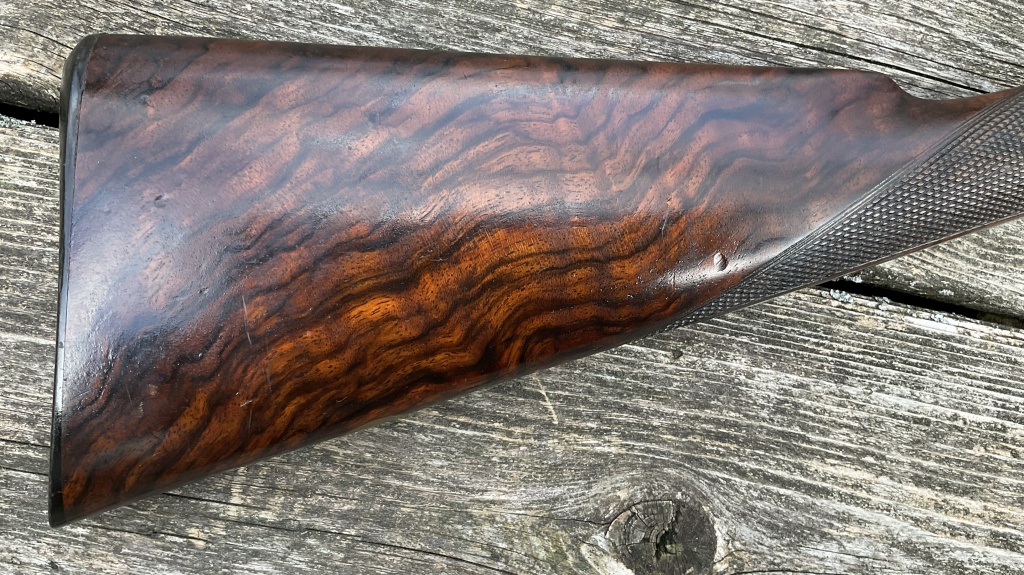
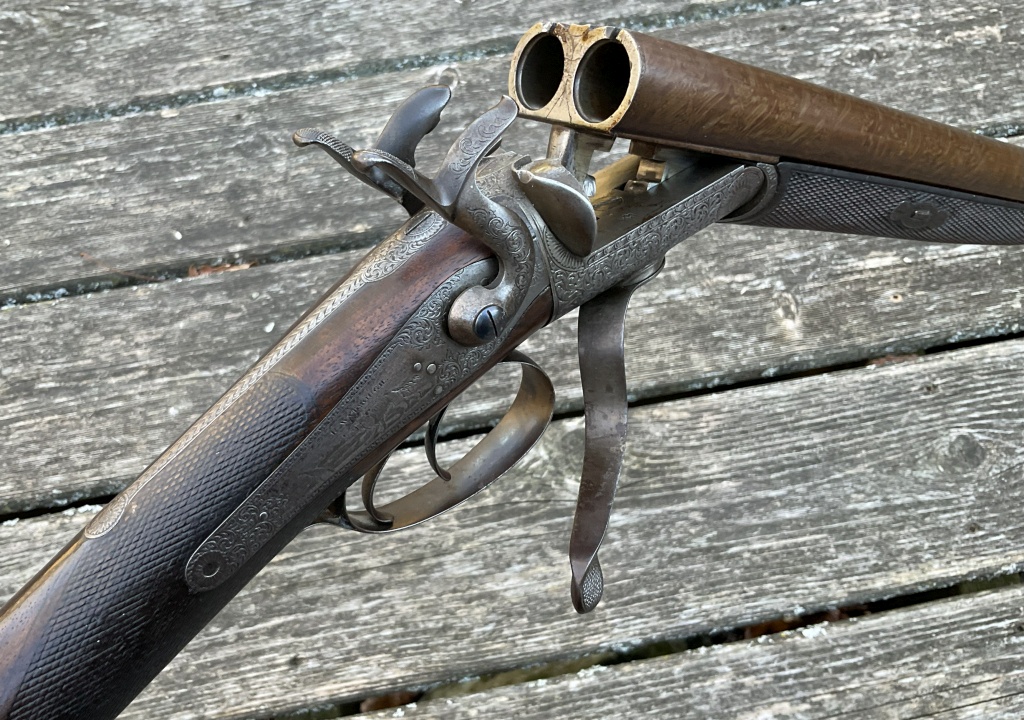
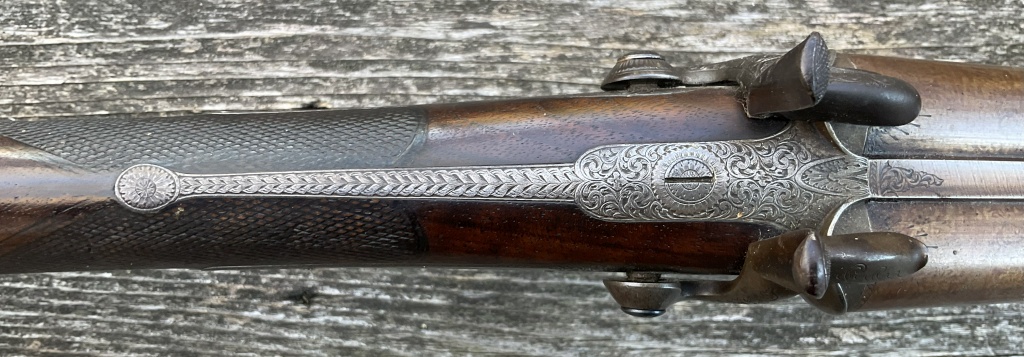
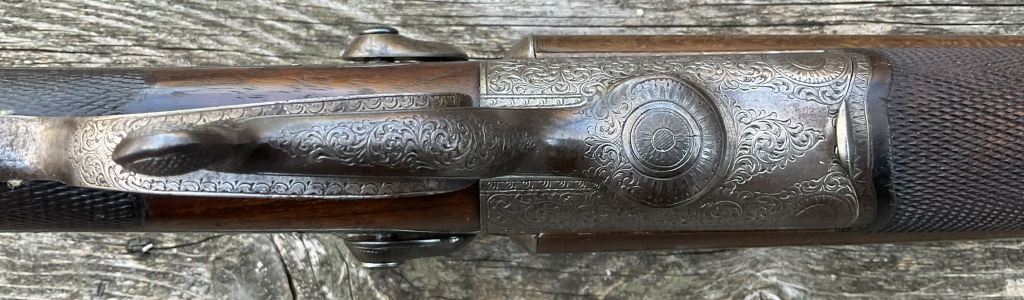
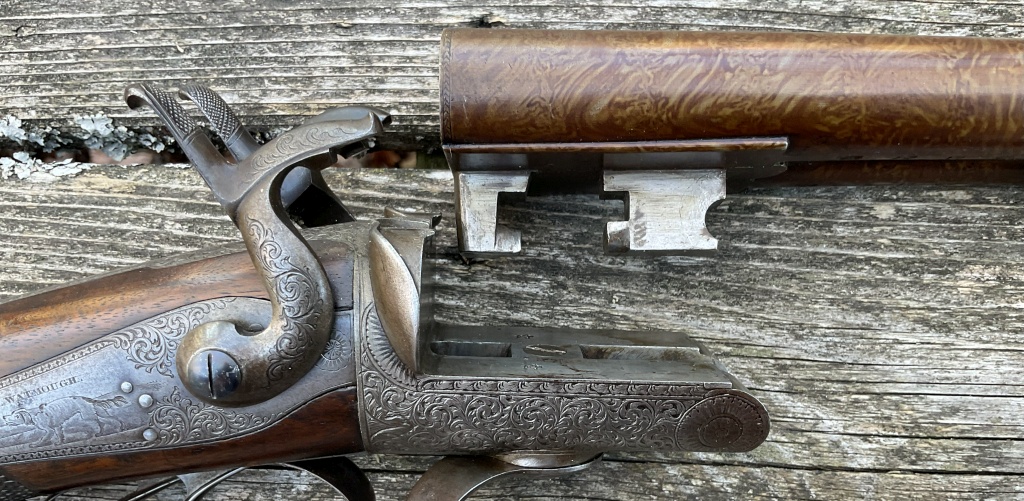
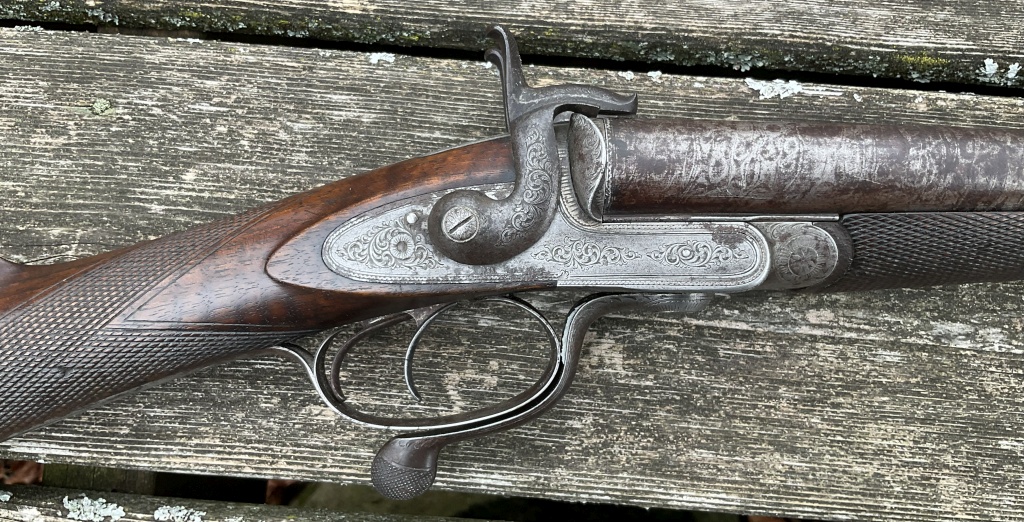
On the surface, it is a 12-bore rotary-underlever pin-fire sporting gun of typical form, without a serial number. It has the ubiquitous post-1862 double-bite screw-grip action, and the 30” laminated (not damascus) barrels have Birmingham proofs. The bore marks (14 and 13) denote a notable bore tightening, not unusual for pre-choke barrels. One might think an unmarked gun would be an entry-level, low-quality piece; however, this is not the case here. More expensive bar locks, a fluted action bar, quality engraving, fine chequering (though with some slightly imperfect edges), a nicely figured stock… Everything about it suggests a good-quality provincial gun, or a second-quality gun from a known maker’s establishment. Perhaps the only hint it might have been destined for a provincial gun seller or general merchant is its weight; at 7 ½ pounds, it is slightly heavier than a typical 12-bore game gun from a competitive maker.

A maker’s name is added to the lock plates before hardening and the final finishing steps, usually when the engraving pattern is done. A rib inscription could be added at any time before the browning process. To sell a finished gun without a name is not typical, and one can speculate as to the reasons. Was it made ‘on spec’ in a workshop, to keep workmen busy? When commissions were not coming in, it might have been prudent to keep output going, but in reality most in the trade were day labourers, and no commissions meant no work, and few workshop operators could front the cost of materials without the possibility of reimbursement.

It could be that the gun was made with the intention of adding a name, but the retailer didn’t bother, and the buyer didn’t care. I’m not convinced by this, as even a second- or third-quality pin-fire represented a significant investment, even if not anywhere in the same league as London guns and long-established gunmakers, and a nameless gun confers no social status. Would you buy a $15K Rolex watch and tell the factory to leave out the name? Possible, but improbable. I mention watches because of my 11 years of living in Switzerland; a Swiss can spot what watch you’re wearing and assess your social status from twenty paces. OK, I’m exaggerating a little, but not by much. Whose gun you shot with in Victorian Britain established your wealth and social bona fides, as did your carriage, choice of tailor, etc. No, I’m a bit stumped on this one. In the 1950s, sure, not unusual. But 1860s? Not so much.

Now, try to see past the rust-discolouration, neglect, and ravages of time; it would have been a handsome gun when new. Yes, I could polish away much of the discolouration and re-brown the barrels – it would look much improved. But I tend to leave antiques in the condition I find them.
Pd0WE6d.jpg

uKxdqQN.jpg

egg9aBX.jpg

d6MSr6i.jpg

qnJ75pV.jpg

DzLfL20.jpg

ZzK26W0.jpg

PrEe5mR.jpg

bU458k8.jpg

9nDM20O.jpg

I3O3QgU.jpg
 
Hey Pin , she certainly is an original beauty .

As a purest I side with you , only when a gun has been degraded to the
point where nothing you do will affect it's value negatively , then any
work will improve shootability and or increase value .

Therefore I don't buy re-worked or relined guns./
///skwerl
 
To each his own. Everybody has to make their own decisions regarding aesthetics and functionality. Pinfire could be considered a preservationist - his collection and his writings seek to preserve the history, the relevance, and the physical artifacts of the pinfire era. However, traditionally British guns were returned to the maker at the end of the season to be cleaned, checked, repaired as necessary, and the finishes restored. I understand and respect Pinfire’s choices based on his goals, but they don’t represent the customary British approach (for very good reasons).

Contrast this with the same period in American firearms and you find the opposite. In North America, distances between makers and buyers were often vast. It was simply impractical to be sending one’s guns back to the maker. Also, on this side of the pond they were used primarily for harvesting food and for protection against predators, both animal and human. Being without a gun for months at a time was far from ideal. Local gunsmiths were largely self-taught and focused on functionality not exterior finishes.

For these reasons North American collectors place a premium on examples that are in pristine condition without having been refinished (although those preferences are ignored when rare model/configurations such as an A H Fox sub-gauge are found).

Personally, I have no such scruples. I am willing to restore and refinish any gun that is desirable regardless of make, model, or origin.
 
I am more of a preservationist. Pains me to see a classic vintage gun buffed and refinished with a modern blue. I often look for antiques that are hurting, and work to restore them to a condition of functionality. Ran a thread recently about making tumblers to restore locks to functioning condition. The gun featured is a flint by Isaac Whitehouse which had been converted to percussion. One ramrod pipe missing, no ramrod, tumbler shank broken, no hammer, stirrup and mainspring missing, no forend cap. There are now two ramrod pipes, a ramrod, an ebony cap, a functioning lock that pops caps and the flash channel is clear. The bore is respectable and the gun is ready to test fire.
 
To each his own. Everybody has to make their own decisions regarding aesthetics and functionality. Pinfire could be considered a preservationist - his collection and his writings seek to preserve the history, the relevance, and the physical artifacts of the pinfire era. However, traditionally British guns were returned to the maker at the end of the season to be cleaned, checked, repaired as necessary, and the finishes restored. I understand and respect Pinfire’s choices based on his goals, but they don’t represent the customary British approach (for very good reasons).

Contrast this with the same period in American firearms and you find the opposite. In North America, distances between makers and buyers were often vast. It was simply impractical to be sending one’s guns back to the maker. Also, on this side of the pond they were used primarily for harvesting food and for protection against predators, both animal and human. Being without a gun for months at a time was far from ideal. Local gunsmiths were largely self-taught and focused on functionality not exterior finishes.

For these reasons North American collectors place a premium on examples that are in pristine condition without having been refinished (although those preferences are ignored when rare model/configurations such as an A H Fox sub-gauge are found).

Personally, I have no such scruples. I am willing to restore and refinish any gun that is desirable regardless of make, model, or origin.

I'm with you Straightshooter. While I appreciate and value what Pinfire is doing, I take an approach much along the lines you laid out. I like working guns, ones that I can hunt with and not worry about. At the same time, I like high quality guns, in all the ways that might be measured.....workmanship, adornment, balance and handling. I want to hunt with the best quality guns I can afford. And, while I know it's just me, I don't want to hunt with someone else's damage and excessive wear.

As many here know, I lean towards the ground up restoration approach, bringing the gun back to as new condition as possible. From then on, it becomes "my" gun. I have to make judgments about which gun to do that with because the end product needs to roughly be worth the investment.

I'm always amused by what I call the American collector cult of original finishes. The valuations placed on certain hardware store level guns simply because they are in pristine original condition makes me laugh. But only in the same way that I chuckle when I hear about grown men collecting Pokemon cards. Glad they are enjoying it but not for me.
 
To each his own. Everybody has to make their own decisions regarding aesthetics and functionality. Pinfire could be considered a preservationist - his collection and his writings seek to preserve the history, the relevance, and the physical artifacts of the pinfire era. However, traditionally British guns were returned to the maker at the end of the season to be cleaned, checked, repaired as necessary, and the finishes restored. I understand and respect Pinfire’s choices based on his goals, but they don’t represent the customary British approach (for very good reasons).

Contrast this with the same period in American firearms and you find the opposite. In North America, distances between makers and buyers were often vast. It was simply impractical to be sending one’s guns back to the maker. Also, on this side of the pond they were used primarily for harvesting food and for protection against predators, both animal and human. Being without a gun for months at a time was far from ideal. Local gunsmiths were largely self-taught and focused on functionality not exterior finishes.

For these reasons North American collectors place a premium on examples that are in pristine condition without having been refinished (although those preferences are ignored when rare model/configurations such as an A H Fox sub-gauge are found).

Personally, I have no such scruples. I am willing to restore and refinish any gun that is desirable regardless of make, model, or origin.
Straightshooter makes some good points. I can't say I really know what a pin-fire sold in 1860 actually looked like. As Straightshooter said, British guns were typically returned to the maker after the shooting season for cleaning and repairs; often, this involved re-browning the barrels. Even the most 'original' of my 70-odd pin-fires has had its barrels re-browned, I am sure. Some have been refinished many times, judging from the rib inscription wear. 1860s-era barrels that still have mirror bores have almost certainly been re-honed, perhaps more than once, considering the corrosive effects of early priming compounds and black powder. Colour hardening fades over time, and while I have pin-fires that still show case hardening colours in hidden areas, with mainly purplish colour remaining, I can't know if the original formulas produced other colours as well, that have long since faded.

British custom today is to re-black (blue, to us) the barrels and furniture, with perhaps brilliant fire-blue for the pins. Rust blueing and boiling, not chemical blueing, if correct. The action blocks are usually left as is, leading to a bit of a patchwork look, which bothers no one. I don't know when the current practice started, as my time machine still isn't working yet. Similarly, I cannot say if the furniture of 1860s pin-fires were originally browned or blacked. Even the best-preserved cased examples have a bare-metal look or faded patina.

As to re-browning pin-fire barrels, I have no objection whatsoever, if done correctly; as Straightshooter says, refinishing barrels is not objectionable to the British viewpoint, and I agree. I have re-browned barrels myself, to learn the process. I used British recipes (while in Britain), which produce a warmer, coppery tone. I have not come across similar mixtures here, and I haven't sought to have them made (yet). There are also craftsmen in Britain who do a remarkable job of browning old barrels, and I'm sure a number of my guns would have gone to them for an appropriate refinish, had I still been living there. I just can't afford to consider this now.

I worked in museums for 7 years, and during that time I developed good friendships with those who restored old guns for display (and learned much from them). I have no objection to restoration, even full restoration, if done right. Trying to get back to its original state is a worthy goal, if done right. In a museum, this can take months or years. What I object to are 'restoration' attempts that cut corners and produce results that are unbalanced (eg. new-looking wood and old metal), or overly buffed metal and dulled engraving, etc. Amateur attempts usually produce amateur results.

On wood, I have no objection to rubbing in a bit of linseed oil, or red oil of my own make (linseed and alkanet root). Or lacquer, if that was the original finish. For grime on metal, I usually remove it with olive oil and a cloth, and elbow grease. Conservator's wax (microcrystalline wax) to keep metal and wood protected from dust, fireplace ash, etc.

So, circumstances make me a 'preservationist,' leaving guns as I find them, except for a cleaning. If I had access to the right craftsmen and unlimited funds, I would consider having barrels re-browned and everything stripped and cleaned correctly. I'm also aware of my advancing years and diminishing health, and my collection might have more value to future collectors if they are left to make their own decisions as to restoration.

Some guns I have are in relic condition, real no-hopers in terms of restoration. I knew that when I acquired them. I did so for knowledge, as they still had information that was valuable to me and my research. Knowledge costs money, and that's a fact. There are a handful of craftsmen who could make the missing parts, and re-stock them, but doing so would not add to the knowledge I have gleaned from the guns, and would just be another expense I couldn't afford. Would be nice, though!
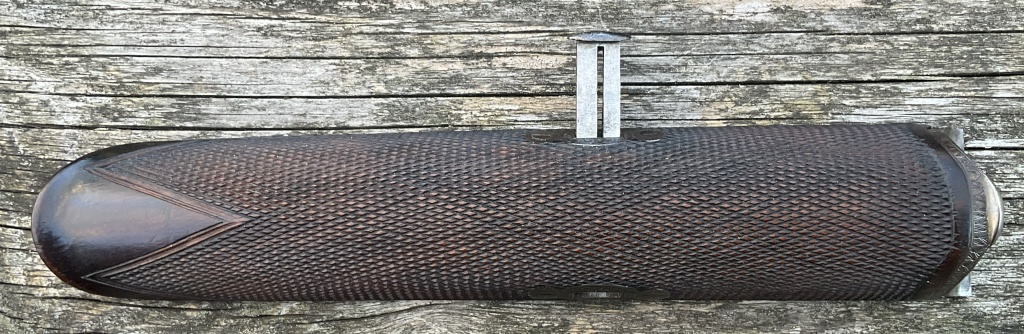
I've also discovered why so many pictures of pin-fires in books, the few that exist, are in black-and-white. Cheaper printing costs, surely, but black-and-white images make many of the blemishes disappear. Colour shows off all the defects, major and minor.

QCyiawp.jpg
 
Last edited:
You make a very good point Steve. Restoration should either be "done right" or not at all. A poorly restored gun is "behind" an un-restored gun.

When I am looking at potential acquisitions, the biggest red flags are usually previous work done badly.
 
Previous work done badly is harder to correct than old legitimate wear, tear or damage.
I'm currently working on a Hudson's Bay Company Imperial Special 26ga muzzleloading double. It had been broken at the wrist. The repair that was attempted years ago has made restoration that much more difficult. The gun had received some care during its period of use. The bores are surprisingly good - someone cleaned them after use. If I can effect a strong wrist repair, I would shoot it.
 
Happy weekend reading!

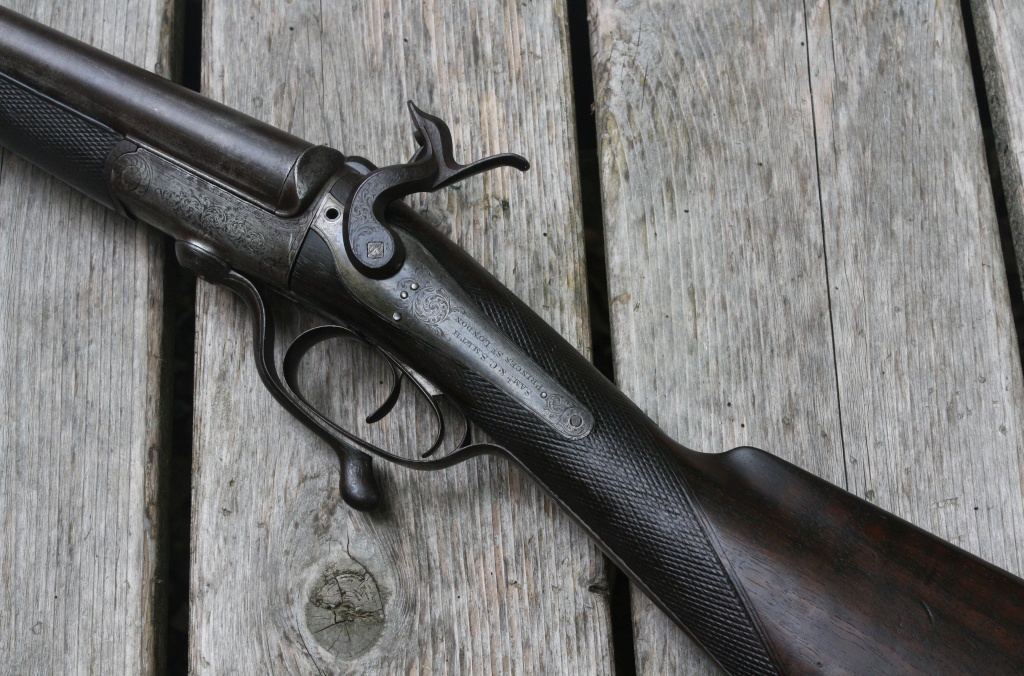
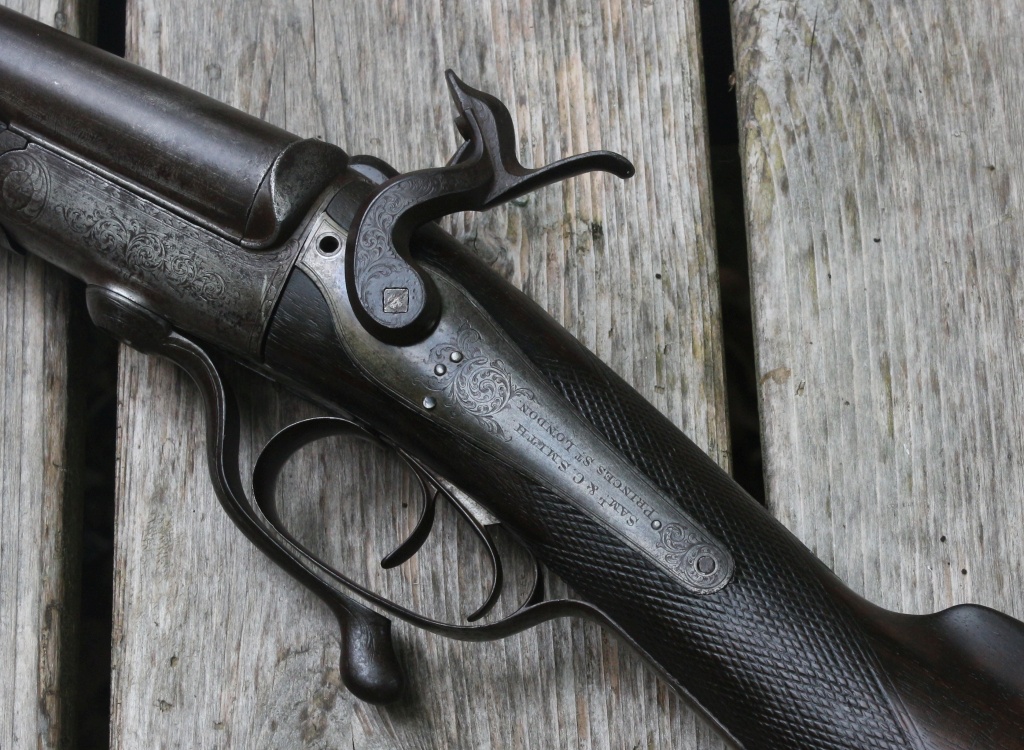
In a previous post, I covered a mystery: a well-made British game gun lacking any identifiable markings — a true no-name gun. I mentioned several possible reasons for the lack of a maker’s name, but there are others, such as a replaced rib or barrels. Though improbable, the client might have specified the lack of a name, as anything is possible in British gunmaking. But in the end, proving a negative is fiendishly difficult, and in that particular case, proving why something didn’t happen. Here is an opposite example, where explaining why something did happen is a mystery. It is, by far, the most peculiar thing I’ve encountered, and I’m no nearer in finding a rational explanation for it.

This involves a gunmaking name of considerable repute amongst London high society. The story begins with the London gunmaker William Smith, who apprenticed to John Joyner in 1766 and then to William Shepherd in 1771. In 1817, William Smith was appointed Gunmaker-in-Ordinary to the Prince Regent, and he moved to 59 Princes Street, Leicester Square. In 1820, when the Prince Regent became King George IV, Smith was appointed Gunmaker-in-Ordinary to the king and moved to 64 Princes Street the following year. Smith was appointed Gun Maker to Tsar Alexander I, Emperor of Russia, and Maximilian I Joseph, King of Bavaria. This recognition says a lot about the quality of Smith guns and the regard in which they were held. In 1825, William was succeeded by his son Samuel, and in 1834, Samuel's brother, Charles, joined him, and the firm became Samuel & Charles Smith. Continuing the family's reputation, between 1835 and 1837, they were appointed Gunmakers to His Majesty (William IV) and the Duke of Gloucester. By 1855, Samuel and Charles had died, and Samuel's two sons, also named Samuel and Charles, took over the firm. All in all, a very solid multi-generational pedigree of top gunmaking.

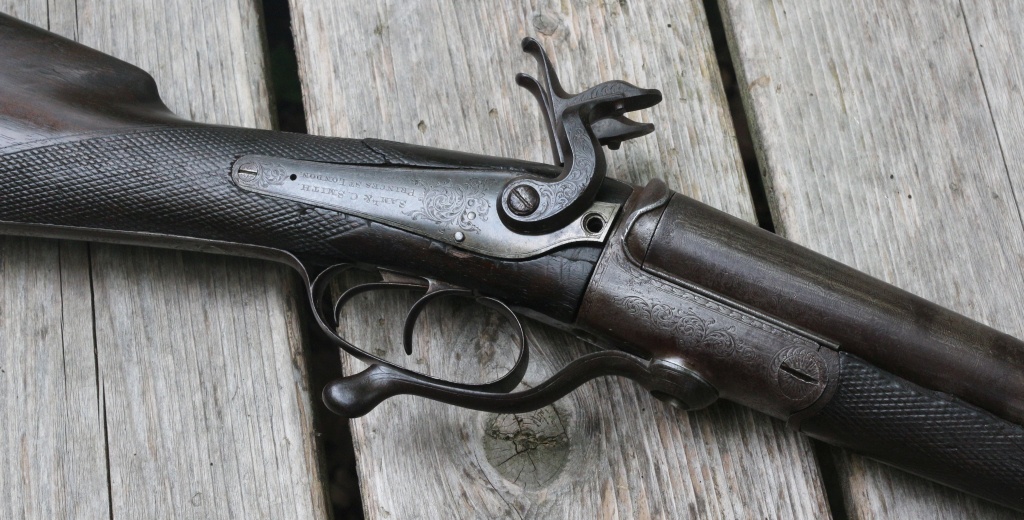
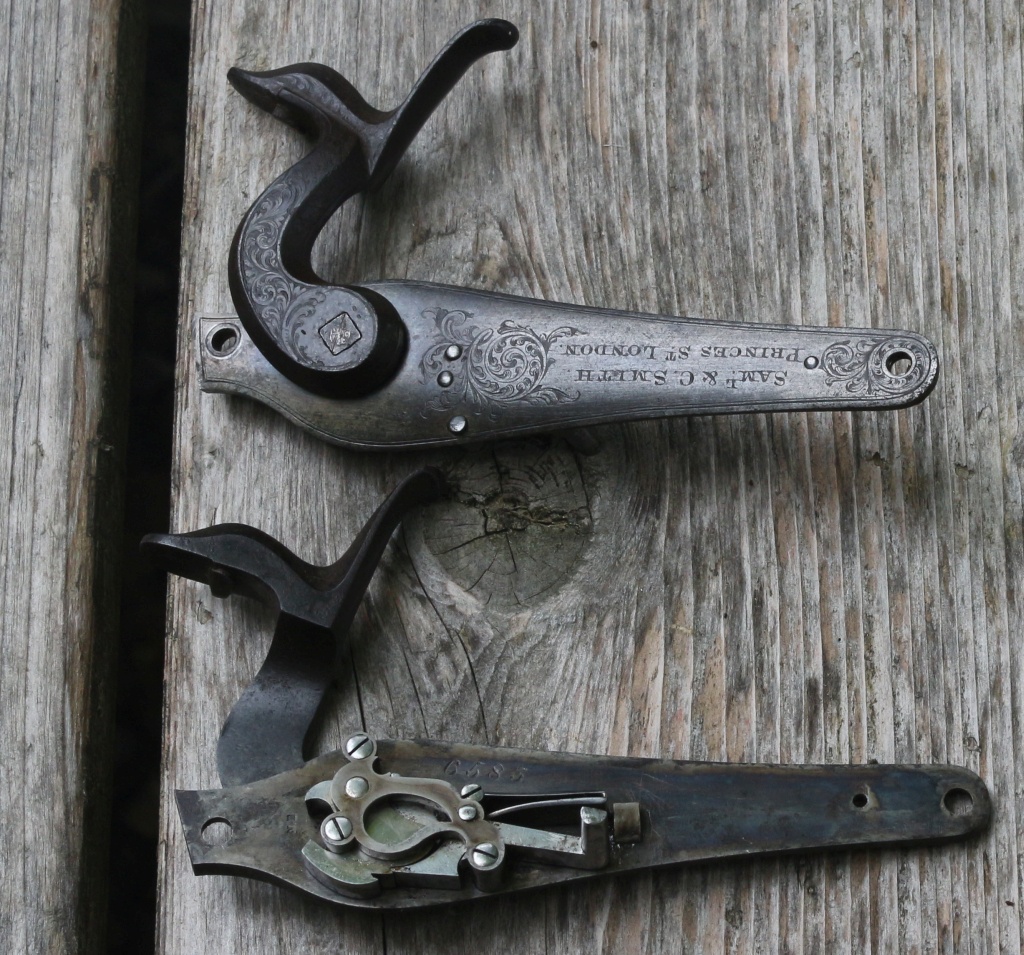
Like most makers of the pin-fire period, Samuel and Charles Smith appear to have offered different grades of guns, including some with patented actions from other makers, and inventions of their own design. This gun, however, is a ‘standard’ 12-bore double-bite screw grip action, and its serial number places it about mid-1860s in date, compared to known Smith guns. The gun, however, is in a very sorry state – with a broken mainspring, parts missing, worn engraving, pitted bores, and an overall tiredness. The 29 3/4” damascus barrels are signed “SamL & C Smith Princes Street Leicester Square London” on the top rib and carry the usual London proof (Samuel and Charles Smith were at 64 Princes St., Leicester Square, from 1821-1870). The barrel maker’s mark is ‘H.S.’, possibly Henry Squires of Upper Seymour Street, a known supplier of quality barrels. The gun has typical percussion-style fences, an extended top strap, and flat-sided hammers, all of no particular note. Engraving is sparse, but well-executed. I do like that underlever, though, very stylish. Weight is 6 lb 10 oz. (it would have been closer to 7 lbs even, with all its parts). Inside the lockplates is the mark ‘NB,’ for Noah Butler of Darlaston Road, Wednesbury, Staffordshire (or 4 King's Hill, Wednesbury). Butler was born in 1827 or 1828, and his trade was common in Wednesbury and nearby Wolverhampton, sources of the best gun locks. These are quality locks with nicely shaped bridles, befitting a Smith gun. Note the still-visible case colours on the inside.

This was a typical pin-fire game gun of the mid-1860s, not different from the mid-level offerings of many London, Birmingham, and provincial makers. Where this gun becomes highly unusual is with the back-action lock plates. Look closely: the name inscriptions, "SamL& C Smith Princes St. London," are inverted. This inversion was undoubtedly not an engraver's mistake (other Smith pin-fires have normal inscriptions) but a special request from the client. The question remains as to why? A real head-scratcher, this one.

k9UgQTb.jpg

Vxg5PRF.jpg

TQyoMmd.jpg

6AD7H0r.jpg

5bm5krL.jpg


A gratifying part of owning a hammer gun is learning about its origins and, if possible, the stories of previous owners. Before the rise of factories, sporting gun making involved numerous small businesses and individuals. Some gunmakers kept meticulous records, not only on the guns produced, but also on the craftsmen and outworkers engaged in their manufacture. Record books can be a gold mine of information; some makers went so far as to pencil in acerbic comments about their clients, especially those who lagged in paying their bills! When a gunmaker's records are lost, it becomes impossible to unravel certain mysteries, like the case of an upside-down lock inscription on a gun with a good pedigree.
 
You make a very good point Steve. Restoration should either be "done right" or not at all. A poorly restored gun is "behind" an un-restored gun.

When I am looking at potential acquisitions, the biggest red flags are usually previous work done badly.
Agree 100%. An older gentleman told me once regarding restoration, " If you're not sure how to proceed, DON'T."
 
OK, so mystery can sometimes add to the allure of the British gun. But that is a case of ‘what could we know, but don’t.’ I’d rather come up with something a bit more concrete, or at least demonstrable. I’m back with the problem that others can make guns of equal quality as the best British guns, so choice of materials and sureness of hand are not the answer, as no country has a monopoly on that. British guns come with a lot of history, no error, and that is definitely part of the mystique. History can be implied, actual, and often documented—that’s solid. To a Brit, that history translates as heritage, not just a numerical assemblage of years.

There is a lot of pride demonstrated in British gunmaking, though this too is not country-limited. How it is expressed, though, might be. French, Belgian, and German guns can, for all intents and purposes, be perfect, with flawless craftsmanship. Designs and ideas, as we’ve seen in this thread, cross national borders and influence creativity; though this might be a polite way of saying that in gunmaking, intellectual property is widely copied, stolen, or appropriated. We confer the highest accolades on a fine British game gun, forgetting that it is based on a French idea, built with Belgian or Swedish steel, and stocked with Mediterranean wood. No, the British gun has earned its place on the top shelf of gunmaking with more than its component parts and mechanical plagiarism.

Some guns demonstrate that near-undefinable extra-ness more than others. We’ve seen a few such guns in this thread, ones that take attention to detail to another level entirely. Some I’ve covered in passing, to demonstrate a point or feature, and these deserve a closer look. Especially when trying to define or isolate the concept of ‘extra-ness’ that grounds the allure of the British gun.

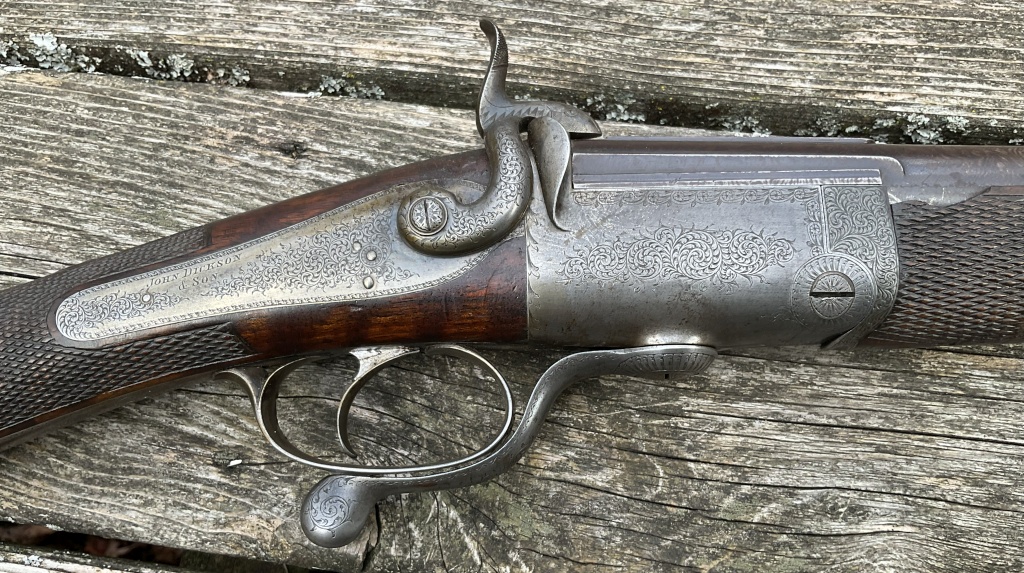
Not surprisingly, we’re talking today about a Scottish gun. The Scots have always excelled at making guns a notch above their English counterparts. I have seen enough to know that given the choice between an equal-looking English gun or a Scottish-made one, I would pick the Scottish one, knowing there was an extra something that might not be obvious to the eye (I would extend the same preference to Irish guns as well, the more I handle those). There are a number of Scottish gun makers that have earned their reputation over the past few hundred years, but the one I’ve chosen to focus on today is the firm of John Dickson & Son, of Edinburgh, and one of their single-barrelled pin-fires.

John Dickson was born around 1795. At the age of 11, he was apprenticed for 7 years to James Wallace at 187 High Street, Edinburgh, completing his apprenticeship in 1814. From 1814 to 1821, he worked as a journeyman for Wallace. In 1821, Wallace seems to have supported him in becoming an outworker, working for Wallace and others in his workshop. In 1828, James Wallace moved to 63 Princes Street, and John Dickson moved with him. From 1830, John Dickson was recorded in the directories as a gunmaker at 63 Princes Street, as his own business (presumably Wallace had died or retired). In 1840, John Dickson brought his son, also named John, into the business, renaming it John Dickson & Son. In 1852, James MacNaughton was apprenticed to John Dickson, and from 1859 to 1864, he worked for him as a journeyman. In 1864, he established his own business at 33 George Street, Edinburgh. From 1865, the firm of John Dickson & Son built snap-action breech-loaders, using patent actions by Richard Brazier, Thomas Horsley, Westley Richards, Charles Lancaster, and James Purdey. In 1873, John Dickson senior retired, and John Dickson junior took over the firm. It was in 1875, the year today’s gun was made, that the eccentric collector Charles Gordon first bought a Dickson gun. The firm would go on to build 225 guns, rifles and pistols for Gordon between 1875 and 1904, many of them out-of-era muzzle-loaders (sadly, today’s gun is not from Gordon’s collection). In 1879, James MacNaughton came out with his trigger-plate round action, followed by Dickson in 1880-- only a short time after this single was built.

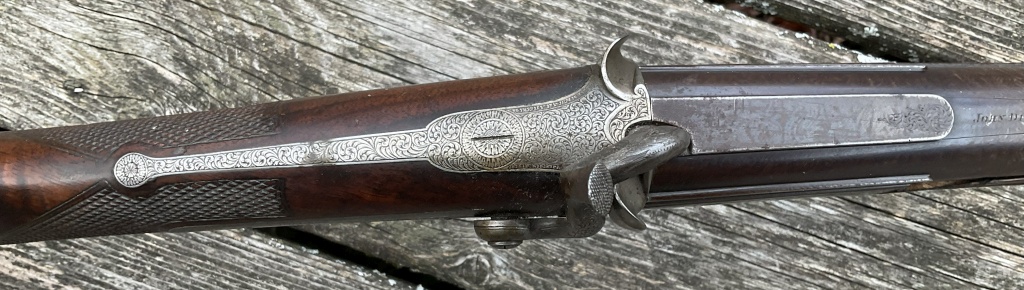
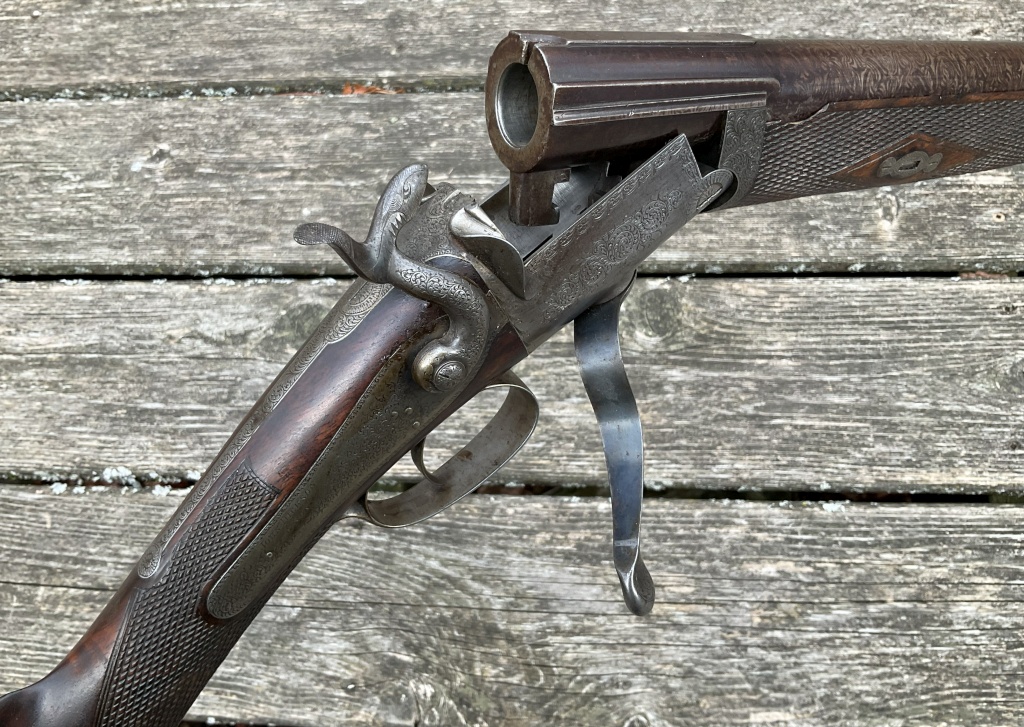
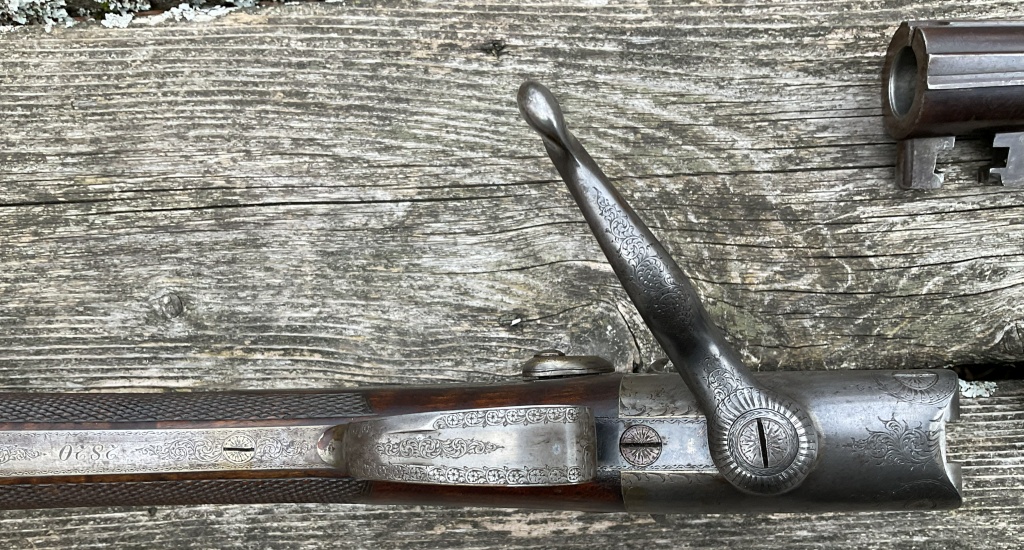
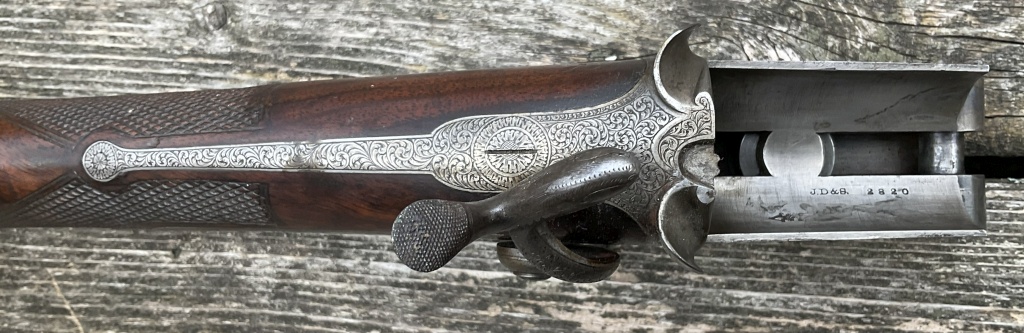
It is a 12-bore single-barrel pin-fire, already by definition rare and unusual. John Dickson & Son made 460 pin-fire guns between 1859 and 1875. Of these, only 10 were singles, and this one, number 2820, was completed in 1875. It was one of the last five pin-fires made by the firm, a last hurrah of the pin-fire system. The knowledge of who commissioned this gun and for what purpose has been lost, as the firm (while still in business) no longer has the sales ledger for this period. Existing workshop records show it was made entirely in-house (though the final barrel browning might have been locally outsourced), at a time when the firm employed 18 men and boys. From an engineering standpoint, it is not exceptional, as it is a standard double-bite screw-grip underlever action, built some 13 years after the Henry Jones patent expired. How it has been made is indeed exceptional; it is a gun of rare beauty and execution. Like, bite-your-knuckles beautiful. I hope photos can do it justice.

To state the obvious, pin-fire cartridges have a protruding pin. Pin-fire hammers are generally of the ‘hare’s ears’ type, with tall vertical thumb-pieces. On a double gun, one aims between the hammer ears, like goalposts. With a single-barrel gun, the exposed pin and corresponding hammer risk obscuring the sight line. One could, I suppose, angle the pin sharply towards one side, but the hammer would not hit the pin true, resulting in bent pins and misfires from lost striking energy. The single pin-fire gets around this by slightly canting the pin hole and pin to one side, and offsetting the hammer nose inwards, to strike the pin as directly as possible. A half-pigeon-toe, if you like.

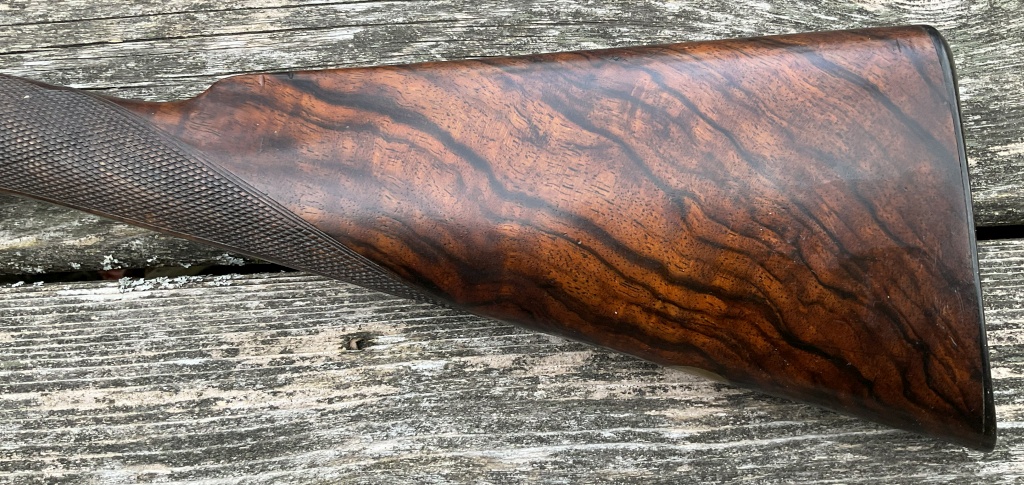
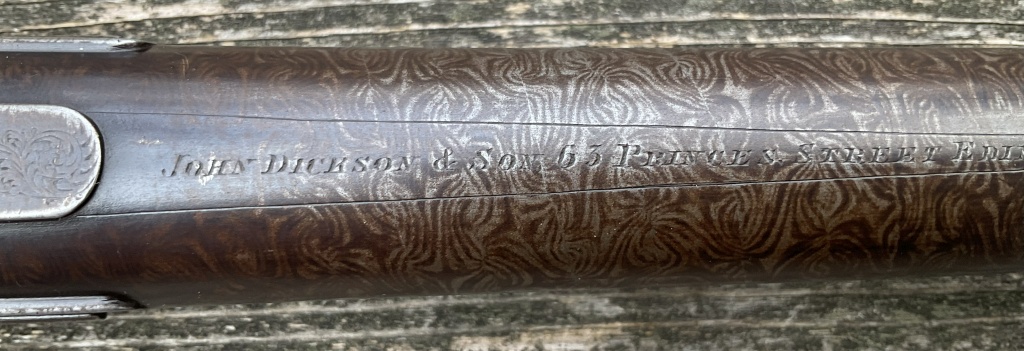
The gun sports a back-action lock, a dolphinfish-styled hammer, London proofs, and the 31 1/16” fine damascus barrel still has a spotless bore. The barrel is signed “John Dickson & Son, 63 Princes Street, Edinburgh.” In pure gunmaking excess, and a show of that special ‘extra-ness,’ it has two symmetrical percussion-style fences, neither of which is in any way functional. There are no action ‘flats’ per se, but a beautifully filed U-shape recess for the barrel. The fore-end is also deep in profile, with a U-shaped channel; it almost looks like you could fit 28-bore over/under barrels to this gun without it looking out of place. It also has a short sighting-rib, a well-figured stock, and a horn fore-end cap. Unusual for a pin-fire, but in keeping with its late manufacture date, is a nicely contoured chequered horn butt plate. I'm particularly enamoured with the minute wreath engraving around the lock crosspin socket, on the left side of the stock. Hardly necessary, but just that little bit extra.

Oh87GWq.jpg

xkUU5h2.jpg

VfyPmOG.jpg

z8XJRGw.jpg

xevvYim.jpg

Ehzf4eH.jpg

ybifDDz.jpg

SrAzvWr.jpg

ORJh8RZ.jpg

Dx28Pub.jpg

VPz5e9c.jpg


Solidly built, the gun weighs 6 lb 7 oz. This was not a gun built for lightness, as singles sometimes were. Was it made for collecting natural history specimens? A lady’s gun for occasional shooting, perhaps? Or a young man’s? Or was it made for someone used to fielding single-barreled percussion or flint guns, and set in his ways? Or someone who preferred walking-up their game (where a second shot is unlikely), as opposed to battue-shooting? I’ll never know. At this quality, it would have been more expensive than most doubles on the market, so not an ‘entry-level Cooey,’ to be sure. The sculpting and build choices would have set it apart from most other guns in the sporting field, and it was most certainly someone’s pride and joy.
 
It would be difficult to exaggerate the allure of the trigger plate, round action doubles built by James MacNaughton and John Dickson. I realise that they aren't the subject of the current thread, but it sent a shiver down my spine when you even mentioned them.
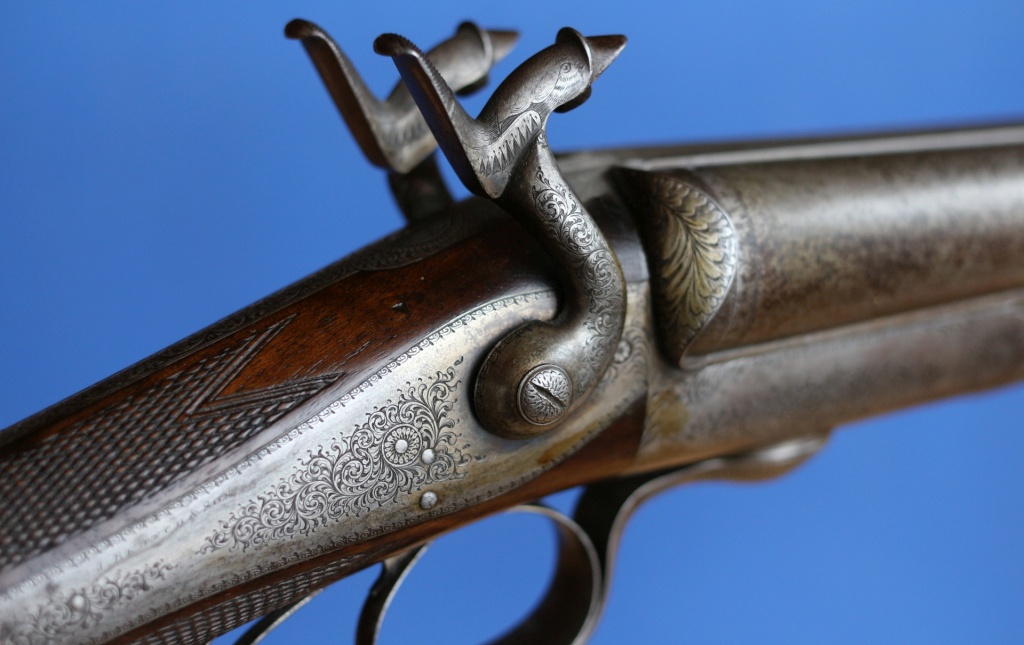
But, back to the single shot pinfire. In addition to the finer details that you've pointed out, the wood to metal fit is impressive - especially considering the century and a half that has elapsed.
 
It would be difficult to exaggerate the allure of the trigger plate, round action doubles built by James MacNaughton and John Dickson. I realise that they aren't the subject of the current thread, but it sent a shiver down my spine when you even mentioned them.

But, back to the single shot pinfire. In addition to the finer details that you've pointed out, the wood to metal fit is impressive - especially considering the century and a half that has elapsed.
Yeah, Straightshooter. It's not hard to imagine someone capable of making this (points upward to the pictures), going on to make the trigger-plate round-action gun. And having learned every secret from the Dicksons, MacNaughton making his 'skeleton' gun (another one of jaw-dropping beauty -- Google it, for those who don't know it).

These are the subject of this thread. I just don't have examples to show. (Buys lottery tickets)

Oh, wait, forget it, they don't have removable chokes...
 
Always nice to see something new. Doubly so when it's a Scottish round action. As you know Steve, I share your enthusiasm for single barreled guns and that is a beauty for sure. Had no idea Dickson made any single barrel guns.....now I know.

I guess there are now three of us who may buy lottery tickets while dreaming of The Edinburgh Gun (and I don't mean the cannon!)
 
I consider the choice of a gun a very personal thing. I choose a gun as carefully as I choose my friends. My gun is a companion, and it is a fundamental part of the joy I have of shooting and hunting. A gun that fits me becomes part of me, and I savour its looks and feel in the hands, its comforting weight. Maybe because I don’t go for modern factory-produced guns, I respect the many people who built, finished and decorated it with their own hands. If a gun is ‘right,’ in balance, looks and feel, gauge is a secondary concern, if it is one at all. Some guns look their best in 12 gauge, and others in 16, 20, or 28. In mid-Victorian Britain, 14 was a very common and popular bore size. Continental Europe favoured the 16 as an all-around cartridge, and I can’t fault them for that; not surprisingly, 16 was also a popular gauge in Victorian Britain, though not as much as the 12.

Part of the reason for the variety of bore sizes in Britain (and I can add the 10 as well) was the range in game species and shooting habitats. It was also partly a matter of personal preference and familiarity, and availability. And myth; if the gun was believed to ‘shoot hard,’ it didn’t matter what gauge it was. Barrel tubes, being forged by hand, will naturally vary. The size of the mandrel around which the strips of twisted steel were hammered will have gone far toward determining the final gauge, but between the rough forgings and finished tubes, a considerable amount of steel will have been removed in the striking/shaping, boring and polishing steps. Only then will the tube forger know the size of the tube sold to the barrel makers. The barrel maker still has to braze the barrels together, lay the upper and lower ribs, form the flats and add the lumps, cut the chambers and forcing cones, and hone the bores to the desired measurements (though some of these steps might be done in the gunmaker’s workshop, if the barrels were outsourced). To fulfil whatever the client wanted, the gunmaker would choose barrel tubes from in-house stock or from a supplier. The gun would be built around the barrels, one of the reasons an ill-proportioned gun is so rarely encountered. In the case of breech-loaders, a gunmaker might have a variety of rough action forgings on hand, with the right size chosen to suit the barrels.

I wrote earlier about my admiration for Scottish (and Irish) guns; their makers seem to understand gun aesthetics very well. But I don’t want to cast shade on English guns, or generalize too much about English guns in any way. It is true that there was a similarity in the output from Birmingham. This is not too surprising, if 500+ workshop benches, many operating side by side and exchanging parts and semi-finished guns, ended up producing work that was much of a muchness. Consistency could be achieved, and many town-level gunmakers were able to sell guns that were of sufficient quality as a result. But in the larger cities, where several gunmakers competed for work, there was potential for more demanding clients and a drive for higher-quality work.


Manchester, a city that boomed during the Industrial Revolution, was a good example of this. In the 1850s and 1860s, cotton and finance were the main areas of development in that city. With this wealth came the possibility of country pursuits and orders for sporting gunmakers. At least 19 gunmaking firms were active in Manchester during this time: John P. Agnew, William Burtinshaw, Thomas Conway, John William Edge, Gasquoine & Dyson, William Griffiths, Griffiths & Worsley, Reuben Hambling, Hamer & Co., Thomas Hepplestone, John Kaye, Thomas Newton, Charles Pearson, Francis Preston, Francis Robinson, Henry Steel, Robert Stensby, Thomas Warhurst, and Robert Watmough. This competition drove up quality, and I can easily add Manchester-built guns to my list of preferred origins.

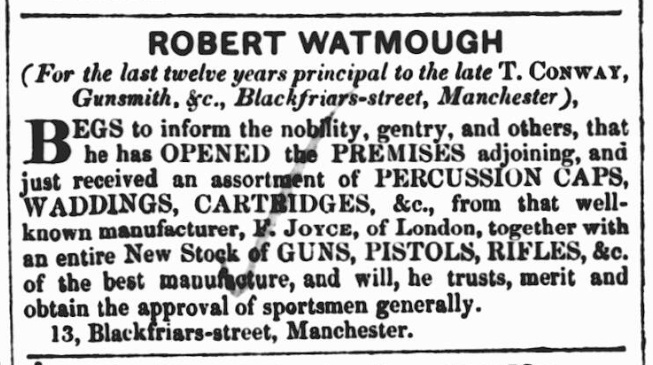
Robert Watmough was born in Lancashire in 1821, and he worked for the gunmaker Thomas Conway, who operated at 4, and later 15, Blackfriars St. in Manchester. Conway was a well-known gunmaker who was renowned for his pistols. Whether Watmough apprenticed under Conway or was a journeyman in his employ is not known. The 1841 census has him listed as a gunsmith. The 1851 census lists him as ‘Head, Salesman To Gunmaker,’ presumably to Conway. Robert Watmough set up his own gunmaking business at 13 Blackfriars St. in 1854. The 1861 census lists Watmough as ‘gunsmith,’ together with his son, Henry, age 19, also as a gunsmith (presumably working for his father). Watmough and his family lived at 6 Sloan St in the Moss Side area of Manchester. The business closed in 1869. In 1870, Robert Watmough was an honorary member of the 8th Lancaster Rifle Volunteer Corps. Watmough may have died in early 1873. There is no further record of Henry as a gunsmith; the 1881 census lists him as a clerk, and in the 1891 census as a domestic labourer. Henry died in 1921, at the age of 79.

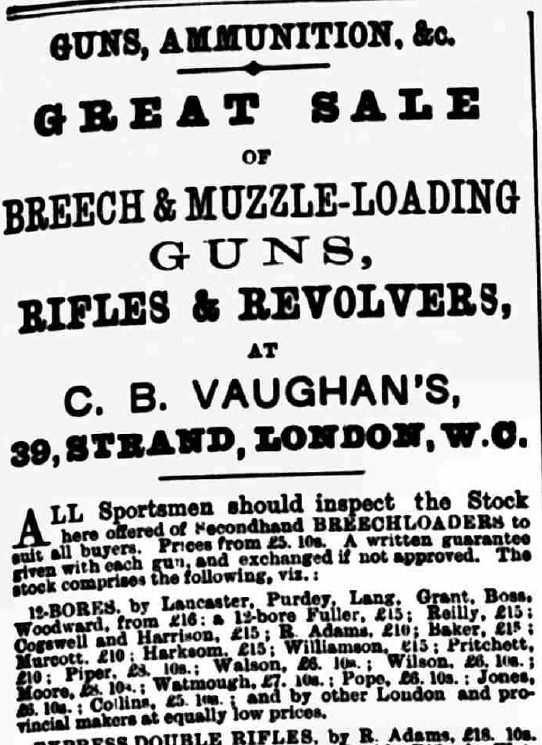
That is about all that can be traced for this maker. His only advertisements were in local newspapers in 1852 (Bolton Chronicle, 7 August 1852):

5Cj5iVh.jpg


However, an 1877 advertisement by C. B. Vaughan, a London second-hand gun dealer, lists having a Watmough gun, alongside well-known names. Had Watmough been considered just another provincial maker, he would not have been singled out.

2PlTqDy.jpg


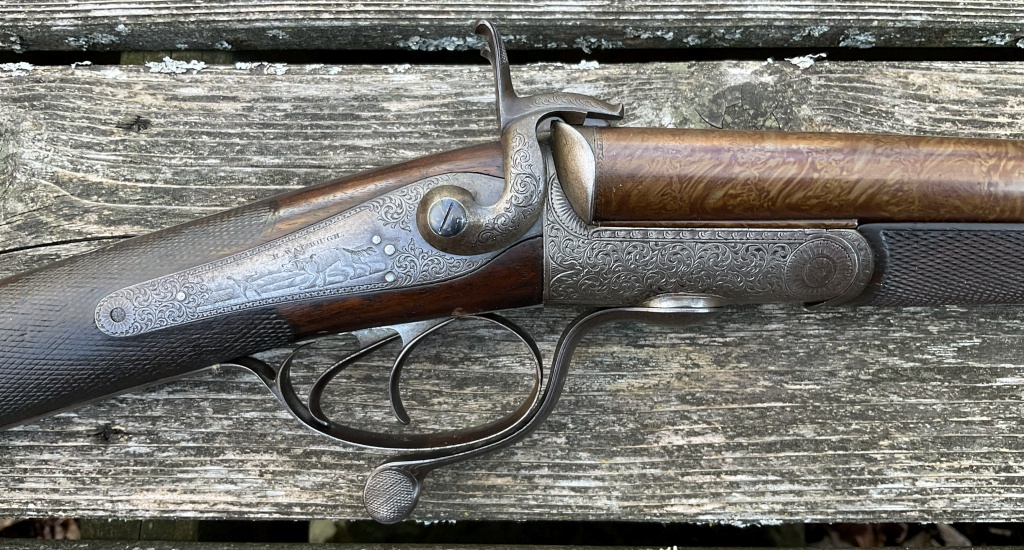
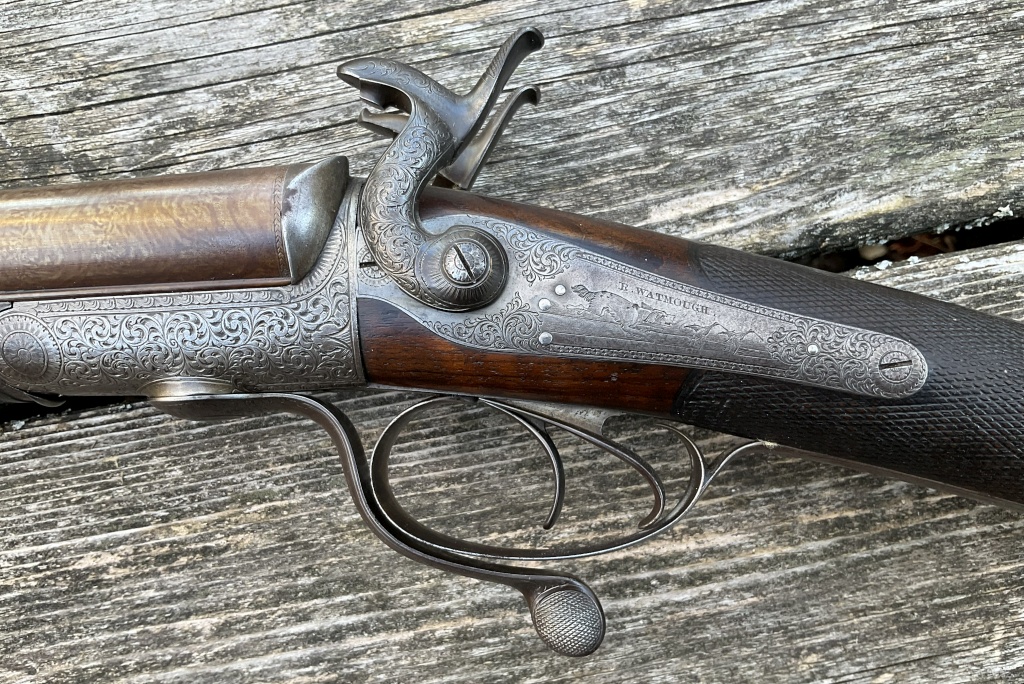
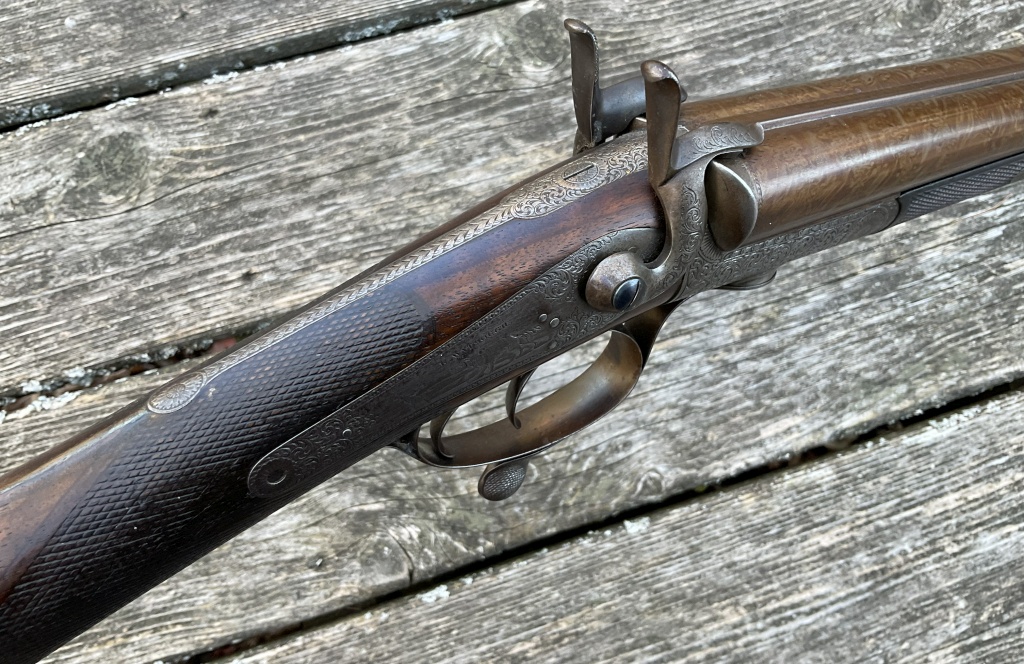
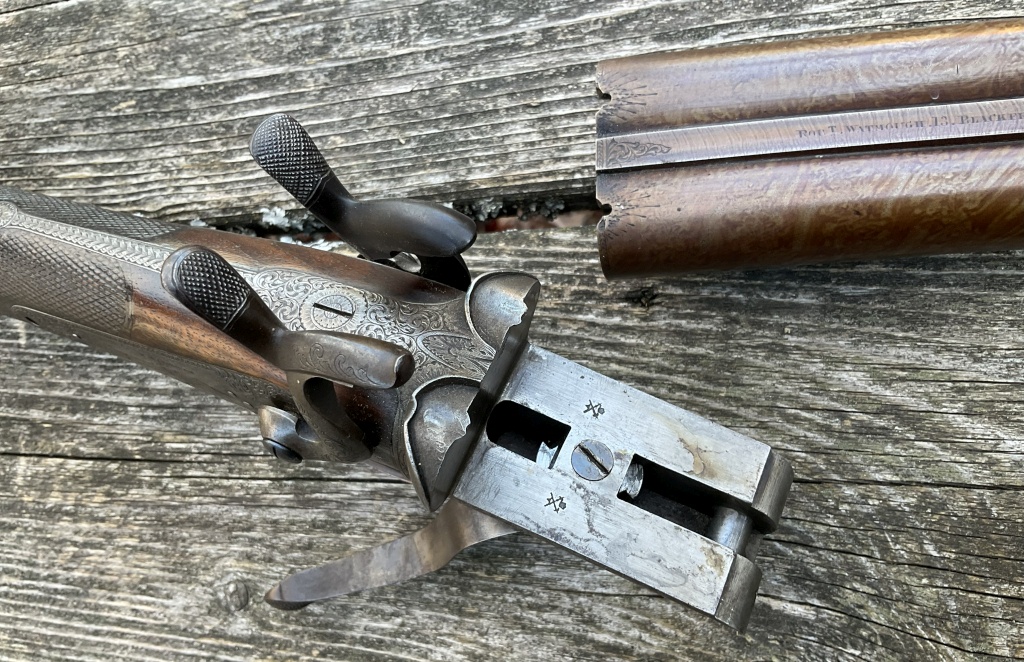
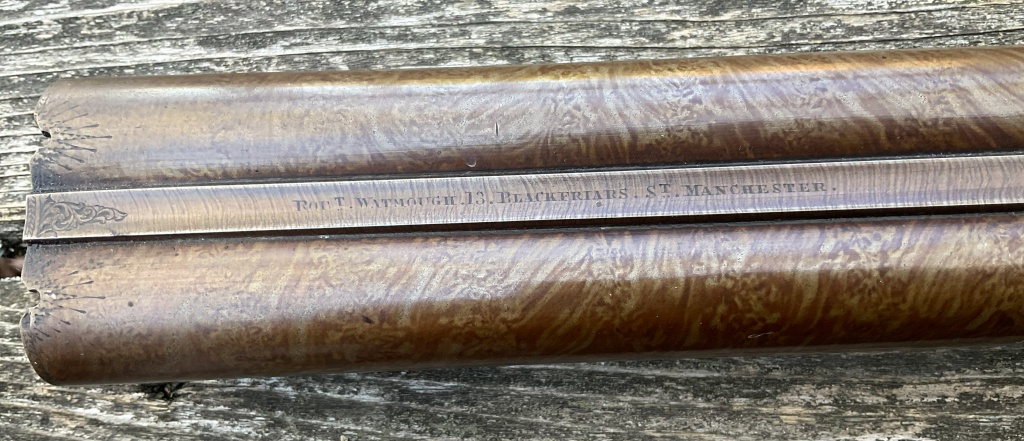
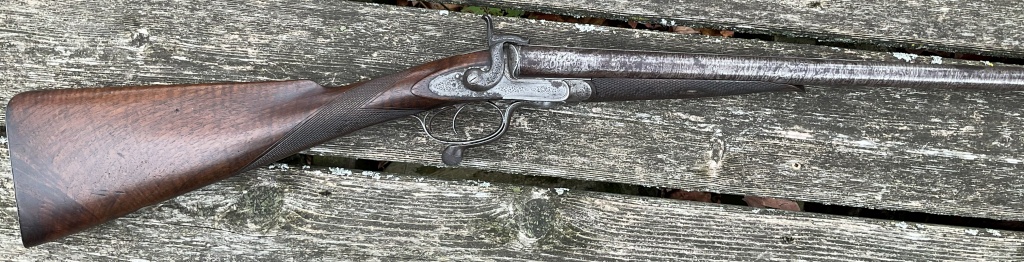
Thankfully, a handful of Robert’s guns have survived, and here is a 16-bore double-bite screw-grip rotary-underlever pin-fire sporting gun of high quality. The 27 3/16” laminated barrels have Birmingham proofs, and the top rib is signed “RobT. Watmough. 13. Blackfriars. St. Manchester.” The barrels also have a maker's mark for W. Marshall, a gun barrel maker at 10 & 14 Vesey St., Birmingham, who was in operation from 1865 to 1868; this helps narrow the gun's date. The back-action locks are signed “R. Watmough” and are nicely decorated with dog and game scenes (curlews and pheasant). Despite their obvious appeal, game scenes are uncommon on pin-fire guns, with acanthus leaf patterns predominating. Price may have been a factor, though I don't think so – talent came at minimal cost back then. The bores are still very good with only slight pitting at the breech, and the right-hand hammer is a period replacement. The gun weighs a light 6 ½ lb.

IqWh8wl.jpg

Ik88GCf.jpg

vHsKVLY.jpg

81JNHPR.jpg

58sp0Fi.jpg

Ficbcue.jpg

0oba7eD.jpg

mkBl4lc.jpg

2QyHns3.jpg


The full-coverage engraving of the action is nicely done, another feature that is uncommon in pin-fires of the period. The gun evidently changed hands during its shooting life, as it has a stock extension. While on the surface it looks like just another Jones-type double-grip action (yawn), upon closer examination, there are some structural/mechanical differences. The action bar is slightly longer than usual, and the space between the locking lugs is quite wide, making the interrupted locking nut correspondingly wide. These two superficially minor adjustments probably meant a very secure and sound lock-up. Whether this is typical of Watmough guns is unclear, as I'm not aware of any others to compare it with. It is only when you start putting similar actions side-by-side do you start to spot the differences between them; gunmakers were experts in mechanical engineering, even if unschooled. This gun has seen considerable use, from the worn chequering (and repairs).

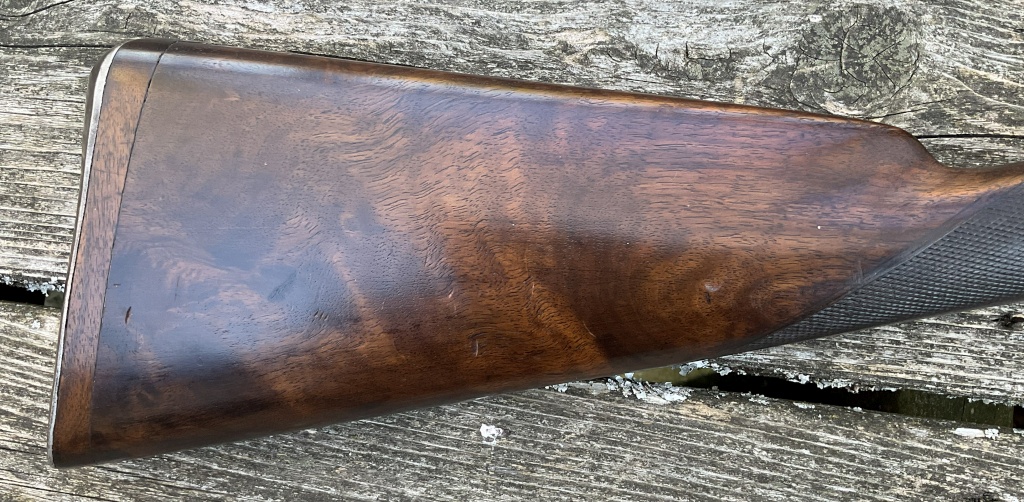
What this gun has, and what is impossible to capture in photos, is an aesthetic balance; the action is slim and beautifully proportioned, as is the stock and fore-end. The game scenes distract from what might have seemed oversized lock plates on a slim-handed gun. The scroll coverage is just right. The laminated barrels are gorgeous. While not finished to the standards of a ‘London Best,’ this product of a small gunmaker is still a very fine gun. I wish there were more guns from this maker around.
 
I started this thread as a discussion of the attraction that British guns seem to have, and a search for the answer as to why the very pinnacle of gunmaking is, in the opinions of many, dominated by a handful of historic British makers. There are other views, of course, especially on this side of the Atlantic. But it is hard to argue that Britain does not deserve its position, one that it has held for well over 100 years.

Over the past 10 months or so, I’ve shared a little bit of what I’ve learned about a narrow subject: British gunmaking in the 1850s and 1860s, and the emergence of breech-loaders in that time. Just about everything we enjoy today about our sport came from the ideas and inventions of that period, and was further perfected in the decades that followed.

The guns I’ve shown in this thread have been chosen to demonstrate particular aspects of British gunmaking and their history, from their component parts to their decoration, and the evolutionary march of mechanical ideas and approaches. For some, I’ve added the histories around their ownership and use. While the subject matter of the breech-loading gun remains rich and there are many areas (and examples) I’ve not yet touched upon, the time has come for me to call it a day with this thread.

This last year has been the worst for me health-wise, and tap-tap-tapping at the keyboard has been a welcome distraction. To all the CGN members who have contributed to this thread, thank you. To members who have followed along but never dared to post, thank you for your interest as well. To the hardy souls who were persistent enough to read the entire 20-page thread from start to finish, I hope you learned something new to enrich your gun experience!

I recognize my interests are but a niche and quaint subject to many here, and I appreciate your patience with my meandering prose. I used this thread to keep me writing, so I wasn’t going to be succinct. Ever. But social media is designed for 10-second attention spans, not complete sentences and thoughtful discussion. Now that I’m back to some kind of normal, it is time for me to concentrate on finishing my book and writing some more fleshed-out articles while there are still people out there looking for a good read, and before AI ruins everything. For this reason, I’m giving social media a rest. While I’ll still lurk around in this corner of CGN, I won’t be posting much. My account will remain active, and I can still be reached via CGN messaging and e-mail should anyone have questions or perspectives to share. I’m always up for a good exchange of ideas and knowledge, and for providing answers where I can.

wuxUg71.jpg
 
I'll pretend I didn't completely read this post... Otherwise I might just go into The-allure-of-the-British-gun-withdrawal ;)

For a reason or another I was half-expecting this thread to somewhat divert into British gun accessories and the like... Oh well, it will be for another thread ( I hope)

Did I mention that this most likely the best thread I've ever come across on CGN ?
:cheers:

Anyway, where do we sign up to reserve our copy of the upcoming book?
 
Steve, this thread has been fantastic and CGN will be poorer for your absence. Glad to hear you are feeling better.....I know it's been a tough slug. Looking forward to catching up when we next meet at the 2026 Upper Canada Double Gun Classic!
 
Back
Top Bottom