
signs of bodging.













































You are using an out of date browser. It may not display this or other websites correctly.
You should upgrade or use an alternative browser.
You should upgrade or use an alternative browser.
The allure of the British gun
- Thread starter Stephen Nash
- Start date


Can't wait for the choke conversation to start
"Greener has entered the room."
Licensed to kill
CGN Regular
- Location
- Peace Country Alberta
I repaired a very nice Armstrong box lock years ago for my brother. It wouldn’t open. Found that the locking ladder (don’t know the actual name) had broken so moving the lever would only disengage the rear lug leaving the front lug engaged. Don’t recall how I got the thing open (this was about 35 years ago) but I did, found the issue, welded the ladder back together and all was good.Maybe someone can chime in and tell of when a boxlock action failed, but I don’t know of any.

I have a good friend who is a fine finish carpenter. His parents came from England in the 1970s. He’s ALWAYS talking about how someone bodgered something.Can't wait for the choke conversation to start
And not only is this thread good at educating us about British doubles... it also helps me adding new word to my vocabulary !
- had to look up signs of bodging
And of course, while the subject of the thread is British guns, so much of what Steve writes is directly applicable to the Continental guns of the time. Similar transitions until the A&D boxlock and the Sidelock became pretty much standard. Barrel development. Forend ends. Chokes. Etc.
I always think of it , in general, that the French conceived it, the English made it work and the Prussians tried to figure out how to make it their own. While I have more Prussian guns in my collection than from anywhere else, the very best of them are simply the Prussian’s trying to make an English game gun for the American market.
Last edited:

Very interesting. And unusual!I repaired a very nice Armstrong box lock years ago for my brother. It wouldn’t open. Found that the locking ladder (don’t know the actual name) had broken so moving the lever would only disengage the rear lug leaving the front lug engaged. Don’t recall how I got the thing open (this was about 35 years ago) but I did, found the issue, welded the ladder back together and all was good.
Yup, in a nutshell, that's it.... the French conceived it, the English made it work and the Prussians tried to figure out how to make it their own.
Sometimes I type faster than my brain catches up, and some words slip in. I forgot I'm no longer in the UK.
Bodger = Bubba
I didn’t intend to kick the hornet’s nest about chokes. Put away your popcorn, I will say right now that choke was/is an improvement. It does improve the patterns of shotguns within a given space, such as that represented by a 30” circle at 40 yards. Thank you, Mr. Pape. Or Mr. Greener, says him. There, case closed.
[Pause]
But it drives me flipping insane that choke is imbued with some kind of magic, that it makes the difference between success and failure, “if only a different choke tube was installed.” No. You missed. Deal with it. Then, it is a question of whose chokes are used (assuming interchangeability, something I am not entirely ready to admit is a step forward). Factory or third-party? Who has the snazzier product name, or best YouTube video?
From the moment someone figured out how to make a gun barrel, it was recognized that some shot better than others. To the user of the gun, it was perhaps magic, and a strong-shooting barrel was not something willingly parted with. Many muzzle-loading-to-breech-loading conversions were precisely to retain the mythic qualities of the barrels of a prized game gun. Barrel-boring was also part of the mystique of the gunmaker since at least the late 17th century, and the recipe for success for makers such as Joseph Manton and Charles Lancaster, whose barrels were held in awe. Every gunmaker of note had their own formulas or methods to achieve desired results. It was only when their methods were patented did they attract popular attention. When William Rochester Pape registered Patent No. 1501 in May, 1866, it was for a single bite, drop-down barrel action, and for barrels tapered internally at the muzzle (what we now recognize as choke boring). The patent concentrated on the action, not on choke boring, and the patent was not renewed in 1873, suggesting it was no big deal to Pape. It was only later, in 1875, that choke boring became a thing, and Pape claimed the ten guinea prize for its ‘invention,’ as a result. William Wellington Greener also claimed the invention, but could not match Pape’s 1866 patent. A great deal of the public attention was due to the newspaper The Field, and the trials it hosted. But really, gunmakers claiming to ‘invent’ choke is like Columbus claiming to ‘discover’ the Americas. It was common knowledge to those already there/involved.
As to the performance of choke, there are many variables. Many have pointed out before, it is not so much the measurement at the muzzle by itself, but the difference between the bore size behind the constriction and the measurement at the muzzle. Not all bores are exactly the same, for any given gauge. In Victorian gunmaking, the chamber might fit a 16-gauge cartridge, but the barrels are bored 15, and marked accordingly – think of it as a full-length choke of sorts. How widespread was this practice? I just did a quick check with a sample size of 60 British pin-fires for which I had noted the marked bore size. Of these, 12 have bore sizes that match the chamber size (though in two cases one barrel did, while the other was more constricted, eg. a set of 12 and 13-bore barrels). The other 48 guns, or 80%, all have bore sizes smaller than the chamber size, usually 13-bore barrels on a 12, and 15-bore barrels on a 16 (in two cases, barrels were even tighter). So constricting internal barrel diameters was the norm, before the ‘invention’ of choke boring. Thank you, proof houses, for the trouble of measuring the actual bores.
Other variables are wadding and pellet hardness. How a choke performs with soft shot versus chilled shot (with antimony), and fibre/felt wads versus plastic shot cups, also has to be considered. Some of you have gone to the trouble of testing chokes with different brands of ammunition, which is the right idea. I suspect many simply use whichever cartridges are on hand/on sale, and hope for the best.
In case some of you might think I’ve been hard on Mr. Greener lately, to make up for it, let’s look at a particularly fine example of his work. As a renowned supporter of the pin-fire system, you would think William Wellington Greener pin-fires would be easy to find, but the firm in the 1860s was not the manufacturing behemoth it would later become. I have no idea how many, or how few, the firm might have made, and today’s gun is the only one I have managed to find in over 25 years of searching. As I mentioned in a previous post, Greener’s views on the pin-fire system put him at odds with his father, the eminent Birmingham gunmaker William Greener, who had nothing good to say about the newfangled breech-loaders. The elder Greener wrote in 1858 that “the French system of breech-loading fire-arms is a specious pretence,” adding “there is no possibility of a breech-loader ever shooting equal to a well-constructed muzzle-loader,” and “the gun is unsafe, and becomes more and more unsafe from the first time it is used.” Perhaps to cement his point, three W. Greener muzzle-loaders were entered in the 1858 Field trial, as mentioned before, and all outperformed the competing pin-fires.
In the 1850s and 1860s, pin-fire guns were sold in a variety of ways. Commissioning direct from the maker was an obvious choice if the maker had a shop in your vicinity and you were particular about what features you wanted, but it was not the only possibility. Guns could also be bought ready-made and “off the rack,” and there was a brisk business in second-hand guns. Some firms sold newly-made guns of various makers, and second-hand guns perhaps taken as trades or part payment. This was reflected in trade labels and newspaper advertisements, by the use of the terms “gun repository” and “gun warehouse.” Hardware stores (ironmongers) and occasionally general-goods merchants also traded in guns, ammunition and loading supplies. In addition, a number of silversmiths and jewellers devoted part of their trade to dealing in guns, acting as agents for gunmakers. This was a favourable arrangement, as a Birmingham maker wishing to sell guns in London could do so through a well-situated London agent at a lower cost than opening and maintaining a London shop themselves. William Wellington Greener used Edward Whistler, a silversmith, pawnbroker, and dealer in guns and pistols at 11 The Strand, London, from 1844 to 1875. In 1867, his business was advertised as “Edward Whistler, Gun and Pistol Repository,” offering new and second-hand guns from “the most approved London makers.” Whistler was one of two London agents used by William Wellington Greener.
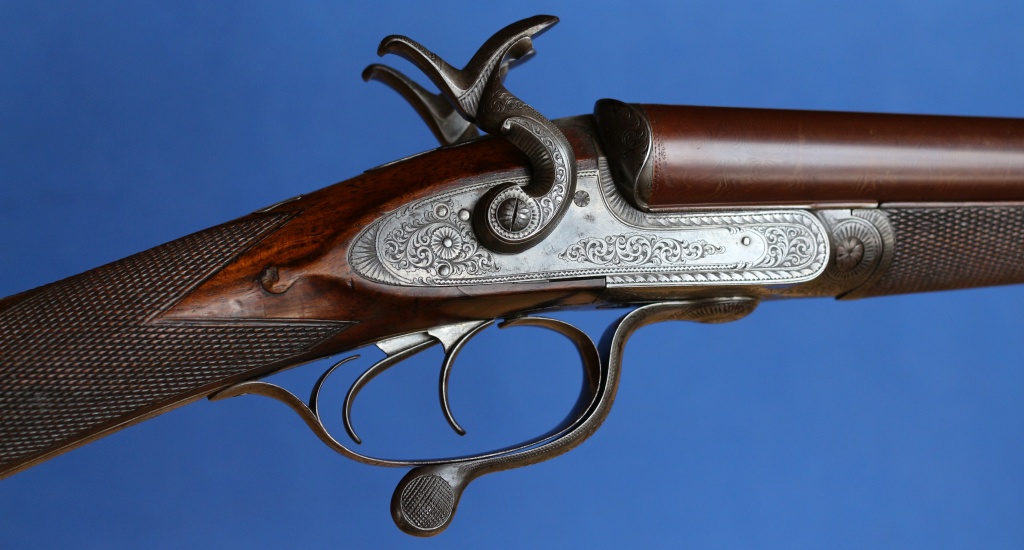
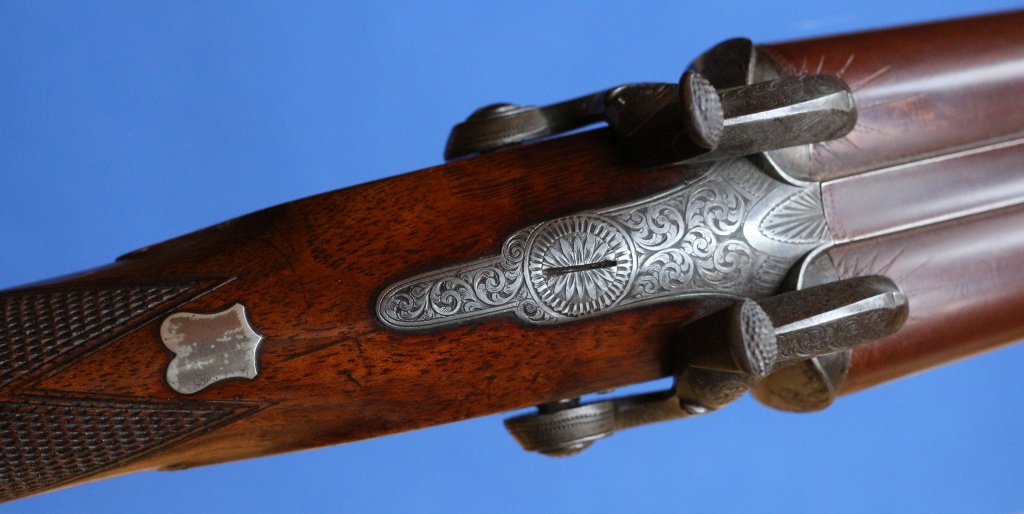
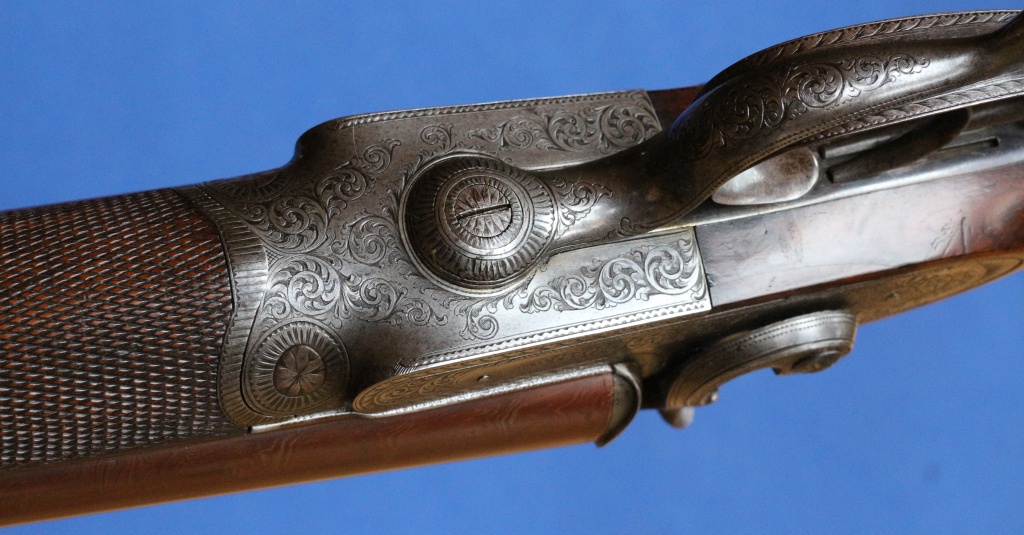
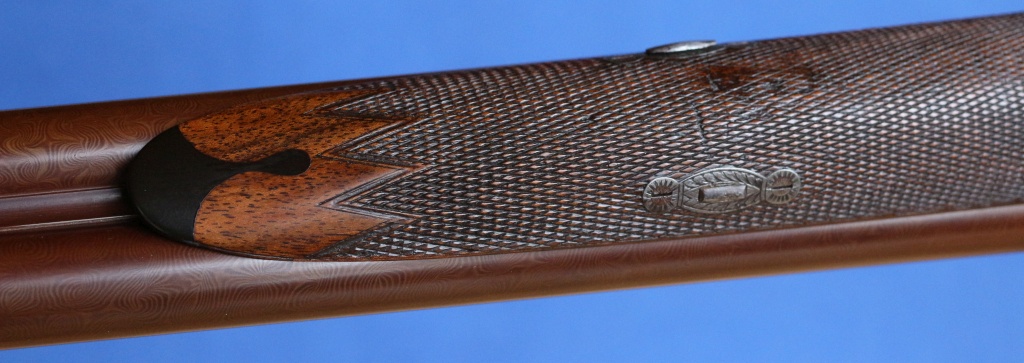
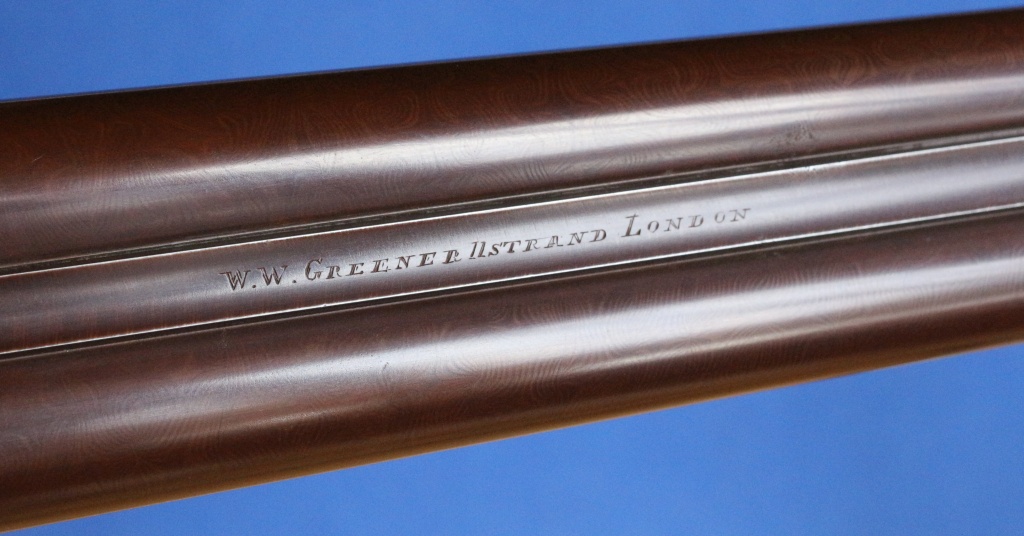
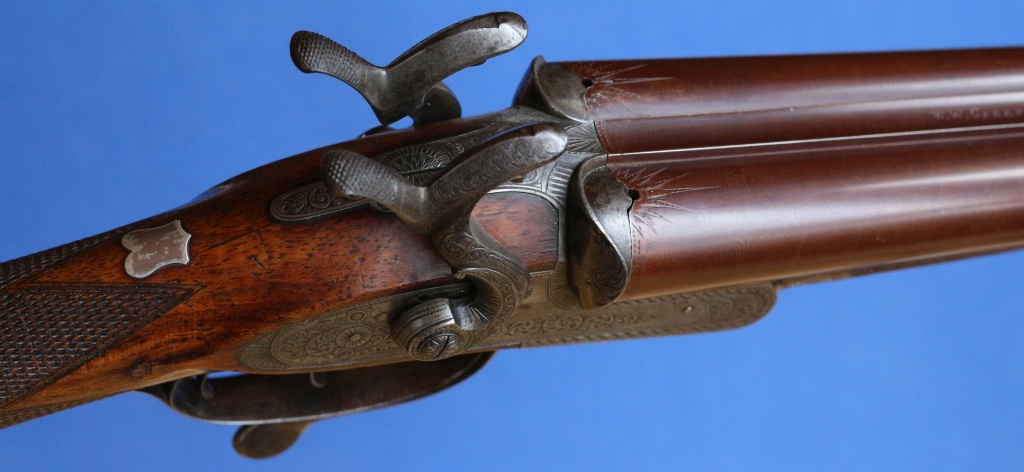
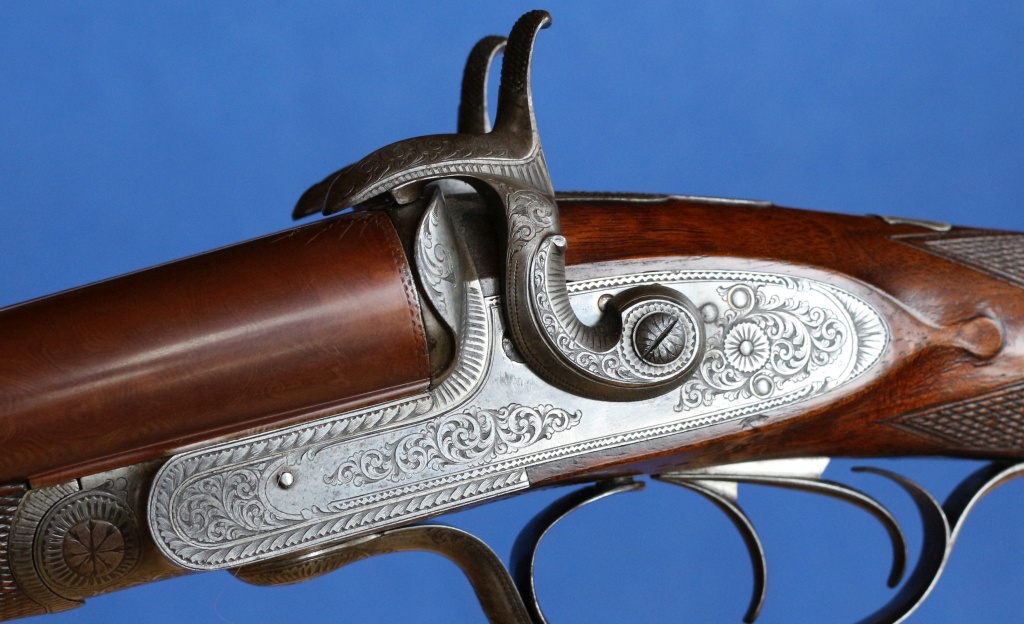
The gun below is a 'best' grade 12-bore double-bite screw grip rotary-underlever pin-fire sporting gun signed William Wellington Greener, retailed by Edward Whistler, and probably made in the late 1860s. The 30 1/8” replacement damascus barrels have a barrel maker’s mark “SP”, which I believe to be the mark of Samuel Probin of Loveday Street. As Greener numbered his guns on the barrels, the change in barrels means the serial number has been lost. The top rib is signed “W. W. Greener 11 Strand London.” The gun has unsigned bar-action locks, nicely sculpted hammers, and a beautifully figured walnut stock with drop points, and the fore-end has a horn or ebony tip. The gun weighs 6 lb 15 oz. It is a gorgeous gun.
[Pause]
But it drives me flipping insane that choke is imbued with some kind of magic, that it makes the difference between success and failure, “if only a different choke tube was installed.” No. You missed. Deal with it. Then, it is a question of whose chokes are used (assuming interchangeability, something I am not entirely ready to admit is a step forward). Factory or third-party? Who has the snazzier product name, or best YouTube video?
From the moment someone figured out how to make a gun barrel, it was recognized that some shot better than others. To the user of the gun, it was perhaps magic, and a strong-shooting barrel was not something willingly parted with. Many muzzle-loading-to-breech-loading conversions were precisely to retain the mythic qualities of the barrels of a prized game gun. Barrel-boring was also part of the mystique of the gunmaker since at least the late 17th century, and the recipe for success for makers such as Joseph Manton and Charles Lancaster, whose barrels were held in awe. Every gunmaker of note had their own formulas or methods to achieve desired results. It was only when their methods were patented did they attract popular attention. When William Rochester Pape registered Patent No. 1501 in May, 1866, it was for a single bite, drop-down barrel action, and for barrels tapered internally at the muzzle (what we now recognize as choke boring). The patent concentrated on the action, not on choke boring, and the patent was not renewed in 1873, suggesting it was no big deal to Pape. It was only later, in 1875, that choke boring became a thing, and Pape claimed the ten guinea prize for its ‘invention,’ as a result. William Wellington Greener also claimed the invention, but could not match Pape’s 1866 patent. A great deal of the public attention was due to the newspaper The Field, and the trials it hosted. But really, gunmakers claiming to ‘invent’ choke is like Columbus claiming to ‘discover’ the Americas. It was common knowledge to those already there/involved.
As to the performance of choke, there are many variables. Many have pointed out before, it is not so much the measurement at the muzzle by itself, but the difference between the bore size behind the constriction and the measurement at the muzzle. Not all bores are exactly the same, for any given gauge. In Victorian gunmaking, the chamber might fit a 16-gauge cartridge, but the barrels are bored 15, and marked accordingly – think of it as a full-length choke of sorts. How widespread was this practice? I just did a quick check with a sample size of 60 British pin-fires for which I had noted the marked bore size. Of these, 12 have bore sizes that match the chamber size (though in two cases one barrel did, while the other was more constricted, eg. a set of 12 and 13-bore barrels). The other 48 guns, or 80%, all have bore sizes smaller than the chamber size, usually 13-bore barrels on a 12, and 15-bore barrels on a 16 (in two cases, barrels were even tighter). So constricting internal barrel diameters was the norm, before the ‘invention’ of choke boring. Thank you, proof houses, for the trouble of measuring the actual bores.
Other variables are wadding and pellet hardness. How a choke performs with soft shot versus chilled shot (with antimony), and fibre/felt wads versus plastic shot cups, also has to be considered. Some of you have gone to the trouble of testing chokes with different brands of ammunition, which is the right idea. I suspect many simply use whichever cartridges are on hand/on sale, and hope for the best.
In case some of you might think I’ve been hard on Mr. Greener lately, to make up for it, let’s look at a particularly fine example of his work. As a renowned supporter of the pin-fire system, you would think William Wellington Greener pin-fires would be easy to find, but the firm in the 1860s was not the manufacturing behemoth it would later become. I have no idea how many, or how few, the firm might have made, and today’s gun is the only one I have managed to find in over 25 years of searching. As I mentioned in a previous post, Greener’s views on the pin-fire system put him at odds with his father, the eminent Birmingham gunmaker William Greener, who had nothing good to say about the newfangled breech-loaders. The elder Greener wrote in 1858 that “the French system of breech-loading fire-arms is a specious pretence,” adding “there is no possibility of a breech-loader ever shooting equal to a well-constructed muzzle-loader,” and “the gun is unsafe, and becomes more and more unsafe from the first time it is used.” Perhaps to cement his point, three W. Greener muzzle-loaders were entered in the 1858 Field trial, as mentioned before, and all outperformed the competing pin-fires.
In the 1850s and 1860s, pin-fire guns were sold in a variety of ways. Commissioning direct from the maker was an obvious choice if the maker had a shop in your vicinity and you were particular about what features you wanted, but it was not the only possibility. Guns could also be bought ready-made and “off the rack,” and there was a brisk business in second-hand guns. Some firms sold newly-made guns of various makers, and second-hand guns perhaps taken as trades or part payment. This was reflected in trade labels and newspaper advertisements, by the use of the terms “gun repository” and “gun warehouse.” Hardware stores (ironmongers) and occasionally general-goods merchants also traded in guns, ammunition and loading supplies. In addition, a number of silversmiths and jewellers devoted part of their trade to dealing in guns, acting as agents for gunmakers. This was a favourable arrangement, as a Birmingham maker wishing to sell guns in London could do so through a well-situated London agent at a lower cost than opening and maintaining a London shop themselves. William Wellington Greener used Edward Whistler, a silversmith, pawnbroker, and dealer in guns and pistols at 11 The Strand, London, from 1844 to 1875. In 1867, his business was advertised as “Edward Whistler, Gun and Pistol Repository,” offering new and second-hand guns from “the most approved London makers.” Whistler was one of two London agents used by William Wellington Greener.
The gun below is a 'best' grade 12-bore double-bite screw grip rotary-underlever pin-fire sporting gun signed William Wellington Greener, retailed by Edward Whistler, and probably made in the late 1860s. The 30 1/8” replacement damascus barrels have a barrel maker’s mark “SP”, which I believe to be the mark of Samuel Probin of Loveday Street. As Greener numbered his guns on the barrels, the change in barrels means the serial number has been lost. The top rib is signed “W. W. Greener 11 Strand London.” The gun has unsigned bar-action locks, nicely sculpted hammers, and a beautifully figured walnut stock with drop points, and the fore-end has a horn or ebony tip. The gun weighs 6 lb 15 oz. It is a gorgeous gun.
Last edited:
I spent years hunting with a good friend, both of us traveling far from home and meeting up in some distant hunting Eden. Which means evenings spent caring for the dogs, the guns, ourselves (food and drink) and talk of chokes and fine SxS.
Both of us recognized the best way to solve a choke problem was to shoot well. But that makes for a short conversation and no debate. So instead we would blather on over our scotches about the ideal choke combinations for any given gauge, barrel length, quarry and terrain. Endless fun with no definitive end result.
Sadly sudden heart failure put an end to those trips.
Both of us recognized the best way to solve a choke problem was to shoot well. But that makes for a short conversation and no debate. So instead we would blather on over our scotches about the ideal choke combinations for any given gauge, barrel length, quarry and terrain. Endless fun with no definitive end result.
Sadly sudden heart failure put an end to those trips.
Every sporting gun holds stories, and tells stories. For our own guns, they have captured special moments afield, often with friends and places that stay with us, as Canvasback related. For many shooters, dogs are part of those moments. These stories are rarely written down, but hopefully, photographs and memories remain. For guns that have belonged to someone else, those stories can be hard to uncover and may be lost forever. As to the stories the guns themselves tell, that is down to their creation and the persons involved, from raw resources to finished product. It also involves the persons who have owned and used them subsequently, until the point at which we become part of the story. A large part of the allure of British guns is the richness of their origins, the time spans involved, and the human element of their story, seen from societal and technological perspectives.
Every once in a while, I encounter a gun that is significant to the understanding I am trying to achieve, and is dripping with history and connections to places and people. Luck sends these guns my way, and each one involves lengthy sessions with a magnifying glass and books. Lots of books. And, because I’m not a Luddite, online records and databases, endless webpages, and the convenience that is e-mail. Sometimes research and web searches fall short of answering the many questions I start with. Even in the best of cases, where gunmakers’ record books have survived the march of time and can be accessed (usually for a fee), information may still be scant. Gunmakers were noting information useful to them in their business, not laying away information for a future me. For the guns that even have serial numbers, the numbers might have been useful in keeping loose parts together in a box on a workbench, or keeping track of payments to outworkers, and nothing more. Sometimes they can relate to production dates, but often not. No one was keeping track of these numbers but themselves, for reasons that were not always clear. When doing your own projects or crafts, do you serial number them?
I find it interesting that some of the best British gunmakers are so unrecognized today. Part of it is timing, as few guns made before 1900 remain in active use, so anyone ceasing to trade before the 20th century can be easily erased from our thoughts. For hand-made guns, it takes years to build up numbers, and a reputation is something built slowly. As businesses, some diversified into non-gun areas for promotion and profit. Several gunmakers, like William Wellington Greener and James Dalziel Dougall, leaned heavily into publishing books. William Rochester Pape launched the very first dog show. Some, because of their training and backgrounds, also manufactured sport fishing gear or other outdoor equipment. Some became gunmakers after finding success in other endeavours, such as Harris Holland, the tobacconist, and Benjamin Cogswell, the pawnbroker. Edward Paton branched out from gunmaking into leasing estates for shooting.
These next three posts will concern Edward Paton, and one of his guns that has just fallen into my lap. CGN limits the number of words and images I can fit in a post, so I have to divide it up. The natural split is a) Paton’s history, b) the gun, and c), the original owner. There’s a lot to cover, so Kamlooky, better have a big pot of coffee ready for this one. I’m on my third mug, and I’ve barely started.
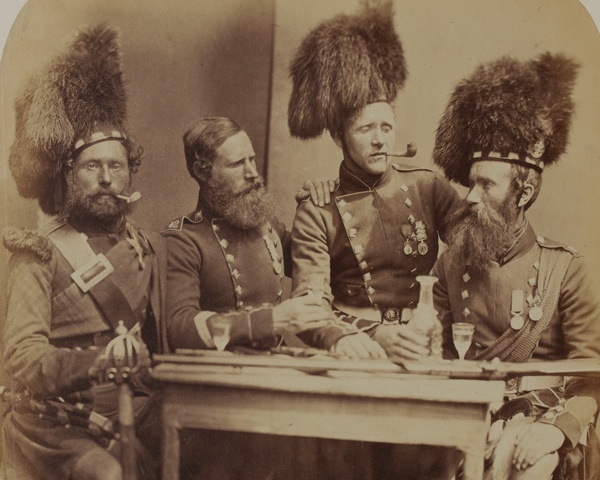
Edward Paton was born in 1819 in Dublin, Ireland, into a military family. His father, also named Edward, was born in 1793 in Inverness, Scotland, in the Regimental Barracks of the 42nd (The Royal Highland) Regiment of Foot (The Black Watch). The family ties with the regiment were evidently strong, and young Edward became the armourer of the regiment. He married Emma Stroud in 1845. In 1847, the garrison was stationed in Malta, where his son, Edward Lonsdale Paton, was born. (Note: the island of Malta, located in the Mediterranean between Sicily and North Africa, was a British territory from 1814 until its independence in 1964; Malta joined the European Union in 2004.) Shortly after this, Edward and his family must have left the regiment and moved to London, where in 1849 they had a daughter, also named Emma. Sadly, his wife died not long afterwards. Edward remained in London for the next five years, possibly working as a journeyman gunmaker. In 1854, he went into partnership with Charles Frederick Walsh, and together they bought the gunmaking business of Ancell & Salmond at 44 George Street, Perth, Scotland. Meanwhile, the 42nd Highlanders were in the thick of battle in the Crimean War (1854-1855), and the Indian Mutiny (1857-1858).
Paton was armourer for these fine fellows.
Robert Ancell was born in 1786 in London. He was first recorded in business as a fishing tackle manufacturer in 1820 in St John Street, Perth, Scotland. By about 1830, he was also a gun maker, and by 1833, he had moved to 44 George Street, and described his business as a sports warehouse. In 1847, he formed a partnership with Alexander Salmond, who may have been apprenticed to Ancell. Ancell described himself as a master gunmaker employing 9 men, and was skilled enough to be appointed gunmaker to His Royal Highness Prince Albert, Victoria’s Consort, possibly in 1853 or 1854 (a muzzle-loading percussion lock sporting gun by Ancell & Salmond is in the Royal Collection). In 1854, at the age of 68, Robert Ancell retired and sold the business to Paton and Walsh. Alexander Salmond established his own business and later moved to London, where he may have worked for Paton. Paton and Walsh employed John Robinson Gow, who stayed with Paton until 1864, until he set up his own gunmaking business in Dundee.
Gow advertisement, Dundee Advertiser, 26 August 1864
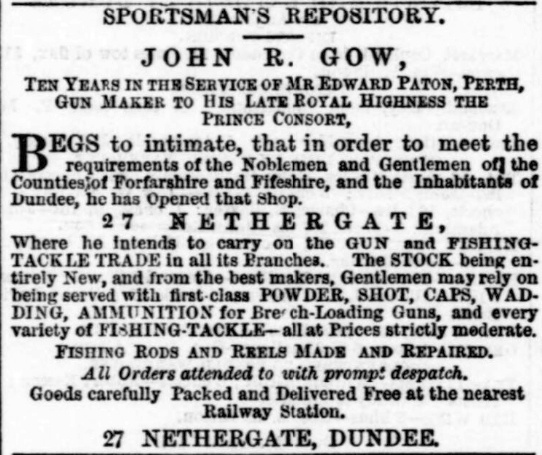
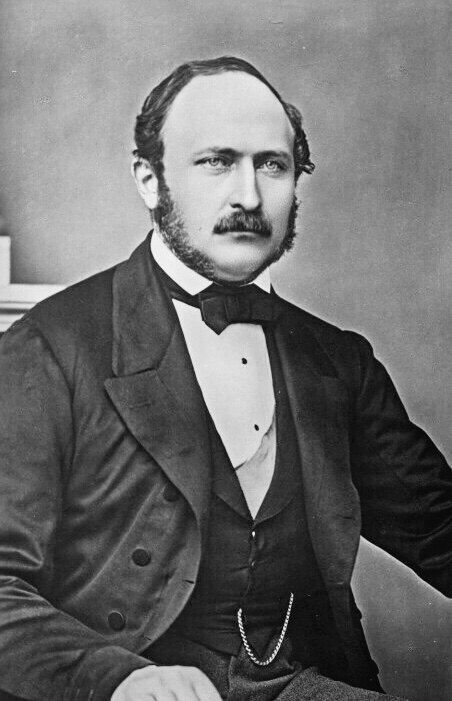
Paton and Walsh had a few patents together, but Walsh left the partnership in 1859 and the firm continued trading under the name of Edward Paton. At some point, Paton must have also impressed the Prince Consort, achieving the accolade of gunmaker to Albert, something he never failed to mention in his advertising.
Prince Albert, Consort to Queen Victoria, is known to have enjoyed his Westley Richards pin-fire game gun. Paton may have built a rifle for him.
To give an idea of the standing Paton had within the rarefied upper strata of shooting society, the Inverness Courier published an account in its 20 January 1859 issue of a week-long shooting party hosted by George Grey, the 7th Earl of Stamford, at Bradgate House, Leicestershire, who was shooting with Paton guns. While also listing the ten other participants, which included Sir Thomas Moncreiffe (7th Baronet of Moncreiffe), Gilbert Heathcote (Gilbert Henry Heathcote-Drummond-Willoughby, 1st Earl of Ancaster), and Captain Bateson (Thomas Bateson, 1st Baron Deramore), the article noted that “Mr Edward Paton, of Perth, who by his lordship’s special desire was present.” To be invited to such a prestigious event would have been significant, and I hope Paton got some new gun orders out of it! During the week, some 8,627 head of game were shot, involving rabbits, hares, pheasants, partridges, snipe, woodcock, and ducks, which were “as usual, distributed among the tenantry and poor on the estate.”
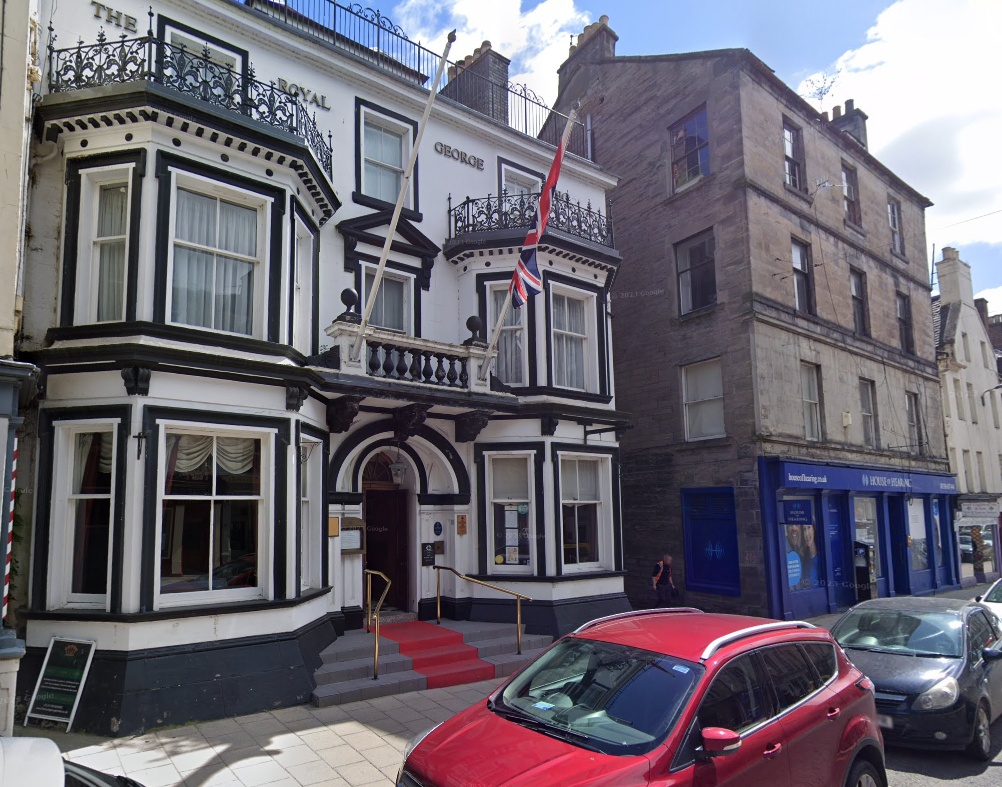
44 George Street, Perth (right, beside the hotel), gunmaking premises from 1833 to 1913 (Robert Ancell, Ansell & Salmond, Paton & Walsh, Paton, Paton & Son, David Crockart, James MacNaughton, and finally David Bissett Crockart) (Photo from Google)
In the 1861 census, Edward was recorded living with Edward Lonsdale and Emma. At the time, Edward employed 7 men and 2 boys, and the business had a good reputation for converting muzzle-loaders to the breech-loading system. In 1866, Paton opened additional premises adjacent to the Station Hotel by the Perth railway station, to facilitate selling supplies to those arriving by train for shooting on the moors, and sport fishing.
Pall Mall Gazette, 7 July 1866
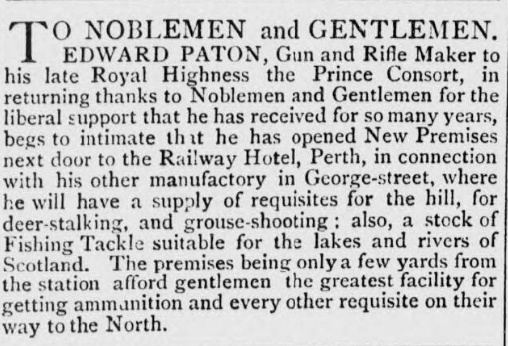
The Field, 3 August 1867
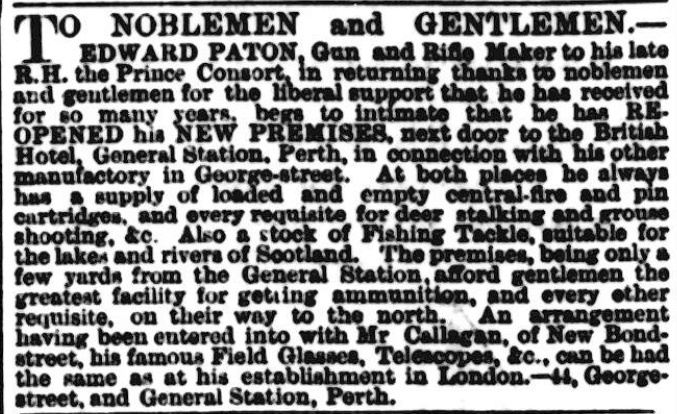
The Field, 18 April 1868
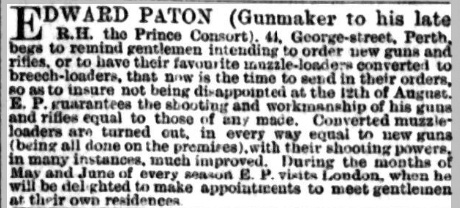
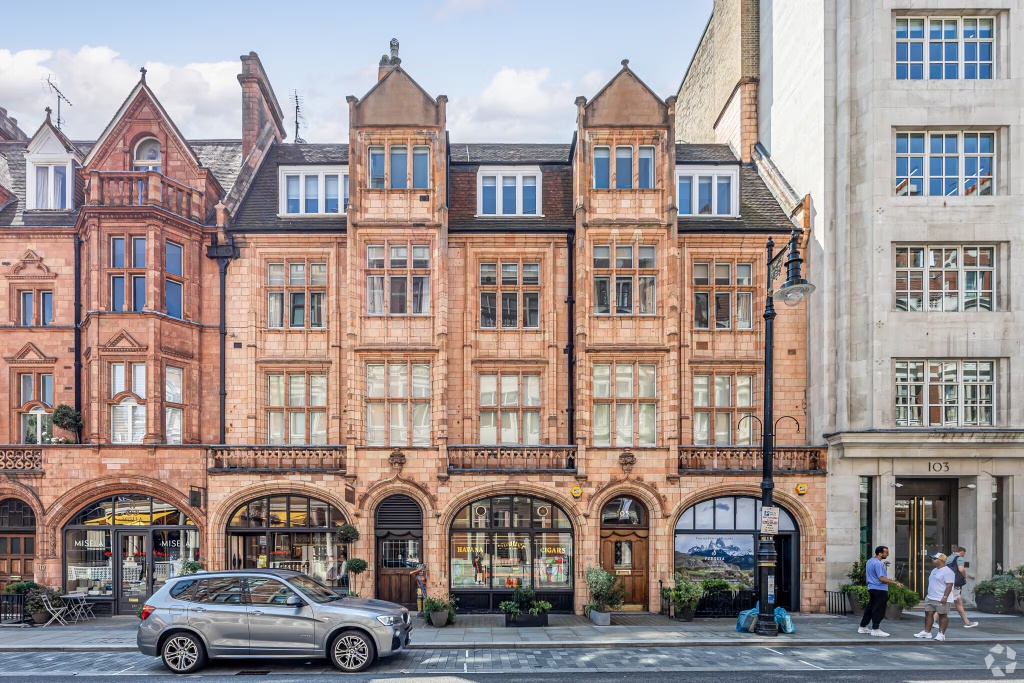
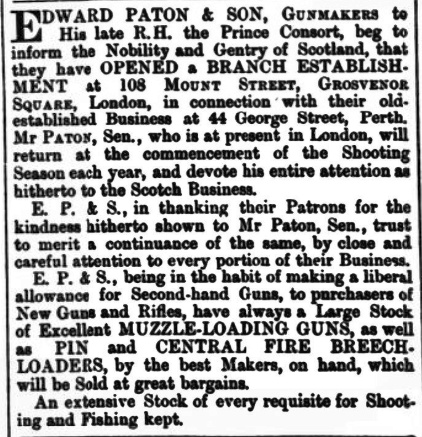
By 1870, the firm had been renamed Edward Paton & Son, when Edward Lonsdale Paton joined as a partner. Edward Lonsdale then ran the Perth business while Edward opened a branch in London, at 108 Mount Street, Grosvenor Square, close to other top London gunmakers (this is where Alexander Salmond may have shown up again). At this time Edward Paton also finished guns for Boss & Co., which says something about the quality of his work. In 1882, a branch was opened in Inverness, at 37 Church Street, and in about 1886 the Church Street branch moved to High Street, Inverness. Paton also acted as a shooting agency, offering leases on shooting grounds in Scotland. This work ended up being a large part of the business. In 1884, Paton's shooting agency and gun making business in London moved a few doors down to 99 Mount Street, and in 1885 it moved again to 88 St James's Street, to be at the epicentre of London’s top-end gunmaking community. In 1890, the gunmaker David Crockart of Perth bought Paton's business at 44 George Street, and from this point Edward Paton is listed as an estate agent. Edward Paton died on 20 August 1898. Edward Lonsdale Paton died in London in 1910.
108 Mont Street, London
The Field, 1 July 1871
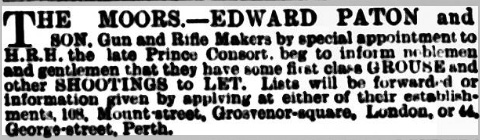
Perthshire Constitutional & Journal, 19 May 1870 (notice muzzle-loaders still offered for sale)
Next, the guns.
Every once in a while, I encounter a gun that is significant to the understanding I am trying to achieve, and is dripping with history and connections to places and people. Luck sends these guns my way, and each one involves lengthy sessions with a magnifying glass and books. Lots of books. And, because I’m not a Luddite, online records and databases, endless webpages, and the convenience that is e-mail. Sometimes research and web searches fall short of answering the many questions I start with. Even in the best of cases, where gunmakers’ record books have survived the march of time and can be accessed (usually for a fee), information may still be scant. Gunmakers were noting information useful to them in their business, not laying away information for a future me. For the guns that even have serial numbers, the numbers might have been useful in keeping loose parts together in a box on a workbench, or keeping track of payments to outworkers, and nothing more. Sometimes they can relate to production dates, but often not. No one was keeping track of these numbers but themselves, for reasons that were not always clear. When doing your own projects or crafts, do you serial number them?
I find it interesting that some of the best British gunmakers are so unrecognized today. Part of it is timing, as few guns made before 1900 remain in active use, so anyone ceasing to trade before the 20th century can be easily erased from our thoughts. For hand-made guns, it takes years to build up numbers, and a reputation is something built slowly. As businesses, some diversified into non-gun areas for promotion and profit. Several gunmakers, like William Wellington Greener and James Dalziel Dougall, leaned heavily into publishing books. William Rochester Pape launched the very first dog show. Some, because of their training and backgrounds, also manufactured sport fishing gear or other outdoor equipment. Some became gunmakers after finding success in other endeavours, such as Harris Holland, the tobacconist, and Benjamin Cogswell, the pawnbroker. Edward Paton branched out from gunmaking into leasing estates for shooting.
These next three posts will concern Edward Paton, and one of his guns that has just fallen into my lap. CGN limits the number of words and images I can fit in a post, so I have to divide it up. The natural split is a) Paton’s history, b) the gun, and c), the original owner. There’s a lot to cover, so Kamlooky, better have a big pot of coffee ready for this one. I’m on my third mug, and I’ve barely started.
Edward Paton was born in 1819 in Dublin, Ireland, into a military family. His father, also named Edward, was born in 1793 in Inverness, Scotland, in the Regimental Barracks of the 42nd (The Royal Highland) Regiment of Foot (The Black Watch). The family ties with the regiment were evidently strong, and young Edward became the armourer of the regiment. He married Emma Stroud in 1845. In 1847, the garrison was stationed in Malta, where his son, Edward Lonsdale Paton, was born. (Note: the island of Malta, located in the Mediterranean between Sicily and North Africa, was a British territory from 1814 until its independence in 1964; Malta joined the European Union in 2004.) Shortly after this, Edward and his family must have left the regiment and moved to London, where in 1849 they had a daughter, also named Emma. Sadly, his wife died not long afterwards. Edward remained in London for the next five years, possibly working as a journeyman gunmaker. In 1854, he went into partnership with Charles Frederick Walsh, and together they bought the gunmaking business of Ancell & Salmond at 44 George Street, Perth, Scotland. Meanwhile, the 42nd Highlanders were in the thick of battle in the Crimean War (1854-1855), and the Indian Mutiny (1857-1858).
Paton was armourer for these fine fellows.
Robert Ancell was born in 1786 in London. He was first recorded in business as a fishing tackle manufacturer in 1820 in St John Street, Perth, Scotland. By about 1830, he was also a gun maker, and by 1833, he had moved to 44 George Street, and described his business as a sports warehouse. In 1847, he formed a partnership with Alexander Salmond, who may have been apprenticed to Ancell. Ancell described himself as a master gunmaker employing 9 men, and was skilled enough to be appointed gunmaker to His Royal Highness Prince Albert, Victoria’s Consort, possibly in 1853 or 1854 (a muzzle-loading percussion lock sporting gun by Ancell & Salmond is in the Royal Collection). In 1854, at the age of 68, Robert Ancell retired and sold the business to Paton and Walsh. Alexander Salmond established his own business and later moved to London, where he may have worked for Paton. Paton and Walsh employed John Robinson Gow, who stayed with Paton until 1864, until he set up his own gunmaking business in Dundee.
Gow advertisement, Dundee Advertiser, 26 August 1864
Paton and Walsh had a few patents together, but Walsh left the partnership in 1859 and the firm continued trading under the name of Edward Paton. At some point, Paton must have also impressed the Prince Consort, achieving the accolade of gunmaker to Albert, something he never failed to mention in his advertising.
Prince Albert, Consort to Queen Victoria, is known to have enjoyed his Westley Richards pin-fire game gun. Paton may have built a rifle for him.
To give an idea of the standing Paton had within the rarefied upper strata of shooting society, the Inverness Courier published an account in its 20 January 1859 issue of a week-long shooting party hosted by George Grey, the 7th Earl of Stamford, at Bradgate House, Leicestershire, who was shooting with Paton guns. While also listing the ten other participants, which included Sir Thomas Moncreiffe (7th Baronet of Moncreiffe), Gilbert Heathcote (Gilbert Henry Heathcote-Drummond-Willoughby, 1st Earl of Ancaster), and Captain Bateson (Thomas Bateson, 1st Baron Deramore), the article noted that “Mr Edward Paton, of Perth, who by his lordship’s special desire was present.” To be invited to such a prestigious event would have been significant, and I hope Paton got some new gun orders out of it! During the week, some 8,627 head of game were shot, involving rabbits, hares, pheasants, partridges, snipe, woodcock, and ducks, which were “as usual, distributed among the tenantry and poor on the estate.”
44 George Street, Perth (right, beside the hotel), gunmaking premises from 1833 to 1913 (Robert Ancell, Ansell & Salmond, Paton & Walsh, Paton, Paton & Son, David Crockart, James MacNaughton, and finally David Bissett Crockart) (Photo from Google)
In the 1861 census, Edward was recorded living with Edward Lonsdale and Emma. At the time, Edward employed 7 men and 2 boys, and the business had a good reputation for converting muzzle-loaders to the breech-loading system. In 1866, Paton opened additional premises adjacent to the Station Hotel by the Perth railway station, to facilitate selling supplies to those arriving by train for shooting on the moors, and sport fishing.
Pall Mall Gazette, 7 July 1866
The Field, 3 August 1867
The Field, 18 April 1868
By 1870, the firm had been renamed Edward Paton & Son, when Edward Lonsdale Paton joined as a partner. Edward Lonsdale then ran the Perth business while Edward opened a branch in London, at 108 Mount Street, Grosvenor Square, close to other top London gunmakers (this is where Alexander Salmond may have shown up again). At this time Edward Paton also finished guns for Boss & Co., which says something about the quality of his work. In 1882, a branch was opened in Inverness, at 37 Church Street, and in about 1886 the Church Street branch moved to High Street, Inverness. Paton also acted as a shooting agency, offering leases on shooting grounds in Scotland. This work ended up being a large part of the business. In 1884, Paton's shooting agency and gun making business in London moved a few doors down to 99 Mount Street, and in 1885 it moved again to 88 St James's Street, to be at the epicentre of London’s top-end gunmaking community. In 1890, the gunmaker David Crockart of Perth bought Paton's business at 44 George Street, and from this point Edward Paton is listed as an estate agent. Edward Paton died on 20 August 1898. Edward Lonsdale Paton died in London in 1910.
108 Mont Street, London
The Field, 1 July 1871
Perthshire Constitutional & Journal, 19 May 1870 (notice muzzle-loaders still offered for sale)
Next, the guns.
Last edited:
Here is a Paton gun I’ve briefly shown before. It dates from around 1863, as best as I can tell. It is a 14-bore, number 2397. It has a tight double-bite screw-grip action, thin percussion fences, back-action locks marked “Edward Paton,” rounded dolphinfish-headed hammers, and interestingly, a perforated trigger guard bow and corresponding raised button on the underlever (no right-of-centre is possible with this arrangement). Like apparently all of Paton’s guns, the wide top rib is marked “Edward Paton. maker to His late RH the Prince Consort. Perth.” The 30” damascus barrels are also 14-bore, so no constriction on this one. The foliate scroll engraving is very similar in design and execution to the top London guns of the day. In fact, this gun is near identical to two Boss & Co pin-fires of the same time period. This is not so unusual, as the top makers bought their barrels, locks etc. from the same sources, and often employed the same outworkers. For slightly less money than the top London makers, you could have a gun of equal quality. This gun has seen hard use, and the bores are moderately pitted. Befitting a smaller gauge gun, it weighs 6lb 13oz.
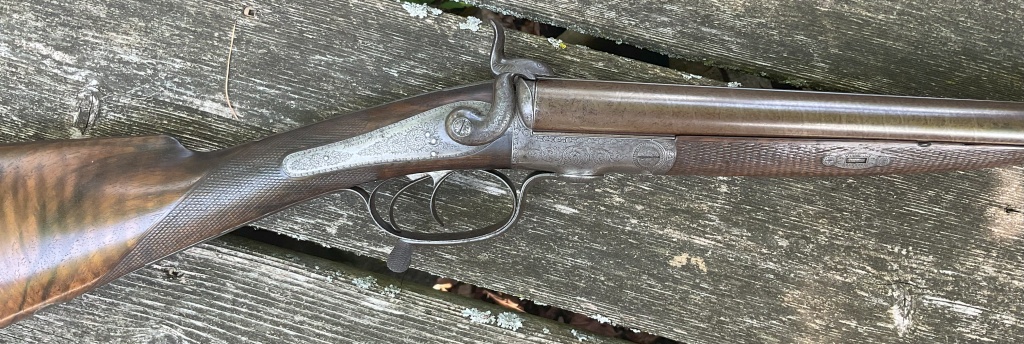
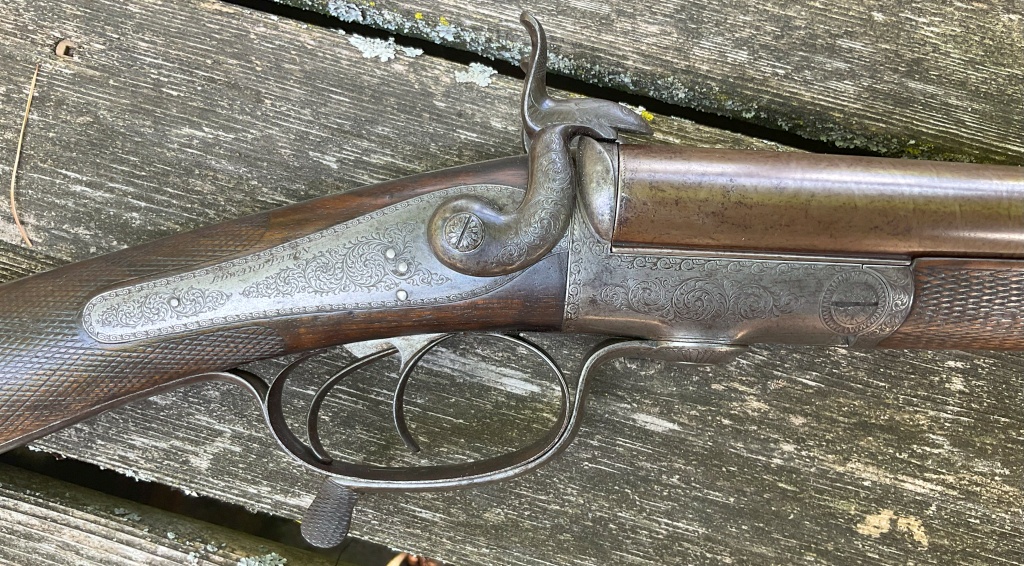
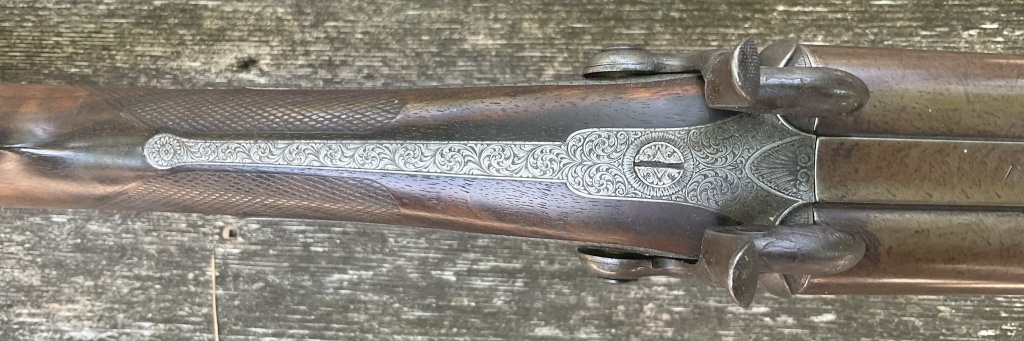
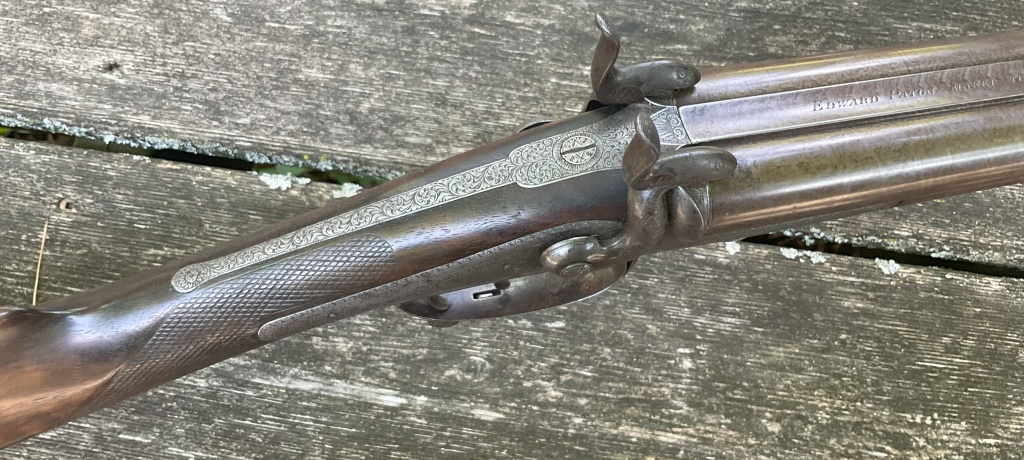
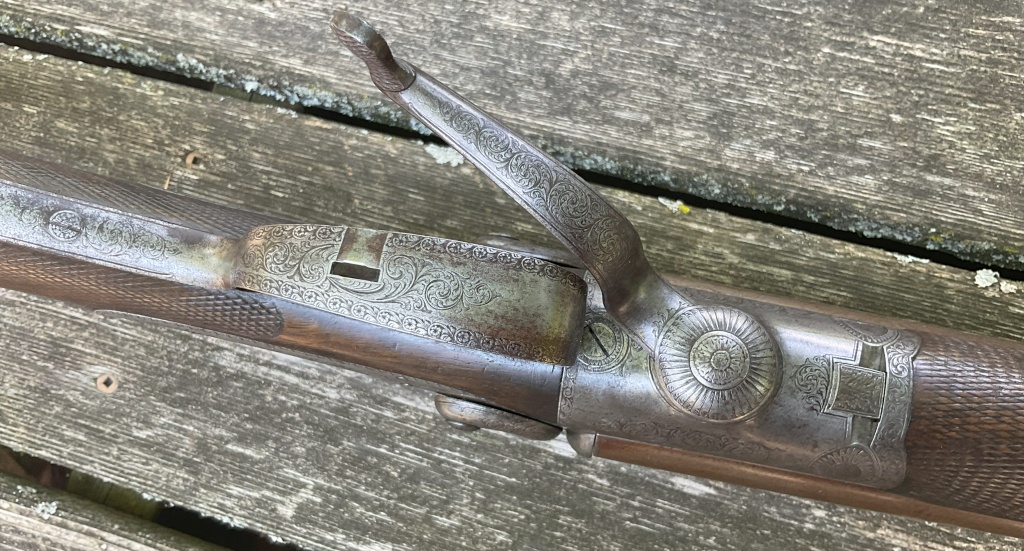
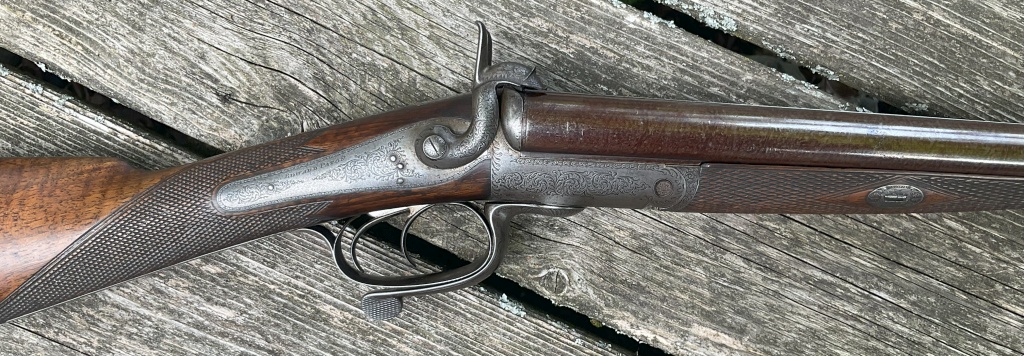
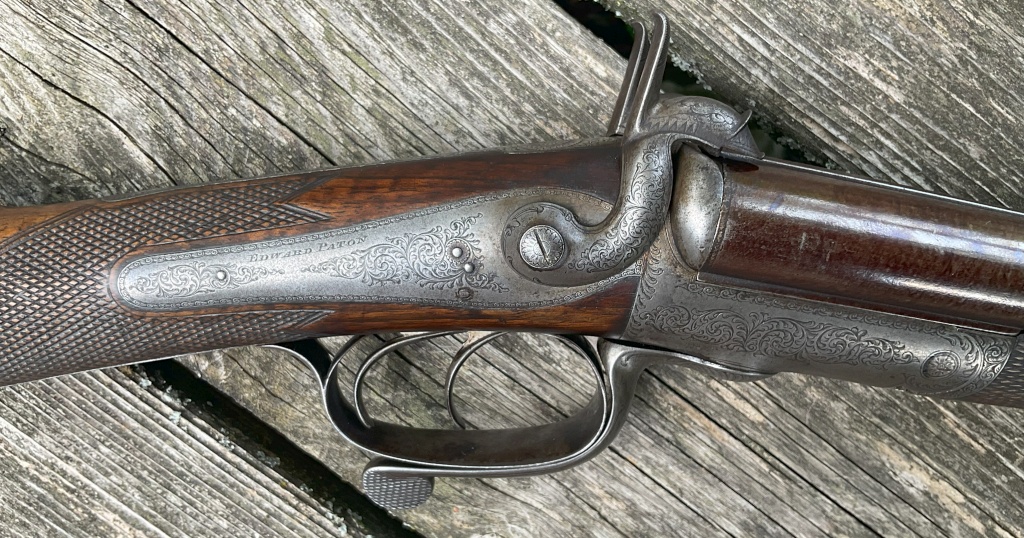
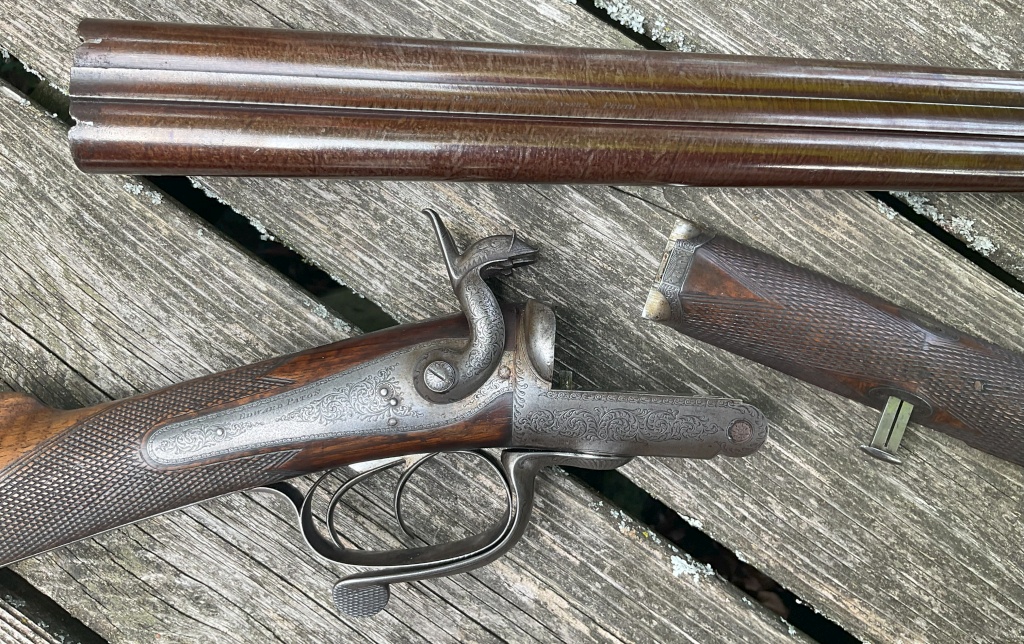
As luck would have it, I’ve only just now acquired a second, earlier, Edward Paton pin-fire, a 16-bore game gun which has likely passed through the hands of Paton, his son, and Mr Gow. Think of how often you’ve seen a pin-fire game gun for sale, and then how often a second example from the same maker turns up… This one is a 16-bore, serial number 2337, made around 1861. Internally, the 30” damascus barrels measure as 15 bore. It is of the early single-bite rearward under-lever with the assisted-opening stud, copied from the Parisian inventor Beatus Beringer. This design was popular with certain London makers starting in 1856, but mostly disappeared when the stronger double-bite design appeared on the scene. As with the later gun, the wide top rib is marked “Edward Paton. maker to His late RH the Prince Consort. Perth.” The underlever lacks the fitted projection into the trigger guard bow, but on this gun, the shape of the lever fills the interstice between the lever and the front of the trigger guard (another Beringer stylistic mark, seen on the earliest British pin-fires). Otherwise, the gun is very similar to the first gun pictured. Being 60 serial numbers apart, this suggests an output of some 20-30 arms a year, though this number would likely include rifles and pistols as well as game guns (if the numbers were sequential, always a risky assumption). Despite being an older gun, it has been well kept and has mirror bores, and it weighs a similar 6lb 13oz.
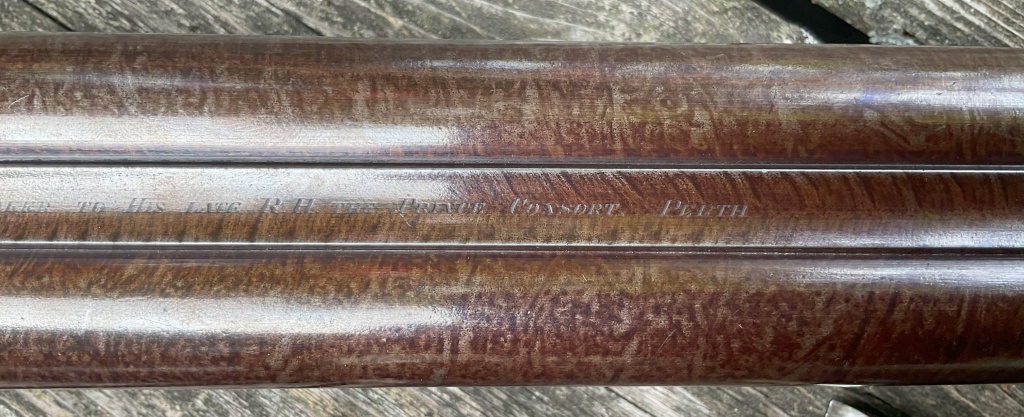
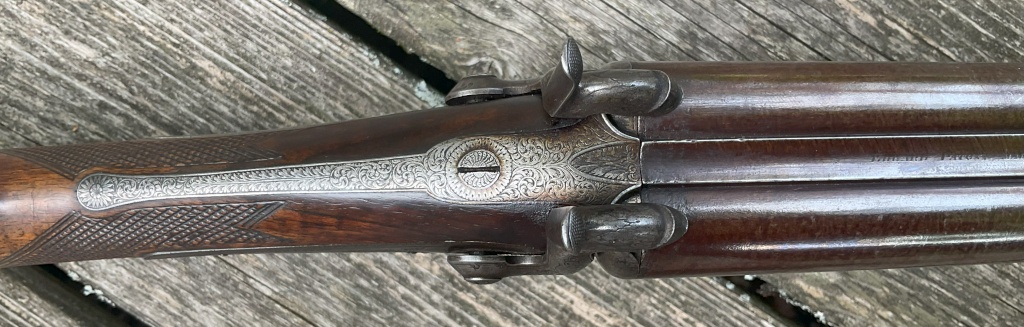
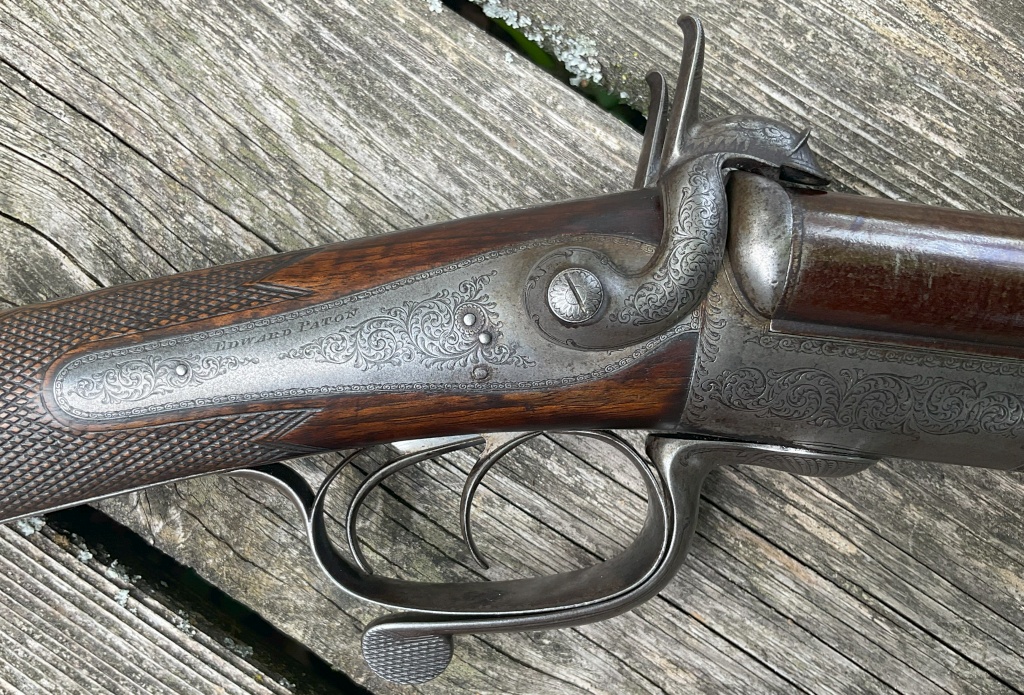
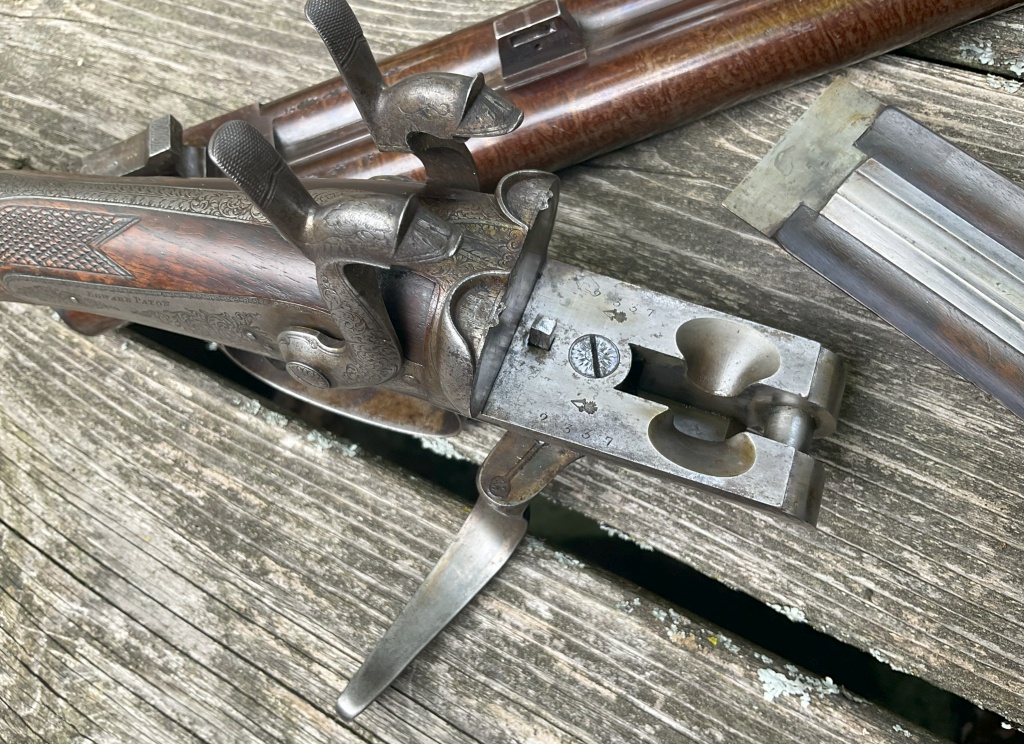
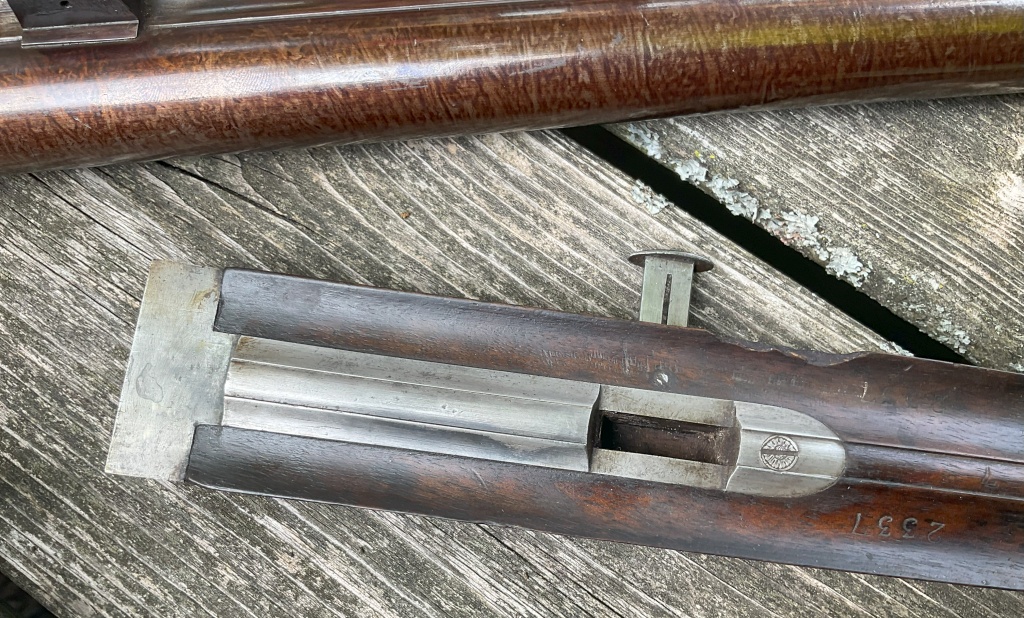
A sign of a ‘best’ gun, look at how the hidden part of the fore-end is shaped and grooved to fit against the under-rib, and even the pin is timed and engraved. The chipped wood edge is the typical result of a bodger (I'll keep using this term) who tried to remove the fore-end without understanding how the cross pin fastener works.
Next, the owner of this gun, and the gun’s life.
A sign of a ‘best’ gun, look at how the hidden part of the fore-end is shaped and grooved to fit against the under-rib, and even the pin is timed and engraved. The chipped wood edge is the typical result of a bodger (I'll keep using this term) who tried to remove the fore-end without understanding how the cross pin fastener works.
Next, the owner of this gun, and the gun’s life.
Part Three, the families.
It is not common to find guns engraved with the family crest, despite silver (and sometimes gold) stock escutcheons being present on many Victorian-era guns. If everyone from a noble background took the trouble, it would make it infinitely easier for arm-chair historians like myself!
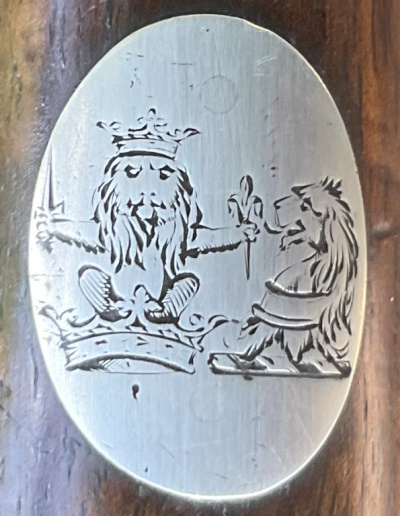
Edward Paton gun number 2337 has two crests which are, in heraldic terminology, as follows: 1) on a ducal coronet, a lion sejant affrontée, ducally crowned, holding in the dexter paw a dagger and in the sinister a fleur-de-lis (over a crown, a front-facing crowned lion holding a dagger in its left paw, and a fleur-de-lis in its right), and 2) a lion’s head erased and collared (a lion’s head with a ragged edge, wearing a collar). To someone researching family crests, these can be found in use amongst several noble families. However, there is only one result where these two crests are combined: these are the crests of Sir Alexander Charles Ramsay-Gibson-Maitland, 3rd Baronet of Clifton Hall, Midlothian (1820-1876), and his wife, Thomasina Agnes Hunt of Pittencrieff, Fife.
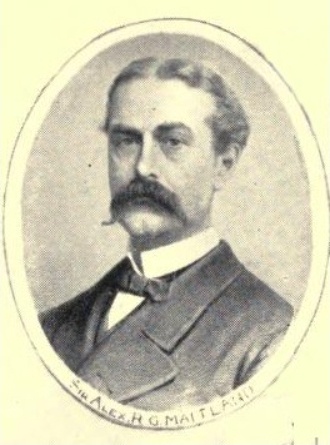
Sir Alexander Charles Ramsay-Gibson-Maitland, 3rd baronet (7 January 1820 – 16 May 1876) was a Scottish Liberal politician who sat in the House of Commons from 1868 to 1874. Alexander Ramsay-Gibson-Maitland was born Maitland-Gibson, the son of Alexander Maitland-Gibson of Clifton Hall (Cliftonhall), Midlothian. He was educated at Edinburgh Academy and at Weimer College and became a lieutenant in the 79th Highlanders. He married Thomasina Agnes Hunt, daughter of James Hunt of Pittencrieff, in 1841, and he succeeded his grandfather, the 2nd baronet, in the Maitland baronetcy of Clifton Hall in 1848, becoming Sir Alexander Gibson-Maitland, 3rd Baronet of Barnton, Sauchie and Bannockburn. In 1866, he assumed the surname of Ramsay before that of Gibson-Maitland, when he succeeded to the estates of Ramsay of Barnton. After leaving the army, the young baronet was enabled to follow his military bent by obtaining a captain’s commission in the Mid-Lothian Yeomanry Cavalry, and, subsequently, he became Colonel of the 90th Highland Borderers (Stirlingshire). Sir Alexander was also for many years connected with the Royal Company of Archers, Her Majesty's Body Guard for Scotland, in which he held the rank of Brigadier-General.
As a county gentleman, he was involved in the general business of Mid-Lothian and Stirlingshire, of both of which counties he was a Magistrate and Deputy Lieutenant. He was an office-bearer of the Highland and Agricultural Society, and was also Provincial Grand Master of the local Freemasonry, overseeing ten Lodges. Sir Alexander at one time acted as a Director of the Scottish Central Railway, and during the latter years of his life was an ordinary director of the Royal Bank of Scotland. At the general election in 1868, he came forward as a Liberal to contest the representation of Mid-Lothian against the Earl of Dalkeith and, after a keen contest, succeeded in securing the seat, which he held till 1874. Sir Ramsay-Gibson-Maitland died in 1876 at the age of 56, leaving two sons and three daughters, and is buried in the Grange Cemetery in Edinburgh. The three estates, Sauchie Estate, Barnton Estate, and Bannockburn Estate, comprised 10,228 acres, and brought in an annual income of £20,238.
About 14 years ago a gun appeared at auction, belonging to Sir Alex’s daughter-in-law, Fanny Lucy Fowke White, who married Sir James Ramsay-Gibson-Maitland, who later became the 4th Baronet. It is a Holland & Holland 20-bore single, dating to 1880. I suppose it would have sat in the gunroom alongside the Paton. The pictures are from the Danish auction house:
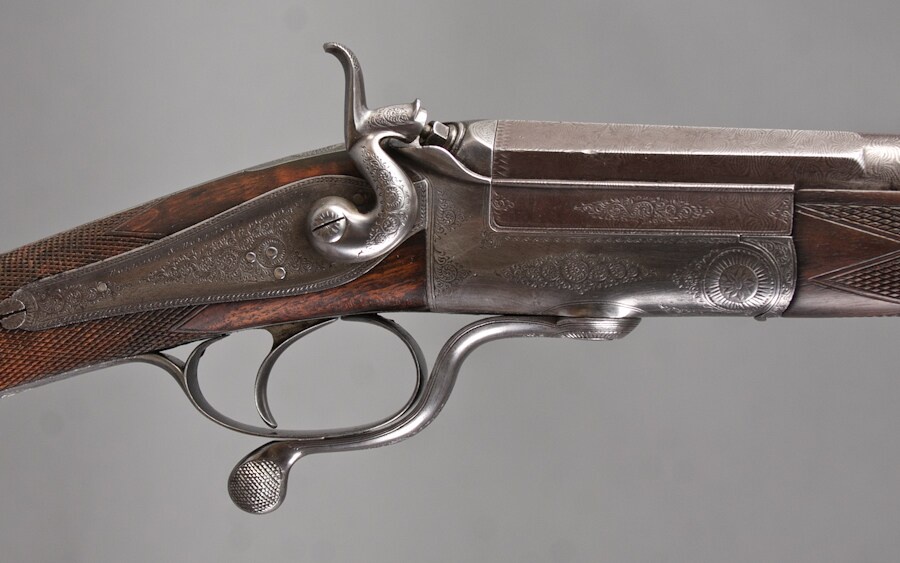
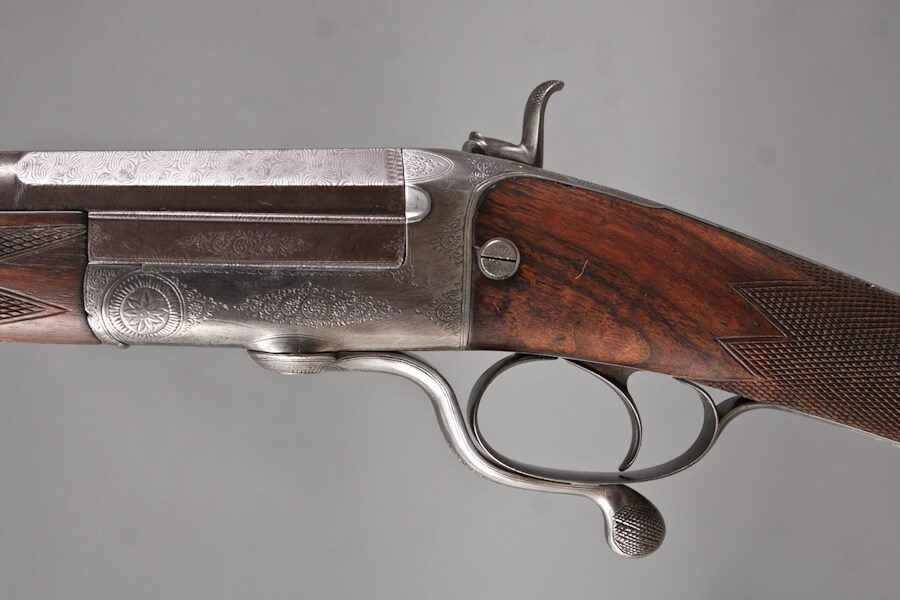
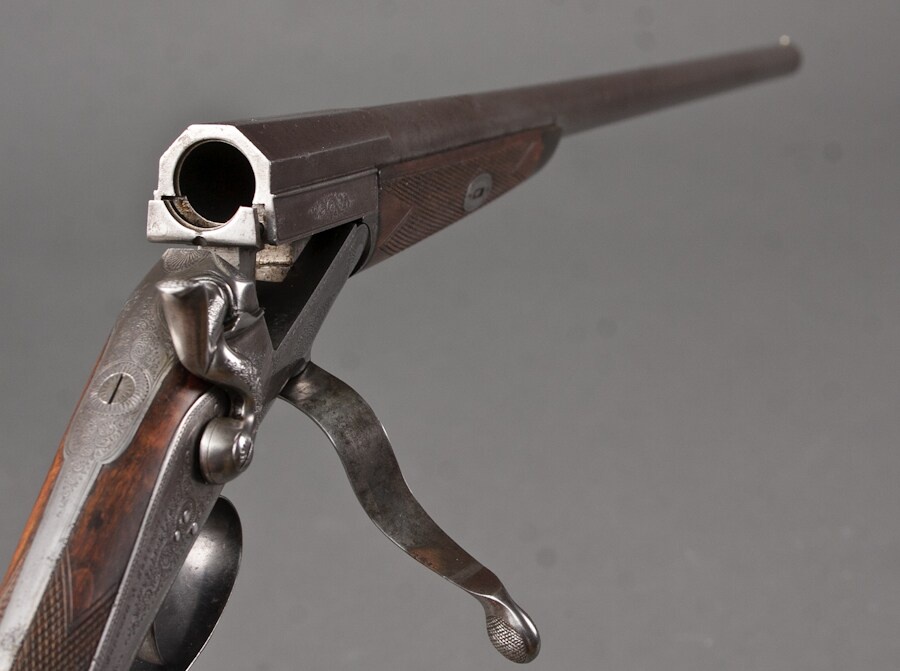
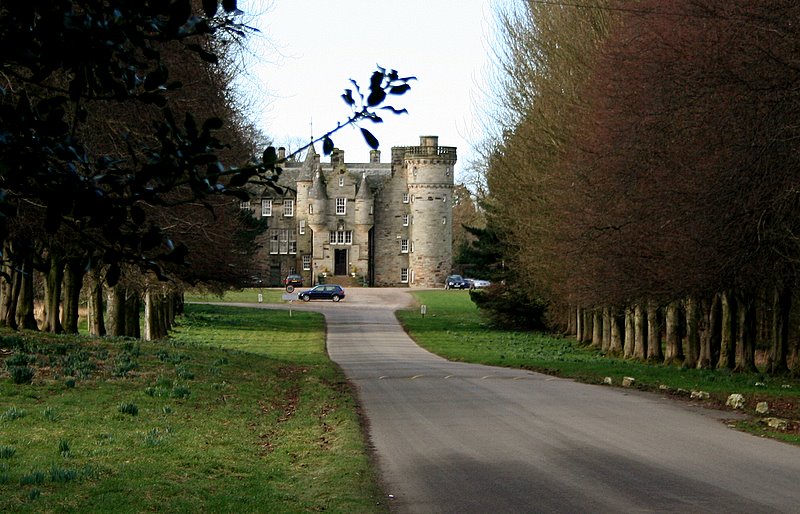
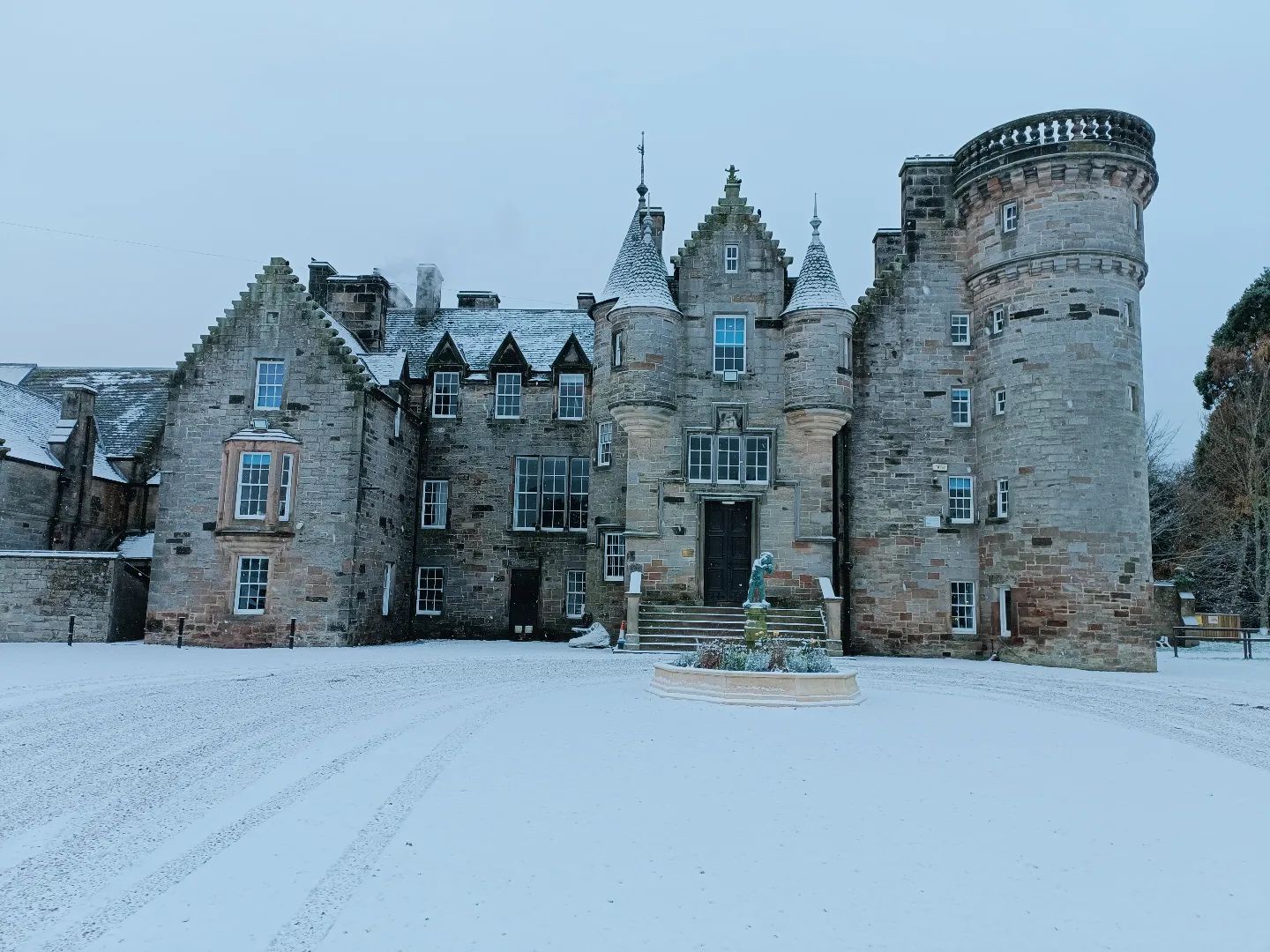
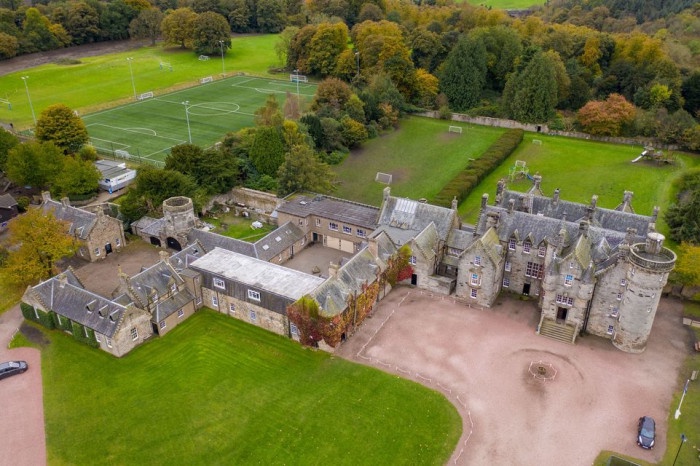
Clifton Hall (really a castle, and also known as Cliftonhall) was built around 1214 for the Graham family. The castle changed hands several times, and it was once the home and property of Euphame Macalzean, Scotland’s most celebrated witch, who was tried, convicted, and subsequently burned alive on 25 June 1691. After being the baronial seat for the Ramsay-Gibson-Maitland family, Clifton Hall was purchased by Robert Bell around 1880. Walter Dalrymple Maitland Bell (1880-1954), better known as ‘Karamojo’ Bell after the Karamoja sub-region in Uganda, was born at the Clifton Hall estate. He was a Scottish adventurer, big game hunter in East Africa, soldier, decorated fighter pilot, sailor, writer, and painter. Much of his fame was from being one of the most successful ivory hunters of his time, and from being an advocate of accurate shot placement with smaller calibre rifles, over the large-bore rifles used by his contemporaries. He perfected the technique of shooting elephants through the brain from a position diagonally behind the animal, which became known as the ‘Bell Shot.’ In 1896, at the age of 16, Bell hunted lions for the Uganda Railway using a single-shot rifle chambered in .303 British. Afterwards, Bell travelled to North America, where he panned for gold in the Yukon gold rush and earned a living by shooting game to supply Dawson City with meat. After a winter of shooting moose and bear with a .350 Farquharson single-shot and a .45 Colt, he joined the Canadian Mounted Rifles, seeing service during the Boer War. After the Boer War ended in 1902, Bell remained in Africa, and for 16 years, he hunted elephants for their ivory in Kenya, Uganda, Ethiopia, Sudan, the Lado Enclave, French Ivory Coast, Liberia, French Congo, and the Belgian Congo. Bell shot 1,011 elephants during his career. He started with a sporting .303 Lee Enfield rifle, later preferring the .275 (7x57) Rigby-Mauser rifle (around 800 of his elephant kills were made with this rifle). He also used a Mannlicher–Schoenauer 6.5×54mm carbine by George Gibbs, and Mauser rifles chambered in .318 Westley Richards. While all of this has nothing to do with Paton shotguns, I would wager that Robert Bell had spent time in the Clifton Hall gunroom from a very early age, where Paton gun no. 2337 sat patiently.
Clifton Hall, or Cliftonhall (nowadays a private school):
Alright, I'm done for now. I stopped counting the coffees. Will anyone write about Turkish gunmaking companies in the same way in the distant future? I'm guessing not, but I've been wrong in my predictions before.
It is not common to find guns engraved with the family crest, despite silver (and sometimes gold) stock escutcheons being present on many Victorian-era guns. If everyone from a noble background took the trouble, it would make it infinitely easier for arm-chair historians like myself!
Edward Paton gun number 2337 has two crests which are, in heraldic terminology, as follows: 1) on a ducal coronet, a lion sejant affrontée, ducally crowned, holding in the dexter paw a dagger and in the sinister a fleur-de-lis (over a crown, a front-facing crowned lion holding a dagger in its left paw, and a fleur-de-lis in its right), and 2) a lion’s head erased and collared (a lion’s head with a ragged edge, wearing a collar). To someone researching family crests, these can be found in use amongst several noble families. However, there is only one result where these two crests are combined: these are the crests of Sir Alexander Charles Ramsay-Gibson-Maitland, 3rd Baronet of Clifton Hall, Midlothian (1820-1876), and his wife, Thomasina Agnes Hunt of Pittencrieff, Fife.
Sir Alexander Charles Ramsay-Gibson-Maitland, 3rd baronet (7 January 1820 – 16 May 1876) was a Scottish Liberal politician who sat in the House of Commons from 1868 to 1874. Alexander Ramsay-Gibson-Maitland was born Maitland-Gibson, the son of Alexander Maitland-Gibson of Clifton Hall (Cliftonhall), Midlothian. He was educated at Edinburgh Academy and at Weimer College and became a lieutenant in the 79th Highlanders. He married Thomasina Agnes Hunt, daughter of James Hunt of Pittencrieff, in 1841, and he succeeded his grandfather, the 2nd baronet, in the Maitland baronetcy of Clifton Hall in 1848, becoming Sir Alexander Gibson-Maitland, 3rd Baronet of Barnton, Sauchie and Bannockburn. In 1866, he assumed the surname of Ramsay before that of Gibson-Maitland, when he succeeded to the estates of Ramsay of Barnton. After leaving the army, the young baronet was enabled to follow his military bent by obtaining a captain’s commission in the Mid-Lothian Yeomanry Cavalry, and, subsequently, he became Colonel of the 90th Highland Borderers (Stirlingshire). Sir Alexander was also for many years connected with the Royal Company of Archers, Her Majesty's Body Guard for Scotland, in which he held the rank of Brigadier-General.
As a county gentleman, he was involved in the general business of Mid-Lothian and Stirlingshire, of both of which counties he was a Magistrate and Deputy Lieutenant. He was an office-bearer of the Highland and Agricultural Society, and was also Provincial Grand Master of the local Freemasonry, overseeing ten Lodges. Sir Alexander at one time acted as a Director of the Scottish Central Railway, and during the latter years of his life was an ordinary director of the Royal Bank of Scotland. At the general election in 1868, he came forward as a Liberal to contest the representation of Mid-Lothian against the Earl of Dalkeith and, after a keen contest, succeeded in securing the seat, which he held till 1874. Sir Ramsay-Gibson-Maitland died in 1876 at the age of 56, leaving two sons and three daughters, and is buried in the Grange Cemetery in Edinburgh. The three estates, Sauchie Estate, Barnton Estate, and Bannockburn Estate, comprised 10,228 acres, and brought in an annual income of £20,238.
About 14 years ago a gun appeared at auction, belonging to Sir Alex’s daughter-in-law, Fanny Lucy Fowke White, who married Sir James Ramsay-Gibson-Maitland, who later became the 4th Baronet. It is a Holland & Holland 20-bore single, dating to 1880. I suppose it would have sat in the gunroom alongside the Paton. The pictures are from the Danish auction house:
Clifton Hall (really a castle, and also known as Cliftonhall) was built around 1214 for the Graham family. The castle changed hands several times, and it was once the home and property of Euphame Macalzean, Scotland’s most celebrated witch, who was tried, convicted, and subsequently burned alive on 25 June 1691. After being the baronial seat for the Ramsay-Gibson-Maitland family, Clifton Hall was purchased by Robert Bell around 1880. Walter Dalrymple Maitland Bell (1880-1954), better known as ‘Karamojo’ Bell after the Karamoja sub-region in Uganda, was born at the Clifton Hall estate. He was a Scottish adventurer, big game hunter in East Africa, soldier, decorated fighter pilot, sailor, writer, and painter. Much of his fame was from being one of the most successful ivory hunters of his time, and from being an advocate of accurate shot placement with smaller calibre rifles, over the large-bore rifles used by his contemporaries. He perfected the technique of shooting elephants through the brain from a position diagonally behind the animal, which became known as the ‘Bell Shot.’ In 1896, at the age of 16, Bell hunted lions for the Uganda Railway using a single-shot rifle chambered in .303 British. Afterwards, Bell travelled to North America, where he panned for gold in the Yukon gold rush and earned a living by shooting game to supply Dawson City with meat. After a winter of shooting moose and bear with a .350 Farquharson single-shot and a .45 Colt, he joined the Canadian Mounted Rifles, seeing service during the Boer War. After the Boer War ended in 1902, Bell remained in Africa, and for 16 years, he hunted elephants for their ivory in Kenya, Uganda, Ethiopia, Sudan, the Lado Enclave, French Ivory Coast, Liberia, French Congo, and the Belgian Congo. Bell shot 1,011 elephants during his career. He started with a sporting .303 Lee Enfield rifle, later preferring the .275 (7x57) Rigby-Mauser rifle (around 800 of his elephant kills were made with this rifle). He also used a Mannlicher–Schoenauer 6.5×54mm carbine by George Gibbs, and Mauser rifles chambered in .318 Westley Richards. While all of this has nothing to do with Paton shotguns, I would wager that Robert Bell had spent time in the Clifton Hall gunroom from a very early age, where Paton gun no. 2337 sat patiently.
Clifton Hall, or Cliftonhall (nowadays a private school):
Alright, I'm done for now. I stopped counting the coffees. Will anyone write about Turkish gunmaking companies in the same way in the distant future? I'm guessing not, but I've been wrong in my predictions before.
Licensed to kill
CGN Regular
- Location
- Peace Country Alberta
It’s been my contention that as the bore diameter decreases, the amount of choke needs to increase. This conclusion, right or wrong is based on the fact that pattern size does not change for a given choke regardless of bore diameter (in my experience) so the smaller bores need more choke to increase the pattern density near the center where bigger bores already have a more dense pattern centre due to the increased shot volume. Probably didn’t explain that very well but that is how I see it.So instead we would blather on over our scotches about the ideal choke combinations for any given gauge, barrel length, quarry and terrain. Endless fun with no definitive end result.
It’s been my contention that as the bore diameter decreases, the amount of choke needs to increase. This conclusion, right or wrong is based on the fact that pattern size does not change for a given choke regardless of bore diameter (in my experience) so the smaller bores need more choke to increase the pattern density near the center where bigger bores already have a more dense pattern centre due to the increased shot volume. Probably didn’t explain that very well but that is how I see it.
All that’s missing is a couple fingers of scotch and a dissenting opinion! The makings of a fine post-hunt evening in a nutshell!

Licensed to kill
CGN Regular
- Location
- Peace Country Alberta
Would be interested in hearing (reading) dissenting opinions. If my “logic” is flawed I would like to know. While being called out in public for being wrong is rather “uncomfortable”, I would rather be “uncomfortable” for a day or so and be right for my remaining years than avoid the temporary discomfort and remain wrong for the remainder of my existence. Anyone disagrees with my contention, bring it on, if I’m wrong I need to know. PS, anyone wishing for a mature discussion please chime in, for those that just want to argue and act like an arrogant douche nozzle, save it, not interested in adolescent BS.All that’s missing is a couple fingers of scotch and a dissenting opinion! The makings of a fine post-hunt evening in a nutshell!
Would be interested in hearing (reading) dissenting opinions. If my “logic” is flawed I would like to know. While being called out in public for being wrong is rather “uncomfortable”, I would rather be “uncomfortable” for a day or so and be right for my remaining years than avoid the temporary discomfort and remain wrong for the remainder of my existence. Anyone disagrees with my contention, bring it on, if I’m wrong I need to know. PS, anyone wishing for a mature discussion please chime in, for those that just want to argue and act like an arrogant douche nozzle, save it, not interested in adolescent BS.
Just a suggestion.
Perhaps starting a new thread, including your original thesis from a few posts back, might be a more appropriate spot for that discussion. Then people know the subject is chokes rather than fine vintage doubles and I’d think you’d get a better discussion. While the two subjects do overlap when you do a Venn diagram, it’s a pretty small overlap.
The advantage of a separate thread is that persons with no interest in British guns or my interminable history rants can participate. On the other hand, the development of choke has been of keen interest to gunmakers and shooting enthusiasts since whenever, and can certainly reside here.
I consider choke a percentage game, playing with the number of pellets in the outer region of the pattern. The pellets that are at the centre of the pattern, well, they’re just going where the barrel is pointed, regardless of gauge. Choke fiddles with the pellets at the edge, either letting them go on their merry way, or nudging them to follow a path closer to the main group. My “logic” is that I concentrate on getting the main group to where it should be, and not bother with the fringes — hence my not worrying about choke, rightly or wrongly.
Reducing the gauge reduces the number of pellets. Or, if the same charge is used, like a 11/4oz in a 12 or a 16 or a 20, then as the size constricts, the charge is longer in the cartridge, and there will be more ‘outer’ pellets to engage with the choke, therefore yes, if you lengthen the load, then choke becomes more important/needed, as there will be more pellets rubbing against the barrel which will need to be directed towards the main line of flight. Maybe. Shorten the charge, to what is often called a ‘square load’, and there will be fewer ‘outer’ pellets, if that makes sense. Choke might have less of an impact in such cases? It might help explain why the 16 gauge one-ounce load is considered perfect by many. I prefer 7/8oz in a 12, which again does not make for lots of ‘outer’ pellets, by proportion.
Gun manufacturers have probably done extensive research, but the results might conflict with the money-making side of the choke tube business, and they might not want to tell us. Who really knows? As Canvasback says, a few fingers of scotch might help here. Recently Beretta has been championing full-length chokes, with constrictions spread out over the whole length of the barrel. I winder if the Victorians got there first, by having bores one size smaller than the cartridge size…
In any case, if by reducing the gauge you reduce the number of pellets, then you can’t afford to ‘waste’ pellets, and percentage-wise, choke will help. In Victorian gunmaking, 12 predominated, but 14 and 16 were very popular. Even when choke became available, often one barrel was left cylinder, and the other only slightly choked 1/4 or half). They really didn’t go for smaller gauges, though small gauges were found on the Continent, where they often shot smaller targets, like songbirds. I don’t know much about the origins of the 20 and 28, or the .410 for that matter. I’ll save those rabbit holes for another day.
I consider choke a percentage game, playing with the number of pellets in the outer region of the pattern. The pellets that are at the centre of the pattern, well, they’re just going where the barrel is pointed, regardless of gauge. Choke fiddles with the pellets at the edge, either letting them go on their merry way, or nudging them to follow a path closer to the main group. My “logic” is that I concentrate on getting the main group to where it should be, and not bother with the fringes — hence my not worrying about choke, rightly or wrongly.
Reducing the gauge reduces the number of pellets. Or, if the same charge is used, like a 11/4oz in a 12 or a 16 or a 20, then as the size constricts, the charge is longer in the cartridge, and there will be more ‘outer’ pellets to engage with the choke, therefore yes, if you lengthen the load, then choke becomes more important/needed, as there will be more pellets rubbing against the barrel which will need to be directed towards the main line of flight. Maybe. Shorten the charge, to what is often called a ‘square load’, and there will be fewer ‘outer’ pellets, if that makes sense. Choke might have less of an impact in such cases? It might help explain why the 16 gauge one-ounce load is considered perfect by many. I prefer 7/8oz in a 12, which again does not make for lots of ‘outer’ pellets, by proportion.
Gun manufacturers have probably done extensive research, but the results might conflict with the money-making side of the choke tube business, and they might not want to tell us. Who really knows? As Canvasback says, a few fingers of scotch might help here. Recently Beretta has been championing full-length chokes, with constrictions spread out over the whole length of the barrel. I winder if the Victorians got there first, by having bores one size smaller than the cartridge size…
In any case, if by reducing the gauge you reduce the number of pellets, then you can’t afford to ‘waste’ pellets, and percentage-wise, choke will help. In Victorian gunmaking, 12 predominated, but 14 and 16 were very popular. Even when choke became available, often one barrel was left cylinder, and the other only slightly choked 1/4 or half). They really didn’t go for smaller gauges, though small gauges were found on the Continent, where they often shot smaller targets, like songbirds. I don’t know much about the origins of the 20 and 28, or the .410 for that matter. I’ll save those rabbit holes for another day.
I admit I'm greatly behind in the readings. 3 week kayaking trip and the getting back to live and catching up on all I missed has kept me from my phone
If allowed I do have a question of modern times that I've been curious of. The bore diameter of a 12ga. We all know it varies. I'd like to see a test where a bore of say .719 is compared to a .724 and .730 and .738 and .740. See if recoil is enhanced or slowed but most importantly the patterns of said bores. I have guns with bores across the board but the guns themselves vary so greatly as to render a comparison useless.
Also Fibre wads vs plastic cups. I've had various guns pattern one better than the other and vise versa.
I realize I'm a few weeks late to post the question of a modern field trial but these topics have been on my mind as I'm looking more into using vintage guns for migratory bird hunting
If allowed I do have a question of modern times that I've been curious of. The bore diameter of a 12ga. We all know it varies. I'd like to see a test where a bore of say .719 is compared to a .724 and .730 and .738 and .740. See if recoil is enhanced or slowed but most importantly the patterns of said bores. I have guns with bores across the board but the guns themselves vary so greatly as to render a comparison useless.
Also Fibre wads vs plastic cups. I've had various guns pattern one better than the other and vise versa.
I realize I'm a few weeks late to post the question of a modern field trial but these topics have been on my mind as I'm looking more into using vintage guns for migratory bird hunting
Bry, make sure you get a heavy enough gun if you are thinking of vintage SxS for waterfowl. My 7 1/2 pound guns (Fox and Lindner Daly) are not nearly heavy enough. Okay for one morning a year in the marsh but not as a regular go-to. The guns I see people happiest with. SuperFoxes, big Parkers, big Ithacas, are all over 10 and knocking on 11 lbs.
If you are aiming for English, look for the big wildfowling guns or pigeon guns.
If you are aiming for English, look for the big wildfowling guns or pigeon guns.
I'm looking at loading bismuth or nice shot 7/8oz loads for dove and puddle jumping in the woods. Not heavy or hot loads or much shooting. More carrying then firing. My main waterfowling guns are a 10ga sxs and my beretta autos





















