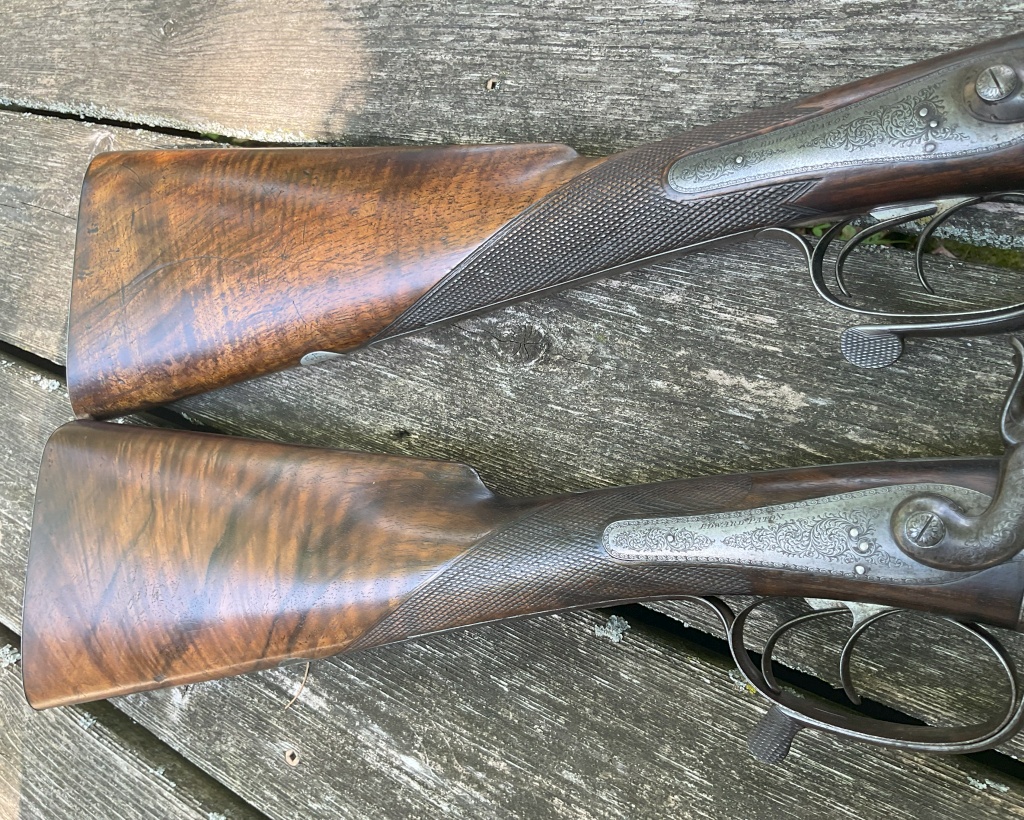
The allure of the British gun

LTK, first off, dating Reilly guns has been made much easier by the research of Gene Williams. Here is a link that will help:

Dating your Reilly

As to the position of hammers, there was a bit of an evolution in hammer placement. It might have been due to frustrations with the early central-fire cartridges, due to light primer strikes (it seems many thought pin-fire cartridges were more reliable!). Earlier guns have strikers (firing pins) very much in line with the barrels/chamber, in as straight a line as possible. This means that for the noses of the hammers to be in line with the strikers, they have to be 'inward' when seen from the back, resulting in hammers appearing close together. Either as a result of thicker fences, better cartridges, or something else, makers could slant the strikers through the fences, meaning the hammer noses could be wider apart. I suspect the lowering of the hammer pivot point in later hammerguns, which allowed hammers, when c_o_c_k_e_d, to disappear altogether from the sighting plane (and not look like looking through rugby goalposts), probably also had something to do with changes in hammer shapes and profiles.

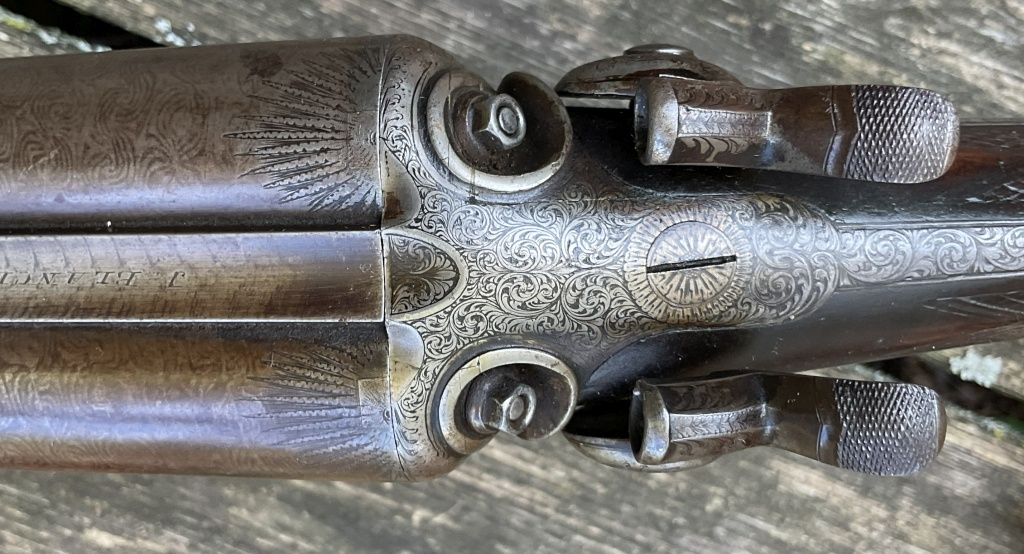
Here is a Blanch conversion from pin-fire (original gun dated 1862), showing the hammer noses in line with the strikers; from behind, the hammers seem close together:
9gmo4TX.jpg


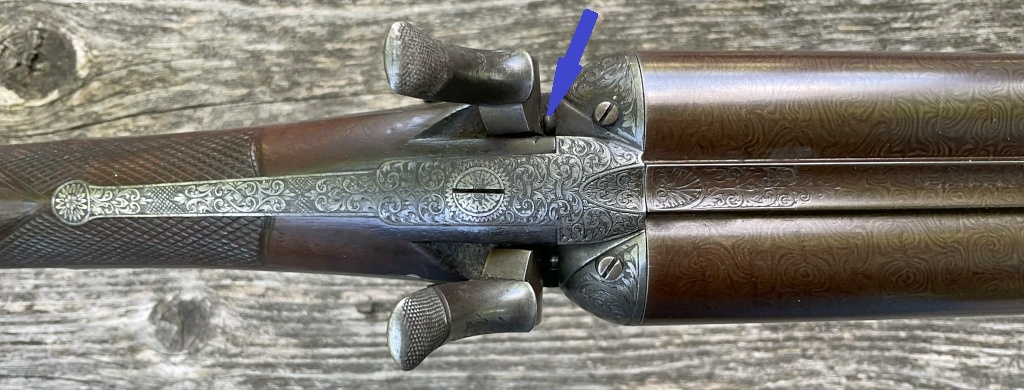
Here is an 1858-dated central-fire, from Charles Lancaster. In this design, the noses are hidden inwards, in line with the strikers (blue arrow), so the hammers seem farther apart.
wprd0B3.jpg


I think I've scoured every British book, treatise and pamphlet on shooting hammer guns, and poured over endless newspaper discussions. Not once has there been any description of 'sweeping back hammers' with one hand. I think that is cowboy fiction, probably invented in Hollywood, or by someone imagining it looks cool. I can almost assure you that no one in Britain ever did so, or contemplated doing so. The delight in hammerguns is hearing the locks 'speak.' First one hammer, then the other. Victorians judged the quality of locks by that wonderful noise. Sweeping hammers with the hand means taking your hand from the gun, which is contrary to preparedness and aiming, and pulling the hammer back with the thumb while watching the game is far more secure and certain.

I was actually referring to cocking both hammers at the same time. I said “sweep with the hand “, but thinking the thumb. The reason I was considering that is on another forum the question came up about hunting upland with a hammer gun, doctoral around with hammers cocked or #### them when needed, then the question came up about cocking both in the same motion if a covey took flight. In such a scenario, where someone is hunting with hammers at rest and us going un #### them when needed, closer hammers may accommodate that better.
 
I was actually referring to cocking both hammers at the same time. I said “sweep with the hand “, but thinking the thumb. The reason I was considering that is on another forum the question came up about hunting upland with a hammer gun, doctoral around with hammers cocked or #### them when needed, then the question came up about cocking both in the same motion if a covey took flight. In such a scenario, where someone is hunting with hammers at rest and us going un #### them when needed, closer hammers may accommodate that better.
Ah, got it, thanks.
 
So Stephen, I have a couple EM Reilly 16ga hammer guns. One is earlier I suspect as it utilizes a wedge to hold the forend and is a side lever, the other, a top lever, both back action. Question, the earlier one has the hammers quite close together, much like my Henry double .500BPE. Is there a reason to put the hammers so close together ( compared to most others) ?. Is it to reduce the angle of the firing pins, or perhaps close together to make it easier to sweep both hammers with one motion……or just a style choice ?


Of all my open hammer guns I own, the only one I have ever been able to #### rhe hammers on with one thumb is my Westely Richards, but the geometry is such that they
Are also very precise.
Cat
 
PURDEY HAMMER EJECTOR AT AUCTION
Just spotted this gem at an upcoming US auction. Hammer ejectors are very scarce particularly when it was made by Purdey. They reportedly made about 50---I recall seeing one other at auction a few years ago. This one was made in 1905 and has the coveted "island lock". It has been rebarrelled (not by Purdey), is nitro proved and has the maker's original oak and leather case.
The Auctioneer has a number of other Purdey's for sale including percussion guns right up to modern guns.
https://bid.poulinauctions.com/JAMES-PURDEY-NO-11750-AN-ISLAND-LOCK-TOP-LEVER_i61198635
 
There’s a reason so few were made. Ejectors on a hammer gun? 🤮
YUP---ejectors on a hammer gun. Ejectors weren't too common on any gun back in the early 1900's. And, hammer guns were being replaced by hammerless ones. Fast forward to the present day and a hammer ejector is in high demand and low in supply. A great recipe for a highly collectible gun and when its made by Purdey its even more desirable.
 
Another good TGS video. Not all are British guns, but there are a few that are definitely worth the watch.

Inside the Room of Doomed Guns

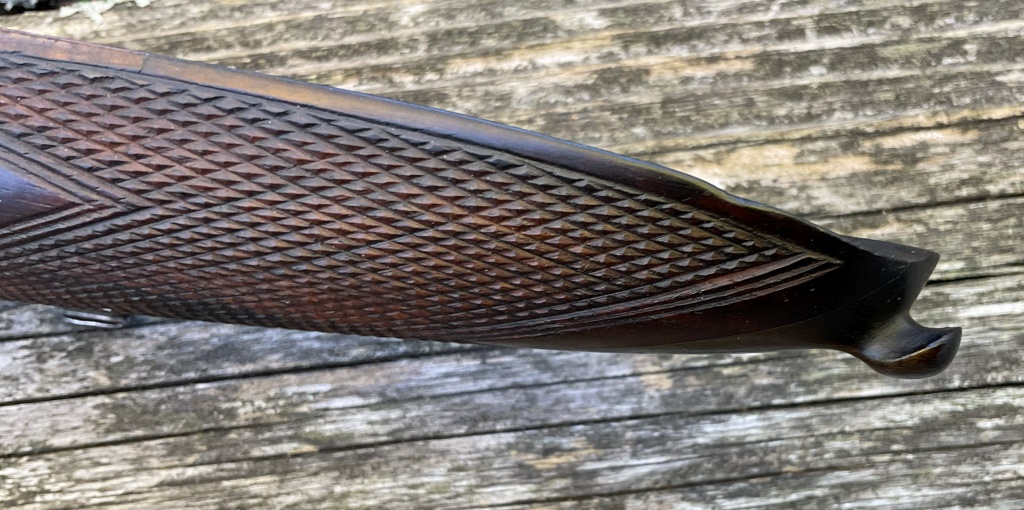
Several great makers are covered in the video. There is a Rigby hammer gun, with Rigby's odd horn fore-end tip flourish, like this one:
A3Ry3DJ.jpg


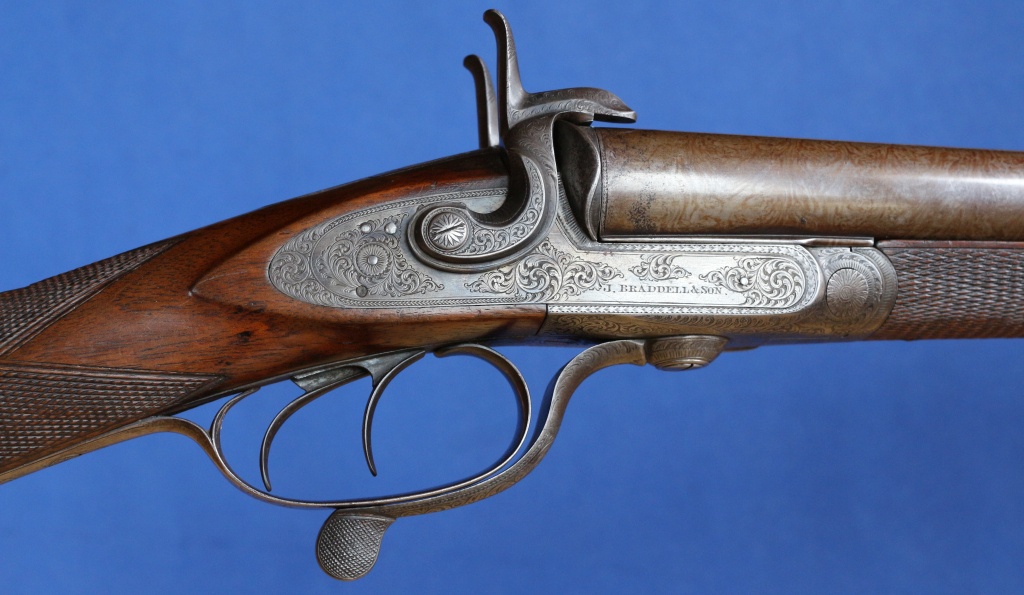
And two of my favourite makers, Joseph Braddell,
uZj58Y7.jpg


...and Edward Paton:
1yRkofQ.jpg


Jonny observes that many of the guns in that gunroom are destined for export, which is probably good news for us.
 
Back
Top Bottom