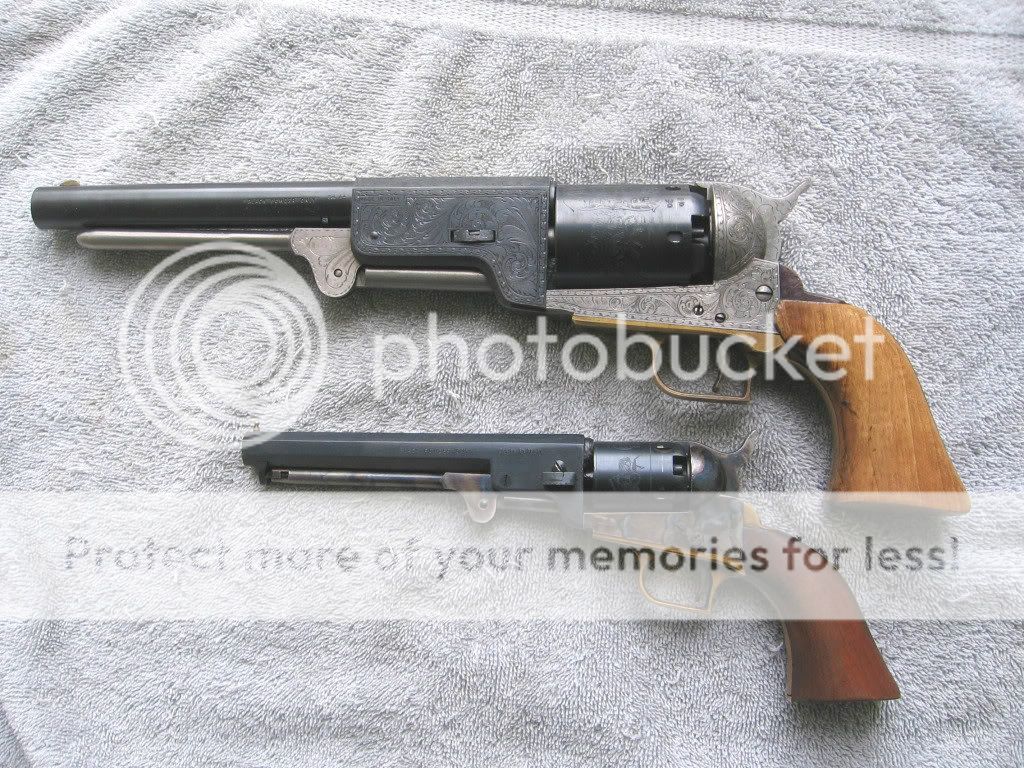
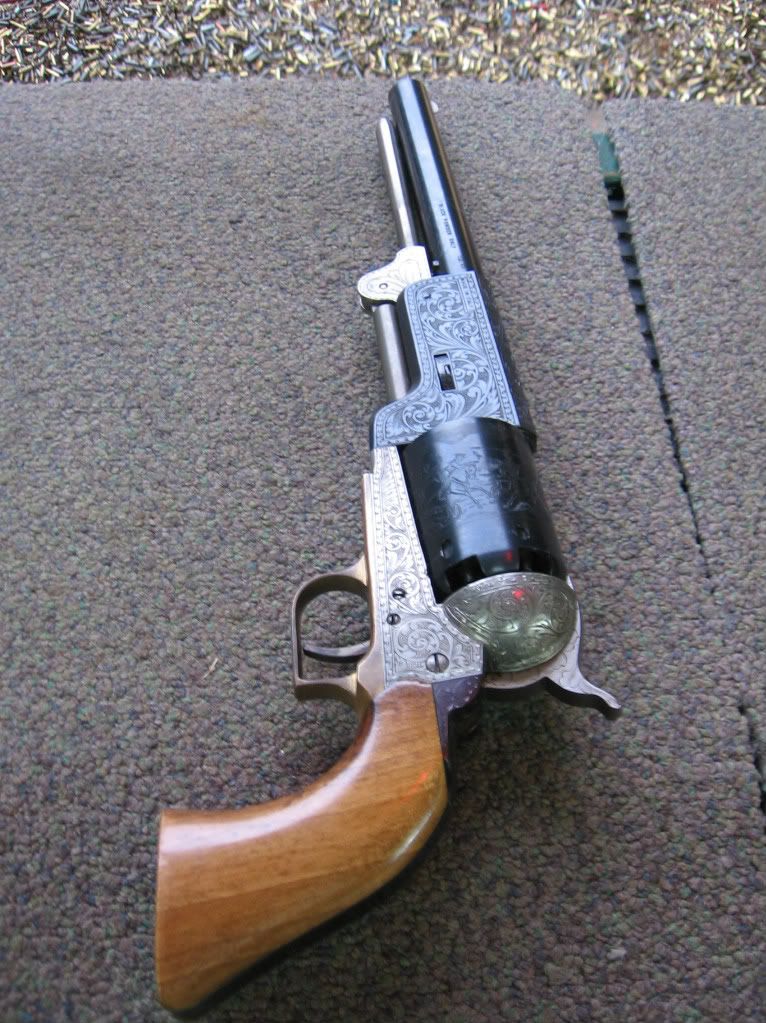
The formidible Colt Walker

mrclean89

CGN frequent flyer
Rating - 100%
81   0   0
Location
Nanaimo, BC
Morning everyone, So ive been wondering what a walker woul be like. I have a couple cap and ball revolvers and have seen a walker at a gunshow once. They are huge almost look fake they are so big haha

I was wondering if anybody had one and their thoughts, comments, criticisms, Etc...

Also who sells uberti in canada im having trouble finding anybody.

Cheers, McLean
 
I had one for a while and the problem I had with mine was that the cylinder pin would foul up rapidly and jam the cylinder. I had to remove the cylinder after two cycles (12 shots) or it was seized completely and I would have to put the gun muzzle down in a bucket of water, with the water up to the trigger roughly, to get it apart. I don't know why the gun had the problem in the sense that I also had a navy colt with no problems and friends had various colts without problems. I did grease the cylinder pin but that did not solve the problem

Other than that problem, the gun was no better or worse than any other replica percussion colt

cheers mooncoon
 
I've owned a Colt Second generation Walker, serial #1816, since 1986, and love it bits. It came with #26 nipples to take the original Joyce caps, which I changed out for the easy-to-find #11s. In deference to the fact that I don't have BP, but have to cadge it from generous fellow-shooters, I only load it with 45gr of FFg per chamber, and not the 55gr that it will take with ease. It sure is a serious conversation piece whenever it gets shot, no matter who unlimbers it and lets loose. I guess that I'm doing something different to Mr Mooncoon, as mine doesn't get crudded up until it's had at least five cylinder-loads through it.

I recommend the Uberti version rather than anybody else's - those that I have seen have always been very well finished and seem to be great performers, in my experience. Trouble is, you'll really need two, to get a balanced opinion. Josey Wales had the right idea.

tac
 
Wrap a piece of wire around the loading lever & barrel. I've got a Remington that still drops the lever with heavier loads. And the catch & spring are fine.
 
A lot of the old B/P (and new ones also) jammed up from fowling in the pin/bushing area.
I have a set of Uberti's (SAA) that fowl worse than the others I have. So much so that after soaking as Mooncoon says, I still had to grip the pin head with a pair of pliers and drive on the pliers to remove the pin.

A friend who has studied the old Colt liturature a lot said very early on in production that Colt started grooveing the pins close to the frame opening. Not sure what models they did this in. They cut small grooves 1/16 to1/32" apart on the pin for about 5/8 "( from frame to back in under the bushing.

I chucked the pins from the two guns I have that gave me the most problems in the lathe and give them the treatment. I don't know why giving the fowling a place to collect helps, but it did make quite a difference in these two guns.
A drill press and a file will work as well. Its a snap to do for the SAA and any of the Remington pistols and I'm sure a small cutting tool could be mounted in some sort of holder to cut grooves in the pins in the Colt B/P guns by hand.
 
Thanks for al the info everyone, I want one just for the hell of it. They look awesome, what do they sell for ? I cant seem to find one anywhere.

Cheers, McLean
 
I guess that I'm doing something different to Mr Mooncoon, as mine doesn't get crudded up until it's had at least five cylinder-loads through it.

I am guessing that there are differences in the design of the cylinder pin, between manufacturers and perhaps over time. Mine had a grooved cylinder pin but the grooves were different from the navy Colt. It has been close to 30 years ago now and I don't remember how the pin differed exactly. To get a sticky barrel off, I used to rotate the cylinder a part turn so that I could use the loading lever for pushing on the cylinder

cheers mooncoon
 
Walkers are Horse pistols, that is the pistol is carried on a holster attached to the saddle.
That being said they are fun to shoot.
 
I have a pair, one Uberti and the other is an Armi San Marco... The ASM does not compare 1 bit to the Uberti, the fit and finish just aren't there, but it does work... I have not had an issue with fouling binding the action until about 6 cylinders... A quick misting with a spray bottle around the arbor pin will free them up for another few cylinders and you just do it again... I shoot the full 55 grains in mine most of the time... As previously mentioned with a full charge the loading levers do like to release but a rubber band or a couple turns of electrical tape will solve that issue...

I seem to recall Shooter's Choice in Waterloo Ontario keeping them as a regularly stock item, I am not sure if they still have them though...

I think once you touch off your first shot you will be hooked... My avatar picture is my Uberti being fired on a dimly lit indoor range...
 
I shot in 'Frontiersman' class at Hefley Creek last summer shooting a pair of .44 Remingtons. In our possee we had a shooter using a pair of Walkers! He used a full load and had spare cylinders as well. I only saw a loading lever drop a couple of times.
He didn't use any lube over the chamber mouths and didn't suffer any chain fires in the course of a ten stage match (10 pistol rds per stage) thereby dispelling that myth.

I've got a Colt 2nd gen 3rd Model Dragoon, and it is all the gun I need or want in a cap & ball gun. When I want more, I borrow a friend's walker.
 
I have a pair, one Uberti and the other is an Armi San Marco... The ASM does not compare 1 bit to the Uberti, the fit and finish just aren't there, but it does work... I have not had an issue with fouling binding the action until about 6 cylinders... A quick misting with a spray bottle around the arbor pin will free them up for another few cylinders and you just do it again... I shoot the full 55 grains in mine most of the time... As previously mentioned with a full charge the loading levers do like to release but a rubber band or a couple turns of electrical tape will solve that issue...

I seem to recall Shooter's Choice in Waterloo Ontario keeping them as a regularly stock item, I am not sure if they still have them though...

I think once you touch off your first shot you will be hooked... My avatar picture is my Uberti being fired on a dimly lit indoor range...

I have an Armi San Marco 3rd model Dragoon. You are absolutely right on fit and finish compared to Uberti.
My 3rd model had to have a bushing shim installed to tighten the barrel/cylinder gap.
 
Wrap a piece of wire around the loading lever & barrel. I've got a Remington that still drops the lever with heavier loads. And the catch & spring are fine.

I have a 47 Walker, made in 1849 that does the same thing. I find it odd that they never did cure that minor issue.
I can run about 6 cylinders worth of BP through before she starts to get sticky.
Cool guns to shoot however, real nice for mosquito repelling too.
 
I have a 47 Walker, made in 1849 that does the same thing. I find it odd that they never did cure that minor issue.
I can run about 6 cylinders worth of BP through before she starts to get sticky.
Cool guns to shoot however, real nice for mosquito repelling too.

If you ever want to horse trade that 1847 Walker for a M.L. Volunteer Cav. 58 Remington or an ivory gripped Roger & Spencer Army drop me a p.m.;)
 
Not too many original Walkers around so I had to settle for a reproduction,I found an new in the box ASM but had to shoot it. As posted previously I checked the velocity with a full chamber and it went super-sonic at 1135 Feet/Second. I had the same problem that Mooncoon outlined when the gun was new but it is getting better every time I take it out.
Here is a picture that shows the Walker on top and a Baby Dragoon .31 Cal on the bottom.

Untitled.jpg

1847WalkerDec192011003-1.jpg
 
Walkers are Horse pistols, that is the pistol is carried on a holster attached to the saddle.
That being said they are fun to shoot.

Interesting, I always assumed "horse pistol" meant a large pistol that could mercifully put down a horse should the need arise...not where the pistol itself was holstered? Makes sense though, who in their right mind would want to carry that on their hip!? Horseback or otherwise!?
 
Last edited:
If you dont at least giggle a little bit after shooting one, there is something wrong with you. Mine does not get sticky as other posts have mentioned, the lever drops like the original on firing. Its an ASM, but for my purposes that is just fine!
 
Interesting, I always assumed "horse pistol" meant a large pistol that could mercifully put down a horse should the need arise...not where the pistol itself was holstered? Makes sense though, who in there right mind would want to carry that on their hip!? Horseback or otherwise!?

http://lewis-clark.org/content/content-article.asp?ArticleID=2380

American horse pistols

They were called "horse pistols" because they usually were issued in pairs with a set of connected holsters designed to be draped over the pommel of a saddle. Horse pistols weighed several pounds each, and were so long they could not comfortably be carried at the hip. In fact, the belt holsters that we commonly associate with cowboys were not used in the era of Lewis and Clark.

In 1803 Lewis picked up a set of two horse pistols from the Schuylkill Arsenal in Philadelphia, where records indicate there were several hundred pairs on hand. The standardized U.S. military pistol of that period was the Model 1799 single-shot flintlock gun made under contract with North & Cheney of Berlin, Connecticut. This would most likely be the weapon Lewis chose because it could use the same .69 caliber ball as the standard U.S. military musket. It was 14½ inches long overall, and weighed three pounds.

In addition to the North & Cheney pistols, Lewis could have chosen from over 100 horseman's pistols of an earlier model on hand in Philadelphia's Schuylkill Arsenal in 1803. In the late 1790s the U.S. Army ordered pistol barrels, locks and stocks from both European and domestic sources. They let contracts-for-assembly to various regional gunsmiths, supplied them with locks, stocks and barrels; the craftsmen returned finished pistols and charged only for their labor and incidental parts. The second pistol illustrated above represents these assembly-contract weapons. They were small caliber than the North & Chaney, so many historians conclude that Captain Lewis would have chosen the North & Cheney because of the convenience of interchangeability of bullets with the standard Army musket.
 
Interesting, I always assumed "horse pistol" meant a large pistol that could mercifully put down a horse should the need arise...not where the pistol itself was holstered? Makes sense though, who in their right mind would want to carry that on their hip!? Horseback or otherwise!?

Wearing a Walker on the hip would be much the same as wearing a Desert Eagle. Stinkin heavy on the belt and if worn for long periods of time would tend to make 1 leg shorter I suspect;)
Given that folks tended to be smaller in stature in the 1800s these must have been considered REALLY been big guns.
Personally I would rather let my horse do the packing of these "hand" guns.

Danceswithempties
My Walkers story.
I picked it up several years ago at the a gun show along with 3 other 1800s era Colts (2nd , 3rd Dragoon & an 1860 Army) from an younger hippy like idiot who had no use for guns, even 1s his Dad had collected over his lifetime then passed own and that were worth a small fortune. He was talked into taking them to the gun show by his buddy and this clown appeared to want to be cuddled up with a pound of plutonium FAR more than being around a room full of guns. He told me if someone did not buy them on that day he was going to turn them over to the police.
Lets just say I got a bargain on them.:D

As they say "some peoples kids??"
 
October 08, 2008

1847 Colt Walker .44 Fetches $920K at Auction -3

by Outdoor Life Online Editor

untitled.png


A pristine, corrosion-free Colt Walker .44 black powder revolver (ca. 1847) sold at auction in Fairfield, Maine to an unknown bidder yesterday for $800,000 (plus a 17 percent auction commission).

The sale reflected the most ever fetched for the model, of which fewer than 170 are believed to exist. It was also the highest price ever paid for any type of Colt firearm.

The black powder cartridge pistol was sold with the original powder flask, issued at Vera Cruz to Private Sam Wilson in 1847.

The gun’s owner, Montanan John McBride, 80, said he decided to sell it at auction because his family had no interest in historic firearms and wanted to use the proceeds to purchase property. The gun previously belonged to McBride’s great-great uncle.

“It was a painful decision,” McBride told the Kennebec (ME) Journal newspaper. “The family would rather have land than pistols. I can understand that. I don’t necessarily agree with it.”

A spokesman for the auction company’s firearms division said the price commanded for the pristine Colt was all about condition. There was not a spot of rust or oxidation on the massive, 9-inch barrel--or anywhere else on the gun.

“This is a military gun that normally is found in relic condition,” said Wes Dillon, “What we are seeing here is a unique opportunity in the gun-collecting world.”

Known as one of the most powerful handguns in history, the original Colt Walker had an overall length of 15.5 inches and weighed approximately 4.75 pounds. It held 50-to 60-grains of black powder and shot a conical 220-grain bullet or .44 cal. roundball.

By comparison, the original .45 Colt cartridge used a 250 grain bullet and 40 grains of powder. The Walker stood alone in repeating handgun ballistics superiority until the introduction of the .357 Magnum in 1935.

Only about 1,100 Walker pistols were made during a short production run in 1847. Its namesake, Capt. Samuel Hamilton Walker, a war hero who fought in the Texas-Mexico wars, collaborated with gunmaker Samuel Colt to create a pistol suitable for the Texas Rangers and the U.S. Dragoons.

Capt. Walker wrote in 1847 that the gun was “as effective as a common rifle at 100 yards and superior to a musket even at 200.”

Besides the fact that relatively few of the pistols were manufactured in the first place, a contributing factor in the scarcity (and value) of the Walker Colt today is that many of the guns were damaged by mis-loading. When it was introduced, few men had ever seen a revolver--much less shot one--resulting in burst cylinders and the accidental firing of all six chambers

 
Back
Top Bottom