The restoration of Kettenkrad 116714

one of those was featured on American Pickers last night. was up for sale for $60 000 euro. was in bit better shape.
I rarely bother watching American Pickers as its all kind of corny but hope I see that episode at some point. At 60,000€ thats a screaming deal, for being in Europe. Getting it here and to your door and being taxed, then restoring it and the costs go up, up, up.
 
Wow! That is a serious labor of love! I have the interest to return such things to original condition but could not possibly justify such expenses as the price on an original opal carb.

My hats off to you for willing to restore such an obscure piece of history at such a cost.
Out of curiosity what do you do for a living XRCDO11?
 
I assume the device on the front fender is a downward shaded light? If so, the resemblance of the shade to a stahlhelm is amusing. You could put a little helmet decal on the side and see if anyone gets the joke!
 
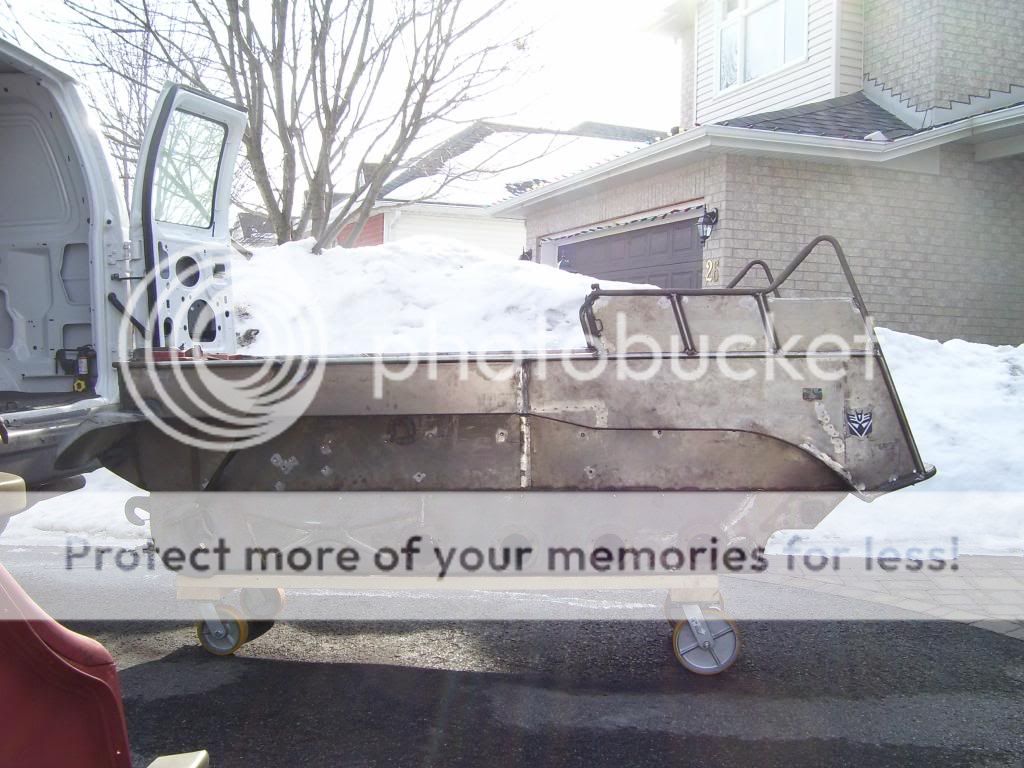
OFF FOR FINAL SANDBLASTING AND PAINT
Sooner or later one runs out of things to make, correct, adjust and the time comes to send the body off for the trip up to Bruce at Blast-It-All in Almonte. Bruce does great work at sand blasting and at the same time I had will shoot on two coats of Dunkel Gelb with me doing stuff like air hosing, vacuuming, media out of every nook and cranny and scuff sanding the primer and first coat. The urge to do a show room perfect paint job has to be fought back as wartime paint werk was sloppy and runs galore are totally acceptable to be correct.
Sandblasting, and working around Blast-it-Alls schedule took longer then I hoped for but I had long determined that the kettenkrad was going to be restored on its schedule and taken the long view for it to be "finished", one is never really "finished" or done a restoration as there is always something to attend to, new/better part to source, paint work to retouch, the list goes on and on. So here is the big day the body of 116714 goes for its drive to Almonte.


The "HoverKrad"

116714 finally in paint and looking pretty close to it did one day back in 1944.


Now looking about 300% better then when it arrived on a pallet three years earlier. I long decided to leave the rust pitted panels, pits and all early on. At first (when I first received the kett) I was inclined to smooth the pitting in with bondo but grew to see that as part of the vehicles lifestory plus it shows at a glance whats is new made Vs original panel wise. Anyways when painted one hardly notices.


Back at the garage of dreams, drivetrain meet refreshed body. No more rust, no more bearings galore, no more insanely expensive parts to locate in Europe (thank god for the internet), its time to start wrenching this thing and its umpteen parts and pieces back together again.
 
Last edited:
Good thinking re: pits. She's been places and done things. Bondo would be kinda disrespectful of her history.

How did you do the stencils?
The pitting is honest and part of the vehicles life and if I was to slap the bondo on it it would be like icing a cake with the stuff. Stencils came from France and are dead on copies taken from original stencil work. One HUGE suprise I came across that I found REALLY cool was this steering brake shaft and parts, This was up under the dash pod and not exposed to elements (very much). Considering how rusty the kett was this blew me away. The Germans where big on painting grease points with red and all the red and hand painted arrows showing the little soldat where to hook on the grease gun fitting are 100% original and correct. The only fresh and new paint on this part is on the left hand side of the shaft while the good side was preserved as found.
 
Last edited:
If this machine doesn't win "Best In Show" at any event, there is no justice. Especially if a photo log is part of the display.
 
^ I had to cool it on the postings for a couple reasons 1. I was at 98% for Photobucket bandwidth and I finally broke down and paid for more so that is addressed 2. the big one is I cannot find a SD card full of scary restoration work and lastly 3. time has been tight over the past few days. Anyways I will help you out with your kettenkrad restore withdrawal syndrome shortly.
 
Could the front wheel actually steer that thing? It seems like such a weird combo but I guess it worked for the Ski Doo Alpine.
One was to hand it to the Germans and their engineering (or maybe over engineering for some of the stuff they did, and do still). To answer your question the front wheel affected turns up to about 5 degrees from the center, after that the forks are connected to a pair of brake drums that make for tighter turns. The wartime German 3/4 tracks such as the Sd.Kfz 250, 251 and Demag D7 all used brake steering also, unlike the American half tracks that are more truck based. The kettenkrad could be operated with the front wheel removed (fork remains on) and just use track steering to turn. The girder style fork is pretty cool to watch while the kett is driving off road with it going up and down over bumps but the handle bars staying level.
 
Now that I am good to go with unlimited bandwidth after getting the Photobucket shakedown I can start posting to my hearts content. The down side is a AWOL SD card that detailed the reinstall of the suspension and road wheels and the heart stopping remounting of the drivetrain back inside the vehicle. Where that oh so precious card is gawd only knows and I am in the process of taking the garage apart seeking it. Anyways I can plow ahead with a goodly selection of pics off the other cards.
I believe I left off here (before the hoisting of the drivetrain up and into the body) rolling everything out for some morale pics.

The coolant expansion tank is now the correct chocolate brown and as we type I am awaiting the stencils to finish that detail for it. The Knecht aircleaner also needs its "Knecht Diamond" water transfer to be complete. While its supposed to be a oil bath aircleaner I decided to give myself a break and rigged it up to take a dry filter instead.
Some people in Europe swear the only colour for a kettenkrad motor is Semi gloss black but after degreasing it was grey and no primer. So grey it is. Where I think the confusion arises is so many kettenkrads that have been reengined with 1.5L car motors from Opel Olympias that where black pre and post war. Did black wartime kettenkrad engines exist probally, but mine (original) is grey.


One detail I now have a correct brass filler cap on the coolant tank.

Dash details, stencil werk and bullet strike on gas tank flange. The tiny First Aid compartment must have held two band-aids and a 9mm bullet, Early kettenkrads would have a first aid compartment on the left side and a small (and equally useless) Tool Compartment on the right side of the dash. Later kettenkrads such as mine have no tool compartment and it is covered over and a small green Bosch temp light installed, it took forever but I have the correct lights fitted.

Mounting the front fork for the umpteenith time getting pretty handy at doing so and NOT having all the ball bearings falling out and boucing off to hide under stuff.

My neighbour down the street who is into model making painted my front plate number on (same as the rear plate) I bet most people here have seen that number before. Note canvas (just draped there for pic) so the driver is not splashed with water and mud.

Its come a long way.
 
Last edited:
Back
Top Bottom