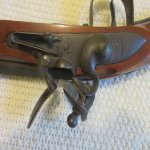
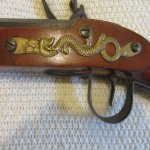
Trade Gun with serpent on the side

They are a interesting subgroup of antique muzzle loaders. Not for firing in original condition, but particular examples of the British gunmaking trade. The HBC did not keep stacks of them in Britain, but ordered each year's supply new based on predicted demand. There was an inspector who would call for tenders, and examine the sample muskets on offer. When the contract was let, the maker had less than 4 months to make and deliver every one so they would get on the ships. No two will be exactly alike, and that is not because of individual variation, but contract fulfillment through subcontractors.
 
That’s a great bit of information, thank you! I found half of a serpent(end with the head) while metal detecting near the North Saskatchewan River a few years ago. I’ve never seen one of these guns for sale, I am sure they are hard to come by due to the age and the environment they were used in.
 
The barrels were simple steel as was the technology of the time. The stock was ordinary English hardwood. The fittings pinned not necessarily screwed. Buttplates were routinely repurposed as hide scrapers when the stock broke. The serpent,which I associate with the manufacturer Grice, was brass for class and to hold the through bolts for the lock. They were very ordinary pieces, and they are scarce in Canada for many reasons. Not the least of which is their contribution to Canada was for a long time underappreciated. I attended an auction in Westport, Ontario about 35-40 years ago. The hour of the sale approached and the auctioneer announced a closed bid for the entire collection of muzzleloaders (US Revolutionary War, Civil War, trade muskets, Upper and Lower Canada, etc) had been received. The buyer was an American dealer with a substantial line of credit - even then at 12 or 15% interest rates. The consigner accepted the bulk purchase and everyone went home unhappy. That is where I learned that a polar bear's hide is black under the white fur.
 
The absolute best reference book on Northwest Guns is the encyclopedic volume published by the Museum of the Fur Trade in Chadron Nebraska.
Guns with serpent sideplates were traded into North America for over 300 years.
Most fur trading companies offered them, in different patterns. The last ones the HBC bought were made in 1900-1905. Apparently there were still trade guns in inventory in Winnipeg in the early 1930s. The HBC was still ordering flintlock guns in the 1870s. Percussion NW guns didn't last all that much longer, because breechloading rifles and shotguns were the standard for trade.
In Southern Ontario, many/most of the serpent sideplate guns that surface are not fur trade guns, but rather are trade pattern guns made for distribution to His Britannic Majesty's Indian Allies during the 1812 War period. These stand out because of the crown broadarrow mark on the lockplate and the inspector's mark on the barrel tang.
In the early 1970s, I was involved in the manufacture of reproduction trade guns. We supplied guns for Old Fort William, and some US State Historical societies.
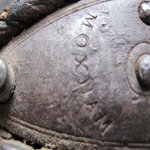
I have a few original trade guns - earliest is a Moxham contract piece issued by the Indian Department of the British Army. Couple of HBC guns. Some HBC muzzleloading single and double shotguns. "imperials".
Here are photos of a repro I made some years ago:

IMG_0805.jpg
IMG_0803.jpg

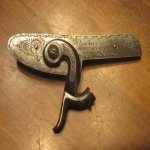
Here is a brand new, never used replacement lock for a HBC Imperial ml shotgun:

IMG_0809.jpg

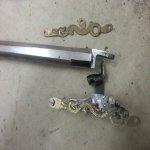
Parts for a repro percussion trade gun. If you look at this serpent, and the one on the flint gun, you can probably determine if the serpent fragment you found is from a flint or percussion gun.

IMG_0821.jpg
 

Attachments

  • IMG_0805.jpg
    IMG_0805.jpg
    76 KB · Views: 353
  • IMG_0803.jpg
    IMG_0803.jpg
    94.3 KB · Views: 355
  • IMG_0809.jpg
    IMG_0809.jpg
    97.7 KB · Views: 352
  • IMG_0821.jpg
    IMG_0821.jpg
    73.6 KB · Views: 352
Wow, thank you very much for all the information. This is incredible. That’s great that you’ve been part of the history of these guns through the reproductions. I’ve been interested in these muskets since I found that artifact, which is in addition to my interest in the early fur trade and history of Canada.
 
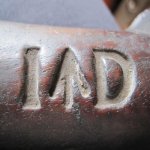
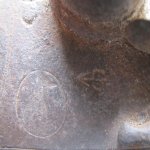
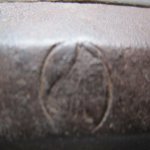
Here are some photos of the Moxham gun, ca.1815. It surfaced in Brant County; every possibility that it had been supplied to the Mohawks allied with the Crown. I/l\D brand (one of three on the gun) showing Indian Department origin.

008.jpg
011.jpg
012.jpg
013.jpg
 

Attachments

  • 008.jpg
    008.jpg
    91.4 KB · Views: 300
  • 011.jpg
    011.jpg
    100.1 KB · Views: 300
  • 012.jpg
    012.jpg
    47 KB · Views: 301
  • 013.jpg
    013.jpg
    97.5 KB · Views: 300
Trade guns are a part of Canadian/North American history. Survival rate is low. Guns were a staple in trade from the 17th century on. The HBC started trading guns in the 1670s. Thousands imported in the first 30 years, yet there is not one surviving intact specimen known. There are bits and pieces from archeological sites. Serpents appeared early, and lasted through 1900. The earliest guns had flat brass serpents with engraved details. Serpents were common on a lot of guns of that period, not just on trade guns.
One gun that passed through my hands, and is now in the Museum of the Fur trade was an 1883 Barnett percussion gun in 12ga. At the time, the Museum had never heard of a NW gun in 12ga. Anyway, it was loaded when acquired. I pulled the load with a worm. Newspaper top wad, a charge of #5 shot, more newspaper wadding, charge of 2F powder. When the newspaper was torn to make the wadding, the top corner of the page was used. Steamed the paper, flattened it out. The Free Press, Nov. 13, 1924. It was in '72 or so when I unloaded it.
While the serpent sideplate Northwest Guns are the classic trade guns, a variety of other types were traded as well. The companies supplied fancy guns, Chief's grade guns, double barreled flintlock shotguns, pairs of pistols. During the 1812 War period, numerous Chief's Guns were distributed by the Government. Light, handy fusils, easily identified by the silver Indian's head medallion on the wrist, and a boar's head with hunting horn engraved on the lockplate. Survival rate for these guns seems better than most, perhaps because they were attractive handy sporting guns.
 
Not a serpent sideplate gun, but I have just been working on a petite HBC single barrel muzzleloading gun. 24ga, the standard for most 19th century HBC trade guns. Made a ramrod for it, and installed an original hammer to replace the missing one. Just needs a nipple to be complete. Doubt that it weighs 5 pounds - but with ball and a stiff powder charge a moose could be taken at close range.
 
Not a serpent sideplate gun, but I have just been working on a petite HBC single barrel muzzleloading gun. 24ga, the standard for most 19th century HBC trade guns. Made a ramrod for it, and installed an original hammer to replace the missing one. Just needs a nipple to be complete. Doubt that it weighs 5 pounds - but with ball and a stiff powder charge a moose could be taken at close range.

A picture would be nice if you have one
thks ☺☺☺
 
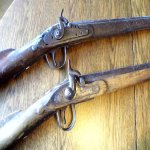
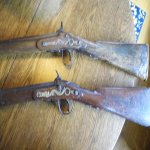
Here are two in rather poor conditionDSCI0229.jpgDSCI0228.jpg
You are correct, these are getting hard to come by.
 

Attachments

  • DSCI0229.jpg
    DSCI0229.jpg
    103.6 KB · Views: 94
  • DSCI0228.jpg
    DSCI0228.jpg
    82.9 KB · Views: 94
Upper gun has a converted lock. Lower is typical original percussion.
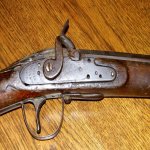
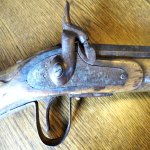
What are the lock markings?
 
DSCI0235.jpg
DSCI0231.jpg
A very faint square stamp on the Parker, doesn't show in the photo.
 

Attachments

  • DSCI0235.jpg
    DSCI0235.jpg
    146.8 KB · Views: 94
  • DSCI0231.jpg
    DSCI0231.jpg
    128.8 KB · Views: 93
Always wondered if this Ketland conversion was also a trade gunDSCI0240.jpg
DSCI0239.jpg
DSCI0242.jpg
 

Attachments

  • DSCI0240.jpg
    DSCI0240.jpg
    105.9 KB · Views: 91
  • DSCI0239.jpg
    DSCI0239.jpg
    114.5 KB · Views: 92
  • DSCI0242.jpg
    DSCI0242.jpg
    109.1 KB · Views: 91
I don't wish to hijack this fascinating thread, but I hope you'll allow a temporary diversion concerning the makers illustrated in Loyer's post. I enjoyed looking at the Barnett and Parker Field trade guns. These, along with military contracts, were the mainstay products for these two London firms, providing the British empire with military weaponry, and trade guns for Africa and North America.

Barnett was the most prolific English manufacturer associated with the American Confederacy, making and selling thousands of Pattern 1853 Enfield Rifle-Muskets and P-1856 cavalry carbines. Their flint and percussion trade guns were supplied to both the Hudson's Bay Company and the North West Company. Barnett had a sizeable in-house capacity in their premises in East London, could afford water- or steam-powered machinery and factory space, and provide work for hundreds of outworkers supplying the gun trade. What is less known is that Barnett also built a small number of sporting guns. The sporting market in the 1850s was tiny compared to government contracts, especially for the new breech-loading game guns. In a business selling thousands of guns on contract, you could wonder why they might bother with a market in which they might sell fewer than ten guns in a year. And, from a sportsman's perspective, why buy a bespoke hunting gun from a military supplier when several respected makers could supply the same? I can't answer either question, but Barnett did dabble, if only briefly, in the burgeoning breech-loading sporting market. Here is a Barnett 12-bore pin-fire sporting gun from the late 1850s.
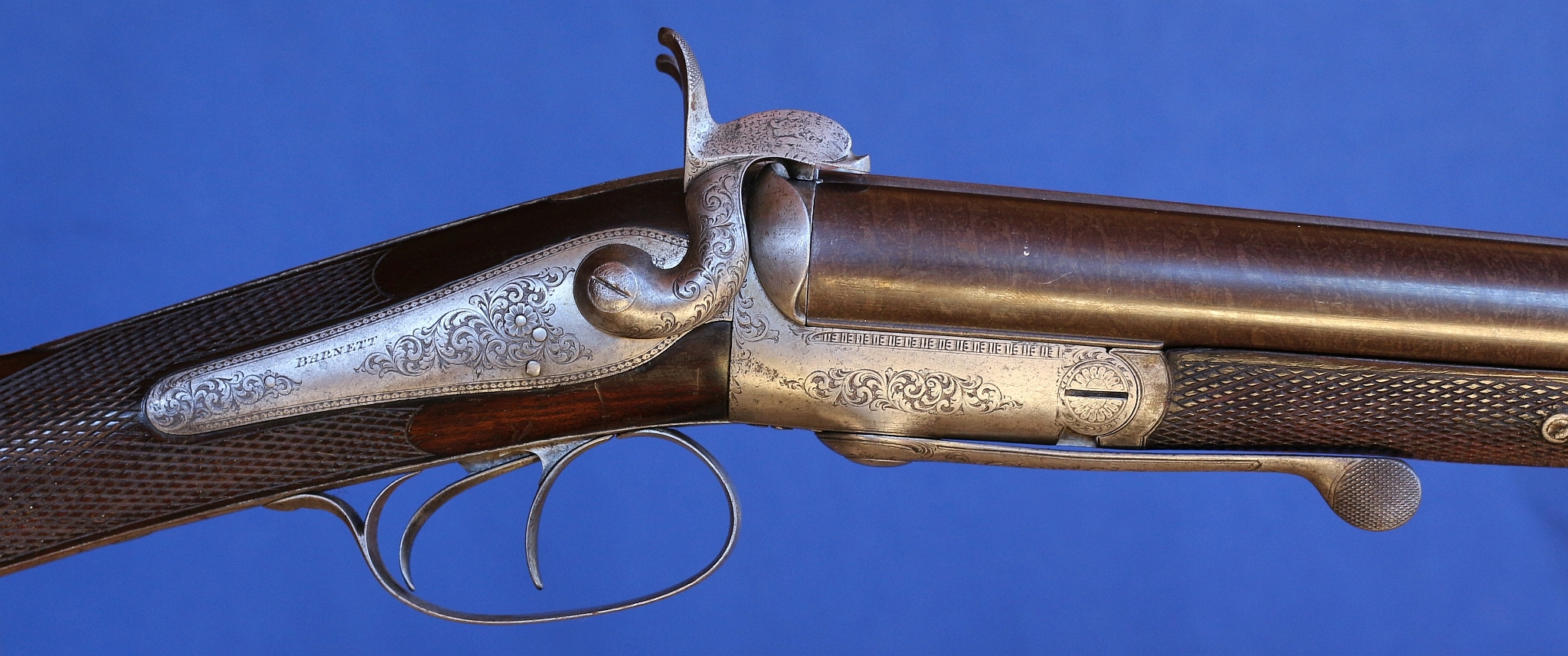
hgxlt3o.jpg


The origins of the Parker Field & Co. business started with John Field, who had been a goldsmith, sword cutler and gun maker at 233 High Holborn, London, from 1783 to 1791. When he died in 1791, William Parker went into partnership with his widow, and they traded as Field & Parker. Further strengthening the family connection, William's daughter married John Field Junior. Parker became gun maker to Prince Edward, Duke of Kent and Strathearn (the future Queen Victoria's father), then to King William IV. When Parker died in 1841, John Field Junior and his sons John William Parker Field and William Shakespeare Field started trading as Parker, Field & Sons. In 1850, the sons took over the business. At some point, Parker, Field & Sons received the greatest accolade, becoming gunmaker to Her Majesty Queen Victoria. Though it produced martial, trade, and sporting arms, the firm is probably best known for its military contracts. It supplied arms to the Honourable East India Company, trade guns to the Hudson's Bay and North West Companies, and military Enfield muskets to both sides in the American Civil War. The firm also provided police forces with pistols, truncheons, tipstaffs, cutlasses, and handcuffs, and wrist shackles and leg irons for the slave trade (!). Here is one of their sporting guns, a 12-bore bar-in-wood pin-fire gun, made around 1865. The action is John William Parker Field's patent No. 3485 of December 1862.

nJ1HFBc.jpg


OK, back to the subject of trade guns. If you're interested in a good description of how the 'trade gun' business worked, down to the costs of the individual parts and the contracts with suppliers, I would recommend getting a copy of Priya Satia's book, Empire of Guns, The Violent Making of the Industrial Revolution. Quite an informative and entertaining read on the London and Birmingham gun trade in the 1700s and 1800s.

Apologies for the diversion, but Parker Field and Barnett are interesting makers.

 
Last edited:
Interesting to see Parker Field and Barnett names on premium sporting guns as well as on the trade guns. Quite a range in product quality.


Yes, these were serious businesses with extensive production capability.
I recall seeing a Parker Field double flint gun. Obviously late production, in 24ga. Didn't have any HBC or other marks, but given the gauge, I am sure it was a "trade gun".
Loyer - I don't think the Ketland fowler was a trade gun, in the sense of being a fur trade trade gun. There was a tremendous export market for guns.
 
Back
Top Bottom