












































You are using an out of date browser. It may not display this or other websites correctly.
You should upgrade or use an alternative browser.
You should upgrade or use an alternative browser.
Volume sorting brass
- Thread starter Kezh1729
- Start date

By "volume sorting," you don't mean actually measuring the volume (or weight) of water in each, do you? Sorting by cartridge case weight is far faster and easier and accomplishes the same thing. If weight sorting, I'd do so after neck turning, as variations in neck thickness (as tiny as they may be) need to be eliminated. Whether you do this before or after first firing shouldn't make much difference, it seems to me, but turning the necks and trimming to identical length should be done.
By "volume sorting," you don't mean actually measuring the volume (or weight) of water in each, do you? Sorting by cartridge case weight is far faster and easier and accomplishes the same thing. If weight sorting, I'd do so after neck turning, as variations in neck thickness (as tiny as they may be) need to be eliminated. Whether you do this before or after first firing shouldn't make much difference, it seems to me, but turning the necks and trimming to identical length should be done.
That’s exactly what I mean... fill it up with water and weight it since the internal volumes of each case is what causing muzzle velocity variations so I kinda want to eliminate that factor.
If you are shooting a bench rest rifle and only use 50 cases for the life of the barrel, sure sort by volume. I have a couple thousand cases that I run through my target rifles so sorting by volume would drive me crazy. Case weight sorting within .5 gr is as far as I go with a .308. within .3gr with the .223. I compete with both of these calibers out to 1000 yards.
The distribution of water weights will correlate close to 1.0 with that of case weights. In other words, you'll get the same rank-ordering with both methods. There is just no benefit in using water rather than the dry cases.That’s exactly what I mean... fill it up with water and weight it since the internal volumes of each case is what causing muzzle velocity variations so I kinda want to eliminate that factor.

Some case have more metal in them. This means less internal volume. It also means they weigh more.
I sort by weight on a digital scale. I sort by 0.5 gr with 308, unless I have 1000 cases. Then I sort by 0.2 gr.
I sort by weight on a digital scale. I sort by 0.5 gr with 308, unless I have 1000 cases. Then I sort by 0.2 gr.

- Location
- Saskatchewan
Nobody has ever explained to me how sorting brass by water volume makes any sense whatsoever. How much could small differences in brass alloy, and corresponding bulk density affect volume? Not enough to measure. So in my opinion, weight = volume. Weighing brass is easy, and by logic, weight predicts volume. Heavier cases have less internal volume.

Munkey1973
CGN frequent flyer
- Location
- Regina, SK
Sort by case weight not by H2O volume weight. H2O sorting will get old really fast (even if you use a good tool for the job like a 21st Century Primer Pocket Plug).... This is my recommendation even if you are an OCD type reloader for F class shooting such as I am.
Why?.... the results are not repeatable.
Take any given 308 Winchester case for example, you could get +/- 0.5 grain re-measuring that case a second time.
This happens due to the Meniscus water line of the sample.... it could be convex the first time you weight it.. could be concave the second time you weigh it.
https://en.wikipedia.org/wiki/Meniscus_(liquid)
Through personal experience, I found H2O sorting to be a time consuming rabbit hole... least I did it during the winter months.
I agree 100% with Ganderite...
Some cases have more metal AND IF the exterior dimensions of the cases are all identical (same primer pocket depth, all resized the same, same length, etc etc)... THEN logically more weight means less internal volume.
When to sort you asked?
Sort after you fire form.... then stainless steel tumble all the carbon out, resize consistently, turn the necks, trim to identical lengths, uniform the primer pockets, debur the flash holes... Do all that machining. Rinse the cases off to get rid of any brass shavings.
After all that, you should theoretically have cases that have near identical exterior dimensions... therefore variations in case weight are inversely related to variations in case capacity.
H2O capacity sorting is a Fool's Errand (take it from this fool who once sorted 600 cases one winter)... just weight sort empty cases after going through process I prescribed above.
Why?.... the results are not repeatable.
Take any given 308 Winchester case for example, you could get +/- 0.5 grain re-measuring that case a second time.
This happens due to the Meniscus water line of the sample.... it could be convex the first time you weight it.. could be concave the second time you weigh it.
https://en.wikipedia.org/wiki/Meniscus_(liquid)
Through personal experience, I found H2O sorting to be a time consuming rabbit hole... least I did it during the winter months.
I agree 100% with Ganderite...
Some cases have more metal AND IF the exterior dimensions of the cases are all identical (same primer pocket depth, all resized the same, same length, etc etc)... THEN logically more weight means less internal volume.
When to sort you asked?
Sort after you fire form.... then stainless steel tumble all the carbon out, resize consistently, turn the necks, trim to identical lengths, uniform the primer pockets, debur the flash holes... Do all that machining. Rinse the cases off to get rid of any brass shavings.
After all that, you should theoretically have cases that have near identical exterior dimensions... therefore variations in case weight are inversely related to variations in case capacity.
H2O capacity sorting is a Fool's Errand (take it from this fool who once sorted 600 cases one winter)... just weight sort empty cases after going through process I prescribed above.
Last edited:

Quickload tells you to measure the case volume of a fired case that conforms to your chamber. This is because Quickload defaults to the lowest case capacity of that caliber and effects chamber pressure readings.
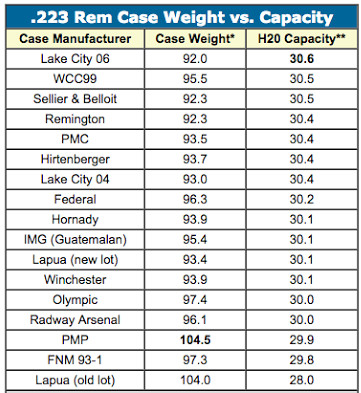
Example below, the top capacity of 30.6 and the bottom capacity of 28.0 will cause over 5,000 psi difference with the same powder charge.
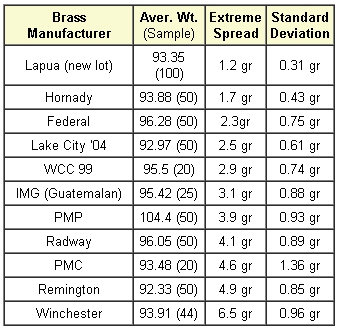
Below buying high quality brass means a great deal, the top Lapua cases only varied 1.2 grains in weight. But the bottom Winchester cases varied 6.5 grains in weight and this can effect volume.
Save $$ By Using Lake City 5.56x45mm Once-Fired GI Brass
http://bulletin.accurateshooter.com/2019/10/save-by-using-lake-city-5-56x45mm-once-fired-gi-brass/
Accuracy Potential of Mil-Surp 5.56×45 Brass
"So, how accurate can previously-fired GI surplus brass be in a good National Match AR-15? Well, here’s a data point from many years ago that might be of interest. A High Power shooter who wrote for the late Precision Shooting magazine took a Bill Wylde-built AR match rifle to a registered Benchrest match. His first 5-round group ever fired in a BR match was officially measured at 0.231″ at 200 hundred yards. This was fired in front of witnesses while using a moving target backer that confirmed all five rounds were fired."
He recounted that his ammo was loaded progressively with factory 52gr match bullets and a spherical powder using mixed years of LC brass with no special preparation whatsoever. Obviously, this was “exceptional”. However, he had no difficulty obtaining consistent 0.5-0.6 MOA accuracy at 200 yards using LC brass and a generic “practice” load that was not tuned to his rifle.
NOTE, My comment, I buy once fired Lake City 5.56 and 7.62 brass and will weight sort it for my very best brass for in my bolt actions. BUT I can't tell the difference shooting at 100 yards between the sorted and unsorted brass. And I'm 70 years old and have chronologically gifted eyesight and 90% of my case prep may be wasted time.
Bottom line, my opinion, much of what bench rest shooters do with their custom made rifles with tight neck chambers and brass prep is wasted effort on off the shelf factory rifles. And many competitive shooters at accurateshooter.com just buy Lapua brass and load it as it comes out of the box with no prep work.
Example below, the top capacity of 30.6 and the bottom capacity of 28.0 will cause over 5,000 psi difference with the same powder charge.
Below buying high quality brass means a great deal, the top Lapua cases only varied 1.2 grains in weight. But the bottom Winchester cases varied 6.5 grains in weight and this can effect volume.
Save $$ By Using Lake City 5.56x45mm Once-Fired GI Brass
http://bulletin.accurateshooter.com/2019/10/save-by-using-lake-city-5-56x45mm-once-fired-gi-brass/
Accuracy Potential of Mil-Surp 5.56×45 Brass
"So, how accurate can previously-fired GI surplus brass be in a good National Match AR-15? Well, here’s a data point from many years ago that might be of interest. A High Power shooter who wrote for the late Precision Shooting magazine took a Bill Wylde-built AR match rifle to a registered Benchrest match. His first 5-round group ever fired in a BR match was officially measured at 0.231″ at 200 hundred yards. This was fired in front of witnesses while using a moving target backer that confirmed all five rounds were fired."
He recounted that his ammo was loaded progressively with factory 52gr match bullets and a spherical powder using mixed years of LC brass with no special preparation whatsoever. Obviously, this was “exceptional”. However, he had no difficulty obtaining consistent 0.5-0.6 MOA accuracy at 200 yards using LC brass and a generic “practice” load that was not tuned to his rifle.
NOTE, My comment, I buy once fired Lake City 5.56 and 7.62 brass and will weight sort it for my very best brass for in my bolt actions. BUT I can't tell the difference shooting at 100 yards between the sorted and unsorted brass. And I'm 70 years old and have chronologically gifted eyesight and 90% of my case prep may be wasted time.
Bottom line, my opinion, much of what bench rest shooters do with their custom made rifles with tight neck chambers and brass prep is wasted effort on off the shelf factory rifles. And many competitive shooters at accurateshooter.com just buy Lapua brass and load it as it comes out of the box with no prep work.
Last edited:

Mystic Precision
CGN Ultra frequent flyer
- Location
- Summerland, BC
Hi everyone,
I have a question, should I volume sort my brass before firing for the first time or after firing? Also should I neck turn first before volume sorting it?
Volume sort AFTER fire forming. Neck turning will not affect your outcome
Weight sorting can be misleading.... machining of extractor grooves is far from precise. Doesn't take much brass to cause a change on the scale.
I have weight sorted 1 manf, 1 lot of poorly made brass and had horrendous results. When I checked the volumes, they were all over the place... but they weighed the same
So do a spot check... with a new batch of say 100cases, I might check case volume for 10 cases. If the volume varies very little, I then check their weight. If that also varies very little, then I will run with weight as I am too lazy to volume check all cases.
Ultimately, if you are using a standard case and extruded powder, the slight variation in case volume is not likely to cause an issue on target. If running very small cases and want very high levels of precision, then I would check the volume
Jerry
Honestly I don't reload precision and therefore haven't sorted my brass, but I would think water volume to be significantly less precise than dry case weight. Both the skin and meniscus effects where water doesn't have a level surface will affect your measurements, as well as water retention inside the case and in whatever container your using on your scale. Essentially it would introduce a bunch of additional errors in the final measurements. Heck, even air retention in the flash hole vs not would be a problem.

Hi everyone,
I have a question, should I volume sort my brass before firing for the first time or after firing? Also should I neck turn first before volume sorting it?
A coincidence that you are asking. I have brand new Hornady brass for the 270 win. and 300 H&H. I full-length sized them both in their respective die and then outside neck turned them. When I was neck turning it was only removing the high spots and skipping over the low areas. It was removing about 50 to 75% of brass on the neck. I haven't sorted them by weight, as of yet, that's next. After my first firing, they will be neck reamed. I believe that is there no harm to turn the necks on new brass, case in point, you will be that much further ahead in your development.
Volume sorting is a complete waste of time in my opinion, but weight sorting makes perfect sense.
Just think about it for a second...
First of all, filling a case with water has a greater degree of uncertainty that the volumetric difference you are attempting to measure.
Forget there is a case at all for a second and just envision a bullet touching the lands. All that is left behind the bullet is an empty space... ie the chamber.
Off the top of my head... The only real question volumetrically is how much of that space is displaced by the brass. The shape of the brass is of no consequence in this regard... just volumetric displacement. The volume of any metal can be calculated as a derivative of its weight... L" x W" x H" x 0.31 = weight in pounds (for brass) x 7,000 = weight in grains.
Therefore if you know the weight, you by default also know it's volume.
One could argue that velocity could be affected by where in the chamber that brass material is positioned, but it's a negligible point in practical terms as case to case wall stock variation is only slight.
These days I buy several thousand rounds at a time all the same brand and I do a full process resize, neck turn, length trim etc on all of them, and anneal. Once complete, I weigh every single case and write the case weight on it with a sharpie. I then group the cases into lots of identical weight to 0.1 grains. In the end, my case to case weight variation is of no concern. Once fire formed, they are all automatically volumetrically identical within the lot.
From there rounds go into boxes of 100 and they live together until the time of their death.
Sure it takes a while and its kept my busy during winter months, but its a one time exercise that keeps me in good supply of target grade brass for a very long time.
Just think about it for a second...
First of all, filling a case with water has a greater degree of uncertainty that the volumetric difference you are attempting to measure.
Forget there is a case at all for a second and just envision a bullet touching the lands. All that is left behind the bullet is an empty space... ie the chamber.
Off the top of my head... The only real question volumetrically is how much of that space is displaced by the brass. The shape of the brass is of no consequence in this regard... just volumetric displacement. The volume of any metal can be calculated as a derivative of its weight... L" x W" x H" x 0.31 = weight in pounds (for brass) x 7,000 = weight in grains.
Therefore if you know the weight, you by default also know it's volume.
One could argue that velocity could be affected by where in the chamber that brass material is positioned, but it's a negligible point in practical terms as case to case wall stock variation is only slight.
These days I buy several thousand rounds at a time all the same brand and I do a full process resize, neck turn, length trim etc on all of them, and anneal. Once complete, I weigh every single case and write the case weight on it with a sharpie. I then group the cases into lots of identical weight to 0.1 grains. In the end, my case to case weight variation is of no concern. Once fire formed, they are all automatically volumetrically identical within the lot.
From there rounds go into boxes of 100 and they live together until the time of their death.
Sure it takes a while and its kept my busy during winter months, but its a one time exercise that keeps me in good supply of target grade brass for a very long time.
Last edited:
Mystic Precision
CGN Ultra frequent flyer
- Location
- Summerland, BC
Honestly I don't reload precision and therefore haven't sorted my brass, but I would think water volume to be significantly less precise than dry case weight. Both the skin and meniscus effects where water doesn't have a level surface will affect your measurements, as well as water retention inside the case and in whatever container your using on your scale. Essentially it would introduce a bunch of additional errors in the final measurements. Heck, even air retention in the flash hole vs not would be a problem.
So don't use water...
Jerry





















