Webley .45 autorim loads.

A useful guideline for anyone who reloads .45 auto or autorim cases for their bubba'd Webleys.

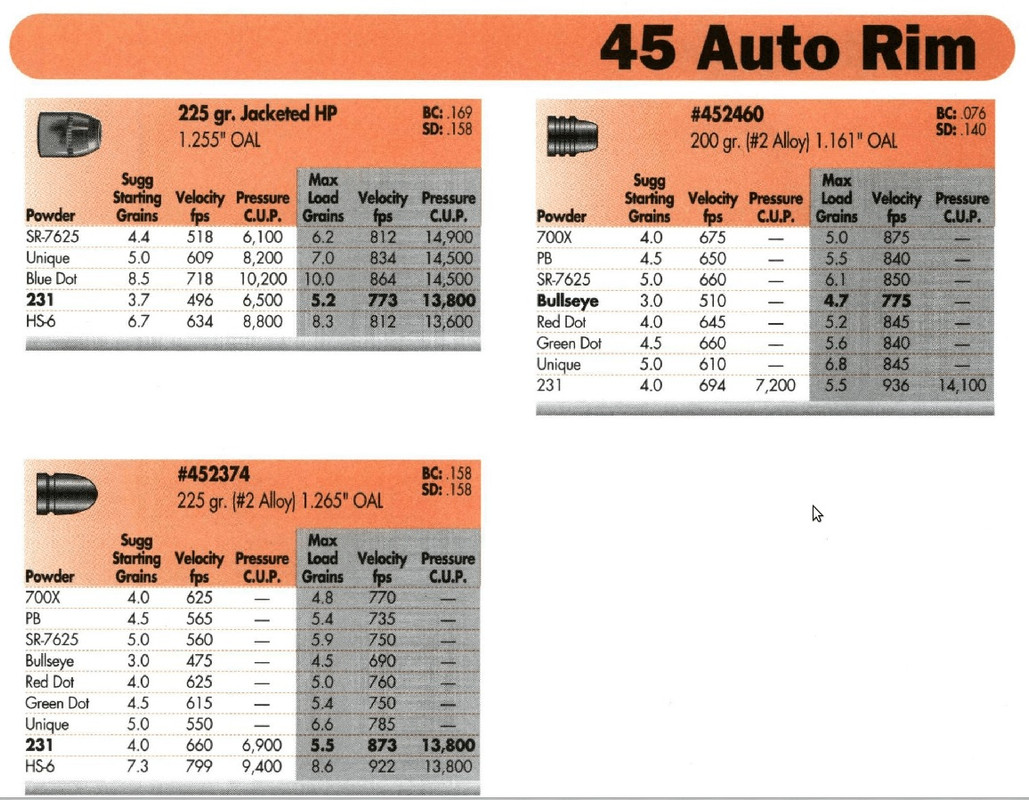
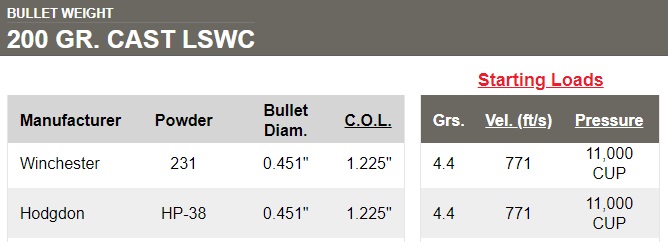
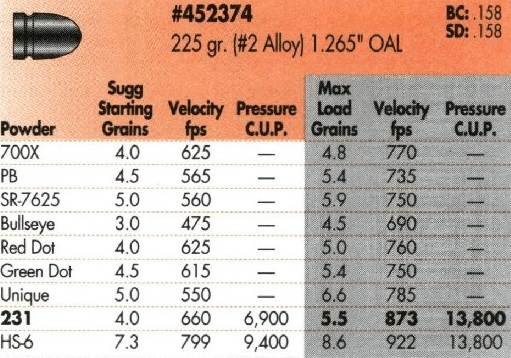
.452' 200grain lead, 4.6 grains of WIN 231

.454' 250grain lead, 4.0 grains of WIN 231

I load between 5.4 and 5.7 gr. of 231 behind 200 gr. in my 1911, so these reduced loads look about right for a Webley. Presumably they would be OK in .455 Webley brass as well.

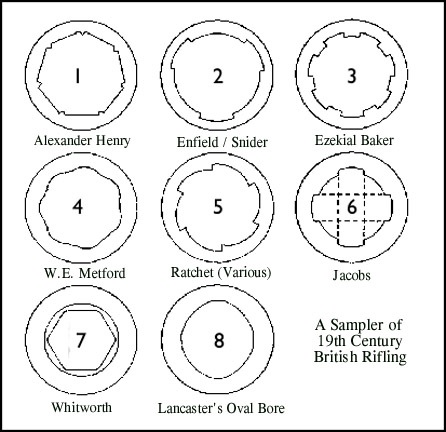
So, how about identifying the rest of those rifling profiles?

:) Stuart
 
There are several threads already about reloading the Webleys. 45 AR means the cylinder has been shaved for 45ACP with clips. You basically are using the normal 45ACP casings and use a 454 soft lead cast bullet. Then you put those rounds on a clip, they are available on ebay. You can also use AR casings but it's a hassle to find them in Canada. 4 to 4.4 grains of Unique is plenty for the the old Webleys 1 to 3. 4.8 grains brings you to 980 FPS and too much pressure.
 
There are several threads already about reloading the Webleys. 45 AR means the cylinder has been shaved for 45ACP with clips....

Or .45 Auto-Rim brass without moonclips (hence "45 AR")

980 fps would be pretty scary in a Webley. As has been mentioned in other threads, standard .45 ACP loads are about equivalent to .455 Webley proof loads, ie about 50% over regular pressures :eek:

:) Stuart
 
Or .45 Auto-Rim brass without moonclips (hence "45 AR")

980 fps would be pretty scary in a Webley. As has been mentioned in other threads, standard .45 ACP loads are about equivalent to .455 Webley proof loads, ie about 50% over regular pressures :eek:

:) Stuart


I wrote that if you read my posting.
 
I wrote that if you read my posting.

Oops.... "If all else fails, read the instructions!" So you did.

I'm trying to remember where I got my AR brass. I think it was from Higginson's, but Henry Nierchylo or Jerry (Mystic Player) would be sources too.

:) Stuart
 
I load between 5.4 and 5.7 gr. of 231 behind 200 gr. in my 1911, so these reduced loads look about right for a Webley. Presumably they would be OK in .455 Webley brass as well.

So, how about identifying the rest of those rifling profiles?

:) Stuart

Identified!

Sampler.jpg
 
Last edited:
I have to seriously question the claim of 980 ft/sec with 4.8 grains of Unique.

For all practical purposes case volume is nominally similar for 455 mkII brass and 45acp, autorim.

That said these are my actual chronographed results using Unique powder, MKII brass and various bullet sizes. Make note of OAL as this can change pressure signifigantly.

180 grain lead hollow point sized .454, OAL 1.10, 6 grain of powder gets you 740ft sec, 6.5 gets you 825ft/sec.

255 flat nose cowboy type bullet .452 OAL 1.10

5.2 grains of powder - 620 ft/secs
5.6 grain - 710 ft/sec

I saw the same results with the official 265 grain HBRN bullet with 1.26 inch OAL

So in my experience 5.2 grain of unique at the stated OALs and a bullet between 255-265 grain would give you 620 ft/sec, a very safe facsimilie of an 1890's factory load.

I did push the big bullet with 6 grain and this got me close to 800 ft/sec, hard on the gun and it was unpleasant to shoot.
 
Holy molee, I cannot figure out those rifling profiles, anyone please take a stab at it! Best I got is 'egg' rifling for the one 3rd row 2nd column.:p

Well, a little bit of progress. I posted the image here: http://britishmilitariaforums.yuku.com/topic/11441/Identifying-rifling-types

I numbered each type for ease of identification:

Rifling.png


And so far one response from David Kieser (of Brownell's, I think)
1 is Henry, 2 was used by Springfield, 5 I've seen described as ratchet. #8 is Lancaster's Smooth Oval Bored Rifling.

If #4 is Metford and #7 is Whitworth, that's 6 down and 2 to go.

:) Stuart
 
Bingo! A full identification, c/o one of the fine folks on British Military Forum (see link in prev. post.)
I am surprised by #3, though, as the pics I've seen of the Baker Rifle indicate that it fired a belted bullet, like the Jacobs but with only one belt.
1. Alexander Henry
2. Enfield / Snider
3. Ezekiel Baker
4. W. E. Metford's later type marking the transition from muzzle to breech loading.
5. Ratchet rifling tried by more than one maker.
6. Jacobs
7. Whitworth
8. Lancaster's Oval Bore.

--------------------------------------------
W. S. Curtis, A.C.I.I.,
Vice President (Hon.), Crimean War Research Society,
HBSA (Hon. Life),
Assistant Curator, Museum of the National Rifle Association,
Whitworth Rifle Research Project,
MLAGB, NLRC, ATRA, &c.

An addendum from "martinibelgian" another stalwart of the British Military forum:
I believe you're confusing the Baker 6-groove flintlock rifle with its successor, the Brunswick 2-groove percussion rifle... The Brunswick used the belted ball.

As we're now well off-topic, I'm going to post the results on the Blackpowder and Antiques forum here.

:) Stuart
 
Last edited:
By the way guys, as for the 45ACP versions of the guns being "Bubba'd", I believe that you're off the mark. As per what I've been reading, their cylinders were actually factory cut (or shaved) at Webley to accept 45ACP/45 AutoRim prior to being exported to the States, as the .455 Webley cartridge was unavailable in America. So, the guns have a different history, but are not the result of some basement operation by Bubba. There is a value difference though, as the unaltered versions (from Britain) bring a premium on the collectors' market. For shooting however, the modified ones are much more reloader-friendly (for obvious reasons) and will perform just the same as the unaltered ones. When used with moon-clips (available on eBay.ca), they are also much faster to reload than unaltered versions. ;)

As for reloading dies, I find that a set of 455 Webley dies from Lee is a perfect all around die set for loading everything Webley (and then some). I use mine to load for my 45ACP/AR MkI Webley, for 45 Schofield and of course for 455 Webley (which the dies were designed for). I am pretty positive that my 45ACP ammo would fit & shoot well in any 1911 also. The added benefit of 455 dies is that they're slightly larger than standard 45ACP ones, therefore will preserve your brass longer when used in a Webley (thanks to lesser amounts of stretching during resizing of the brass). That is particularily important with 45AR brass, which today is both scarce and expensive.

That said, enjoy your Webleys! They are certainly very unique and well made revolvers.

:cool:


P.S. These loads are much too hot for a Webley and can cause the revolver to blow up or the frame to stretch. Do not use them! The safe amount of powder (range) for a Webley would be somewhere in between 4.5 to 5.5 of Unique, not more (as pressure has to be kept under 12,000 psi in these according to info available). Remember that you're not dealing with a modern S&W revolver here. :eek:

455Webleyloads.jpg
 
I'm not into casting my own at this point, but NEI makes a HB 230gn bullet that might work, although it would probably shoot a bit low. A lower front sight wouldn't be all that hard to make, though.

NEI%20454-230-hb.jpg


:) Stuart
 
That image there is quite enticing, 2 lube grooves, hollow base, 230 grain goodness. :p So just wondering do you prefer heavy or light bullets? I kinda like the 200 grainers.

Well, I've just loaded up some of the traditional HB 265's and am waiting to get to the range for the first time. If I ever get into casting my own, I might look into that NEI mould, though.

:) Stuart
 
By the way guys, as for the 45ACP versions of the guns being "Bubba'd", I believe that you're off the mark. As per what I've been reading, their cylinders were actually factory cut (or shaved) at Webley to accept 45ACP/45 AutoRim prior to being exported to the States, as the .455 Webley cartridge was unavailable in America. So, the guns have a different history, but are not the result of some basement operation by Bubba. There is a value difference though, as the unaltered versions (from Britain) bring a premium on the collectors' market. For shooting however, the modified ones are much more reloader-friendly (for obvious reasons) and will perform just the same as the unaltered ones. When used with moon-clips (available on eBay.ca), they are also much faster to reload than unaltered versions. ;)

As for reloading dies, I find that a set of 455 Webley dies from Lee is a perfect all around die set for loading everything Webley (and then some). I use mine to load for my 45ACP/AR MkI Webley, for 45 Schofield and of course for 455 Webley (which the dies were designed for). I am pretty positive that my 45ACP ammo would fit & shoot well in any 1911 also. The added benefit of 455 dies is that they're slightly larger than standard 45ACP ones, therefore will preserve your brass longer when used in a Webley (thanks to lesser amounts of stretching during resizing of the brass). That is particularily important with 45AR brass, which today is both scarce and expensive.

That said, enjoy your Webleys! They are certainly very unique and well made revolvers.

:cool:


P.S. These loads are much too hot for a Webley and can cause the revolver to blow up or the frame to stretch. Do not use them! The safe amount of powder (range) for a Webley would be somewhere in between 4.5 to 5.5 of Unique, not more (as pressure has to be kept under 12,000 psi in these according to info available). Remember that you're not dealing with a modern S&W revolver here. :eek:


455Webleyloads.jpg
X2, 100% right on. Even at a guestimated 12000 lbs cup your Mk I or Mk II might shoot loose over time. You positively shouldn't shoot loads intended for 1911s!

I had one once that the first owner had shot "slightly reduced" 45 acp loads (by his guess), and it was starting to show slack in the latch.
 
Very informative thread, thanks gent's.

Re; AR brass, recently received my starline .45AR cases from Jerry at Mystic Precision. Took a while(backorder), he took good care of me and the product is very nice. Paid $35/100. Now I just need a shell holder.

Re; Mk1 rifling, just assumed that my shiney clean bore was somewhat worn, but no!, 'tis not so, it was made that way. Happy vviking.

Re; Webley factory conversion to .45 acp. Always thought that they were shaved en mass by the US importer. It would be pleasing if that proved to be heresay. Can you give us any more detail on your research 762mm?.

Re; NEI #323A mold, thanks for that josquin, looks good. Added yet another option to the mold purchasing decision. Lyman #454424, or LBT custom Keith, or NEI #323A, or RCBS.45 270 SAA, or Saeco #452. Any opinions from members, based on experience, would be appreciated.

Re; Fast powder handloads. Unique. I've learned to be carefull and wary while charging the cases. Small increases in charge weight yield relatively large changes in peak chamber pressure. .1 or .2 grains more makes a difference when using powder with a steep pressure spike. Mine gets uncomfortably hot at ... 6.0gr. unique/.454"/200gr swc acp case, or, 5.6gr unique/.454"/245gr swc acp case 680fps. Am no longer using this powder if looking for higher than plinking speed loads.



Re; Slow powder handloads. #2400. Working well for me, but a totally different kettle of fish to load for. While still usable in the smaller capacity .45acp cases, it works much better in longer brass with heavy bullets, seated out close to the throat. I'm using .45 Win Mag brass trimmed to fit my chambers @ 1.00"(yours may differ). If you try this be sure the case mouth stays back from the chamber throat taper, or pressure could go through the roof. Moon clips must be altered for the WM extractor groove as well.
I'ts dirty, unburned powder is always present, however it shoots tighter groups at higher speeds with lower pressure. A much more forgiving and linear pressure curve. In mine, 10gr. with 245gr. bullets in .45acp cases yields 620fps., 11gr. in Win Mag brass goes the same speed. One grain more powder in either case is as warm and accurate as I want in a "working" load.

YMMV. This is internet 'data'. Approach from well below.
 
Back
Top Bottom