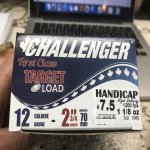
What does this label mean?

Potashminer

CGN Ultra frequent flyer
Uber Super GunNutz
Rating - 100%
589   0   0
Location
Western Manitoba
I am hoping someone experienced with shotguns can tell me what is "HANDICAP" meaning on this label - not sure that 1200 fps is actually High Velocity compared to other shotgun loadings - but there it is. #7.5 lead shot (I hope), 1 1/8 ounce load, 3 drams equivalent powder load. I do not compete - informal shooting at clay pigeons in a pasture - hoping to maybe get a grouse or two with these. I intend to use in a made-in-1955 Model 12 Winchester - that barrel is marked as 12 gauge, 2 3/4" chamber, and Full choke. I hope these turn out to be suitable ammo?

ED07053E-4402-4826-9699-8783A8B2147C_1_201_a.jpg
 

Attachments

  • ED07053E-4402-4826-9699-8783A8B2147C_1_201_a.jpg
    ED07053E-4402-4826-9699-8783A8B2147C_1_201_a.jpg
    89.6 KB · Views: 779
Standard trap is shot at 16 yards. When you get into longer distances, up to 27 yards, it is known as handicapping. The suggestion is this ammo is suitable for that, with more shot and higher velocity to help you make hits further out, compared to a standard target load with 1oz of shot at 1150fps. Many makers will call this a heavy target load, but calling it a handicap load is not unusual.

Yes, it will work just fine for grouse. Some people find they kick a little hard for those days you set out to smash 3-400 clays.
 
Anything 1200 fps to 1290fps loaded with 7.5 shot at 1 1/8 oz payload is considered for use on longer range targets and called “handicap” to denote this. The only thing missing is that the shot should be 5 or 6 percent antimony so that it deforms less on its journey down the barrel and flies truer. I’m not sure what Challenger is using for hard shot but AA is usually 5.5 and STS is usually closer to 6% while cheaper loads are usually 1.5 to 3%.
Handicap loads make good pigeon medicine!
 
Absolutely nothing wrong with those shells,I consider 1250 fps. more of a handicap load but those work well.Just had a bunch on sale at our club .
 
Thanks for bringing this up Potashminer. My mind goes the opposite direction when I see the word handicap - makes me think the load is going to handicap you, eg be less effective than a "regular" target load, but evidently that is entirely backwards.
 
Personally I would consider those a bit overkill for ruffies. I more typically hunt grouse with 7/8 or 1 oz loads moving at between 1150 and 1200 fps. Not that they won't work....just more than is needed.
 
A 7/8 ounce load at 1100-1150 is more than adequate for any grouse. Theyre super soft and easily dispatched. I like the smaller gauges for a foray of forest chickens. Everybody has an opinion, like 3 1/2 inch shells are required for waterfowling. Use whatever gives you confidence but light loads keep you on target better for multiple engagements.
 
Why not get steel shot if you are aiming at an animal?

Do you think it feels different being dispatched by one versus the other! Besides that the lead is much more effective. Your from California Im guessing. (meant as humour) Lead kills much more efficiently than steel. Ask anyone who lived thru the transition from lead to steel for waterfowling, I only shoot tungsten when I waterfowl for ducks and geese cuz its even better than lead. I use steel for Commies for the cost factor and the amount we shoot.
 
Why not get steel shot if you are aiming at an animal?

I guess because I have killed a large number of things with lead shot - so I am convinced it works - when gov't said I needed to use "non-toxic" shot, about the only stuff around to buy was steel shot - in most every way, that I could read about, it is inferior to lead shot for killing things. But if steel shot is all that someone knows about, it is understandable they may not know or realize how inferior it is, compared to what used to be used. The last goose shoot I was on, we were using #2 and BB lead shot - 3" and 2 3/4" Magnum loads - and the four or five shooters of us all limited out that shoot - never did it since - no real need to - too many "restrictions". Was common back in those days to use #4 lead for ducks, and #6 or #7.5 lead for grouse - if you chose to take a shotgun for them.

The guy holding the mallard was a MUCH younger me; this picture was taken after that morning's shoot.

zelmageese.jpg
 

Attachments

  • zelmageese.jpg
    zelmageese.jpg
    90.4 KB · Views: 272
Last edited:
Do you think it feels different being dispatched by one versus the other! Besides that the lead is much more effective. Your from California Im guessing. (meant as humour) Lead kills much more efficiently than steel. Ask anyone who lived thru the transition from lead to steel for waterfowling, I only shoot tungsten when I waterfowl for ducks and geese cuz its even better than lead. I use steel for Commies for the cost factor and the amount we shoot.

I've called BS on that since day 1 and decades of research by Tom Roster has pretty much proven that. I said right from the beginning the guys who claimed you couldn't kill with steel didn't kill any better than they did with lead and I've hunted with plenty of them. The good shooters I've hunted with could kill just as effectively with steel as lead because they shot well enough and could judge range well enough to centre birds in the pattern. Steel gave the marginal ability shooters the excuse they needed for their misses and crippled birds.

As for target loads it is now less expensive for ammunition manufacturers to produce shot made from steel than high antimony lead and steel is HARD and patterns much better due to not deforming when fired. I hear alot of claims if steel shot became mandated for the clays games many would walk away but I've shot steel shot target loads on several occasions and it worked very well on sporting clays, skeet and 5-stand. I have never tried it on trap. It would be interesting to try it from my assigned yardage of 25.5. I would not give up the clay shooting because of a shot change. I'm actually kind of surprised in this day and age that more clubs and ranges haven't switched over.
https://www.outdoorlife.com/guns/steel-shot-lethality-testing/?amp

 
Last edited:
I've called BS on that since day 1 and decades of research by Tom Roster has pretty much proven that. I said right from the beginning the guys who claimed you couldn't kill with steel didn't kill any better than they did with lead and I've hunted with plenty of them. The good shooters I've hunted with could kill just as effectively with steel as lead because they shot well enough and could judge range well enough to centre birds in the pattern. Steel gave the marginal ability shooters the excuse they needed for their misses and crippled birds.

https://www.outdoorlife.com/guns/steel-shot-lethality-testing/?amp


No one ever said you couldn’t kill with steel. Just that it is much less effective than lead. As you acknowledge in the last couple lines of your post. It is utter BS to claim steel pellets are as lethal as lead pellets. They need to be bigger, they need to go faster and there is less margin of error. The last 30 years have proven that. And Roster is not the all knowing guru he’s made out to be. He’s a shill for the steel lobby.
 
I suppose my biggest "beef" about that changed requirement was the insistence by so many that I would have to get my shotguns altered - and I thought, at the time, there was other better things to spend my money on - like beer. My Browning BPS had a Modified choke - so I was told that was likely okay for steel shot - the others with Full Choke - likely they were not suitable without modification. So I chose not to go hunting with them. And this Model 12 that showed up this week - 12 guage, 2 3/4" chamber and Full Choke - is likely not suitable for steel shot either - though I could likely get by with other types of "non-toxic" shot, now that I can afford to do so. Just does not seem to be worth the effort to me. I have an O/U 28 guage with 5 choices of screw-in choke and an O/U 20 guage that is Skeet and Skeet - so about any choke that I might want to use - they would do fine for grouse - but neither of them is even close to being made-in-1955.
 
Last edited:
potashminor, for casual clays in your field, the handicap load or 3 dram loads is, in my opinion overkill. pick up some 2 3/4 dram 1oz, or some 2 3/4 dram 1 1/8 oz loads. more fun with less recoil. fps stands for feet per second, and 1100 to 1150 fps is plenty for recreational clays. and plenty for trap at your gun club.
 
The biggest difference between lead shot and steel shot is the ability to retain velocity and as a consequence of that energy. Big game hunters have known for years that the most effective bullets at long range are the ones able to retain energy. At close range there is little difference in energy between steel shot and lead shot but at longer ranges the lighter steel pellets slow down quicker and loose energy. That’s why you see steel hunting loads that are using lighter payloads loaded to higher velocity, it’s an attempt to retain higher velocity out to a further distance to retain energy. 1 1/8 oz of steel leaving the muzzle at 1200 fps is travelling much slower at 50 yards than the equivalent lead load so there is no way possible that the steel is as effective at that distance, I’m not saying it won’t break a target or kill a bird, only that it’s not as effective.
 
The biggest difference between lead shot and steel shot is the ability to retain velocity and as a consequence of that energy. Big game hunters have known for years that the most effective bullets at long range are the ones able to retain energy. At close range there is little difference in energy between steel shot and lead shot but at longer ranges the lighter steel pellets slow down quicker and loose energy. That’s why you see steel hunting loads that are using lighter payloads loaded to higher velocity, it’s an attempt to retain higher velocity out to a further distance to retain energy. 1 1/8 oz of steel leaving the muzzle at 1200 fps is travelling much slower at 50 yards than the equivalent lead load so there is no way possible that the steel is as effective at that distance, I’m not saying it won’t break a target or kill a bird, only that it’s not as effective.

Absolutely FF the speed is what works with steel ,early steel loads were imho junk as they failed miserably ,resulting in more than a few cripples.Modern steel works pretty well now but I to remember those early days...RD
 
I've called BS on that since day 1 and decades of research by Tom Roster has pretty much proven that. I said right from the beginning the guys who claimed you couldn't kill with steel didn't kill any better than they did with lead and I've hunted with plenty of them. The good shooters I've hunted with could kill just as effectively with steel as lead because they shot well enough and could judge range well enough to centre birds in the pattern. Steel gave the marginal ability shooters the excuse they needed for their misses and crippled birds.

As for target loads it is now less expensive for ammunition manufacturers to produce shot made from steel than high antimony lead and steel is HARD and patterns much better due to not deforming when fired. I hear alot of claims if steel shot became mandated for the clays games many would walk away but I've shot steel shot target loads on several occasions and it worked very well on sporting clays, skeet and 5-stand. I have never tried it on trap. It would be interesting to try it from my assigned yardage of 25.5. I would not give up the clay shooting because of a shot change. I'm actually kind of surprised in this day and age that more clubs and ranges haven't switched over.
https://www.outdoorlife.com/guns/steel-shot-lethality-testing/?amp


Steel shot would be a handicap for the longer range sporting clays targets, as you would need to go with a larger shot size to still break targets reliably, and that would result in a less dense pattern at the distances where you really need it. And it would be a handicap when shooting skeet with a 410, again because you would need to go with a larger shot size than #9 to reliably break targets, and with only 1/2 ounce of shot, the pattern density is already not great.

I like the 28 gauge for upland hunting, and again having to step up in shot size, to ue steel, would reduce the pattern density. While steel is effective in many situations, it is not as effective in some situations.
 
Back
Top Bottom