What pressure do you load to in modern firearms?

1.3% is correct. Let's work it out a different way but amounts to the same thing in my first calc.

At 65,000 psi:

9.3 thrust: pi/4 x d^2 x F = pi/4 x 0.476^2 x 65,000 = 11,566.9 lbs
'06 thrust: pi/4 x 0.473^2 x 65,000 = 11,421.6 lbs

Thrust ratio: 11,566.9 / 11,421.6 = 1.013 which equates to 1.3%

Or for a difference of: 11,566.9 - 11,421.6 = 145.3 lbs

So as a percentage that would be: 145.3 / 11,421.6 = 0.013 x 100 = 1.3%
 
Bolt thrust math formulas are "ball park" estimates and not very accurate. The hardness of the brass and the amount of head clearance or shoulder bump determines the amount of bolt thrust and the dwell time the base of the case contacts the bolt face in a "dry" chamber.

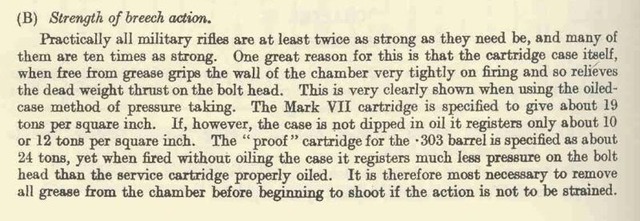
The British used the base crusher system to measure chamber pressure. A hollow copper crusher was used at the base of the case that allowed the firing pin to pass through the copper crusher. Then the case was oiled to keep it from gripping the chamber walls and then fired. Below is from the 1929 British Textbook of Small Arms.

NOTE, a British .303 Enfield rifle was proof pressure tested with two oiled proof cartridges. And if the the headspace increased over .003 the rifle failed proof testing due to excessive bolt setback.

W8oz09S.jpg


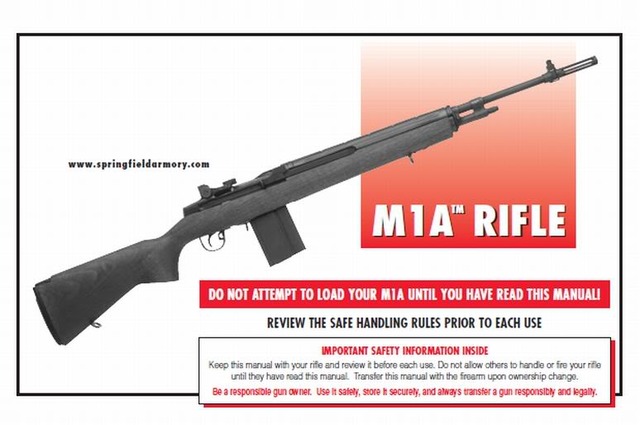
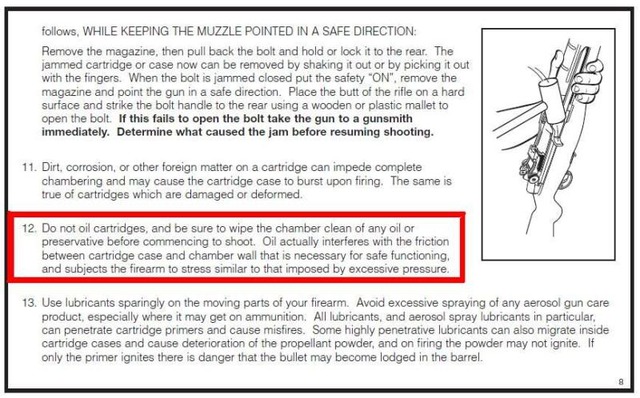
You now know why to "NOT" lube a cartridge case and also keep your chamber free of any oil or grease.

NKNfs2n.jpg


l82GT10.jpg
 
Interesting. Rhetorically, which yields first as a ham-fisted handloader goes about exceeding the SAMMI-specified maximum pressure with his hot loads - bolt lugs or chamber?
 
Last edited:
Interesting. Rhetorically, which yields first as a ham-fisted handloader goes about exceeding the SAMMI-specified maximum pressure for his rifle - bolt lugs or chamber?

As the rifle gets older the headspace increases, the SAAMI lists headspace as min and max with .010 between the two. The GO and NO-GO gauges are .003 apart and are for new barrel setup.

With a little humor added, I have never heard anyone complaining that their chamber diameter is getting larger.

Below is from the H.P. White Testing Laboratory. Sorry for the small size of the image.

eWiBhrF.jpg


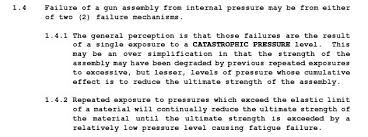
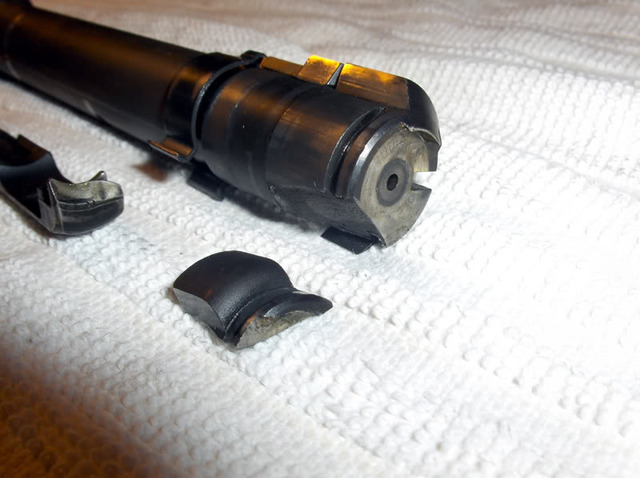
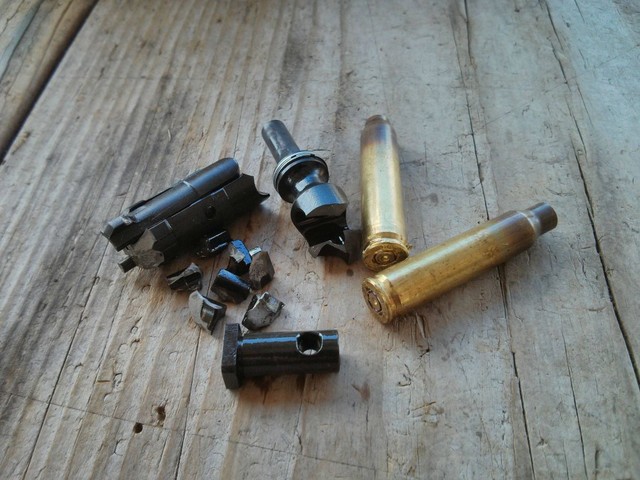
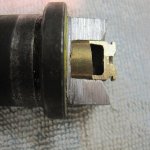
Below the effects of excessive bolt thrust.

cKCA1re.jpg


PijdpgS.jpg


When you have clearance between the bolt face and base of the case (shoulder bump) the case must stretch to meet the bolt face.

In simple terms the case will act like a cars shock absorber and reduce the amount of bolt thrust and the dwell time the case head contacts the bolt face.

P.O. Ackley did a experiment with a 30-30 Winchester lever action and removed the locking bolt. He dried the chamber and wiped the case free of any lube and remotely fired the rifle and nothing happened. The case gripped the chamber walls but chamber pressure was not great enough to cause the case to stretch to meet the bolt face. And the only part of the case that contacted the bolt face was the primer when it backed out of the primer pocket.

Another example is our military Lake City cases made of harder brass. This harder and stronger brass exerts less bolt thrust because it take a higher pressure to make the brass stretch to meet the bolt face.

A reverse example, the older Enfield rifles could be made of softer and cheaper steels. And the headspace could be adjusted with replaceable bolt heads to makeup for lug setback and the increasing headspace.

Your Canadian No.4 manual for the Canadian Rangers tells them if the bolt closes on the max .074 headspace gauge to only use the next longer bolt head that will not allow the bolt to close. Meaning keep the rifle at the longer headspace settings and let the case stretch and exert less force on the bolt face to make the rifle last longer.

 
Last edited:
The brass doesn't withstand the pressure. If it did, it wouldn't seal the chamber.

When the powder is burning, the brass acts like a tube in a bicycle tire. The brass is the tube and the chamber is the tire. Without the brass (or without the tube), pressure would escape. But just like a tube you would inflate to 100psi would expand until it would blow up, the brass would expand until it would blow up.

Case in point, some models of glock had "bad" chambers, that wouldn't contain the brass correctly. So the 35kpsi or so of a 9mm bulged the brass until it found something to support it or pressure is relieved (by the bullet leaving the case or through enough case expansion).

The whole point of the case is that it's thin enough to be stretched while the chamber is tough enough not to lose its shape.

The brass does seal the chamber. When the brass fails, the escaping gases find their way out in places they are not intended to, like the shooters face or the gas ports on the M98 mauser. It is a basic concept of metallic cartridges that the brass seals the chamber. :) v.


The brass DOES need to seal and contain the pressure in areas where it receives no support from the chamber. The unsupported areas are small enough and the actual resultant forces so small that the brass can contain the pressure in those areas. FOR EXAMPLE there are unsupported areas on the bolt face of many firearms for firing pins, ejector and extractor. Staying within the reasonable pressure limit and everything is OK, but you'll start to see those UNSUPPORTED areas start to extrude when the pressure gets too high and the unsupported brass is stretched beyond it's elastic limit. It's a fairly well known and understood concept.

ALL chambers have areas that do not provide complete support for the cartridge case. The problem with the Glock you mentioned was the unsupported area was too large.
 
So does 65,000 psi chamber pressure induce a stress level of 65,000 psi in the bolt lugs? Or chamber?

The bolt lugs don't see the actual pressure, they just see the thrust. Because the brass seals the the chamber. :)

Newton's third law: For every action there is an equal and opposite reaction.
 
Last edited:
Fact remains. 1.3% more.

In another reloading forum the moderator banned me for posting the same information I posted here. The moderator was a Engineer and was telling the forum it was OK to lube their cases.

So rather than have me prove his math formula was wrong about bolt thrust and lubing cases he banned me and deleted all my postings.

It is my understanding that in the U.K. at one time if a firearm was sold to someone else it had to be proofed and inspected again. And the additional proofing was discontinued because the headspace was increasing. Meaning the lubed proof rounds were causing lug setback from the added bolt thrust.

In Europe two lubed proof cartridge are fired to test the firearm, and here in the U.S. only one dry proof cartridge is used and testing is more relaxed. In fact I bought the parts to build my AR15 rifle and the barrel and bolt were never proofed as a unit together. I'm not sure if even the barrel was even proofed.
 
I have a 9.3x62 Zastava a Remington 700 in 8x57 and a Howa 1500 in 8x64 coming soon. I should be able to push them to 60k. Based on the comments the harder the brass the better. For the 8x64 I'm stuck with S&B but it seems pretty hard based on the chart. I was thinking Norma but after reading the chart Winchester seems like a good choice based on value/hardness. On a side note. When I started loading for my .35 Whelen years ago the max load for Nosler was lower. When I check the web site now that max load is hotter and I'm still using the same Remington 700 so I don't get it.
 
One thing to keep I mind when looking at pressure numbers is that it is important to know how the numbers were derived. CUP and PSI are not the same.

The individual rifle and the brass contribute a great deal to what is the maximum acceptable pressure. Can vary. There are a variety of indicators that pressure is getting up there. Case head expansion is a sure sign that the pressure is way too high.
 
ok so if I take factory ammo and measure after firing vs my hand load I should be able to tell if I'm over plus the chrony number should also tell me. Correct? What would be a normal expansion number measured at the case head?
 
ok so if I take factory ammo and measure after firing vs my hand load I should be able to tell if I'm over plus the chrony number should also tell me. Correct? What would be a normal expansion number measured at the case head?

Simple Trick for Monitoring Pressure of Your Rifle Reloads
http://www.hodgdonreloading.com/reloading-education/tips-and-tricks/simple-trick-monitoring-pressure-your-rifle-reloads


"One of the first rules of handloading is to always follow the approved reload data. The cautious reloader gradually works up to approved maximum loads to ensure his particular gun does not show pressure signs. Generally this is visual observation of the fired shell case head and primer. There is another slick way to check for pressure signs if you are interested.

Using a blade micrometer that measures in ten thousandths (.0001"), new, unfired cases can be gauged before and after firing to determine reasonably accurate maximum loads. Micrometers measuring in thousandths (.001") are insufficiently accurate to perform these measurements, and should not be used. Previously fired cases cannot be used accurately due to various levels of brass hardening. Measurement is taken just ahead of the extractor groove on the case head and must be taken at the same place on the case before and after firing. By placing a small mark on the case head – entering the cartridge in the chamber with mark at 12 o’clock – a consistently accurate measurement can be taken with each firing.

Lower pressure rounds, like the .30-30 Winchester, usually yield maximum pressures at .0003"-.0004" expansion. Modern cartridges, like the .223 Remington, will show maximum pressure at .0004"-.0005", while .308 Winchester, .270 Winchester, etc., typically yield .0005"-.0006" expansion at max pressure. Magnums, like the .300 Winchester Magnum, show maximums at .0006”-.0007” expansion, and should be measured on the belt.

In conjunction with these measurements, case head signs of pressure should be monitored as well. These signs include very flat primers, slightly cratered primers, ejector marks on the case head, and stiff extraction. All these case head signs indicate high pressure, and loads should be reduced until these signs disappear.

As always, start with the beginning load listed, and cautiously work up to the maximum shown for that set of components, using the methods listed herein."
 
Last edited:
Well let's see...

F = P x A

A = pi/4*d^2

Case head area ratio, 9.3 vs. 06: (0.476/0.473)^2 = 1.01273, so 1.3% more bolt face thrust on the 9.3 for any given chamber pressure compared to the '06.

1.3% > 0.0%. ;)

1.3% is correct. Let's work it out a different way but amounts to the same thing in my first calc.

At 65,000 psi:

9.3 thrust: pi/4 x d^2 x F = pi/4 x 0.476^2 x 65,000 = 11,566.9 lbs
'06 thrust: pi/4 x 0.473^2 x 65,000 = 11,421.6 lbs

Thrust ratio: 11,566.9 / 11,421.6 = 1.013 which equates to 1.3%

Or for a difference of: 11,566.9 - 11,421.6 = 145.3 lbs

So as a percentage that would be: 145.3 / 11,421.6 = 0.013 x 100 = 1.3%

The area of a circle is calculated as Pi (3.141592654) multiplied by the radius raised to the power of two, not by the diameter squared.

Here's a simple example of the error. Take a circle with a diameter of 10 inches. The area of the circle is 78.5398 square inches.

The calculation using the diameter squared yields 314.1592654 square inches

Your formula pi/4 x d^2 for the area of a circle is incorrect. It should be pi(d^2)/4

Here's the long answer: pi(d^2)/4=¼πd² with d=2r, or ¼πd²=¼π(2r)²=¼π(2²r²)=¼π(4r²)=πr² :)

Ted
 
Last edited:
This is one of the reasons I like Barnard actions. I have never heard of one failing. I guess it may be possible but it would have to be intentional and even then I bet you would have to try a number of times to do it.It is way way stronger than a remington etc etc. In any event I load to about max then back off to were the accuracy node is below that which usually ends up being a grain or two under max.It's super accurate and my brass lasts.
 
Action strength is one factory.
Support of the brass, and how an action handles gas in the event of a catastrophic case failure is another.
Actions rarely fail because of locking lugs shearing, etc. They fail when there is a release of high pressure gas.
 
Action strength is one factory.
Support of the brass, and how an action handles gas in the event of a catastrophic case failure is another.
Actions rarely fail because of locking lugs shearing, etc. They fail when there is a release of high pressure gas.

That is kinda my point. Even in such an event I doubt you could get a Barnard to fail. To my knowledge there has never been a failure of a Barnard action. There have been failures of Bats, Rems, Tikka, Sako, Winchster, ruger etc etc but never heard of a Barnard failing.
 
Back
Top Bottom