Wilderness Handgun Safety Course

hafetysazard

CGN Regular
Rating - 98.9%
94   1   0
Open question to anyone who has taken an approved course, or instructs the course, of what to expect for the course material, live-fire testing, what you have learned, etc.

I'll be taking the course shortly, and I would like to know what I am getting into.

From what I have gleamed from my instructor thus far is that you have to qualify with the gun you wish to carry, with the minimum acceptable cartridge being a .357 Magnum; or .22 LR if you're only carrying a sidearm as a trapper to dispatch animals.

I couldn't find any specifics online about what the course covers, or actually tests you on (ie what kind of target you must qualify on), but merely some side notes about it being required for a wilderness ATC, and how much some people charge for it.
 
Last edited:
Tagged for interest

Are you a trapper or guide or something? Or just a regular guy who realizes we should be allowed to ensure our own safety in the bush but are prevented from doing so by arbitrary and burdensome laws?
 
Tagged for interest

Are you a trapper or guide or something? Or just a regular guy who realizes we should be allowed to ensure our own safety in the bush but are prevented from doing so by arbitrary and burdensome laws?

Would be interesting to try and be a "regular guy" and get it
 
I recently got into trapping, to keep the family tradition going. I figured since I also shoot, and own, handguns, it would be a good idea to take the course as well, since I know an instructor willing to put the course on. I would rather the option to carry on my hip instead of trying to fumble with a rifle when I need (sometimes more than) two hands with what I am doing. During trapline maintenance, I wouldn't want to turn around to see some rabid animal between me and my rifle, or have to fumble with a .22 rifle trying to dispatch an animal in a leghold trap, during the season. Trappers have the wildest stories, and some didn't always walk away unscathed from them; some never lived to tell the tales.

Honestly, it is hard to say what I will be doing down the road for work, or how long this privilege is going to be around, so in my mind, having these qualifications are worth the fee for the course. Knowledge is power, and all that stuff...
 
Apparently, at least in some provinces, you need to derive a certain amount of your income from trapping to get an atc. Otherwise they consider it a "hobby".

If you don't have a registered line though, I'd say your chances are about zero. More power to you to try, but I don't think it will be easy at all, and you'll likely find a lot of push back.

Remember, we are merely plebes.... Our lives matter not
 
Trapline helpers are still required to submit harvest reports at the end of season as a condition of their license. Any fur they ship counts as income as a separate line on their tax return, plus any trapping related expenses can be tax deductable. You would be hard pressed to find any trappers these days who make a decent income from trapping alone. I wouldn't imagine they would call you a hobbyist because you're not making a decent profit.

Always worth a shot though...
 
Last edited:
Update #1: Successfully completed the Ontario Wilderness Handgun Safety Course, along with two other gentleman.

The course comprised of 3 examinations: practical test, live fire shooting test, and a written examination all focusing on handgun for defence, or dispatching.

The course covered a wide variety of topics related to carrying in the bush, and went over practical, and safety considerations above and beyond what you would learn in your CFSC/CRFS (function checks, holster selection, unholstering/reholstering, ammunition selection, ammunition handling, etc.)

Some interesting facts (an rumours) I learned:

- You must carry your gun in a strong side hip holster, with a minimum of one method of retention (level 1), and exposed. You can apply for a special condition on your ATC to carry it differently such as a shoulder holster, or cross-draw, and even protected (underneath clothing), but must prove that you are required to so. I think it was prior to 1994, that guys could carry however they wanted.

- The main recognized occupations that have their own particular application form are trapper, bear baiter, nuisance animal control, prospector/geologist, and wilderness pilot. There is also a separate form for any other wilderness occupation which the individual can prove they have a justifiable reason to carry a handgun (instead of a long gun). My instructor mentioned he has had wilderness photographers, and wilderness writers, take this course.

- The live fire shooting test involved a 5 yard timed course of fire, and an untimed 7 yard, and 10 yard, course of fire. Each course of fire was 6 shots at a target that was roughly a 6" black circle. You had 18 seconds to discharge all 6 rounds at the 5 yard distance. Minimum pass rate was 30/36, or 15/18 on your first try; basically if you could get 5/6 in the black for each course of fire, it is a pass. You are required to qualify with the gun you intend to carry for defense. If you strictly wanted to qualify for a dispatching handgun, then you only had to qualify with a .22 handgun and were not timed. I opted to qualify for defense with my .357 Mag (minimum for black bear), which also qualified me for dispatching. One of the other guys qualified with his .44 Mag. (recommended by experts & minimum for polar bear), and his 10mm pistol.

**Note: this was the live fire shooting test requirement for Ontario only, other provinces may likely have difference courses of fire. One province was rumoured to require people to shoot a full RCMP course of fire, at a 25 yard target, standing/kneeling/prone. Why? Who knows. If you're taking the course, but aren't sure of your province's requirements, it think you'll be pretty safe if you practice at 25 yards on a standard pistol target.

- The course is good for 4 years, then you must take a recertification course. Your ATC and ATT will typically be good for 2 years. Unfortunately, you must pay to reapply for your ATC, but it is tax deductable.

- Rumour has it that Ontario has roughly 600 individuals with ATCs and ATTs for wilderness protection, and only one individual with an ATC for 24/7 personal protection.

More to come...if you have any questions...shoot away!

note: Before you ask any legal stuff, it is important to know I am just a person who recently took the course in Ontario; nothing more. I can answer the best I can referencing what the book says, or my understanding of what the instructor told me.
 
Last edited:
Thanks for sharing. I am interested in taking this course. Could you provide the instructors contact details as well as cost and length of course? PM if you wish. Thanks.
 
From what you've posted I have a couple of observations, although my point of view is that of the defensive use of the wilderness handgun, rather than a trapper's kill gun. IMHO, the requirement for a strong side hip holster is nuts, we carry strong side, cross draw, or shoulder rigs as our individual circumstances dictate, the only requirements are that the gun is not concealed, and that the holster has a secure retention device, and the gun is not drawn unless you believe your life, or another's, is in danger. A .44 magnum is only a useful cartridge for bear defense when the individual carrying it, can shoot it well enough to save his life; hitting a 6" circle doesn't cut it. A person who is upset by the recoil of a .44 is clearly better armed with a .357, when the latter is loaded with bullets of 170 grs or more, that are designed more towards penetration and less towards expansion, and even 9mm 147 gr Truncated Cones are better than a pointy stick. A rule of thumb that I follow is to choose the heaviest bullet that can be loaded to 1150-1200 fps; my .44 is loaded with hard cast 325 gr WFNs, and my .357 is loaded with 195 gr hardcast SWCs. All rounds that are carried in the field should first be loaded and unloaded to ensure they chamber effortlessly; the last thing you ant is to struggle getting rounds in the gun.

A good target for bear defense training is the broad side of a 2X4, about a foot long, suspended 36" - 40" high, parallel with the ground, the idea is that you place your bullets as close to center as you can manage on the rearward 4"-6" to simulate a bear's head. A bear's brain cavity is only the width of its nose, and lies between the eyes to the front and the ears to the rear. I'm not a fan of timed fire, since IMHO, its more important to make your shot as quickly as possible, while ensuring a hit. Since the handgun is a last ditch weapon, concentrate shooting within 10 yards, with the most attention paid to shooting at 5 yards. A target that is moving rapidly towards you, is a difficult problem to solve, the inclination is to shoot where the target was, rather than where it is. A plastic pail that is tied to a line that is pulled by a vehicle, is a useful, and challenging training aid that provides the answer to the problem. Don't shoot towards the vehicle, begin with the pail to your front, and the vehicle to your rear.

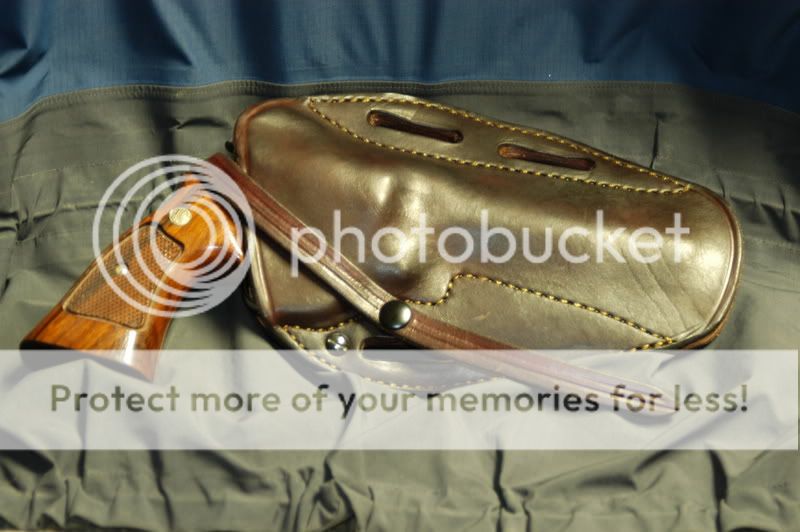
This holster epitomizes the wilderness carry holster, open muzzle so it doesn't fill with tinder, protection of both the hammer and trigger, and the provision to be carried strong side or cross draw. The gun is my M-27 Smith .357.

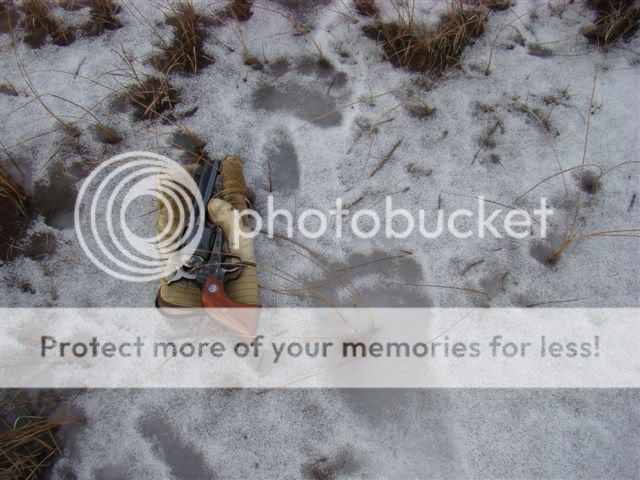
My Ruger Vaquero .44 magnum, dehorned and the front of the trigger guard narrowed to prevent a bruised trigger finger. The SA is my preference since there are no adjustable sights to break or knock out of alignment, and there is no crane to spring.

Keep in mind the brain is only the width of the snout, and it lies behind the eyes and ahead of the ears. This guy as mild mannered, but the photo illustrates the problem of target acquisition; see the problem with a 6" round target?


By contrast this grumpy little SOB was a serious candidate for getting shot, and since he was slightly below me, the target angle as nearly perfect, even if the brain was missed, if high, or late, the shot would break the spine.
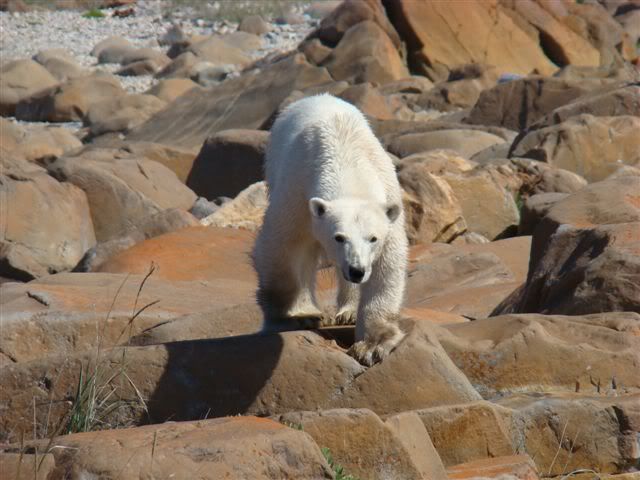

At this moment the target is so small as to be all but unavailable


Here is the pail shooting drill I referred to (click on the photo) although I used a rifle in the video, it could be conducted with a rifle, shotgun, or handgun . . . if your range has provisions for it.
 
That's a really cool drill. I wish we could actually do things like that in Canada with a handgun, but I can pretty much guarantee there are likely no ranges that would allow it. Too much risk of a shot not going where you want, they'd say

 
Very interesting. So now that you have the course do you need to apply for the ATC with references ect like a PAL?

I have to request the forms from the CFO, so I am not sure exactly what is required. However, in most cases, if you genuinely have income slips, letters from employers, reference letter from a head trapper, or something concrete to show that you're in a lawful wilderness occupation, you aren't likely to get denied. I don't imagine there would be any requirement for a reference, since you're already vetted theough your PAL, but I would have to grt back to you on that when the time comes.
 
Hey Boomer,

Great reply, everything you touched on was pretty much discussed at length during the course, which would be difficult to reiterate into one reply. I must say everyone else thought the strong side carry was ridiculous too, and you would have fit right in, because like you said, it should be what suits us. Unfortunately, in order to carry in a shoulder, or cross-draw, holster, and even protected, was something you have to justify wjth the CFO, such as writing a letter, and taking pictures of you wearing your kit, videos, etc...

Also, the minimum cartridge was .357 Magnum, unless you were in polar bear country, which I think is fair because it was understood a gun too hot to handle is more useless than a gun you could shoot even though it had less power. I think that is why it was required that you bring the gun you intended to carry to qualify with. Bullet selection, and so forth, was talked about and how heavier bullets tend to penetrate better in most corcumstances, and how faced bullets did a better job and breaking through bone, as opposed to round-nosed bullets which could easily ricochet, etc. Interestingly, back in the day, they were approving guys for .45 ACP, .38 Special, etc., but will no longer issue ATCs, and ATTs for anyone wishing to carry those guns.

In regards to the course of fire. It was aimed at proving that you had reasonable control over your firearm and could hit an animal reliably. Although ideally you would smack them in the loonie sized snout, or the playing card sized spot between their eyes, but that is something that practicing will help a person improve. Not to sound like I disagree with what you're saying is best, but I would say most people who need an ATC for wilderness protection are not target shooters, so requiring them to be able to hit a bear in the snout at 10 yards, in order to pass is a bit unrealistic. However, these requirements were discussed and decided on by the training organization in Ontario, and the CFO. Each province is different, with BC rumoured as being especially stringent because of the grizzlies. I think what is boils down to is reasonableness, not what is most ideal. If only 1 person in 20 were capable of hitting a loonie sized snout target, or playing cars sized skull target at 10 yards, then what need is there for the CFO to continue to issuing ATCs and ATTs if nobody could hit the target that we decided was adequate? I think what you said is most important, that what is boils down to is practice, which is why they made it a requirement that ATC holders also must belong to a shooting club to maintain proficiency (which is a no brainer). Myself and the individuals taking the course were all target shooters, so it went without saying, but for those who weren't the instructor would heavily stress the practice part. Things could change though, and if you don't pass your recert, you have to take the course all over again until you do.


edit: by the way, that training drill looks amazing! I don't think my outdoor range would allow it, for handguns "no midrange targets, and all must go into the back stop." However, at the indoor range, the target holders move pretty fast....
 
Last edited:
Back
Top Bottom

































































