From what you've posted I have a couple of observations, although my point of view is that of the defensive use of the wilderness handgun, rather than a trapper's kill gun. IMHO, the requirement for a strong side hip holster is nuts, we carry strong side, cross draw, or shoulder rigs as our individual circumstances dictate, the only requirements are that the gun is not concealed, and that the holster has a secure retention device, and the gun is not drawn unless you believe your life, or another's, is in danger. A .44 magnum is only a useful cartridge for bear defense when the individual carrying it, can shoot it well enough to save his life; hitting a 6" circle doesn't cut it. A person who is upset by the recoil of a .44 is clearly better armed with a .357, when the latter is loaded with bullets of 170 grs or more, that are designed more towards penetration and less towards expansion, and even 9mm 147 gr Truncated Cones are better than a pointy stick. A rule of thumb that I follow is to choose the heaviest bullet that can be loaded to 1150-1200 fps; my .44 is loaded with hard cast 325 gr WFNs, and my .357 is loaded with 195 gr hardcast SWCs. All rounds that are carried in the field should first be loaded and unloaded to ensure they chamber effortlessly; the last thing you ant is to struggle getting rounds in the gun.
A good target for bear defense training is the broad side of a 2X4, about a foot long, suspended 36" - 40" high, parallel with the ground, the idea is that you place your bullets as close to center as you can manage on the rearward 4"-6" to simulate a bear's head. A bear's brain cavity is only the width of its nose, and lies between the eyes to the front and the ears to the rear. I'm not a fan of timed fire, since IMHO, its more important to make your shot as quickly as possible, while ensuring a hit. Since the handgun is a last ditch weapon, concentrate shooting within 10 yards, with the most attention paid to shooting at 5 yards. A target that is moving rapidly towards you, is a difficult problem to solve, the inclination is to shoot where the target was, rather than where it is. A plastic pail that is tied to a line that is pulled by a vehicle, is a useful, and challenging training aid that provides the answer to the problem. Don't shoot towards the vehicle, begin with the pail to your front, and the vehicle to your rear.
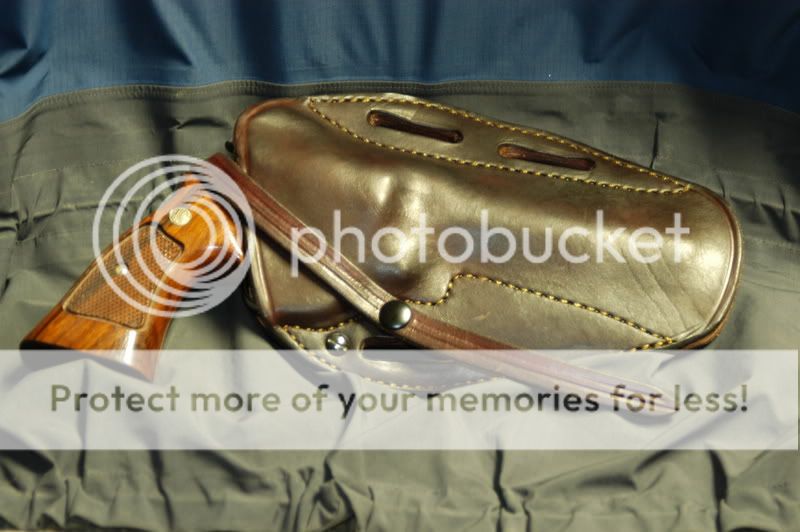
This holster epitomizes the wilderness carry holster, open muzzle so it doesn't fill with tinder, protection of both the hammer and trigger, and the provision to be carried strong side or cross draw. The gun is my M-27 Smith .357.
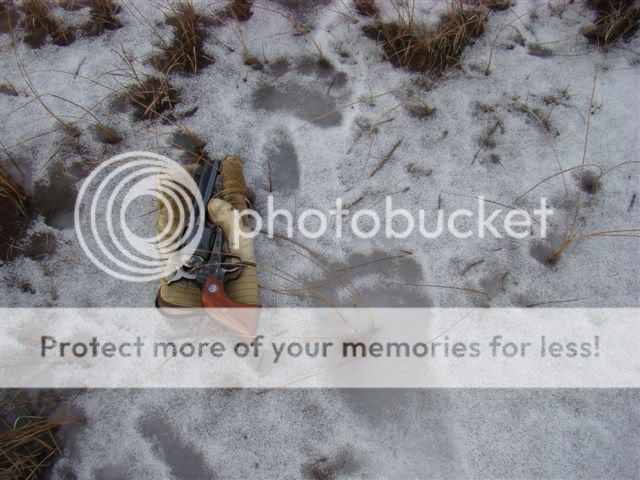
My Ruger Vaquero .44 magnum, dehorned and the front of the trigger guard narrowed to prevent a bruised trigger finger. The SA is my preference since there are no adjustable sights to break or knock out of alignment, and there is no crane to spring.
Keep in mind the brain is only the width of the snout, and it lies behind the eyes and ahead of the ears. This guy as mild mannered, but the photo illustrates the problem of target acquisition; see the problem with a 6" round target?

By contrast this grumpy little SOB was a serious candidate for getting shot, and since he was slightly below me, the target angle as nearly perfect, even if the brain was missed, if high, or late, the shot would break the spine.

At this moment the target is so small as to be all but unavailable

Here is the pail shooting drill I referred to (click on the photo) although I used a rifle in the video, it could be conducted with a rifle, shotgun, or handgun . . . if your range has provisions for it.







































































