Bullet failures - What your experience has been.

What bullet construction has failed you the most, on big game.

  • Mono Metal

    Votes: 25 20.3%
  • Partition or A Frame Style

    Votes: 2 1.6%
  • Bonded

    Votes: 6 4.9%
  • Cup and core

    Votes: 42 34.1%
  • Ballistic tip style

    Votes: 39 31.7%
  • Other

    Votes: 9 7.3%

  • Total voters
    123
Really? and how did you observe this?

On the subject of yaw: I've observed it on paper targets after clipping twigs and even fluffy snow (and of course slow rifling twist). Would never have thought a bullet would be upset that much having scraped an inch or two of fluffy snow but five keyholes resulted having tumbled from the snow in under twenty inches to the target. The tiny twigs I clipped with 90gr varmint bullets in a 270win and they key holed in under a foot of travel from twig to target. It's an interesting subject... I should try paper, fabric and fur/hide as obstructions in front of a target and see how quickly tumbling occurrs.

Bullets precess (yaw) twice in flight, once when they emerge from the muzzle and again when they encounter a denser than air medium. They can precess a third time at long range when they enter the transonic velocity range, if their rotational velocity is insufficient. The degree of yaw at close range can be established by looking at the concentricity of your bullet holes in paper. If the bullet hole is not concentric at 5-10 yards but is at 100, that's telling. If you recover an expanded bullet from a game animal that has a nose that has expanded at an angle, that's a sign of precession at impact, where the rotational velocity of the bullet was insufficient to recover.
 
This is a 130 gr. TTSX shot from a 300 Savage. Hit the deer left side at a quartering away shot,went almost the full length of the body. It did not hit any bone. Found it under the skin on the right side. deer went down when hit then got up and went about 30 yrds. and died. Not very much meat damage at all. Range was about 45 - 50 yrds.

rbuu6gP.jpg

kbYhWsu.jpg
 
What? The animal that hit the dirt and then stumbled to its death inside of 30 yards?

I can see it now. A photo of that barely expanded bullet and the tag line "Well, the animal died, didn't it? What more do you want?" Sales take the Nestea plunge.

If ones sole criteria for the success of a bullet is "hey, the animal dropped and died pretty quickly" then perhaps that kinda, sorta vaguely expanded bullet will do. Different strokes for different blokes and all. Personally I'd expect that of maybe a 180gr going at piddling speeds. The fact a 130 fared that poorly doesn't give me the warm and fuzzies.

Dead deer or no.

To each their own. I consider that a bullet failure in which the animal was luckily retrieved, wouldn't be willing to roll the dice if I knew they would come out looking like that all the time. YMMV.
 
Interesting, Boomer.
This is why I chose TTSX or TSX. I find the expansion reliable at any sane range.
My longest shot was about 330 yards, prone with a bipod, using a 150 grn TTSX in 7mm Rem Mag.
Bang flop, and no lead in my meat.
 
Bullets precess (yaw) twice in flight, once when they emerge from the muzzle and again when they encounter a denser than air medium. They can precess a third time at long range when they enter the transonic velocity range, if their rotational velocity is insufficient. The degree of yaw at close range can be established by looking at the concentricity of your bullet holes in paper. If the bullet hole is not concentric at 5-10 yards but is at 100, that's telling. If you recover an expanded bullet from a game animal that has a nose that has expanded at an angle, that's a sign of precession at impact, where the rotational velocity of the bullet was insufficient to recover.

Interesting: aside from the possible yawing imposed as they re-enter sub-sonic velocity range again I assumed all bullets left the muzzle rotating/true as the barrels could impart. I have recovered only one bullet from a game animal... (unbalanced expansion) made even less conclusive as it had smashed bone, heart and lungs before lodging several inches higher in the spine. I'm going to look silly shooting targets 5y away with a rifle just for the sake of seeing this.
 
My issue was a pencil exit wound, close range, on a average mule deer I recovered. Pretty much broadside, right through the heart. I consider it a bullet failure, saved by shot placement. Not ever giving tsx the chance to fail like that again. Ive had multiple physical exit holes the size of playing cards with partitions.
 
Black bear @ 60 feet with a Barnes TSX 250 9.3mm that drilled through the beast in the ribs, pierced the heart au exited with the same hole diameter. The bear died, but wasn't impressed.
Also a moose @ 300 meters, 165 gr 308 Win Ballistic Tip... the bullet was annihilated on entrance but there was almost no lungs to brag about when opened... at least, the beast died on the spot...
 
Interesting: aside from the possible yawing imposed as they re-enter sub-sonic velocity range again I assumed all bullets left the muzzle rotating/true as the barrels could impart. I have recovered only one bullet from a game animal... (unbalanced expansion) made even less conclusive as it had smashed bone, heart and lungs before lodging several inches higher in the spine. I'm going to look silly shooting targets 5y away with a rifle just for the sake of seeing this.

Short range terminal ballistics with consideration to twist rate is a thing. Consider that a 45/70 limping along at 1200 fps is fine with 400 to 530 grain bullets and a 1-20 twist. A .458 Win Mag which at least hopes for 2000 fps or more and using typically 450- 510 grain bullets is usually wrapped 1-14”. The difference is the 458 is twisted for stability in the target which is expected to be very close. The bullets do some freakish things otherwise. Sometimes do anyways.
 
Interesting question, which I think is best answered by, it depends. The Partition's terminal performance is based on losing the frontal section to explosive expansion and the TSX's terminal performance is based on weight retention. Monos are frequently chosen based on their length relative to a known lead core bullet, rather than being equal weight. A lighter bullet can have a higher muzzle velocity, and across moderate ranges, have a higher impact velocity. The greater the impact velocity, normally the more dynamic the rate of expansion, but a mono might expand or it might not expand. A bullet that does not expand will always penetrate deeper, though due to it's tapered profile, penetrate erratically, compared to a bullet of equal caliber and weight and that does expand. If the mono does expand, then its depth of penetration depends on whether or not it retains its petals or looses them. If the TSX retains it's petals, it retains 90% to 100% of its original weight, the expanded caliber increases 1.5X, moving the center of gravity forwards, ensuring straight line penetration. The large frontal area results in increased drag as the bullet passes through tissue, which decays its velocity quickly. The Partition by contrast will lose about a third of it's mass, but it's lead core shank is heavier than the shank of the TSX that's lost its petals, so its velocity decay is more gradual, provided the shanks of both bullets are reduced to their original caliber, which is unlikely. If the TSX expands and retains it's petals, it should be heavier than the shank section of the Partition, and its forward center of gravity should ensure it penetrates straighter, so it might well penetrate deeper, despite the drag of its greater frontal area. Partitions and TSXs both pernitrate deeply enough, when chosen appropriately for the size of game intended, but the terminal performance of the Partition is more predicable, over a broader range of impact velocities. If you wanted to compare the penetration of a TSX and a Swift A-Frame where both retain 95% of their original weight, its no contest.

Edited to add . . .
The longer the bullet, the more its affected by precession (yaw) from a barrel with a given twist. The TSX of equal weight to a lead core bullet is longer and will precess at impact for a longer period of time, which reduces penetration.

I see where youre coming from however...
You speak of losing petals causing the TSX to underperform the NP. More often they lose a petal, rather then all of them ime. Each petal is approximately 5% of the overall weight of the bullet, from the limited sample size of the TSX that I have recovered that are missing a petal. Losing all the petals, a TSX might lose 20-25% of its weight. Potentially carrying more weight than a NP at your referenced 33%

Further, the expanded TSX bullet exposes sharp cutting surfaces. So you get a large cutting wound channel that, I would guess, will out penetrate a NP. Or any other expanding lead hunting bullet.

Imo.
 
Bullets precess (yaw) twice in flight, once when they emerge from the muzzle and again when they encounter a denser than air medium. They can precess a third time at long range when they enter the transonic velocity range, if their rotational velocity is insufficient. The degree of yaw at close range can be established by looking at the concentricity of your bullet holes in paper. If the bullet hole is not concentric at 5-10 yards but is at 100, that's telling. If you recover an expanded bullet from a game animal that has a nose that has expanded at an angle, that's a sign of precession at impact, where the rotational velocity of the bullet was insufficient to recover.
Inspired to do some reading because of this discussion, I came across this short and concise article on bullet flight characteristics as well as terminal performance. If anyone is interested it's worth a read I think.


https://webpath.med.utah.edu/TUTORI... rotation of,bullet from the barrel increases.
 
a bullet has yaw out of the muzzle and wig-wags a bit for the first 100 yards.

Really? and how did you observe this?


First, I was taught this in Ballistics 101. Mann, in his book "The Bullet's Flight" (probably published in the 20's) Set up cards at various distances and noted the egg shaped holes made by yawing bullets, and, as I recall, the yawing stopped around 100 yards. I don't think I have read the book in the last 50 years, but I might still have a copy somewhere. In the book he had pictures of his set up and of the egg shaped bullet holes.

In our lab we had a 40 yard tunnel, and I recall taking pictures of bullets in flight. the back ground was white cardstock with lines on it for reference. We could see yaw.
 
I see where youre coming from however...
You speak of losing petals causing the TSX to underperform the NP. More often they lose a petal, rather then all of them ime. Each petal is approximately 5% of the overall weight of the bullet, from the limited sample size of the TSX that I have recovered that are missing a petal. Losing all the petals, a TSX might lose 20-25% of its weight. Potentially carrying more weight than a NP at your referenced 33%

Further, the expanded TSX bullet exposes sharp cutting surfaces. So you get a large cutting wound channel that, I would guess, will out penetrate a NP. Or any other expanding lead hunting bullet.

Imo.

Actually, in a test I conducted with my .375, the 380 gr solid shank, lead core, bonded bullet I used virtually tied the penetration I got with a 270 gr XLC and a 300 gr X. Like the Xs, the 380 expands with 4 petals. The test consisted of a number of 5 gallon oil pails filled with drill mud lined up and fired into from 20 ft. The shot up pails were set aside, and fresh pails were used for each subsequent shot. Granted the construction of the early X bullets wasn't as sophisticated as the later TSXs, and perhaps one could argue that the test was skewed in favor of a very heavy for caliber bullet, due to the lower impact velocity, even the 300 gr Xs impacted more than 500 fps faster than the 380 gr lead core bullet. The point of the test was to determine which bullet would be less likely to break up on an off the muzzle, frontal shot on a buffalo, and the depth of penetration was only a secondary consideration. I had anticipated the Xs would outperform the lead core bullet; even Kevin Robertson's "The Perfect Shot" extolled the virtues of the new and fabulous .375/300 gr X bullet for all game one might encounter during an African safari. My test didn't support the superiority of the X bullet, and interestingly enough, Robertson's second book, Africa's Most Dangerous" speaks of the superiority of the 380 gr Rhino, which, by the time it was published, I had already figured out. So the X bullets impacted the test medium at 2900 fps for the 270 and at 2800 fps for the 300, left nice wound channels, and penetrated 32" into the drill mud. The petals broke off resulting in a frontal diameter of .510". By contrast the 380 expanded to .920", destroyed the first pail of drill mud making it impossible to measure the volume of the wound channel and was found an inch inside the 3rd pail, where the Xs had just dented it, the point is that although penetration was for all intents and purposes the same, the lead core bullet penetrated with nearly double the frontal caliber. and about 3X the frontal area, .205 square inches for the Xs and .665 square inches for the 380.

In the end the .375 stayed home and I killed the buffalo with a double rifle chambered for .500 NE. The range was about 50 yards, and the buffalo was quartering away. The 570 gr X bullet had a muzzle velocity of 2150 fps, expanded to an inch, and penetrated 32 inches of buffalo. That was almost identical to the performance I got from my .375 loaded with 380s in my test, not that I'm suggesting that drill mud is the equivalent of tissue, but if the tissue is an African buffalo, it might be.

With respect to the sharpness of the petals affecting wounding, if that makes any difference at all, it is at the very end of the bullet's trajectory. The bullet is surrounded by a shockwave that prevents it from touching water bearing tissue. For a long time I thought this was only the case while the bullet was supersonic, but apparently the shockwave is present even when the bullet has slowed dramatically, although I don't know for sure at what velocity the bullet actually begins to contact tissue.

As an aside, my African trip left me with a great deal of respect for modern solids, which perform far better than the old fashioned Kynoch tapered solids. With the .375 I shared on that hunt, I used Speer 300 gr solids exclusively, and was rewarded with fast one shot kills on both my wart hog and impala. That bullet was dropped by Speer since it was too expensive to manufacture, but it had a tungsten core which kept the length of the bullet short, which combined with parallel sides ensures straight line penetration, and the flat nose ensures a wide wound channel. The faster you drive these things, the deeper they'll penetrate, the opposite of an expanding bullet.

Petal type expansion as the 380 gr Rhino begins to open in a low density target . . .


Recovered from bullet test, 270 gr XLC, .300 gr X and 380 gr Rhino, with an unfired Rhino for comparison . . .
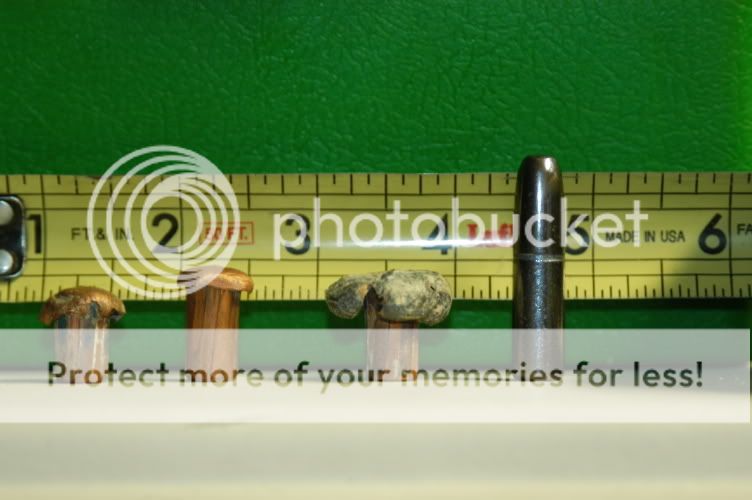

Recovered .375 270 gr XLC from test and the .510 570 gr X from my buffalo . . .

 
Last edited:
With respect to bullet failures, while its long into this thread, perhaps we should define our terms. A bullet failure is when the bullet performs differently that we have come to expect, or performs differently than what has been advertised by the manufacturer. Anchor3593 would consider a bullet that expanded and retained 90% of its original weight a failure because he wants the bullet to grenade inside the body cavity. To others this would be a disaster. A mono that sheds its petals has failed, and worse is one that has the petals fold back on themselves towards the hollow point, which might, but I can't prove, be a result of precession at impact. The idea is that the bullet in yaw forces the petal to fold across the hollow point, preventing fluid from entering and driving expansion. A lead core soft point that doesn't expand, shatters, or expands to the point that there is no shank left to provide a linear axis for rotational stability has failed. A solid that bends, rivets, or that has a squashed base has failed. These failures to perform within the design parameters of the bullet have nothing to do with whether or not the game animal was recovered, its purely about the bullet performing within its design parameters.

 
Back
Top Bottom