I see where youre coming from however...
You speak of losing petals causing the TSX to underperform the NP. More often they lose a petal, rather then all of them ime. Each petal is approximately 5% of the overall weight of the bullet, from the limited sample size of the TSX that I have recovered that are missing a petal. Losing all the petals, a TSX might lose 20-25% of its weight. Potentially carrying more weight than a NP at your referenced 33%
Further, the expanded TSX bullet exposes sharp cutting surfaces. So you get a large cutting wound channel that, I would guess, will out penetrate a NP. Or any other expanding lead hunting bullet.
Imo.
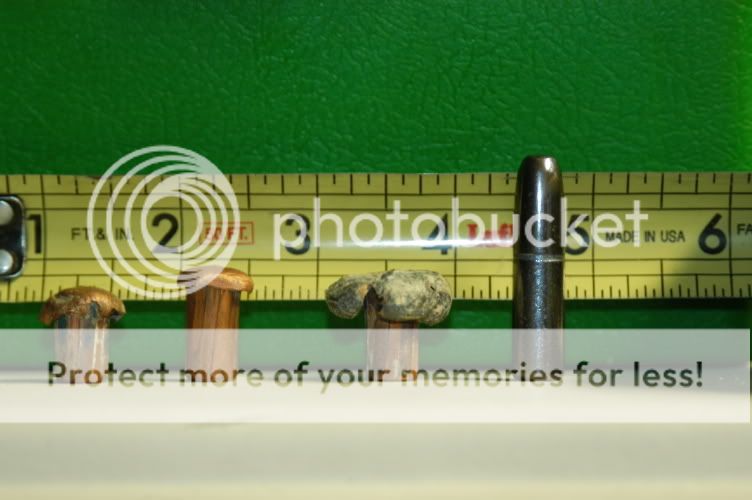
Actually, in a test I conducted with my .375, the 380 gr solid shank, lead core, bonded bullet I used virtually tied the penetration I got with a 270 gr XLC and a 300 gr X. Like the Xs, the 380 expands with 4 petals. The test consisted of a number of 5 gallon oil pails filled with drill mud lined up and fired into from 20 ft. The shot up pails were set aside, and fresh pails were used for each subsequent shot. Granted the construction of the early X bullets wasn't as sophisticated as the later TSXs, and perhaps one could argue that the test was skewed in favor of a very heavy for caliber bullet, due to the lower impact velocity, even the 300 gr Xs impacted more than 500 fps faster than the 380 gr lead core bullet. The point of the test was to determine which bullet would be less likely to break up on an off the muzzle, frontal shot on a buffalo, and the depth of penetration was only a secondary consideration. I had anticipated the Xs would outperform the lead core bullet; even Kevin Robertson's "The Perfect Shot" extolled the virtues of the new and fabulous .375/300 gr X bullet for all game one might encounter during an African safari. My test didn't support the superiority of the X bullet, and interestingly enough, Robertson's second book, Africa's Most Dangerous" speaks of the superiority of the 380 gr Rhino, which, by the time it was published, I had already figured out. So the X bullets impacted the test medium at 2900 fps for the 270 and at 2800 fps for the 300, left nice wound channels, and penetrated 32" into the drill mud. The petals broke off resulting in a frontal diameter of .510". By contrast the 380 expanded to .920", destroyed the first pail of drill mud making it impossible to measure the volume of the wound channel and was found an inch inside the 3rd pail, where the Xs had just dented it, the point is that although penetration was for all intents and purposes the same, the lead core bullet penetrated with nearly double the frontal caliber. and about 3X the frontal area, .205 square inches for the Xs and .665 square inches for the 380.
In the end the .375 stayed home and I killed the buffalo with a double rifle chambered for .500 NE. The range was about 50 yards, and the buffalo was quartering away. The 570 gr X bullet had a muzzle velocity of 2150 fps, expanded to an inch, and penetrated 32 inches of buffalo. That was almost identical to the performance I got from my .375 loaded with 380s in my test, not that I'm suggesting that drill mud is the equivalent of tissue, but if the tissue is an African buffalo, it might be.
With respect to the sharpness of the petals affecting wounding, if that makes any difference at all, it is at the very end of the bullet's trajectory. The bullet is surrounded by a shockwave that prevents it from touching water bearing tissue. For a long time I thought this was only the case while the bullet was supersonic, but apparently the shockwave is present even when the bullet has slowed dramatically, although I don't know for sure at what velocity the bullet actually begins to contact tissue.
As an aside, my African trip left me with a great deal of respect for modern solids, which perform far better than the old fashioned Kynoch tapered solids. With the .375 I shared on that hunt, I used Speer 300 gr solids exclusively, and was rewarded with fast one shot kills on both my wart hog and impala. That bullet was dropped by Speer since it was too expensive to manufacture, but it had a tungsten core which kept the length of the bullet short, which combined with parallel sides ensures straight line penetration, and the flat nose ensures a wide wound channel. The faster you drive these things, the deeper they'll penetrate, the opposite of an expanding bullet.
Petal type expansion as the 380 gr Rhino begins to open in a low density target . . .

Recovered from bullet test, 270 gr XLC, .300 gr X and 380 gr Rhino, with an unfired Rhino for comparison . . .
Recovered .375 270 gr XLC from test and the .510 570 gr X from my buffalo . . .