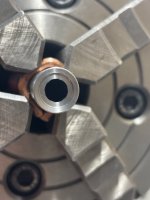
Barrel facing / crowning tools

Just a thought, theoretically could you not hammer a lead slug into the end of the barrel before machining the crown and upon cutting the crown (which will also cut the lead) hammer the lead out? This should push outwards any minor burrs that exist and help prevent burrs from forming in the steel in the first place, allowing them to be removed?
 
Actually, I have very limited experience at cutting crowns, maybe 1/2 dozen , and at the time I did them I was way more lackadaisical at realizing the importance of what I was doing...to me it was just an operation to create a good bore guard from damage. Not giving it any thought that the actual last cut will determine if a barrel will be accurate or not. Every slug that is fired from a barrel has to leave that bore at precisely the spot that your cutter will leave a bump or burr at the end of every land ever made.
My renewed interest in crown cutting came about from the thread postings over at Canadian Hobby Metal Workers and I had the time to think & corelate machining principles to cutting a perfect crown.
Machining experience tells me that it is virtually impossible to cut an absolute perfect crown by rotating a rifled bore against a stationary cutter....it just cant be done with the 3 facets ( the groove face, the first land face and the land face that the cutter exits from) of a bore that presents itself to a cutter. The cut tru the groove face & entering the land side's are both supported by barrel steel so no burr is possible but when that cutter ecits the land , that is unsupported by barrel steel and it is a machining property that steel will be pushed ahead of that cutter, creating an anomaly to that land side face.
Now i will muddy the waters a bit more on crowns...which side of that land do you prefer the burr to be on, the pressure side that has bullet thrust & rotational torque against it or the non pressure side that just acts as a slide path for the slug after rifling is engraved in it...because which side has the burr can be changed by simply rotating the barrel the other way and re-orientating your cutter to work backwards.
ill bet a few folks reading this will be giving the crown on their rifles a new thought , especially a few class 7 shooter that have spent thousands of dollars trying for perfection when simply having a new crown cut could change their rifle to a tack driver.

here we go a teck winnie reads every thing and has limited experience
gun tech and myself have put together 100's of rifles target rifles sporting rifles and other type of rifles
my point is when you catch up to the leaders then your in
your information my be correct on paper but the reality is it's only jargon
much like the guys that buy not scopes and look down a rifle bbl and say it won't shoot
 
After machining on a lathe I always 'finished' my crowns using a piloted 60 degree cutter. I had the opportunity once to have a crown finished that way be inspected on an electron microscope. The fellow doing that said the edges appeared to be cut as smooth as any he had inspected and better than many.

View attachment 1103716View attachment 1103717
Sorry i don't mean to speak on your behalf i built my first rifle in 1983 and have built many since and still build the occasional the eye site isn't as it used to be
i bought that big old La Blond lathe from Barroto's sports in 93 ish and built many rifles on it
 
Sorry i don't mean to speak on your behalf i built my first rifle in 1983 and have built many since and still build the occasional the eye site isn't as it used to be
i bought that big old La Blond lathe from Barroto's sports in 93 ish and built many rifles on it
I used that lathe for several years. I worked for the original owners Barry and Otto (1969) in the 4 story Adams building and over the years every owner after they died. I built a lot of rifles on that lathe.
 
Just a thought, theoretically could you not hammer a lead slug into the end of the barrel before machining the crown and upon cutting the crown (which will also cut the lead) hammer the lead out? This should push outwards any minor burrs that exist and help prevent burrs from forming in the steel in the first place, allowing them to be removed?
Or you could simply use a piloted 60 degree tool to finish. Much simpler, much quicker and a proven metrhod.
 
The smaller/lighter the bullet, the more critical the crown is. Any disruption of the gas at bullet exit will cause the bullet to be deflected. A 20 gr .17 cal is very easily bumped askew, compared to a 300 gr .338 projectile. If your bore isn't on centre when you cut the 11* cone, or any angular chamfer, you can get a depth error with the land width of the chamfer being early and late, depending on the position of the runout.

For milspec stuff going into combat, I have a different spec than a rifle for domestic use. Combat rifles being larger calibre, are not as easily deflected and can tolerated a less than perfect crown, and we go with a 60* carbide single flute chamfer.

For competition guns I run the barrel face at a 0* with a wee carbide tool, flat face so concentricity isn't an issue, even though it's dialed in. Next, I have specific brass spheres of a different diameter based on calibre, and lap each so that the land and groove end up with a broken corner, that is of perfect land width, and 100% burr free. The different diameter spheres are tailored to give a 45* break at the land/groove. My .17 cal rifles shoot incredible, as does everything larger. This crown is more suited to rifles that have brakes to protect them, unbraked I'll sink the flat area slightly.

 
Back
Top Bottom