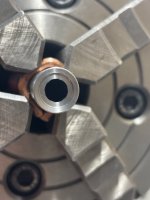
Actually, I have very limited experience at cutting crowns, maybe 1/2 dozen , and at the time I did them I was way more lackadaisical at realizing the importance of what I was doing...to me it was just an operation to create a good bore guard from damage. Not giving it any thought that the actual last cut will determine if a barrel will be accurate or not. Every slug that is fired from a barrel has to leave that bore at precisely the spot that your cutter will leave a bump or burr at the end of every land ever made.
My renewed interest in crown cutting came about from the thread postings over at Canadian Hobby Metal Workers and I had the time to think & corelate machining principles to cutting a perfect crown.
Machining experience tells me that it is virtually impossible to cut an absolute perfect crown by rotating a rifled bore against a stationary cutter....it just cant be done with the 3 facets ( the groove face, the first land face and the land face that the cutter exits from) of a bore that presents itself to a cutter. The cut tru the groove face & entering the land side's are both supported by barrel steel so no burr is possible but when that cutter ecits the land , that is unsupported by barrel steel and it is a machining property that steel will be pushed ahead of that cutter, creating an anomaly to that land side face.
Now i will muddy the waters a bit more on crowns...which side of that land do you prefer the burr to be on, the pressure side that has bullet thrust & rotational torque against it or the non pressure side that just acts as a slide path for the slug after rifling is engraved in it...because which side has the burr can be changed by simply rotating the barrel the other way and re-orientating your cutter to work backwards.
ill bet a few folks reading this will be giving the crown on their rifles a new thought , especially a few class 7 shooter that have spent thousands of dollars trying for perfection when simply having a new crown cut could change their rifle to a tack driver.