Chronographs, ES/SD and Accuracy – What’s Myth and Reality

Twenty thousand rounds from nine different lots across multiple barrels is strong evidence that good ammo shoots well across good barrels. About 2000 rounds from a lot of Center X with multilple rifles showed virtually the same results with each barrel. That's good evidence, too.

No barrel "fixes" bad ammo. Inconsistent ammo always remains inconsistent ammo. There's no magic synergy that makes some barrels cure inconsistent ammo by turning it into something else.

If you have any reliable evidence to support your claims, please direct readers to it. No one should hold his breath for this.
ONE ammo type across multiple HEAVY barrels... With unsurprising similarity in ES results.. is NOT the "science" you claim it to be. 10 shot ES groups can look very different, yet you withheld all evidence of ACTUAL performance on target. No true evaluation of your testing can be made. You are NOT forthright. You HAVE NOT presented any RELIABLE evidence of ammo shooting similarly across multiple barrels.
 
When you present evidence that different lots of match ammo shoot differently in different barrels you'll be on firmer ground. Until then your claims cannot be anything more than unverified speculation. Show the evidence to back them up.
 
When you shoot more than one type of ammo out of more than one profile of barrel you might begin to collect some meaningful data, but you will quickly find that it does not support your baseless assertion and this is why you refuse to do it. I pointed this out to you nearly two years ago.

 
When you shoot more than one type of ammo out of more than one profile of barrel you might begin to collect some meaningful data, but you will quickly find that it does not support your baseless assertion and this is why you refuse to do it. I pointed this out to you nearly two years ago.

There is a real risk that readers will fear that this will become an endless debate. It doesn't need to be. While we continue to wait for evidence you surely have (who in his right mind would make a claim without being able to back it up?), there is a better way to look at the problem.

More to come.
 
There is a real risk that readers will fear that this will become an endless debate. It doesn't need to be. While we continue to wait for evidence you surely have (who in his right mind would make a claim without being able to back it up?), there is a better way to look at the problem.

More to come.

You are confused, I am not debating, I corrected you. Indeed, it is odd that you make such wild claims without anything to back them up. Where is your evidence? This isn't about me, it's about YOU. You made fantastical claims and haven't brought forth evidence to support them yet somehow demand others bring a mountain of evidence to prove your false statements to be just that? It doesn't work like that. Your claim runs counter to the truth, the onus is on YOU to demonstrate it beyond all doubt. You have not done so. You spew unverified speculation.

Do you believe you somehow figured out something millions of shooters over decades have not yet? You're smarter than everyone? Nothing is new under the sun, your theory is just that, a theory, and it's not even a good one when scrutinized. No more talking from you until you've done the work, you are dismissed.
 
You are confused, I am not debating, I corrected you. Indeed, it is odd that you make such wild claims without anything to back them up. Where is your evidence? This isn't about me, it's about YOU. You made fantastical claims and haven't brought forth evidence to support them yet somehow demand others bring a mountain of evidence to prove your false statements to be just that? It doesn't work like that. Your claim runs counter to the truth, the onus is on YOU to demonstrate it beyond all doubt. You have not done so. You spew unverified speculation.

Do you believe you somehow figured out something millions of shooters over decades have not yet? You're smarter than everyone? Nothing is new under the sun, your theory is just that, a theory, and it's not even a good one when scrutinized. No more talking from you until you've done the work, you are dismissed.
For the record.
 
Overview of ES/SD Characteristics Between Lots

In general ES/SD figures are not the same throughout any variety of .22LR match ammo, including Lapua Midas, the variety tested here. This means ES/SD varies between lots of the same ammo.

Just so you're aware, you wouldn't simply average each subset's individual SDs to get an SD of the entire dataset. An SD is already a specific kind of statistical number and you need to treat it a certain way to combine multiple SDs into a single representative SD. You'd also need the mean velocity for each subset, and you'd have to do something like this:

total round count = Subset round counts added together:

N = n1 + n2 + n3 + n4 + n5 + n6 + n7 + n8 + n9

subset round counts and means combined like so:

grand_mean =
(
n1*mean1
+ n2*mean2
+ n3*mean3
+ n4*mean4
+ n5*mean5
+ n6*mean6
+ n7*mean7
+ n8*mean8
+ n9*mean9
) / N

and then

overall SD =
sqrt(
(
(n1 - 1)*SD1^2 + n1*(mean1 - grand_mean)^2
+ (n2 - 1)*SD2^2 + n2*(mean2 - grand_mean)^2
+ (n3 - 1)*SD3^2 + n3*(mean3 - grand_mean)^2
+ (n4 - 1)*SD4^2 + n4*(mean4 - grand_mean)^2
+ (n5 - 1)*SD5^2 + n5*(mean5 - grand_mean)^2
+ (n6 - 1)*SD6^2 + n6*(mean6 - grand_mean)^2
+ (n7 - 1)*SD7^2 + n7*(mean7 - grand_mean)^2
+ (n8 - 1)*SD8^2 + n8*(mean8 - grand_mean)^2
+ (n9 - 1)*SD9^2 + n9*(mean9 - grand_mean)^2
)
/ (N - 1)
)

and that would give you an SD figure that takes all the subset values into account. While that might coincidentally land near 7.1, it probably wouldn't.

As for the subject at hand, chronograph statistics don't really predict precision on target very well because barrel harmonics and overall firearm physics affect what each shot ends up doing, even if we assume every bullet is identical, which of course they aren't. The shot velocity mean and SD tell you what you should expect for future shot velocities from that lot, as that's what those figures predict. It's a bell curve, and the mean and SD tell you the size and shape of the curve. (ES isn't involved in determining that size and shape, which is why people shouldn't really be looking at ES. ES just says "These are the two furthest samples seen so far." and that doesn't really tell you much about the size and shape of the bell curve in question. That's the job of the mean and SD.)

Where shots ultimately land is down to many variables, of which velocity is only one. And that velocity's importance is affected by the other variables. For example, if positive compensation or negative compensation is at play, or some unfortunate combination of the two. Shot velocity mean and SD would only predict points of impact if you had a perfectly static barrel, as well as perfectly identical bullets. Gun drilling and rifling a solid cubic metre block of steel to make a rather unwieldly "barrel" that doesn't really change shape while firing isn't very practical, though. And it would shoot like crap since it wouldn't change shape, resulting in shot velocity variance dictating elevation on target. In that unusual case you would most definitely see shot velocity SD predicting the dispersion on target, quite directly.

So is there any reason to examine shot velocity stats for lots of ammo? Well, it can be useful in some ways. It might be able to tell you whether or not a given lot is likely to stay within a known positive compensation window more often, for example. Better SD means narrower bell curve. Worse SD means wider bell curve. And, naturally, the narrower the bell curve, the more you have staying in the good region. Reducing the scale of the bad region is probably a good thing.
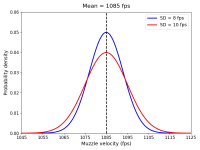

normal_curves_800x600.png
 
Last edited:
Back
Top Bottom

































































