Of course, European makers usually stop forend length at about 10 inches, maximum, regardless of barrel length. Barrel band swivel bases broke up the long expanse of barrel ahead of the forend and allowed the rifle to ride lower on the shoulder when carried with the sling over the shoulder. A European or British rifle with a 26" barrel looks different but OK nonetheless. American makers in the pre-war era, often went with forends of 12" or even more for 24" barreled rifles. Americans usually preferred a stock mounted swivel base probably because much American rifle building was approached from the basis of shooting with the sling as a holding aid. As time went on, American makers also made stocks straighter than did their European counterparts. Again, this is likely because Europeans built offhand rifles while Americans built prone rifles. Shooting styles may have dictated stock design or stock design may have dictated shooting style. I can't say which. The early FN's and Brownings were an example of an Americanized stock with their quite-long forarms. Their slightly humpy shape in the wrist/grip didn't look great but did a good job of positioning the hand.
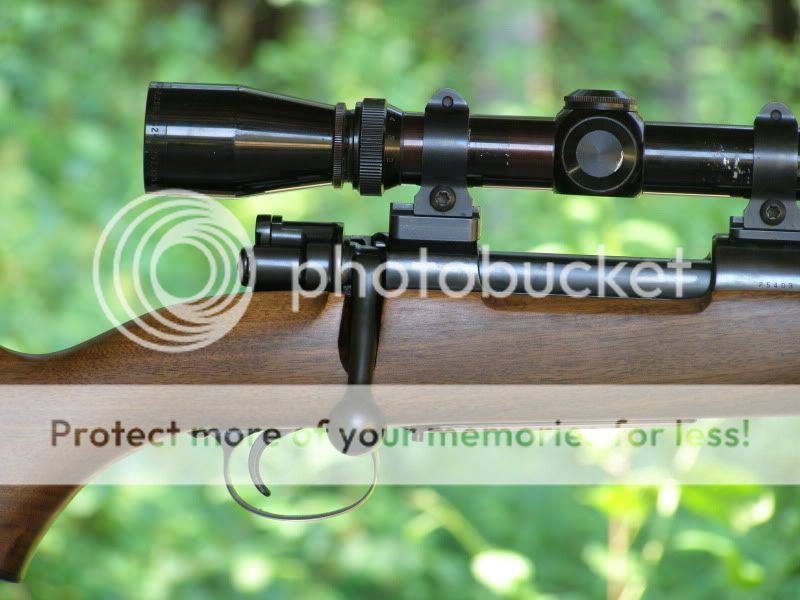
The stock on Mauser 98's rifle is typical of a late 40's American stock given a European forend. It is also an example of some pretty nice finishing work. Notice, the pores are filled and the finish is smooth and uniform. That's also a nice job of rust bluing. Regards, Bill.
The stock on Mauser 98's rifle is typical of a late 40's American stock given a European forend. It is also an example of some pretty nice finishing work. Notice, the pores are filled and the finish is smooth and uniform. That's also a nice job of rust bluing. Regards, Bill.