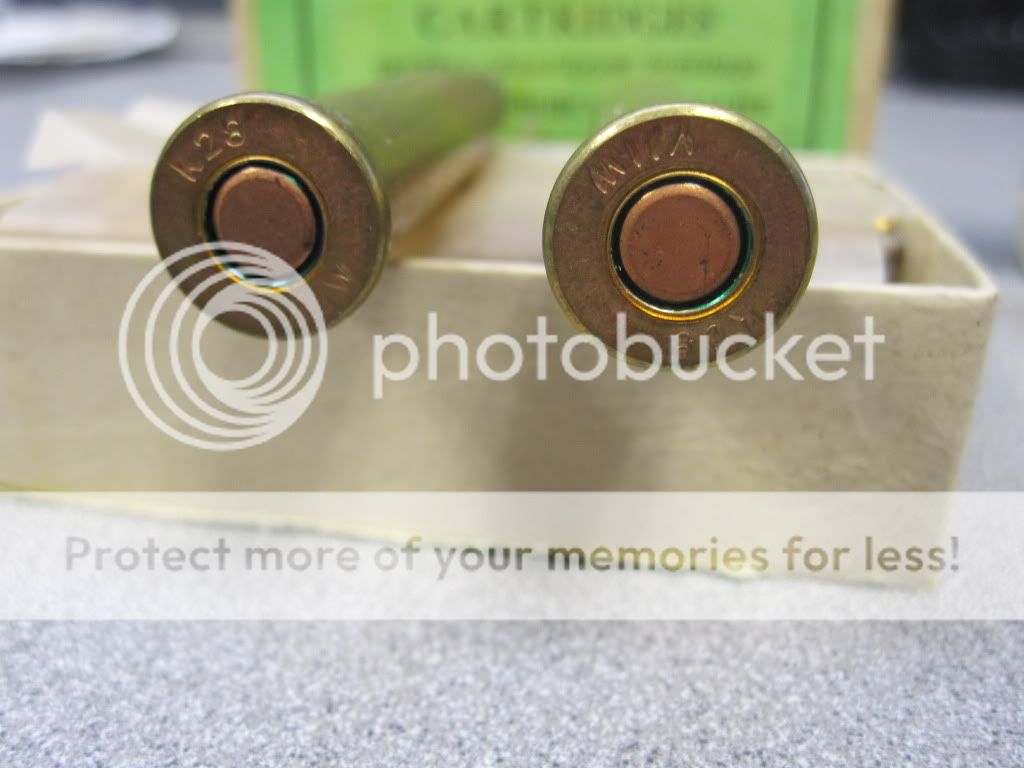
kynoch "air service" cartridges???

I just hope people don't start trying to section Tracers, Explosives and Incendiaries; they don't take too well to side-grinders.

Of course, the last two are illegal in free countries such as ours has become, even though the Government handed out thousands and thousands of rounds of just such ammo (AP, APIT, Tracer, Incendiary, not to mntion Ball) for target practice at one time; there is still a bunch of it out there but the same Government that handed it out now says it is illegal even to have. Sounds logical, coming from a Canadian Government, anyway. But I have seen bags of this stuff and there is still some floating around.

There were half dozen Marks of Tracer, each for a specific purpose. The Navy even had a special one for nighttime use; in it, the trace ignited a fair distance from the muzzle and started off quite dim: so the gunner would not lose his night vision.

W on an AP was instituted in 1917 and replaced the earlier AP type P.

B (for Buckingham) is for Incendiaries, and they came out also in the Great War, first for anti-Zeppelin duty, made by the fireworks company of that name. Later, they were made by the Government. My grandfather and grandmother both were in the Army at that time, Grandpa a sniper in 54 B'n, Grandmother in the Womens Army (British), in adjoining corner rooms of a big hotel, watching a Pup flame a Zepp with Buckinghams. They only met in Canada, several years after the War, and realised, on comparing memories, that they had been within 20 feet of each other that night, without knowing it! There is a Zepp Maxim from that Zepp in the IWM: armoured snout, no fittings for water-tank and hoses. I want it!

There were a LOT of different Specials, as they were termed, and they pretty well ran through the alphabet once-and-a-bit giving them designations. A REALLY impressive one is the B IV Z: AP, Icendiar and Tracer, all in one. Really great for torching the armoured gas tanks on 190s and 109s.

A thoroughly Canadian Special is the GP-B: little short lead bullet, used for indoor target practice with a .303. Designation is for Gallery Practice Ball. Not all designations were as logical.

Lots of variety with .303s. The late Major Peter Labbett literally wrote the book on the things (Calibre .303"), starting with the 1800 from his own collecton and then adding in another 1800 from the collection of the late Bert Woodend, who was Keeper of The Pattern Room until his demise a few years ago. I'm happy because ONE of mine ended up in The Book!

BTW, the designations as wehave them today only date from 1926/7. Before that a Tracer, for example, was headstamped
G VII; afterwards, the stamp became G I and later still G II, the standard War Two Tracer. So if you find old rounds samped VIIP, VIIB, VIIG, VIIW, you will know what they are.

Hope some of this helps.
.
 
BTW, the designations as wehave them today only date from 1926/7. Before that a Tracer, for example, was headstamped
G VII; afterwards, the stamp became G I and later still G II, the standard War Two Tracer. So if you find old rounds samped VIIP, VIIB, VIIG, VIIW, you will know what they are.

Hope some of this helps.
.


The bullet type letter indicator (G for tracer, etc.) usually seems to be after the Mark number (VII, etc.), but sometimes shows up before the mark number? As in G IV and VII W
Until this thread, I hadn't seen the type follow the mark number, such as the VIIP, VIIB, VIIG, or the VIIW as in the photo.



IMG_0291.jpg

 
i always thought this one had a black colored tip until this morning at the sun light..:eek:.anyways,in the color chart,what's the observing round doing?sorry again for the crappy close-up pic.
PICT0291.jpg
[/IMG]
PICT0293.jpg
[/IMG]
 
some other pertinent info:
Letter codes other than Manufacture’s Codes on .303 Headstamp

AA ---- Pomeroy explosive Incendiary Mk 2 Bullet (circa 1917)

B ---- Incendiary Bullet

C ---- Cordite Propellant charge(pre 1912)
D ---- Drill Round

E ---- Smoke Bomb Projector

F ----- Semi Armour Piercing

FG ---- Semi Armout Piercing Tracer

G ---- Tracer bullet

H ---- Grenade Discharger
J ---- Illuminating

K ---- Brock explosaive incendiary bullet (circa 1918)

L ---- Blank

O ---- Observation Bullet

P ---- Practice Round

PG ---- Practice Tracer

Q ---- Proof Round

R ---- Explosive Bullet

SPG ---- Tracer made before 1927

U ---- Dummy Round

W ---- Armour piercing bullet

WG ---- Armour Piercing Tracer

Z ---- Nitrocellulose Propellant Charge
 
Thanks to all for all the information... you have to admit the ammunition itself is as fascinating as the weapons.

So... I guess my guess the "W" stood for "Tungsten Penetrator" is just my overactive imagination.

Does anyone actually know what material the core of these AP rounds are made of?

Holding it on the grinder makes a signature spark trail... dull red-orange, but NOT voluminous at all. Certainly not like the bright white-yellow shower you get from tool steel. ( I'm not a metallurgist, but my Old Man showed me how to tell one steel from another, from cast iron...stuff like that, by grinding it). Mild steel? Low-carbon?

Anyways, now I can see how myths are created and perpetuated. Tungsten indeed! Probably old melted down bedsprings and pig iron!

( Myths!! ... we used to hear about the new M16 rounds in Vietnam... "tumbling throught the air like a buzzsaw and when it hit Charlie it just ripped his friggin' arm RIGHT OFF!!")

Well... I'll shoot off some of these next time I'm out. I've got an old section of railroad track to try the AP on.

( Yes, yes..I'll be well protected and hiding behing a big tree... NO children will be harmed! It's all about Risk Management, folks! )

Thanks again to all, and of course, to smellie, who seems to just have an unreal amount of knowledge on this sort of thing. That, or a library that the National Archives would be envious of.
 
BTW!! (Almost forgot...)

I need to buy THE BOOK !!!!

{{{The late Major Peter Labbett literally wrote the book on the things (Calibre .303"),}}}

Any idea where? ISBN number? Publisher?

I just have to own one!

Oh yeah... #2 ... why aren't the AP rounds considered "cop-killer" bullets and outlawed?

I realize I'm just stirring the pot and giving some arsehole up here another excuse to make more stupid laws... but really... a "teflon" coated 9mm, or a 30-06 AP. Seriously.
 
Back
Top Bottom