Killing an animal

Well, there is worse, some who do lambs will actually use the bone saw and start at the throat and saw through to take the head right off in one step.

You have to ask yourself the morbid questions:
Do you enjoy it?
Do you do it cause you have to?
Does it bother you?
Do you like bacon?

Those will tell ya what kind of person you are IMO, some are loaded questions.;)
 
We cut right at the base of the lower jaw and go right across severing both arteries and Veins in one sweep. No noise, and minimal "twitching"
 
Last edited:
Well, there is worse, some who do lambs will actually use the bone saw and start at the throat and saw through to take the head right off in one step.

You have to ask yourself the morbid questions:
Do you enjoy it?

Enjoy? NO. But there is a certain satisfaction to implementing another portion of the farm to table process. I do it because I don't want to put the responsibility on another nor do I trust them to do it right. Even when I screw up, I own the mistake and can't ##### at another.

Do you do it cause you have to?

No. I choose to. For the same reason that I put my own pets down instead on contracting it out to a vet. I know my animals and am best able to chose the circumstances of their death in a manner that provides the least amount of stress to them.

Does it bother you?

Yes, but only when it goes wrong (once). The pig we slaughtered for our own use did not go gently into that cold night. Ultimately it made me use him to the max. Hardly a scrap was wasted.

Do you like bacon?


Those will tell ya what kind of person you are IMO, some are loaded questions.;)


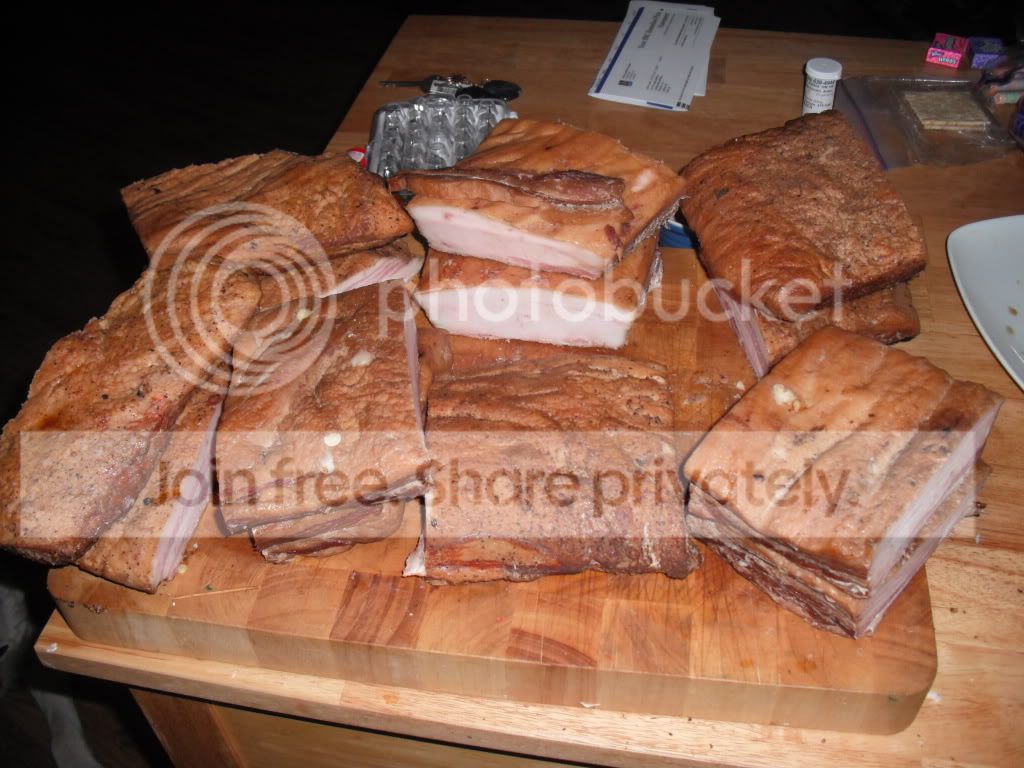
Mmmmmmmmmm! BACON! Made from Porkchop.
bacon2.jpg
 
I've slaughtered lots of animals, and I can't say it's my favorite thing to do. Much prefer killing when hunting, but it's something that has to be done if you are going to have livestock. I always shoot lambs, pigs, cows in the brain then cut their throat to bleed. I can't stand the slaughterhouses that just slice their throats. It's cruel and completely unnecessary in this day and age.
 
I've slaughtered lots of animals, and I can't say it's my favorite thing to do. Much prefer killing when hunting, but it's something that has to be done if you are going to have livestock. I always shoot lambs, pigs, cows in the brain then cut their throat to bleed. I can't stand the slaughterhouses that just slice their throats. It's cruel and completely unnecessary in this day and age.

Using a very sharp knife and a quick slash across the throat that severs the arteries, veins, windpipe and gullet in one go is a very quick and painless way for the animal to go. And allows for a complete bleed out.

This is not only one of the most humane ways to slaughter, it is also the "kosher" and "Halal" way of slaughtering
 
Using a very sharp knife and a quick slash across the throat that severs the arteries, veins, windpipe and gullet in one go is a very quick and painless way for the animal to go. And allows for a complete bleed out.

This is not only one of the most humane ways to slaughter, it is also the "kosher" and "Halal" way of slaughtering

I find the kosher and halal method of slaughtering animals vile. It's not as quick or painless as a bolt gun or a bullet to the brain, and therefore not as humane. I've done both methods, toured slaughterhouses and if I actually bought meat, I would never patronize a halal/kosher butcher.
 
I find the kosher and halal method of slaughtering animals vile. It's not as quick or painless as a bolt gun or a bullet to the brain, and therefore not as humane. I've done both methods, toured slaughterhouses and if I actually bought meat, I would never patronize a halal/kosher butcher.

This I got directly from Dr Temple Grandin's Website
http://www.grandin.com/
http://www.grandin.com/ritual/euthanasia.slaughter.livestock.html

Ritual Slaughter
Ritual slaughter is slaughter performed according to the dietary codes of Jews or Muslims. Cattle, sheep, or goats are exsanguinated by a throat cut without first being rendered unconscious by preslaughter stunning. Ritual slaughter is exempt from the Humane Methods of Slaughter Act of 1978 to protect religious freedom2.

Because ritual slaughter is exempt, some plants use cruel methods of restraint, such as suspending a conscious animal by a chain wrapped around one hind limb. In other plants, the animal is held in a restrainer that holds it in an upright position43,45,45. Whether or not ritual slaughter conforms to the requirements of euthanasia is a controversial question. When ritual slaughter is being evaluated, the variable of restraint method must be separated from the act of throat cutting without prior stunning. Distressful restraint methods mask the animals’ reactions to the cut.

The author designed and operated four state-of-the-art restraint devices that hold cattle and calves in a comfortable upright position during kosher (Jewish; Fig 3) slaughter35,42,43,46. To determine whether cattle feel the throat cut, at one plant the author deliberately applied the head restrainer so lightly that the animals could pull their heads out. None of the 10 cattle moved or attempted to pull their heads out. Observations of hundreds of cattle and calves during kosher slaughter indicated that there was a slight quiver when the knife first contacted the throat. Invasion of the cattle’s flight zone by touching its head caused a bigger reaction. In another informal experiment, mature bulls and Holstein cows were gently restrained in a head holder with no body restraint. All of them stood still during the cut and did not appear to feel it. Disturbing the edges of the incision or bumping it against the equipment, however, is likely to cause pain. Observations by the author also indicated that the head must be restrained in such a manner that the incision does not close back over the knife. Cattle and sheep struggle violently if the edges of the incision touch during the cut.

Figure 3: Head-holding device for ritual slaughter mounted on a double-rail (center-track) restrainer. The chin lift and forehead brachet should be equipped with pressure-limiting valves. The 15 cm wide forehead brachet with a 7.5 cm round pipe behind the animal’s poll holds the animal's head securely with little pressure. The pipe prevents the animal from pulling its head out. The pipe and forehead bracket are covered with rubber belting.

The design of the knife and the cutting technique appeared to be critical in preventing the animal from reacting to the cut. In kosher slaughter, a straight, razor-sharp knife that is twice the width of the throat is required, and the cut must be made in a single continuous motion. For halal (Muslim) slaughter, there are no knife-design requirements. Halal slaughter performed with short knives and multiple hacking cuts resulted in a vigorous reaction from cattle. Fortunately, many Muslim religious authorities accept preslaughter stunning. Muslims should be encouraged to stun the cattle or use long, straight, razor-sharp knives that are similar to the ones used for kosher slaughter.

Investigators agree that kosher slaughter does not induce instantaneous unconsciousness47,48,b. In some cattle, consciousness is prolonged for over 60 seconds. Observations by the author indicated that near immediate collapse can be induced in over 95% of cattle if the ritual slaughterer makes a rapid, deep cut close to the jawbone45. Further observations indicated that calm cows and bulls lose sensibility and collapse more quickly than cattle with visible signs of agitation. The author has observed that cattle that fight restraint are more likely to have prolonged sensibility. Gentle operation of restraint devices facilitates rapid loss of sensibility.

Cattle do not appear distressed even when the onset of unconsciousness is delayed. Pain and distress cannot be determined by measurements such as an electroencephalogram. Behavioral observations, however, are valid measures for assessing pain49. The author has observed that cattle appear unaware that their throat is cut. Investigators in New Zealand have made similar observations50. Immediately after the cut, the head holder should be loosened slightly to allow the animal to relax. The author also has observed that after the head restraint is released, the animal collapses almost immediately or stands and looks around like a normal, alert animal. Within 5 to 60 seconds, cattle go into a hypoxic spasm and sensibility appears to be lost. The spasms are similar to those that occur when cattle become unconscious in a headgate that is used for restraint in feedlots. Practical experience has shown that pressure on the carotid arteries and surrounding areas of the neck from a V-shaped headgate stanchion can kill cattle within 30 seconds.

Even though exsanguination is not an approved method of euthanasia by the AVMA1, the author has observed that kosher slaughter performed with the long, straight, razor-sharp knife does not appear to be painful. This is an area that needs further research. One can conclude that it is probably less distressful than poorly performed captive—bolt or electrical stunning methods, which release large amounts of epinephrine31,32.

Welfare can be greatly improved by use of a device that restrains the animal in a comfortable upright position. For cattle and calves, a conveyor restrainer or an upright restraint pen can be used42,43,46. In small plants, sheep or goats can be held by a person. If an upright pen is used, vertical travel of the lift under the animal’s belly should be restricted to 71 cm to prevent the animal from being lifted off the floor. A pressure limiting valve must be installed on the head holder and rear pusher gate43,45. Many existing upright restraint boxes apply excessive pressure. To prevent excessive bending of the neck, the head holder should position the animal's forehead parallel to the floor. Equipping the head holder with a 15-cm wide, rubber covered forehead bracket will make the head holder more comfortable (Fig 3). The animal should stand in the box with its back level. An arched back is a sign of excessive pusher-gate pressure. In some plants, animals are removed from the restrainer before they become unconscious. Discomfort to the animal can be minimized by allowing it to lapse into unconsciousness before it is removed from the restrainer.

During the past five years, many large kosher slaughter plants for cattle have replaced shackling and hoisting with upright restraint. Large numbers of veal calves and sheep, however, are still shackled and hoisted. Progressive plant owners have installed upright restraint equipment, but unfortunately there are some plant owners who still refuse to install humane restraint equipment because they are not legally required to do so. Animal handling guidelines published by the American Meat institute recommend the use of upright restraint6.

 
I had to (a long story I won't get into and a long time ago) chase down a 3 legged antelope on foot and dispatch it with a tire iron. It was very primitive and exhilarating.

 
Maybe it's human nature to be somewhat fascinated with death, since we're the only species to realize our own is inevitable.

That being said, the OP's fascination would quickly wane if it wasn't a novelty. I'm with H4831 as a farmboy. It's something has to be done, but you need not like it, and while I will never shirk from it, I don't look forward to it, either, and many times I have dreaded it.

I'm also with Gatehouse in his opinions on this.

Far as the fascination, if you keep seeking it, seek help, as you are a phsycopath.
 
This I got directly from Dr Temple Grandin's Website
http://www.grandin.com/
http://www.grandin.com/ritual/euthanasia.slaughter.livestock.html[/QUOTE


The part you highlighted is very telling. Throat slitting is less stressful than POORLY performed gun type killing. It's ridiculous to conclude that slitting a throat (whereby the animal remains conscious until it passes out) is less painful than the "lights out" approach of interupting the animals CNS system with a brain shot.

Proper halal methods may be slightly more humane than poorly done bolt guns, but poorly done halal is horrific.
 
Maybe it's human nature to be somewhat fascinated with death, since we're the only species to realize our own is inevitable.

That being said, the OP's fascination would quickly wane if it wasn't a novelty. I'm with H4831 as a farmboy. It's something has to be done, but you need not like it, and while I will never shirk from it, I don't look forward to it, either, and many times I have dreaded it.

I'm also with Gatehouse in his opinions on this.

Far as the fascination, if you keep seeking it, seek help, as you are a phsycopath.

Yep. Well said. I don't think we are the only species to realize death is inevitable though, I think we are just obsessed with the passage of time, and thus think of the future more. I think all life knows the score, instinctively.
 
This I got directly from Dr Temple Grandin's Website
http://www.grandin.com/
http://www.grandin.com/ritual/euthanasia.slaughter.livestock.html[/QUOTE


The part you highlighted is very telling. Throat slitting is less stressful than POORLY performed gun type killing. It's ridiculous to conclude that slitting a throat (whereby the animal remains conscious until it passes out) is less painful than the "lights out" approach of interupting the animals CNS system with a brain shot.

Proper halal methods may be slightly more humane than poorly done bolt guns, but poorly done halal is horrific.

In the most humane methods of halal slaughter, the edges of the wound are not allowed to touch. I remember reading a research paper on slaughter methods that showed cattle passed on with almost zero stress if cut with a razor sharp blade when their head was held up and the wound edges prevented from touching. If the wound edges touched then the animal would go into a thrashing panic. From what I've seen though, virtually no halal/kosher slaughter houses are doing it properly.
 
And even if they do it correctly, it's still not as quick as taking out the brain. The only reason the method is still allowed to exist in commercial operations is due to religion. Which is pretty crappy in my opinion.
 
Using a very sharp knife and a quick slash across the throat that severs the arteries, veins, windpipe and gullet in one go is a very quick and painless way for the animal to go. And allows for a complete bleed out.

This is not only one of the most humane ways to slaughter, it is also the "kosher" and "Halal" way of slaughtering
Right,keep telling yourself that. :rolleyes:
 
I'm not saying I enjoyed or liked doing it and watching it happen. I'm sayin it was a very differant experiance to watch another living thing die up close like that. If anything, I think it makes a person respect the animals we eat and understand more clearly the amount of work involved in preparing meat for the table. I think people should understand the process if not actualy witness it if they are going to eat meat. I found I have more respect for meat, where it comes from and how the animal has been treated (before and after) and the animal itself.

Also,in a hunting situation, unless its a "bangflop" the animal is going to run a bit and feel pain longer then a properly done "halal" or "kosher" slaughter or even bolt gun or electric stunning before hand.

Being from a jewish family and having members of my family that are fiarly religous, being able to slaughter and make an animal "kosher" is a welcome skill.
 
Back
Top Bottom