30-06's heavier bullet argument

I don't supppose you have ever had Norma 205/MRP to try with the 240 bullets.
It's much denser than H4831, taking up considerably less space in the case, but the same weight usually gives a little more velocity than does 4831, without showing more pressure.
Also, I am always aquainting H4831 to the original war surplus variety. When Hodgdon's started making new 4831, I tested it against my old surplus. With the traditional load, 60 grains in a 270 with 130 grain bullet, five cartridges of each loaded identical, except for the powder, the old surplus gave 102 fps more velocity than did the new H4831, and considerable less variation, as measured with an Oehler.

Hi Bruce. I've found the new H-100V produces slightly higher velocities than either 4350 or 4831 (although I've never tried the short cut version) and it also produced higher velocity than R-22 (MRP) which had to be heavily compressed, which is something I intensely dislike. The H-100V is advertised as a ball type powder with extruded powder burning characteristics, thus its advantage is very high loading density, though not quite as high as a true ball powder.
 
You've hit the nail on the head when it comes to the mono bullet crowd.

I guess that was the most repeatable measurement until the advent of the bullet test-tube.

That and weight retention. Animals now apparently weigh the bullet to determine whether they are dead or not. Wound channels are irrelevant.
 
It could be that he is finicky. Someone on 24hr Campfire asked about the 240's in the .30/06 and Phil said the 22o Partitions penetrated 2x as far as the 240 Woodleighs.

All I can say is that the 220 Partitions work very well!

Whenever someone does a bullet test they always seem to get stuck on penetration like its the only attribute that matters. Why not use solids for everything then?

I have no doubt that the 220 Partition is a great bullet, but both the 220 gr Partition and the 240 gr Woodleigh produce finite wound volumes. In general terms, the heavier bullet is a bit slower, so it follows that penetration is similar all else being equal, as the higher velocity of the lighter bullet makes up for the greater mass of the heavier one. But if the 220 penetrates deeper, its because it does not have as large a frontal area as the 240, so it disrupts less tissue along its tract. This is supported if one remembers the original premise for the terminal performance of the Partition; the front core is expended to create a massive wound, then the rear core, continues on like a light for caliber solid, penetrating deeply. The 240 on the other hand expands to a larger frontal area, yet penetrates deeply enough to exit in the majority of cases. The greater frontal area of the bullet regardless of the degree of expansion, disrupts more tissue along the entire length of its tract than will the rear core of the Partition. Both bullets will penetrate deeply enough to maximize the terminal performance possible with a .30 caliber rifle, but the 240 might have the edge in wound volume depending on the size and density of the target. Its not a case of one bullet being better than the other, its more a case of two bullets working differently towards achieving the same goal.

Some years ago now, I tested a variety of .375 bullets in preparation of going to Africa. I used drill mud as a bullet medium, and fired at very close range, to ensure the bullet I chose would not fail should I have an emergency with a buffalo at bad breath range. As a result of that test I determined the 380 gr Rhino was the best .375 bullet I'd ever encountered, and I am still of that opinion today. But when I gave a few of my pet 380 gr Rhinos to Crazy_Davy, he killed a black bear, recovered the bullet, and I was a bit disappointed with the degree of expansion until I put things in perspective. A 300 pound black bear is not as dense as a bucket of wet drill mud. This is actually good news. It means that the bullet has a mechanism that allows it to "respond" to the size of the target. Had the bullet expanded to .92 caliber in that black bear, as it did in my test, it would have created an unnecessarily massive wound. But instead, it killed the bear neatly without the "varmint bullet on a prairie dog" effect. The interesting thing was when I did shoot my buff, the X bullet I ended up using in a .500 double also expanded to .92 caliber and it penetrated to the same depth as the 380 gr Rhinos in my test (just short of 3') with the heavier weight of the bigger .510" bullet making up for the higher velocity of the smaller .375".

Phil Shoemaker is a smart guy with the personal experience to support what he says, but using a whale carcass as a testing medium for bullets is much like me using drill mud. Unless you go to Africa, Asia, or Australia there are few land animals around that are as dense a target as a whale; perhaps a big bison would qualify if shot on the length. So the bullet performance in the field on say a moose might not correlate exactly to what was observed in the whale, but not to worry, the moose will be dead anyway.
 
X bullet I ended up using in a .500 double also expanded to .92 caliber

I don't believe that 2 X expansion on a X-style bullet equates to 2X on a lead content bullet as far frontal area is concerned. Observeing an expanded TSX from the front it is evident that there is a whole lot of air space that isn't bullet. Calculateing frontal area in the tradition way of pi R squared works on a conventional bullet, but an X style bullets area is better measured by calculateing the area of 5 squares and adding them together.

Penetration on thick skinned game is a bit deceptive, since with few exceptions softs stop when they hit the hide on the far side. Practically all good bullets in suitable calibers are tied at WB - 1/2"; (Width of buffalo minus the hide on the offside) What they do in between the 2 hides does vary greatly.

If I had a whale carcass I'd shoot it too, but beyond selling a magazine article little is accomplished.
 
Interesting discussion, I think it's worth mentioning on the very heavy for calibre bullets and Phil Shoemakers thoughts are he lives in Grizzly country. If he is hunting moose or sheep or grouse there could always be one around the next corner.

So if he's carrying a 30-06 for some reason instead of his pet .458 win, he may need something am not likely to encounter where I hunt.

Barsness was also a big fan of the 200 gr partition semi-spitzer in the 30-06 earlier in his career and went the Barnes way with a lighter bullet generally and the results were similar with a bit more reach. JB wouldn't be considered a guy hooked on magnums and high velocity like Boddington.

For me having dumped a wide variety of creatures with the 30 calibre 168gr TSX, I have always been satisfied with the wound channel and the quick death they brought on, with the exception of a very large poorly hit Eland.
 
I don't believe that 2 X expansion on a X-style bullet equates to 2X on a lead content bullet as far frontal area is concerned. Observeing an expanded TSX from the front it is evident that there is a whole lot of air space that isn't bullet. Calculateing frontal area in the tradition way of pi R squared works on a conventional bullet, but an X style bullets area is better measured by calculateing the area of 5 squares and adding them together.

Penetration on thick skinned game is a bit deceptive, since with few exceptions softs stop when they hit the hide on the far side. Practically all good bullets in suitable calibers are tied at WB - 1/2"; (Width of buffalo minus the hide on the offside) What they do in between the 2 hides does vary greatly.

If I had a whale carcass I'd shoot it too, but beyond selling a magazine article little is accomplished.

I get what you're saying about the frontal area, but given the high rate of rotation of the bullet during its transition of the target, I doubt if it makes much difference to the wound volume whether the face of the bullet is solid or if petals are interupted by the air space between them. The Rhino also expands in a petal formation, but when fully expanded, it creates a wound volume all out of proportion to the Xs.

When I did the test with the .375 bullets, penetration of the test bullets was even at 32" but the Rhino bullet at 2300 produced over 3X the wound volume of either the 270 gr XLC at 2850 or the 300 gr X at 2600. The petals were lost off both X bullets, and the remaining stubs both measured about .72", but I assumed that the disparity in wound volume was due to the final frontal area based on a bullet diameter of .92" compared to one of .72". Its also interesting to note that in this case the situation reverses itself, the X bullet has lost its petals and the sub has a full frontal area where it’s the lead core Rhino that is petaled. The TSX style of the X bullet hadn't reached the market place at that time, and it is possible had a TSX been used the petals would have stayed intact. Would this have significantly changed the wound volume or the penetration of the bullet? I'd be surprised.

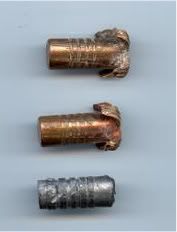
The result of high velocity impacts on TSXs and a hard cast WFN bullet:
Scan1-1.jpg


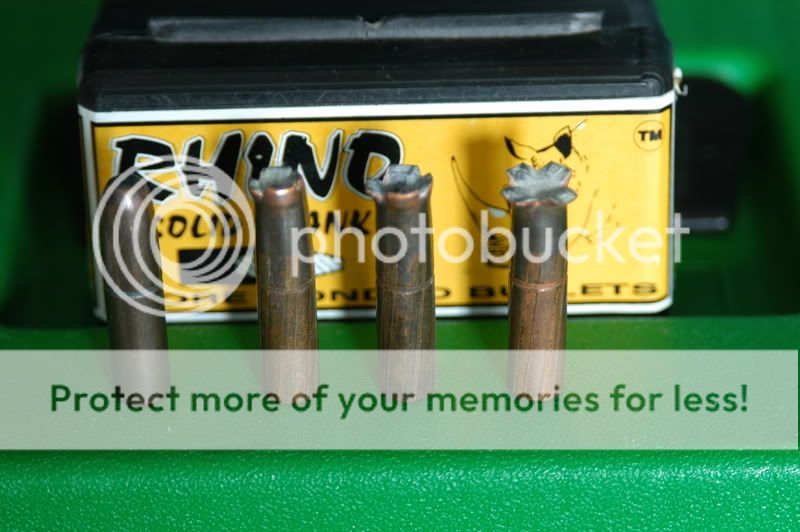
The Rhino jacket is a pleated design to asisit in expansion:
DSC_0009-1.jpg


The fully expanded Rhino lies in sharp contrast to the X bullet stubs:
DSC_0008.jpg
 
Barsness was also a big fan of the 200 gr partition semi-spitzer in the 30-06 earlier in his career and went the Barnes way with a lighter bullet generally and the results were similar with a bit more reach.


JB says:
"I've used just about every expanding bullet made in North America, Europe and Africa, and have yet to find one more suitable for all-around use on a variety of big game than today's Nosler Partitions."

and (respondig to a fellow who claimed Partitions are not good for African game):
I've used Nosler Partitions since the mid-1970's, back when they still had relief grooves and the jackets were turned, not extruded. I've shot over 100 big game animals personally with them, and seen at least that many more killed with Partitions by friends and family.

But they're not the only bullets I use, since part of my job is to test a wide variety of bullets both in various kinds of media and on game. In fact for most of the last decade I rarely used Partitions because there were so many new bullets introduced. I've been shooting Barnes X's of every generation since the late 80's, and have thoroughly tested just about every other "premium" bullet, including all the versions of Trophy Bondeds from Jack Carter's originals to the latest Tipped model; all the Swift bullets (including both the original Scirocco and SII); North Forks; Hornady Interbonds, GMX's and DGX's; Speer Grand Slams and DeepCurls; Remington Core-Lokt Ultras, etc. etc.

I also know the other Nosler bullets quite well, whether Ballistic Tips, AccuBonds or E-Tips. In fact I tested some prototype E-Tips on an African cull hunt in 2007, where almost 200 animals were taken over a month of shooting by me and my companions. I've also gone to New Zealand to thoroughly test Berger VLD's on a bunch feral goats and other game including red stags. Oh, and I also have shot several semi-loads of big game with "ordinary" bullets from Hornady, Remington, Sierra, Speer and Winchester. I always autopsy the animals myself, or watch it done when that isn't possible, as it sometimes isn't in Africa, to find out exactly how the bullets worked.

This year I used more Nosler Partitions than in any other year for the past decade, because I'd learned how those other bullets work--and didn't find any of them killed any better than the right Partition put in the right place. But even while using several Partitions from 6.5mm to .416, I also shot big game with Hornady Interbonds, Federal Fusions, Barnes TTSX's, Nosler Ballistic Tips, and Sierra ProHunters.

Over the years I've seen some very weird field results with some of the bullets you apparently regard as infallible, including repeated instances that would have to be considered total failures, but have yet to see that happen with hundreds of Nosler Partitions. I've also run into a bunch of hunters like you, who "know" all sorts of stuff without actually doing a lot of comparison testing. If you had, you might know as much as you think you do.
 
.308 will do anything you want it to, 30-06 will do it a little bit harder.

SO, buy a .308. Keep it, love it, make it go bang-bang. THEN use the "slightly heavier bullet" argument to justify (to the wife/gf/yourself/The Voices) why you also need to buy a 30-06.

Everyone's a winner.
 
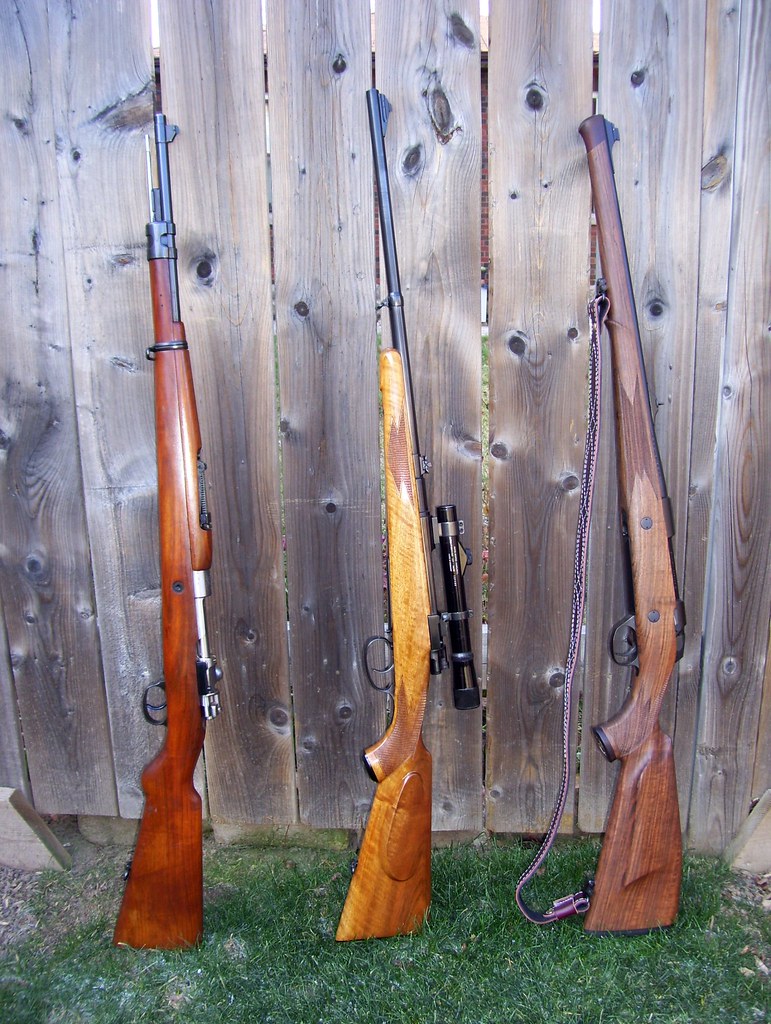
The two on the right, 7x57 and 30-06, put meat in the freezer.

The bottom, 308, puts iddy biddy holes in a 1 inch circle at 150 yards.

I have all my basis convered! ;)

6488552789_1708d13364_b.jpg


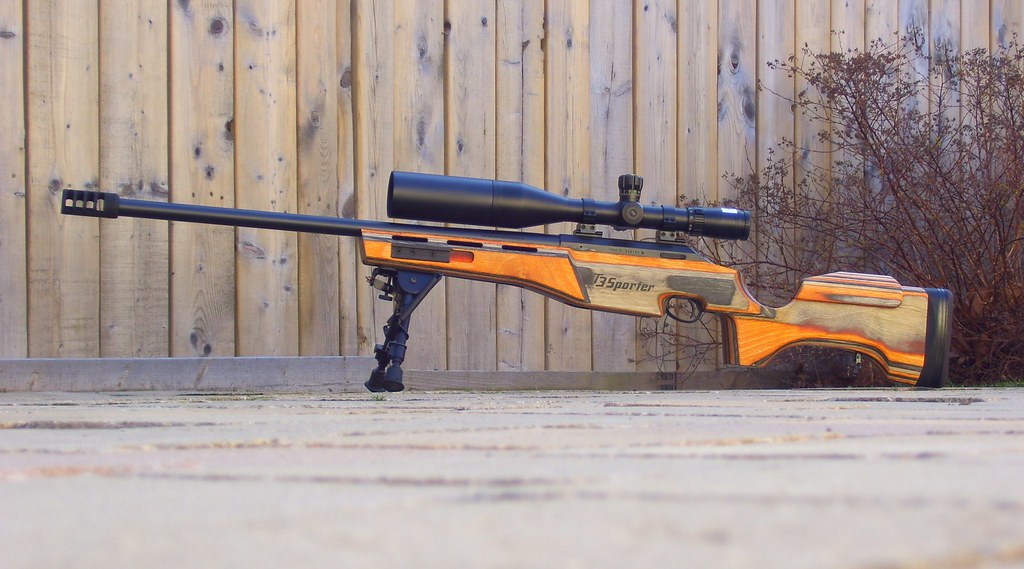
6857783282_8351f7289c_b.jpg


I like all three calibres equally, but the "ought six" and the grand daddy of them all, 7x57, have been my 'go-to' calibres for more years than I can remember. They work well... kind of like a stone axe -- reliable :p

BTW, there's something about 30-06, nice wood, blued metal, and good old fashioned iron sights, that makes it all worthwhile!
 
Wow,..this thread has come along way. A lot of great posts and pics regarding perhaps the 2 of the best .30s on the market.

Some are using factory published ballistic data as a comparison of the 10-20% gain in a similar barrel and action of the .30-06 over the .308Win. This should be the case,..ask any handloader of both cartridges, however........

I've not done a side by side comparison in years, but I remember years ago when if you had say a M70 in both calibers, or say a Remington 7400 in both calibers, and you chrony'd both with same ammo and weight, they were essentially the same cartridge:eek:. This is strictly from memory and if anyone has any current apples to apples please share them and correct me.


Fast forward 20 years, and I haven't done a head to head comparison of like action types and barrel lengths on the newer premium loads, which I believe live a little closer to where their makers say they are.

Again I know that unless you use the same actual barrel for dimensional purposes and therefore pressures, you couldn't really compare a factory Core-lok 150gr in both calibers.

Just something I noticed when I believe the '06 was for years intentionally loaded below the already conservative factory ballistics, for safety concerns in much older and questionable headspace and receiver strength(1903). The .308 seemed to always be doing what everyone said it should based on your particular barrel length.

Anyone else do a side by side comparison recently of both cartridges in similar action and barrel length's?

So this post doesn't get corrupted by some thinking I'm saying the .308 is everything a .30-06 is,... it's not intended for that.

Apples to apples, the '06 just has a bigger case and will produce higher velocities at SAAMI pressure levels.
Just be sure you know your actual factory velocities before betting too much money on a particular round based on factory published velocities.

A chronograph is the final say on velocities. A lot of the "go to" factory loads because of accuracy, and even game getting ability, rarely come close to published data over the chrony in real world testing.

An example was when I zeroed a lovely Parker-Hale sporter for a guy while I had my chrony set up for load development.

The published data was 2480 fps in a 24" test barrel for 180gr Winchester PPSP, but in the 24" cut, new No4 barrrel, those 180 power points were loping along at 2260 +/- 20 fps. Deadly accurate with a tight extreme spread, but a far drop from a 22" .308 sporter firing the same ammo weight at nearly 2600 fps.
The .303 at this actual velocity was approaching the .30-30 /170gr @ 2200fps ballistics data, of course they never achieve this either in the real world.

I decided to fire away some old handloads through my 22" .270Win over the weekend, and over my chronograph at 15 feet center I got these velocities compared to published data.

Winchester 130 grain PPSP average 2880. Published data 3060fps in 24" so should be around 2990 in mine. Down 110 fps

Winchester XP3 elite 130 gr average 2945fps, Published data 3050fps
should have been around 2980 in mine so closer. Down only 45 so okay.

Handloads from 1992 season:eek:, 130gr Sierra BT @ 59 grains IMR 4831/CCI250

average 3087, low 3072 high 3107. Was that a 270 WSM we just passed daddy? Yes son,..it was.:p

Is my chrony clocking low? I get 2800 average with NATO 147FMJ from a 22" barrel M-14, so I'd say it's very close to being on.

After all this rambling, I guess I'm going to have to get "like ammo" for both my semi's, and do some side by side velocity testing with modern premium ammo.

Anyone else up to doing a side by side, same rifle/ same barrel .308Win versus .30-06 testing?????? Please publish your data if you do.

 
Since you want a T-3, get a 30-06 as the action is the same.

What will kill moose better is a toss up. Either one will put a hole completely through a moose.

What Gatehouse said if you shot a moose and it went plumb through him

and into orbit and around the earth three times the moose would still be

DOA!

Bob
 
Back
Top Bottom