












































You are using an out of date browser. It may not display this or other websites correctly.
You should upgrade or use an alternative browser.
You should upgrade or use an alternative browser.
best for Elk at distance 7 mm mag or 300 win mag ?
- Thread starter skneub
- Start date


- Location
- Somewhere on the Hudson Bay Coast
A .300 magnum produces roughly the same velocity at 100 yards that a .30/06 produces at the muzzle, and for that "advantage" you are rewarded with nearly double the recoil, which will feel much worse in a light, plastic stocked rifle, that in all likelihood is too long for you. A .300 magnum does have some advantages over the .30/06 for the long range hunter, but if you are expecting something different than you get on the target with your .30/06 you might be disappointed. Your shoulder will hurt and your ears will ring, so your senses tell you that you are applying far more power to the problem, but its an illusion, and what advantages there might be with respect to trajectory are difficult to exploit due to the heavier recoil.
The 7 mag produces flatter trajectory with recoil that is similar to the .30/06. This level of recoil makes it easier to exploit the (slight) trajectory advantage of the 7 mag. Another option you might consider is the .280 Remington. This cartridge is nothing more than a .30/06 necked down to 7mm, but its rewards are lighter recoil, good accuracy, and a trajectory that rivals and in some cases matches that of the 7 magnum.
So much for trajectory; if power is what you're seeking though consider an increase in bullet diameter and weight. Recoil increases with bullet weight of course, but if you can handle a .300 magnum, a .338, a 9.3 or a .375 is little worse. When loaded with suitable bullets, a medium provides an exploitable advantage on game, without the gore frequently associated with a high velocity small bore. If you prefer synthetic furniture, the Ruger Alaskan in .375 has much to offer, and when loaded with a 260 gr Accubond or a good quality 270 gr bullet, it shoots flat, and produces the ballistics that has accounted for all manner of game since 1912, when the .375 H&H debuted. IMHO, that rifle topped with a suitable scope is an excellent choice for big game of any size.
The 7 mag produces flatter trajectory with recoil that is similar to the .30/06. This level of recoil makes it easier to exploit the (slight) trajectory advantage of the 7 mag. Another option you might consider is the .280 Remington. This cartridge is nothing more than a .30/06 necked down to 7mm, but its rewards are lighter recoil, good accuracy, and a trajectory that rivals and in some cases matches that of the 7 magnum.
So much for trajectory; if power is what you're seeking though consider an increase in bullet diameter and weight. Recoil increases with bullet weight of course, but if you can handle a .300 magnum, a .338, a 9.3 or a .375 is little worse. When loaded with suitable bullets, a medium provides an exploitable advantage on game, without the gore frequently associated with a high velocity small bore. If you prefer synthetic furniture, the Ruger Alaskan in .375 has much to offer, and when loaded with a 260 gr Accubond or a good quality 270 gr bullet, it shoots flat, and produces the ballistics that has accounted for all manner of game since 1912, when the .375 H&H debuted. IMHO, that rifle topped with a suitable scope is an excellent choice for big game of any size.

One or the other...it doesn't matter. Ballistic coefficients don't really matter when it comes to putting bullets through elk lungs all the way out to half a kilometer. Any bottle-necked cartridge paired with any decent hunting bullet from .270 Win. on up will do nicely.
Buuuut...this is a gun board....so if you must, carry-on....
Buuuut...this is a gun board....so if you must, carry-on....

Sure, the 7mm will recoil slightly less, everything else being equal...but when is everything else going to be equal? I love the .300Win with 180 or 200gr bullets, but if you have an '06, it hardly seems like enough of a step up to make it worthwhile. The .338Win seems like a more significant leap from your '06. Yes, today's super-premium bullets make the 7mm much more capable than it was decades ago, but the same is true for the .300 and .338, so it hardly seems like a fair argument in favour of the smaller round.
I will always choose a bigger, heavier bullet over a smaller, lighter one...just call me Elmer!
I will always choose a bigger, heavier bullet over a smaller, lighter one...just call me Elmer!

roberto mervici
Regular
- Location
- Prov.Quebec, Canada
........
I almost am starting to think that if guys are gonna shoot inside 500 the 300WSM is the way to go. I put together a rem 700 alaska TI in 300WSM. I use it for hiking in the mountains. With the optics on it right now im only confident shooting 450yards. With a 165 accubond its only good for 600 anyway. Nice to shave some weight with a short action and a 24inch barrel, lots of power inside 500 aswell ......
Agree, my sons own a 300WSM Browning micro hunter, very accurate little hunder 1MOA on the good days, with it He got a moose at 1425 ft.( gps measured ) few years a go, lung and liver shoots. Reloaded with 180grain tips a pleasure to carrie around or up hill, the down side it kick as a mule!!! the felt recoil seems more brutal than the 300Rem. ultramag loaded with 200grain tip, our ultramag is almos 2 pound heavier than the Browning WSM.


Grrr, I didn't get to go out west for Elk, Mulies and pronghorn this year, but next years hunt is already planned! I miss living in Northern BC where I could go Elk, moose, whitetail, mule, Stone sheep, Bison, black bear, G Bear, Cariboo, Mountain Goat hunting all within a couple hours of home!


I would prefer a 7mm mag anyday. I don't like a ton of recoil. I also believe that a 7mm is perfectly adequate to kill anything on this contenant. Certainly at the ranges most of us can accurately shoot! However there are many who can shoot much better/further than I can, and a bigger rifle is necessary. If your comfortable shooting a 30/06, You won't notice a lot more recoil from the 7mm. Just my 2 cents.
Dave.
Dave.

skneub
CGN Ultra frequent flyer
So, did you get the Mossberg .300 Win Mag with the brake?
Its got the brake yep...and though it dont kick as hard as my 30/06 ...it sure makes a loud bang
I love the scope ...Its the first good scope i ever owned.
Pics as soon as they upload
This is a much better pic than i expected to be adding
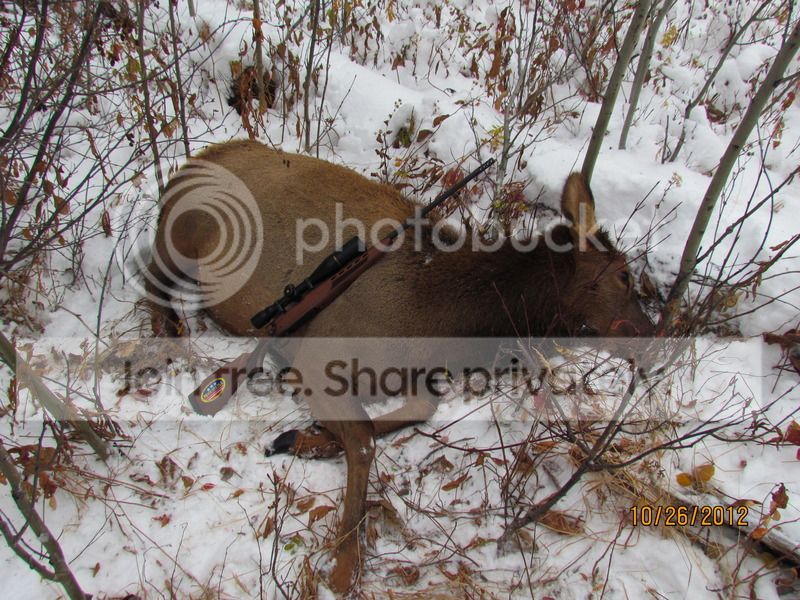
Last edited:
skneub
CGN Ultra frequent flyer
Take the damn sticker off the stock.
Lmao its like the broom pics on the harley forum i attend....show us your bike ..but but a broom up against it so we know you have it..the elk is better
yes the sticker will come off lol


Jordan Smith
CGN Ultra frequent flyer
- Location
- Calgary, AB
OP, nice elk and rifle/scope setup! Hopefully you enjoy it.
Regarding the 7mmRM vs. .300WM debate- we've been down this road a hundred times, but to add to what has already been said:
Byan Litz is designing the 7mm 195gr Berger EOL Hybrid, which should come out soon, and has an estimated G1 BC of .794 and G7 BC of .406. Pretty tough for a .300WM to hang with a 7Mag once you get past a few hundred yards, even with the new Berger .308 pills. A .300 RUM will match/beat a 7Mag, but then again, you're using nearly twice the powder and getting a whole lot more recoil and blast.
The 7Mag is absolutely the most for the least.
Regarding the 7mmRM vs. .300WM debate- we've been down this road a hundred times, but to add to what has already been said:
Byan Litz is designing the 7mm 195gr Berger EOL Hybrid, which should come out soon, and has an estimated G1 BC of .794 and G7 BC of .406. Pretty tough for a .300WM to hang with a 7Mag once you get past a few hundred yards, even with the new Berger .308 pills. A .300 RUM will match/beat a 7Mag, but then again, you're using nearly twice the powder and getting a whole lot more recoil and blast.
The 7Mag is absolutely the most for the least.






















