
After the war there were mllions of primed cases left over. They were loaded by arsenals during the Korean war. After that the rest were probably sold as surplus, so someone could have loaded the virgin primed cases with soft point ammo. And over-loaded a case.













































You are using an out of date browser. It may not display this or other websites correctly.
You should upgrade or use an alternative browser.
You should upgrade or use an alternative browser.
Lee Enfield mk4 No1 Cracked Bolt
- Thread starter Ready Aim...
- Start date

You say the bolt is matching. Can we see some photos of both serial numbers please?
Lots of bolts have been "matched" by people with a set of number stamps.
The coloured primer annulus probably means the primers are original, but I'm thinking the slugs and maybe the powder were not.
Rifle is an old Savage, with Long Branch safety and backsight, looks pretty worn over all. What other markings are on it?
Lots of bolts have been "matched" by people with a set of number stamps.
The coloured primer annulus probably means the primers are original, but I'm thinking the slugs and maybe the powder were not.
Rifle is an old Savage, with Long Branch safety and backsight, looks pretty worn over all. What other markings are on it?
Hey so I looked at the bolt serial number and the rifle serial number and they don't match, I have determined that it is a no1 size bolt as the breechbolt head on it measured 0.625". I also found this table which might be of interest to other enfield owners on bolt sizes:
size/ No.0 0.620"-0.631"
size/ No.1 0.622"-0.635"
size/ No.2 0.630"-0.640"
size/ No.3 0.632"-0.640"
size/ No.0 0.620"-0.631"
size/ No.1 0.622"-0.635"
size/ No.2 0.630"-0.640"
size/ No.3 0.632"-0.640"
That was DEFINITELY a hot round. I have been working with Defence Industries brass, shooting the stuff and reloading it, for better than 45 years now and I have never seen a flash-hole that big.
Yes, Canada made a bunch of ammo during War Two: inspectors passed something over 4.2 BILLION rounds of .303 alone.
This `Belmont` stuff is Defence Industries brass for sure, but the headstamp is badly defaced: very hot pressure levels for sure.
Check the PRIMERS: Defence Industries used the rather distinctive C-I-L noncorrosive, nonmercuric Boxer primer which had an anvil with only TWO flash channels. Most modern primers have THREE flash channels.
Do a full pulldown check on the ammo; this stuff was NEVER sold to the public, being ALL made for the military. And it was NEVER loaded with a 150-grain sporting bullet. Any which has got onto the market (and there is lots of it) has passed through Government hands first, as well as rigid inspection procedures. I think pay special attention to the powder charge and type. Is it NC or is it double-based stuff, what`s the charge weight, all that. Original DI powder was an IMR type supposedly made to Nobel specs, quite similar to IMR-4895.
The bolt may have been dicked with; I haven`t seen it so I can`t say for sure. But that was DEFINITELY a very hot round, FAR above normal DI pressure levels.
Hope this helps.
.
Yes, Canada made a bunch of ammo during War Two: inspectors passed something over 4.2 BILLION rounds of .303 alone.
This `Belmont` stuff is Defence Industries brass for sure, but the headstamp is badly defaced: very hot pressure levels for sure.
Check the PRIMERS: Defence Industries used the rather distinctive C-I-L noncorrosive, nonmercuric Boxer primer which had an anvil with only TWO flash channels. Most modern primers have THREE flash channels.
Do a full pulldown check on the ammo; this stuff was NEVER sold to the public, being ALL made for the military. And it was NEVER loaded with a 150-grain sporting bullet. Any which has got onto the market (and there is lots of it) has passed through Government hands first, as well as rigid inspection procedures. I think pay special attention to the powder charge and type. Is it NC or is it double-based stuff, what`s the charge weight, all that. Original DI powder was an IMR type supposedly made to Nobel specs, quite similar to IMR-4895.
The bolt may have been dicked with; I haven`t seen it so I can`t say for sure. But that was DEFINITELY a very hot round, FAR above normal DI pressure levels.
Hope this helps.
.
I just got a new bolt from marstar canada. I just need to assemble it now. I've read you need a special tool to get the firing pin in though...
Be very careful here, this rifle has expanded side ways, Your first pict of the rifle has the charger bridge pulled out a bit, this is pinned in and often welded. I think the savage rifles it was pinned only.

You need to get your rifle checked over perhaps get some NDT (Non Destructive Testing) done on it, Dye Penetrant Testing & Magnetic Particle? This checks for cracks etc.
I know this sounds extreme but is it worth another accident if cracked for the cost of another sporter worth $125.00. Saying that, the rifle is not worth the costs of testing.
The rifle is done buddy. Strip it for parts, cut it half and take it to your nearest police station and hand it in.
Bolts are hand fitted, you cannot just pull one out and stick another one in.
It's not like Enfields are exactly expensive, nor did you have a particularly unusual or valuable one.
Bolts are hand fitted, you cannot just pull one out and stick another one in.
It's not like Enfields are exactly expensive, nor did you have a particularly unusual or valuable one.
Last edited:

Enfield bolts are hand fitted? So anything with a mismatched bolt would either be too tight or too loose? {I'm not being a DI*K, I've never heard this before. Can we verify?}
Enfield bolts are hand fitted? So anything with a mismatched bolt would either be too tight or too loose? {I'm not being a DI*K, I've never heard this before. Can we verify?}
With a little online research you certainly can, otherwise, take my word for it.
The receiver has been over-stressed. I would not use it again. I think that is the advice that a gunsmith would give you.

Didn't notice the overstressed receiver, your lucky it didn't go "kaboom" while you were aiming down the sights. It just goes to show you how reliable these actions are if they hold up to this type of stress.
As for swapping bolts, I see it a matter of manufacturing tolerances between parts being just right and a bit of luck.
As for this rifle, I would not shoot it again. Sad, poor girl is finished now but atleast you are safe and are able to shoot another day.
As for swapping bolts, I see it a matter of manufacturing tolerances between parts being just right and a bit of luck.
As for this rifle, I would not shoot it again. Sad, poor girl is finished now but atleast you are safe and are able to shoot another day.
Awww shucks - this was just starting to get interesting:
1) The OP appears to be dis-inclined to do a forensic on the ammo.
2) The rifle may have only single lug engagement- again unverified.
3) The receiver appears to be distorted
4) The OP decides to try his luck with another bolt
1) The OP appears to be dis-inclined to do a forensic on the ammo.
2) The rifle may have only single lug engagement- again unverified.
3) The receiver appears to be distorted
4) The OP decides to try his luck with another bolt
Good to hear.....did you "hand fit the bolt?" whatever that means 

I wonder if this gun will, just like in fairy tales, "live happily ever after"...
Ready Aim, I just read this thread for the first time (quickly though, so I may be missing a few details).
- Your gun was subjected to pressures which caused physical damage to critical components.
- You visually inspected the rifle and concluded that this damage affected only the bolt.
- You found replacement parts for the bolt, and decided to fire the gun again.
- You then concluded that this is the end of the story.
Based only on the above-stated information, I would bring the gun to a very good gunsmith and ask what he would do with the gun; and then follow his advice to a T.
Lou
Ready Aim, I just read this thread for the first time (quickly though, so I may be missing a few details).
- Your gun was subjected to pressures which caused physical damage to critical components.
- You visually inspected the rifle and concluded that this damage affected only the bolt.
- You found replacement parts for the bolt, and decided to fire the gun again.
- You then concluded that this is the end of the story.
Based only on the above-stated information, I would bring the gun to a very good gunsmith and ask what he would do with the gun; and then follow his advice to a T.
Lou
I wonder if this gun will, just like in fairy tales, "live happily ever after"...
Ready Aim, I just read this thread for the first time (quickly though, so I may be missing a few details).
- Your gun was subjected to pressures which caused physical damage to critical components.
- You visually inspected the rifle and concluded that this damage affected only the bolt.
- You found replacement parts for the bolt, and decided to fire the gun again.
- You then concluded that this is the end of the story.
Based only on the above-stated information, I would bring the gun to a very good gunsmith and ask what he would do with the gun; and then follow his advice to a T.
Lou
It wasn't the whole bolt that was cracked just the breech bolt, i replaced that but used the same cocking piece, striker and breech bolt head as they were not affected. And before I did any firing I clamped it down, tied string around the trigger and stood back and test fired it 10 times form a distance, so far ive put over 200 rounds through it with the new breech bolt... However your suggestions makes practical and safe sense, do you or anyone else know of any good gun smiths in the lower mainland of BC?
Cheers
Interesting. A guy on milsurps believes the Belmont ammo is tracer ammo that the projectiles were pulled from and new 150gr projectiles added on. No idea if that's true or not, and it would not explain the one over-hot round.
Now we're getting warmer! Tracers pulled, charges weighed or replaced (sometime later?) and...oops! Double charge?
The firing pin kept the front bolt chunk from flying out, but then so did the overhang of the receiver ring and the charger guide. A nasty surprise, but I don't think you were in much danger of that happening.
Notice how the receiver wall has spread, pulling the end of the charger guide bridge out of alignment with the left receiver wall. It looks like it might have been squeezed back in in your later photos. Did you put it in the vise?
Interesting that the bridge wasn't welded on the left side too. I wonder if Messr's Stevens-Savage decided that wasn't necessary?
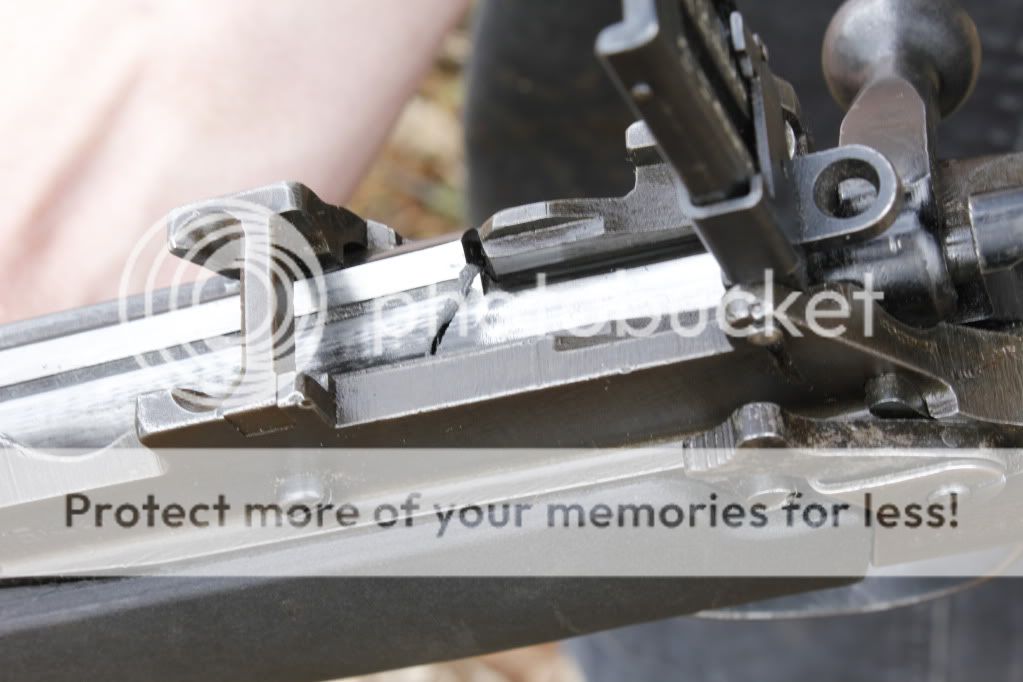
Replacement bolts have to be LAPPED IN to ensure even contact of the recoil lugs and shoulders. At least check the contact with engineers blue.
The part which you describe as "JUST THE BREECH BOLT" happens to be the single part of the rifle (except for "just the frame") which takes the FULL FORCE of firing a cartridge.
That little locking lug on the underside of "just the breech bolt" and the locking rib (IF it is bearing properly: BIG IF in this case) takes the full thrust of a cartridge developing over 42,000 pounds per square inch pressure. That is a LOT of pressure.
But you know best, obviously.
Of course, I've only been playing with these things for 50 years now, so what would I know? You have some of the best advice in the WORLD in this forum, offered to you by some of the most knowledgeable collectors and technicians in this hobby, absolutely gratis.... and you choose to ignore it. Don't blame us the NEXT time it blows.... and there WILL be a "next time", believe me.
You are using commecial ammo now. Have you noticed that the caps don't pop out and the brass doesn't stretch almost to the point of failure? The Belmont stuff certainly did; I sincerely hope you pulled it all down. That ammo gave every evidence of being extremely hot, likely over the 65,000 pound level; what that will do to the actual frame of the rifle cannot be ascertained without a thorough check-over by somebody who knows the Number 4 Rifle intimately.
Further deponent sayeth not.
.
That little locking lug on the underside of "just the breech bolt" and the locking rib (IF it is bearing properly: BIG IF in this case) takes the full thrust of a cartridge developing over 42,000 pounds per square inch pressure. That is a LOT of pressure.
But you know best, obviously.
Of course, I've only been playing with these things for 50 years now, so what would I know? You have some of the best advice in the WORLD in this forum, offered to you by some of the most knowledgeable collectors and technicians in this hobby, absolutely gratis.... and you choose to ignore it. Don't blame us the NEXT time it blows.... and there WILL be a "next time", believe me.
You are using commecial ammo now. Have you noticed that the caps don't pop out and the brass doesn't stretch almost to the point of failure? The Belmont stuff certainly did; I sincerely hope you pulled it all down. That ammo gave every evidence of being extremely hot, likely over the 65,000 pound level; what that will do to the actual frame of the rifle cannot be ascertained without a thorough check-over by somebody who knows the Number 4 Rifle intimately.
Further deponent sayeth not.
.
OP never stated he didn't believe anyone or that he wasn't very thankful for the advice.
Thanks for the "Lapping" info about bolts....this I didn't know and have never come across (all mine have ser# matching bolts so...????)
Thanks for the "Lapping" info about bolts....this I didn't know and have never come across (all mine have ser# matching bolts so...????)
Last edited:
I was asking if anyone knew of any good gunsmiths around that I could take my no4 to.
Thank you for your advice
Not sure where you are located. I think Lever Arms and Reliable Gun and Tackle would be considered Lower Mainland BC? (This, coming from a guy living near Ottawa, so don't shout if I'm out to lunch!)
Lou






















