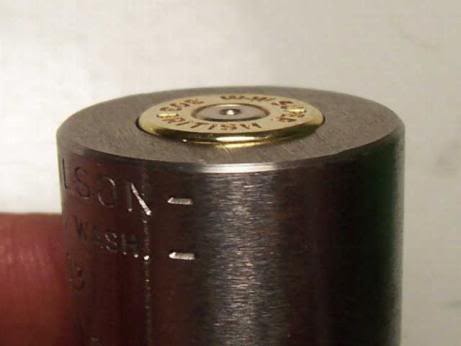
Odd Occurrence? Help!

I am not a fan of partial neck sizing with a FL die. That bulge at the base of the neck can expand enough to cause issues with chambering and/or bullet release.

Why I use a body die to bump the shoulder, and a Lee collet neck die to size the entire neck.

But different strokes and all that.

YMMV.

Jerry
 
But I noticed on the pic showing the primer, there is cratering around the firing pin impact. For those that are unsure what primer cratering looks like, well... here it is.

you would need a really ill fitting firing pin to bolt and that is rare in modern rifles.

Also, note on the first "E" in the creedmoor, it is shiney compared to the rest of the case head..... maybe that is just in the lighting of the pic or brass rub due to pressure. not the best of pressure signs, especially if there are rough spots on the bolt face but in concert with the primer cratering, good indication to consider backing off the load.

Jerry

Remintons have a cratering problem.

As for the E swipe That happens on lots of factory ammo. I get it in my m70's, savage, tikka, weatherby, remington. All with factory ammo but not all the same kind.
 
I am not a fan of partial neck sizing with a FL die. That bulge at the base of the neck can expand enough to cause issues with chambering and/or bullet release.

Why I use a body die to bump the shoulder, and a Lee collet neck die to size the entire neck.

But different strokes and all that.

YMMV.

Jerry

Solid gold right there !
 
LOTS of great info in the preceding replies. I've got to go with Jerry a bit on the over pressure indications. Those pics clearly indicate that the primer is starting to flatten and some slight cratering is present. Not hugely significant but there nonetheless. 6.5CM loaded with 42gr of H4350 with 140gr is above max load in every manual I have. It might be fine in the OP's rifle but without chrony data and fully working up to that load I would be watching very carefully.

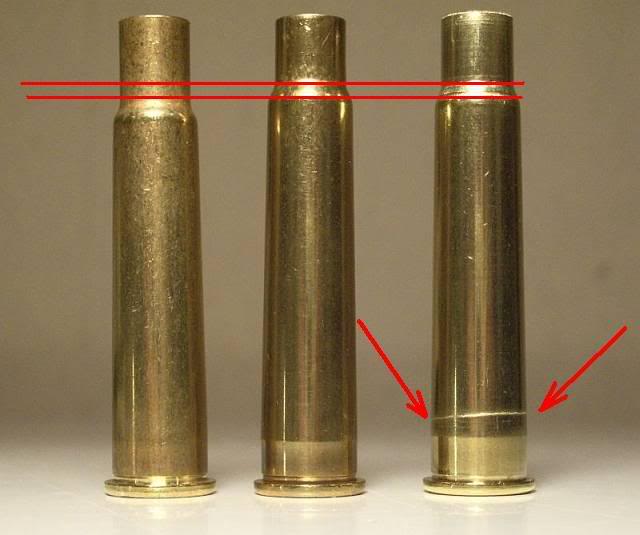
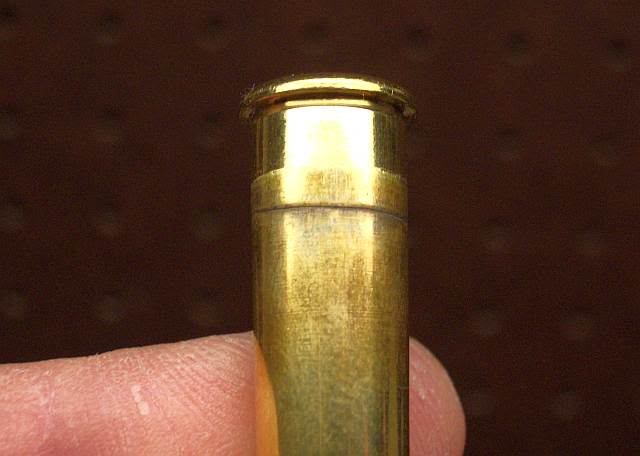
One item I don't think anyone has mentioned is looking for the 'bright' ring that should have been visible where the head separation occurred, just above the web, a loading or two before the head separation occurred. If you clean your brass in a vibratory cleaner with walnut or corn husk media, it really starts showing up strongly as the brass thins. I don't have any experience with ultrasonic or stainless pin media cleaning so I don't know if it can be seen with these methods. If you see this brightened ring, the aforementioned paper clip 'feeler' is appropriate. In my experience, with my older .308 which I used to fully resize back to SAAMI, once I noticed, every time this bright ring was present, using the paper clip feeler, that brass had started the head separation process.

Over the past several years I have slowly modified how I resize brass, I have been following more stringent and careful measuring with variations on chamber sized -0.0015 shoulder full length or shoulder bump procedures. While it is somewhat case/caliber dependent, normally I will do 2 to a maximum of 3 shoulder bump resize only with a full length and trim on the following run. Whether this happens on the second or third reload is entirely dependent on what I feel at the bolt handle both when extracting or feeding rounds.

I am still experimenting with a neck bushing resize to achieve a neck id that is -0.002 to 0.003 of the bullet size to provide tension OR neck bushing resize at the bullet size with a followup of the Lee collet die to provide the tension. Each have worked well for me and I see virtually no difference in use.

There are lots of ways to work your particular dies, and all sorts of different types and styles of dies, but everyone above seems to agree that keeping cartridge shoulder length within a thou or two of YOUR bolt rifle's chamber is best. Jerry's tape method is interesting and seems to be simple and accurate as well. It definitely follows the KISS principle which almost always works very well indeed.

There are many reloading manuals with excellent reloading/handloading introductions and instructions prior to getting to the recipe sections. There is one book that expands on these and is dedicated to the handloading process. It seems to be outstanding to me. Metallic Cartridge Reloading by Mic McPherson. A tome of information. Not exactly light reading. It might seem repetitious at times. It isn't really, but touches on items which may be separate that are or have a common source, and eventually that common source becomes the focus of a chapter. Superb. If find myself returning to it fairly often as I 'rediscover' something that wasn't obvious the first time I read it.
 
Last edited:
I have been very lucky in over 47 years of reloading below is as close to a total case head separation that I ever had. And the only reason this happened was I didn't listen and full length resized the first batch of Winchester .303 British cases on my first Enfield rifle.

NHlR9jO.jpg


DVy4C4T.jpg


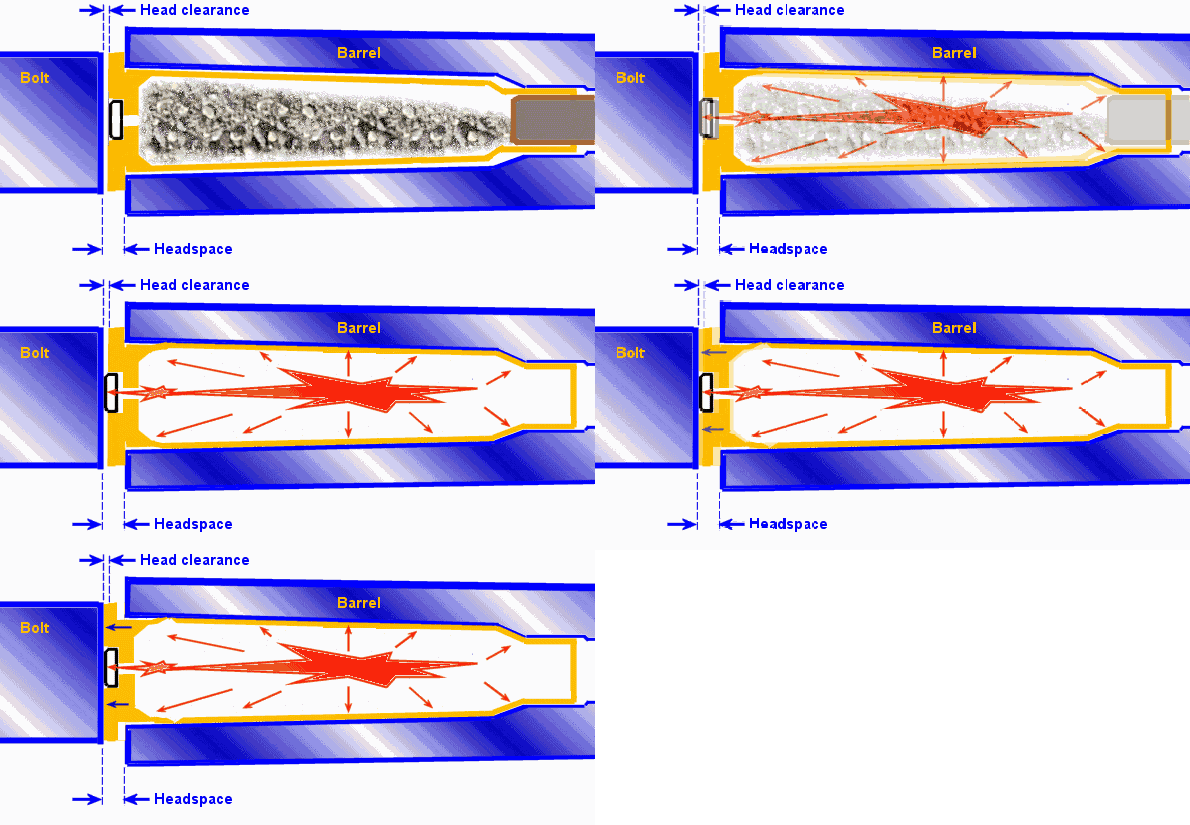
And below is the "WHY" of case head separations, excessive head clearance or "air space" between the rear of the case and the bolt face. And the amount of shoulder bump or how far you push the shoulder back when resizing is your head clearance.

sHgqVJR.gif


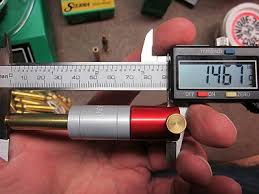
And below is the best reloading investment I ever made, a digital vernier caliper and a Hornady cartridge case headspace gauge. (big numbers for chronologically gifted eyesight) :d

H0SXHH8.jpg


Case Sizing 1: Sizing Die Selection
http://www.mssblog.com/2016/02/02/case-sizing-1-sizing-die-selection/

Understanding Headspace — What You Need to Know
http://bulletin.accurateshooter.com/tag/headspace/

Tech Line & Tips (FAQs)
Create A “Custom Die” With A Simple Shellholder Change! (Redding Competition Shellholder Set)
http://redding-reloading.com/tech-line-a-tips-faqs/144-create-a-custom-die-with-a-simple-shellholder-change

How to Set Up Full-Length Sizing Dies and Control Shoulder Bump
http://bulletin.accurateshooter.com/tag/neck-sizing/

Headspace is also the distance between your ears, so fill this space by reading the front part of your reloading manuals. (and the links above)

And remember only Saddam Hussein's cat enjoys neck sizing.
(if you don't think this is funny then your the type person who would complain if they hung you with a new rope)

oYX8YZT.gif

Holy shoulder set-back, Batman!!


Never though I could see it with the naked eye.
 
Holy shoulder set-back, Batman!!

Never though I could see it with the naked eye.

Ganderite

In the photo below the top photo is a Surplus South African .303 British cartridge in the Wilson case gauge. This case is resting on its shoulder and is just a smidgen under minimum headspace length.

In the bottom of this same photo is a new unfired Remington .303 case. It would drop further into the gauge but the rim is stopping it from dropping further into the case gauge.

twocases-1.jpg


Below is a fired .303 Winchester case in the Wilson case gauge. The amount the case is sticking above the gauge is how much longer the military chamber is than American SAAMI standards. And if you full length resize the case you will push the case shoulder back this much and why full length resizing causes case head separations.

under2-1.jpg


In 1914 the Enfield chambers had to be reamed larger in diameter and longer to the shoulder location. This was due to combat conditions and a political ammunition scandal in Briton over who was awarded contracts ($$$) to make military ammunition. Some of this ammunition was so poorly made it wouldn't chamber without forcing the bolt closed.

Note, no other military rifle used in WWI had to have the chamber enlarged, and the British tried to cover up the ammunition problem.
 
K31 really blows the cases out too, but the shoulder stays pretty level.
Left is a GP11, right is a neck sized handload.

More great pics... For those that ask about fired cases in actions without a true lock up (square lock vs bolt lugs, bolt face and chamber), VOILA... couldn't ask for a better before the after.

Assume on the left is a new factory cartridge. The right is a fired cartridge which has obviously gotten much bigger in the shoulder due to a "large" chamber BUT the lock up is also a wee bit off. Note the tilt in the right case. The base is no longer square to the centerline of the case so the case tilts.

If you have a rifle that shows this type of fired brass, the bolt face and chamber are not square and the case expands in a curve to fill the mis-alignment. Can only assume that there are rub marks on the case head depending on how the case went back into the chamber?

I would also not be surprised that neck sizing alone doesn't allow the case to chamber properly. With higher pressure rds, this "bend" gets severe fast and alot of sizing is needed but ultimately, there is no way to bring the case back into square and that case would be best tossed then cause a jam or separate.

This is what action blueprinting is supposed to resolve. All the alignment issues are machined out (if possible) to return ALL parts involved in the lock up to being square and aligned to each other. When done, the fired case will be as true as the unfired one. The shape may be different but they will both point in the same direction.

Great pic....
Jerry
 
More great pics... For those that ask about fired cases in actions without a true lock up (square lock vs bolt lugs, bolt face and chamber), VOILA... couldn't ask for a better before the after.

Assume on the left is a new factory cartridge. The right is a fired cartridge which has obviously gotten much bigger in the shoulder due to a "large" chamber BUT the lock up is also a wee bit off. Note the tilt in the right case. The base is no longer square to the centerline of the case so the case tilts.

If you have a rifle that shows this type of fired brass, the bolt face and chamber are not square and the case expands in a curve to fill the mis-alignment. Can only assume that there are rub marks on the case head depending on how the case went back into the chamber?

I would also not be surprised that neck sizing alone doesn't allow the case to chamber properly. With higher pressure rds, this "bend" gets severe fast and alot of sizing is needed but ultimately, there is no way to bring the case back into square and that case would be best tossed then cause a jam or separate.

This is what action blueprinting is supposed to resolve. All the alignment issues are machined out (if possible) to return ALL parts involved in the lock up to being square and aligned to each other. When done, the fired case will be as true as the unfired one. The shape may be different but they will both point in the same direction.

Great pic....
Jerry

I'm up to 6 neck sized loads with this brass IIRC, Lee Collet die. No issue chambering in the K31 which also has very little mechanical advantage being a straight pull.
Now it's not loaded hot, 46gr Varget behind a 150 for ~2700fps.
Shoots well with these.
 
Seems the brass took a set and pressures aren't high enough to cause any more distortion. Excellent.

But it does make for a great pic and really helps to explain a tricky problem.

Glad the rifle K31 is shooting well for you. Going to have to get one of these in the future when competition shooting and tuning slows down.

It always struck me as a cool rifle.

Jerry
 
I am not a fan of partial neck sizing with a FL die. That bulge at the base of the neck can expand enough to cause issues with chambering and/or bullet release.

Why I use a body die to bump the shoulder, and a Lee collet neck die to size the entire neck.

But different strokes and all that.

YMMV.

Jerry

Jerry I've been using a Hornady set with a FL resizer die. So rather than adjust the FL die you are using 2 different dies?

What brand/model number of the 2 dies you specify above should I be looking at instead?

This will be for .223 Rem (for an AR).

I see you are an hour south of me so if you have the items in stock let me know.

I have been single staging .223 but will be setting up my 550 to start cranking more out for summer.
 
...If an action is way out of alignment, case life may be reduced simply because the case is actually bent during firing. not much you can do accept toss the cases when they cease to chamber properly and fix the action when a new barrel is installed.

Jerry

My dad used to file a very small notch on the rear of the case, near the head stamp. When loading a round, he would always load it with the notch in the 12 o'clock position for consistency. This was in a Ruger #1, so he was able to ensure it wasn't rotated when closing "the block", in this case. I'm not sure if he was compensating for something (although it was a Ruger #1) or he just felt that if there was anything out of alignment, this approach would prevent it from being an issue for future firings. "Consistent" was his middle name.
 
Jerry I've been using a Hornady set with a FL resizer die. So rather than adjust the FL die you are using 2 different dies?

What brand/model number of the 2 dies you specify above should I be looking at instead?

This will be for .223 Rem (for an AR).

I see you are an hour south of me so if you have the items in stock let me know.

I have been single staging .223 but will be setting up my 550 to start cranking more out for summer.

Thanks for bringing up another very important platform for reloading ...the semi auto

NOTE: EVERYTHING discussed must ensure 100% consistent, reliable and safe function of the firearm.. PERIOD!!!!

Here, you have to balance function AND accuracy. The AR is one of the dirtiest rifles we can play with. Self induced fouling makes it really important that enough clearance on the ammo be provided so that it will function and lock up properly. If you shoot little and clean often, you can reduce this clearance. Jump out of working airplanes.... just go with what the "company" provides.

For precision Semi auto loading, you have to balance sizing enough and not sizing too much. 3 thou as a min, up to 6 thou is workable but hard on case life. Sizing the case body will depend on the chamber dimensions and a bit of trial and error may be needed here. If the AR is working properly and not overgassed and ammo not super sized, the case body/base should not expand too much with a firing or two BUT measure to know for sure.

If any dummy rds tested in cycling even shows a hint of slowing down lock up, size more. There really is no way around this cause out of battery kaboom is mostly considered bad for body parts and overall health.

If the need is accurate ammo and full on performance, be very careful about case life. Unless you can also tune the rifle cyclic forces/parts to reduce the jarring of the cases, limit how many firings you do... just safer to toss the case then have a rupture.

So what tools to use? That really really depends on the chamber specs and headspace dimension of EACH rifle. I have a Norc M4 where the factory chamber is massively oversized in width but pretty close to spec on length - still long but not ridiculous. As it came out of the box, it was massively overgassed so fired cases were stretched a ton.

Using factory spec ammo or FL sized ammo, the fired cases swell ALOT so much, they need some serious convincing to go back into said FL sizer... case munching, scratching and otherwise bad karma occurs.

For the Norc M4, I use 2 dies. The Lee collet neck die and a Redding body die (you can go through all of the FL dies if you want but this is simplier). The Lee handles the neck, the Redding pushes back the shoulder and sizes the body. The case is so oversized that the body die actually starts to behave as a FL sizing die... YEP, BIG....

My Mcgowen AR15 Match barrel has a much smaller chamber. Reamer requested is a bolt action speced reamer and the chamber is like any quality match bolt action rifle. Here I CAN use a FL sizer or lee/body die combo... I started with the Lee/body die combo and got superb results... see 2016 sub MOA AR challenge.

This year I am trying a Lee FL sizer cause I was getting some really nice results with higher neck tension and the RDF's. Note, that the chamber is small enough, the FL sizer really isn't squishing the case much. Think of this situation as the tight neck body die. Will do some final tuning now that temps have stabilised.

SO, for any semi, you need to understand WHAT you are actually discussing. The chamber dimensions can vary a huge amount... the dies you want to use will also vary a ton. I bet the LEE FL sizer I have is tighter then the HRN FL sizer you are using.

FL sizers vary all over the map. Think of FL sizers like Shoe size. Just because you have a "9" foot, doesn't mean you can fit every size "9" shoe

So, measure the chamber and fired brass, decide what, how and where you need to size, select the right die(s) that will get the job done and accept that what you do can be very different from the next internet guru

BUT, the end result will never change... proper fit, enough clearance for 100% lock up, NO case failures.

Blindly recommending FL sizing ALL brass for ALL semis means you either only jumped out of airplanes and likely too busy to pick up your brass, or haven't had a case failure..... YET !!!

YMMV

Jerry

 
My dad used to file a very small notch on the rear of the case, near the head stamp. When loading a round, he would always load it with the notch in the 12 o'clock position for consistency. This was in a Ruger #1, so he was able to ensure it wasn't rotated when closing "the block", in this case. I'm not sure if he was compensating for something (although it was a Ruger #1) or he just felt that if there was anything out of alignment, this approach would prevent it from being an issue for future firings. "Consistent" was his middle name.

Your dad is a smart man indeed... this goes back to the chambering test I suggested a few posts back.

Many factory rifles are not straight in lock up and fired cases can be wonky... the simple rechambering can highlight any bulge or bend.

If you can single feed, marking the case can go a long ways to resolve but most use a bolt or semi and mag... here keeping that case alignment is not so easy. The simplest solution is sizing the case so much that the kink is taken out but that can lead to really short case life????

As always, base your decision on the rifle you are working on... each rifle can be different and use a different set of tools to fit/fix.

Assume nothing, check everything, learn what all these wonderful dies do so you can best choose the right ones for the task.

YMMV

Jerry

 
Interesting comments Jerry, thanks.

This is my first go with rifle ammo, I have been using Federal bulk 223 in a Daniel Defense M4V5. All the brass I have I have fired once myself.
I recently cleaned and deprimed and ran 200 rounds through the FL HDY die and then put them all through a Lyman Case Length/Headspace gauge and also hand mic'ed each one for length.

Out of the 200 pieces, none were long enough to have to be trimmed. So, I am not sure if this is more a function of the near-new brass or the success of the FL resize or both?

I will comment that the HDY FL with light lube on the cases was harder to run the cases through than I had thought, but again this is my first attempt at rifle so have nothing to base it against.
Did not have any stuck, scratched or mushed/misshapen brass from the resize.

Have not completed reloading this brass, it is at the 'prepped' stage (at least I thought so), so cannot say how it will work once finished.

Big learning curve and I have no one that I know so far that I can go to their setup and say 'show me'. I'm a member at 3 clubs in the valley, so this summer will mean meeting a bunch of reloaders and gaining more knowledge.


All the pistol rounds I have been reloading all winter (knowledge from reading reloading books only) have worked great, no issues in many hundreds of rounds once I found the load my pistols liked.
 
Interesting comments Jerry, thanks.

This is my first go with rifle ammo, I have been using Federal bulk 223 in a Daniel Defense M4V5. All the brass I have I have fired once myself.
I recently cleaned and deprimed and ran 200 rounds through the FL HDY die and then put them all through a Lyman Case Length/Headspace gauge and also hand mic'ed each one for length.

Out of the 200 pieces, none were long enough to have to be trimmed. So, I am not sure if this is more a function of the near-new brass or the success of the FL resize or both?

I will comment that the HDY FL with light lube on the cases was harder to run the cases through than I had thought, but again this is my first attempt at rifle so have nothing to base it against.
Did not have any stuck, scratched or mushed/misshapen brass from the resize.

Have not completed reloading this brass, it is at the 'prepped' stage (at least I thought so), so cannot say how it will work once finished.

Big learning curve and I have no one that I know so far that I can go to their setup and say 'show me'. I'm a member at 3 clubs in the valley, so this summer will mean meeting a bunch of reloaders and gaining more knowledge.


All the pistol rounds I have been reloading all winter (knowledge from reading reloading books only) have worked great, no issues in many hundreds of rounds once I found the load my pistols liked.

you might need to look at another lube... some will work better for heavy sizing which it sounds you have done. For better or worst, you have sized the cases and hopefully, the headspace is not too much smaller then your chamber.

I would take a sized case and chamber it. More the likely the bolt will close without any fuss and eject the rd easily. If you have a headspace gauge, you should compare the dimensions between once fired and now sized.

If more then 6 thou shorter after sizing, case life will be shorter so you should keep an eye on any signs of head separation.

Trimming will happen eventually... just keep an eye on that too.

Good luck.

Jerry

 
If you get a set of Redding competition shell holders; you'll never set a FL die by guess and by golly again. Multiple rifles in the same caliber? Swap to the right shell holder and don't touch the die. Measure shoulder bump? Fagetaboutit. Multiple calibers? Put it this way; I've got a truck load of rifles and can do just about all of them with 3 sets. Most of those with 2. Heck, you're probably losing money not buying them.

 
Back
Top Bottom