











































You are using an out of date browser. It may not display this or other websites correctly.
You should upgrade or use an alternative browser.
You should upgrade or use an alternative browser.
Picture of the day
- Thread starter jwhc
- Start date



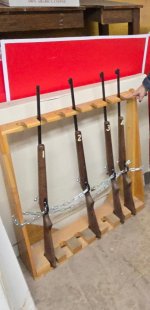

ipscgraz
CGN Ultra frequent flyer

The worst British destroyer class of WW2 might be the Town class. Old American hand-me-downs so worn out that sailors joked they’d roll on wet grass. And one of them pulled off one of the most daring raids of the war.
Summer 1940. France has fallen. German U-boats are tearing into the convoys keeping Britain alive, and the Royal Navy has lost a lot of destroyers off Norway and Dunkirk. Churchill begs Roosevelt for help. The US was still neutral. But it had something sitting around: hundreds of old WW1-era destroyers, many of them laid up in reserve for years. So in September 1940, the two countries made a deal. The US handed over 50 old destroyers.
In return, Britain gave the US long leases on bases in places like Newfoundland, Bermuda, and the Caribbean. The ships were renamed after towns that shared a name in Britain and America. The Town class.
Then the Royal Navy got a closer look at them. They were flush-deck “four-stackers,” with four tall funnels, built for a war that ended in 1918. Many had been sitting idle for years. They arrived with worn machinery, leaks, and all kinds of defects. A lot of them had to spend months in British shipyards before they were fit to fight. They were narrow and top-heavy. In the North Atlantic, they rolled violently. Crews were constantly soaked. They had a huge turning circle, terrible for chasing a submarine. And their weapons and fittings were outdated, so the British spent ages ripping things out and refitting them for anti-submarine work.
They were, frankly, not very good ships. But Britain didn’t need good ships. It needed ships. Any ships. And the Towns went straight into the hardest job in the war: escorting convoys through U-boat waters. They did their part. In May 1941, HMS Broadway was part of the escort group that forced U-110 to the surface. British sailors boarded it and grabbed its Enigma machine and codebooks, one of the most important intelligence captures of the war.
Several of them were sunk by U-boats and lost with most of their crews. But the most famous of them all was HMS Campbeltown, once USS Buchanan. In early 1942, the battleship Tirpitz was the biggest threat in the Atlantic. There was only one dry dock on the French coast big enough to repair her, the huge Normandie dock at Saint-Nazaire. If that dock was destroyed, Tirpitz would think twice about ever coming out.
So the British came up with a plan. Take an old destroyer, disguise it as a German ship, pack it with explosives, and ram it into the dock gates. They picked Campbeltown. Her funnels were cut down and reshaped to look German. Tons of explosives were hidden in her bow, set on delayed fuses and sealed in concrete.
On the night of March 28, 1942, she sailed up the river toward the dock with commandos aboard and a flotilla of small boats behind her. The Germans caught on and opened fire. Campbeltown ran up the British flag and charged. She smashed into the dock gates at full speed and stuck there. Commandos poured off to destroy the dock machinery. Many were killed or captured trying to fight their way out. The next morning, with the old destroyer still jammed in the gate and German officers and troops crowding aboard and around her to look at her, the hidden charges went off.
The explosion wrecked the dock gate and killed a large number of Germans. The Normandie dock was out of action for the rest of the war. Tirpitz never sailed into the Atlantic. Five Victoria Crosses were awarded for the raid. The Town class was old, wet, unstable, and worn out. But when Britain needed a ship it could throw away to change the war at sea, one of them was there.

Rod B
CGN Ultra frequent flyer
He certainly gained a lot of weight between the wars.Hermann Goering in 1918


This one must be from multiple servings of Sauerkraut & Bratwurst... Mmmmm.Hermann Goering in 1918

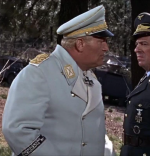
(I know it's from The Battle of Britain... I went and search for the pic... geezz you guys)
Last edited:

Thats German actor and folk singer Hein Riess who played Reichsmarschall Hermann Göring in the 1969 film Battle of Britain.
https://en.wikipedia.org/wiki/Hein_Riess
https://en.wikipedia.org/wiki/Hein_Riess
This is scene from the movie Battle of Britain.

1945 in custody.

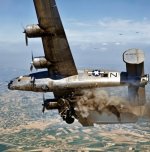

The way that smoke is looks like aircraft was not moving....????B24 Liberator, colorized with AI
View attachment 1240952

The way that smoke is looks like aircraft was not moving....????
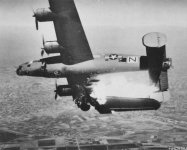
Here is the original photo

Dark Alley Dan
CGN Ultra frequent flyer
- Location
- Darkest Edmonton
AI has done more than colorizing this one. Rear turret's on upside down, insignia has six points, whole front of the plane is twisted 180 degrees from the tail...B24 Liberator, colorized with AI
View attachment 1240952
Fvck, I don't care for AI.
AI has done more than colorizing this one. Rear turret's on upside down, insignia has six points, whole front of the plane is twisted 180 degrees from the tail...
Fvck, I don't care for AI.
The whole plane IS upside down, it's belly up. I posted the original photo. AI changed the star, added numbers on the tail, and changed the flames to smoke.
fingers284
CGN Ultra frequent flyer
- Location
- Alberta Cowboy Ranges
Any info on the fate of the crew....my first thought whenever i see a similar photo
Any info on the fate of the crew....my first thought whenever i see a similar photo
B-24L Liberator heavy bomber nicknamed "STEVENOVICH II" of the 779th Bombardment Squadron, 464th Bomb Group. Taken on April 10, 1945, near Lugo, Emilia-Romagna, Italy. Out of the 10 crew members on board, 9 were killed in action (including the pilot and squadron commanding officer, Colonel James Gilson). Only one crew member, waist gunner Lt. Edward Walsh Jr., managed to survive after being thrown clear of the aircraft and deploying his parachute.