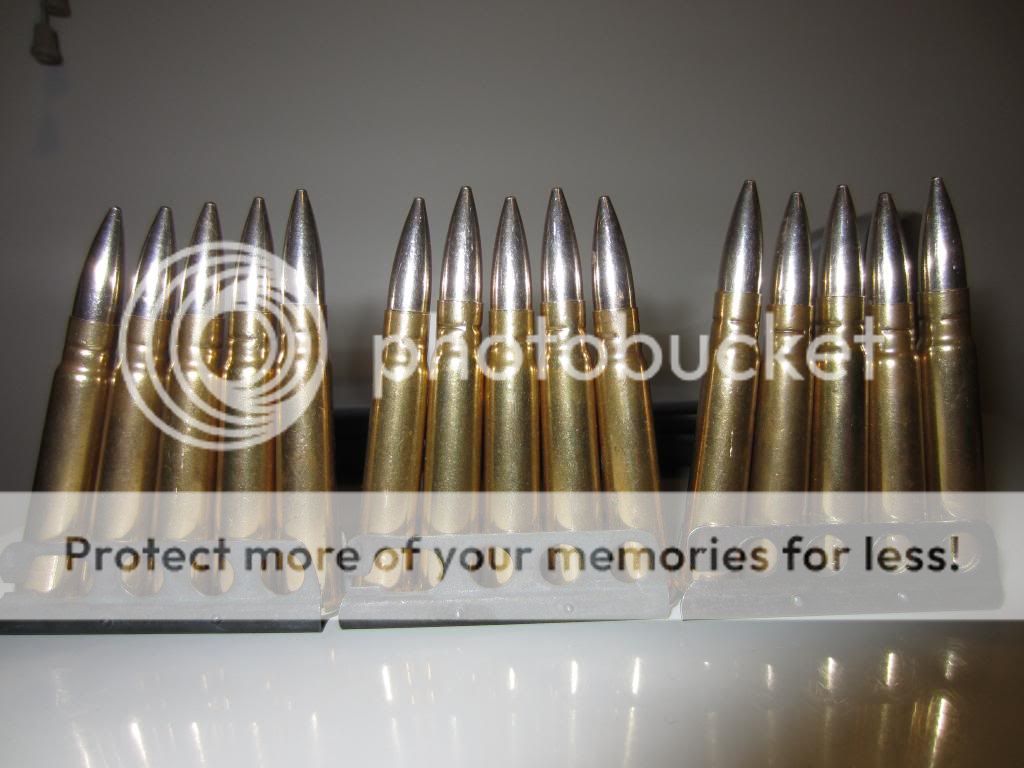
Proper way of .303 clips?

Craig0ry

CGN Ultra frequent flyer
Rating - 100%
234   0   0
Location
Southen Alberta
Alright so I've always been sort of curious of the proper way to load these stripper clips, Is it the first one? Second one? or third one?
First one being each round stacked ontop of the next
Second would be Down, up, down, up, down
And the third the opposite of that.

IMG_0492_zps497622e8.jpg
 
no 2 supposedly, but try it out, if your mag is well fitted, it doesnt matter how they are in the charger

I always loaded them like the #2, Then I bought a bandolier of 1950 British rounds and they were loaded like the #1 picture and alot of single rounds came out of the clip into the pouch.
 
Pyramid is correct for the Russian Moisin-Nagant and for the Tokarev SVT-40.

SECOND is correct for ALL Lee-Eneiflds, P-14s, Roses: DUDUD, _-_-_.

When these were still in the Service you can believe that the Sergeant drilled this right INTO you.

Sure drilled it into ME, anyway!

Have fun!
 
Makes you appreciate why most armies adopted a cartridge with an extractor groove. That being said I do like my Enfields, having 3 of them.
 
.
The correct way is the Number 2, (center) charger. Number 3 will work, but it does not keep the cartridges quite as secure in the charger. The two end cartridges are more easily loosened as they have nothing to help give a bit of friction to keep them from coming out.

The Number 2 charger, with the end cartridges down flat against the back of the charger, has more friction due to the pressure of the overlaping rims of the second and fourth cartridge and are not as succeptable to "coming apart."

The Number 1 charger will also work, and some target shooters, when firing five rounds, used to load their chargers that way. However, the charger must be oriented and the proper end inserted first so that jams do not occur. This is fine for the target range, where the Huns are not on the Wire and you have time to clear any jam, but in a combat situation, there is usually not the time to look and orient your charger, so you want a loaded charger that will work no matter which end you put in first.

Some chargers or en-bloc clips, like the Hungarian straight pull rifles, have a ribbed end so that you can feel the ribs at one end and a smooth section at the other end of the charger. These chargers are designed to be loaded only one way, and the prominent ribs are easily felt so that the soldier can feel and recognize the orientation of them, and flip them over if necessary.
.
 
Great thread, and thanks for sharing your knowledge. So now that I know how to load my clips properly, can anyone tell me what is the meaning or significance of the Mk # stamped on them? I've noticed different Mk #'s on mine and so far, I figure it has something to do with the period of mfg. There doesn't seem to be any discernible differences in function, just appearance as some of the holes are different. Any advice would be appreciated, thanks! :)
 
There are FOUR Marks of Charger for the Lee-Enfield rifle.

Functionally, they all work and interchange.

The Mark I is rare and was out of production before the Great War. MANY of us are still looking for ONE of the things. Iam worse-off than most guys because I am looking for TWO, one for each rifle of the period.

The Mark II is close to the Mark I, has the same long slots in the base but the ends are concave rather than convex. I tend to hoard these for my Great War rifles because they are just so smooth.

Marks III and IV were introduced DURING the Great War and continued until the end of production after Korea, although they are still made in India and Pakistan and were made in Iraq at least into the 1950s.

As introduced, all Chargers were BLUED and this holds for all Great War chargers and many later ones. During the Second War, Suncorite PAINT was introduced, as was Parkerising. There is also an uglynasty%#*&^$#disgusting finish which appears to be a kind of Parkerising except that it leaves the Chargers SPARKLY and really tries not to let your rounds feed. With these ones, you smooth the inside lips and the inside of the base with Crocus cloth and they feed fine after that.

Chargers which I have seen (admittedly not ALL of them, although I wish) are MARKED as to MARK and as to MANUFACTURE. You can build up an entire collection just with different Makes and Marks and Finishes...... and STILL not have 12 rounds for a target! Fun!

It's interesting, that's for certain.

Hope this helps.
 
Sort of off the beaten path regarding how to load rounds in a clip before stuffing the rounds in the mag. I was watching an old NFB series (I think it was Canada At War or something like that) and not really paying to much attention till they showed a soldier pushing the rounds home in the magazine and then NOT removing the clip. The soldier just closed the bolt and the clip sprang out I had to rewind (it was VHS back then) and watch it a couple more times to be sure I was not imagining that. Next thing I dragged out the LE placed a empty clip in the guides and closed the bolt. Hot Stuff! it works great. I do not know if thats the "by the book" method (those who know please add to this) I cannot say but it was a period film, and it works great.
 
.
Actually this was a method of increasing your firepower and was taught to soldiers. You load the first charger into the magazine, pull the empty charger out and DROP IT while reaching for the second charger. The reason you drop it is that it wastes time to throw it away. You then load the second five rounds and simply close the bolt, and the charger will spring away from the charger guide.

This will also work with some other charger fed Military rifles. However, I do not recommend it as it tends to deform the charger and chargers are a bit difficult to find for many of the older milsurps. We are not faced with a horde of attacking enemy soldiers, so it is better to pull your chargers out manually and set them down so that you can use them over and over again. Conservation of chargers were not really a consideration under most military circumstances so they really didn't care if the charger got banged up a bit.
.
 
Last edited:
Thanks for the insight about first charger being manually removed and then second being loaded into magazine with bolt being closed to eject the second charger. I will also start calling a charger, a charger, instead of a clip. Learn something new all the time. Up to now a "charger" to me was a device attached to a C1-C7 or C8 mag that a clip went into. Now I got the correct WW2 term
 
Cartridges with extractor grooves (rimless cartridges) get rid of the RIM problem and substitute for it a far more dangerous problem: the problem of producing both ammunition AND chambers to a very tight specification.

Look at some of the early Ross Rifles: chambers so loose at the front that the fired brass looks like anything except a .303 round. But they were SAFE because the Cartridge headspaces ON THE RIM. The Rim acts as a definite STOP and does not allow the cartridge to go too far into the Chamber. Because the Cartridge CAN'T go too far into the Chamber, it is possible to make Chambers with radical amounts of excess space in them. Such a Chamber can accumulate an incredible amount of filth, dirt, dust, sand and fouling and still work perfectly.

You cannot do this with a Rimless Cartridge. The casing headspaces somewhere on the shoulder, at a semi-mythical point partway along the Shoulder of the round (straight-wall cases headspace on the MOUTH, making chambering of huge numbers of firearms in wartime into a nightmare for the machinists and inspectors both). Gauging is constant because you can't SEE how much is left to do and the Gauges are tight enough that, if you do go over spec, it can be difficult to judge just HOW much before attempting remedial action. In a production situation, it is more efficient simply to trash a barrel and install a new one and chamber it. Reamers wear in use and come back from resharpening smaller and shorter than they started off: another requirement for constant gauging.

When Rimless cartridges get mixed-up and get fired in rifles which do not have extractors which HOLD the casings in contact with the face of the Bolt, terrifying things can happen..... and do. Here is a little f'rinstance for you: the .30-06 was used in the Garand, which has a snap-over extractor which grabs the casing on chambering fully. The old '06 as superceded by the 7.62 NATO, known in its civilian guise as the .308 Winchester. The .308 has all the power of the original '06 but in a shorter case...... and it also has a casing with LESS TAPER. If you get the rounds mixed up, generally a Garand will function fairly well because the .308 rounds get JAMMED into the chamber by that more-square shape and held in a position in which the Extractor can grab them and the rifle be fired without a problem. But if you REALLY want trouble, run some of those .308 rounds through an '06 sizing die and THEN mix them up. Suddenly, the .308 rounds CAN go too far into the Chamber, case separations will become common...... and it becomes possible to wreck Rifle and Shooter with a single round which goes too far into the Chamber, ignites slowly, builds pressure, adheres to the wall of the Chamber, fires at full pressure and THEN the Head of the case rams itself backwards against the face of the Bolt with a considerable SHOCK rather than a PRESSURE, the Case stretches and separates at the Web and releases hot gas at 55,000 pounds a square inch out of the Chamber and into the face of the guy pressing the Trigger, should he be holding the rifle too low.

The BEST system is to use Semi-Rimmed ammunition. SR cartridges headspace on the RIM, as with a Rimmed cartridge, but the small Rim which exists generally will "jump" in the Magazine if required to do so and does not require the careful Charger-loading of a true Rimmed casing. It is interesting to note that the only Semi-Rimed cartridges which most of us are likely to encounter will be the .236 Lee, the 6.5 Arisaka, 7.7 Arisaka and the .280 Ross. Interesting point: the .276 for the P-13 was to have been Semi-Rimmed also. These all work just fine in Mauser-type Magazines, which are much more finicky than the original Lee Magazines.

The British stayed with the Rimmed type long after it had been abandoned by everyone else for one main reason: it worked. And their tests indicated that it worked BETTER in machine-guns than did Rimless ammunition. In Rifles, it made increasing production much easier, and this is borne out by the historical record: despite that fact that the Lee-Metford/Lee-Enfield was produced for British Service for just short of 70 years, nearly 90% of ALL production took place in the 4 years of the Great War and 6 years of the Second World War: ONE decade rather than seven. And you can add to those Wartime rifles ALL of the Pattern 14s and 99% of all Ross Mark III rifles.

Rimmed ammo definitely has something going for it.

Actually, I'm surprised that the impractical Rimless type has lasted so long......

 
There are FOUR Marks of Charger for the Lee-Enfield rifle.

Functionally, they all work and interchange.

The Mark I is rare and was out of production before the Great War. MANY of us are still looking for ONE of the things. Iam worse-off than most guys because I am looking for TWO, one for each rifle of the period.

The Mark II is close to the Mark I, has the same long slots in the base but the ends are concave rather than convex. I tend to hoard these for my Great War rifles because they are just so smooth.

Marks III and IV were introduced DURING the Great War and continued until the end of production after Korea, although they are still made in India and Pakistan and were made in Iraq at least into the 1950s.

As introduced, all Chargers were BLUED and this holds for all Great War chargers and many later ones. During the Second War, Suncorite PAINT was introduced, as was Parkerising. There is also an uglynasty%#*&^$#disgusting finish which appears to be a kind of Parkerising except that it leaves the Chargers SPARKLY and really tries not to let your rounds feed. With these ones, you smooth the inside lips and the inside of the base with Crocus cloth and they feed fine after that.

Chargers which I have seen (admittedly not ALL of them, although I wish) are MARKED as to MARK and as to MANUFACTURE. You can build up an entire collection just with different Makes and Marks and Finishes...... and STILL not have 12 rounds for a target! Fun!

It's interesting, that's for certain.

Hope this helps.


Hey smellie, thanks for the intel! Here's some pics of my strippers and a few other goodies (the pic of the backside of the bandoleer came out in a wonky color, not sure why)... So, I've got Mk 2's, 3's, and a couple different Mk 4's, but no Mk 1's - YET! :)

IMG_0066_zps2392f282.jpg

IMG_0065_zps40b125eb.jpg


IMG_0058_zps14e7fda5.jpg

IMG_0059_zps7bff22e1.jpg

IMG_0060_zps9b51b579.jpg

IMG_0061_zps131a2d8d.jpg

IMG_0062_zpsc9628acb.jpg


A couple different kinds of milsurp .303's...in the other pics, I'm not sure what the dents/crimps are in the brass just below the bullet...?

IMG_0063_zpsdc121702.jpg

IMG_0064_zps80ce957a.jpg


I noticed the C & broad arrow on this (besides the rust stains), I think that's pretty coolio!

IMG_0056_zps70cf2b0f.jpg

IMG_0057_zps79d6c493.jpg


In the pic of the "layout" showing the top of the bandoleer, I put some milsurp ctgs on the left side that appear to have met a grinding wheel...not sure why this was done but I've got a few of these, and I suppose someone was trying to make some steel (?) jacketed bullets into semi-jacketed..? meh, with that kind of bubba-ing, they are probably better suited now for the range, than the keeping, so that's ok. :)

 
Back
Top Bottom