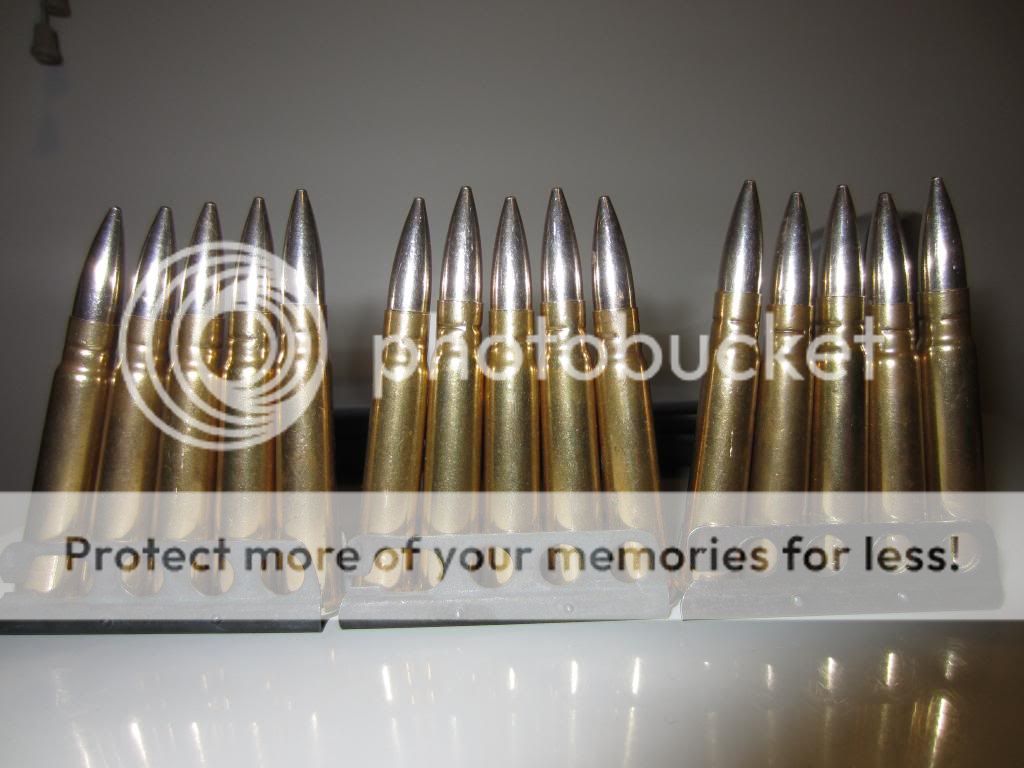
Cartridges with extractor grooves (rimless cartridges) get rid of the RIM problem and substitute for it a far more dangerous problem: the problem of producing both ammunition AND chambers to a very tight specification.
Look at some of the early Ross Rifles: chambers so loose at the front that the fired brass looks like anything except a .303 round. But they were SAFE because the Cartridge headspaces ON THE RIM. The Rim acts as a definite STOP and does not allow the cartridge to go too far into the Chamber. Because the Cartridge CAN'T go too far into the Chamber, it is possible to make Chambers with radical amounts of excess space in them. Such a Chamber can accumulate an incredible amount of filth, dirt, dust, sand and fouling and still work perfectly.
You cannot do this with a Rimless Cartridge. The casing headspaces somewhere on the shoulder, at a semi-mythical point partway along the Shoulder of the round (straight-wall cases headspace on the MOUTH, making chambering of huge numbers of firearms in wartime into a nightmare for the machinists and inspectors both). Gauging is constant because you can't SEE how much is left to do and the Gauges are tight enough that, if you do go over spec, it can be difficult to judge just HOW much before attempting remedial action. In a production situation, it is more efficient simply to trash a barrel and install a new one and chamber it. Reamers wear in use and come back from resharpening smaller and shorter than they started off: another requirement for constant gauging.
When Rimless cartridges get mixed-up and get fired in rifles which do not have extractors which HOLD the casings in contact with the face of the Bolt, terrifying things can happen..... and do. Here is a little f'rinstance for you: the .30-06 was used in the Garand, which has a snap-over extractor which grabs the casing on chambering fully. The old '06 as superceded by the 7.62 NATO, known in its civilian guise as the .308 Winchester. The .308 has all the power of the original '06 but in a shorter case...... and it also has a casing with LESS TAPER. If you get the rounds mixed up, generally a Garand will function fairly well because the .308 rounds get JAMMED into the chamber by that more-square shape and held in a position in which the Extractor can grab them and the rifle be fired without a problem. But if you REALLY want trouble, run some of those .308 rounds through an '06 sizing die and THEN mix them up. Suddenly, the .308 rounds CAN go too far into the Chamber, case separations will become common...... and it becomes possible to wreck Rifle and Shooter with a single round which goes too far into the Chamber, ignites slowly, builds pressure, adheres to the wall of the Chamber, fires at full pressure and THEN the Head of the case rams itself backwards against the face of the Bolt with a considerable SHOCK rather than a PRESSURE, the Case stretches and separates at the Web and releases hot gas at 55,000 pounds a square inch out of the Chamber and into the face of the guy pressing the Trigger, should he be holding the rifle too low.
The BEST system is to use Semi-Rimmed ammunition. SR cartridges headspace on the RIM, as with a Rimmed cartridge, but the small Rim which exists generally will "jump" in the Magazine if required to do so and does not require the careful Charger-loading of a true Rimmed casing. It is interesting to note that the only Semi-Rimed cartridges which most of us are likely to encounter will be the .236 Lee, the 6.5 Arisaka, 7.7 Arisaka and the .280 Ross. Interesting point: the .276 for the P-13 was to have been Semi-Rimmed also. These all work just fine in Mauser-type Magazines, which are much more finicky than the original Lee Magazines.
The British stayed with the Rimmed type long after it had been abandoned by everyone else for one main reason: it worked. And their tests indicated that it worked BETTER in machine-guns than did Rimless ammunition. In Rifles, it made increasing production much easier, and this is borne out by the historical record: despite that fact that the Lee-Metford/Lee-Enfield was produced for British Service for just short of 70 years, nearly 90% of ALL production took place in the 4 years of the Great War and 6 years of the Second World War: ONE decade rather than seven. And you can add to those Wartime rifles ALL of the Pattern 14s and 99% of all Ross Mark III rifles.
Rimmed ammo definitely has something going for it.
Actually, I'm surprised that the impractical Rimless type has lasted so long......