Question for expert reloaders.

zZ_denis

CGN Regular
Rating - 100%
121   0   0
I have some odd - length .308 bullets that i want to load.
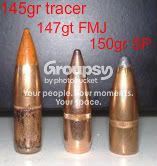
Lets take 2 bullets for example - pulled M25 145gr mil tracer and a standard mil-spec 147gr M80 FMJBT. These bullets have the same weight, but the tracer is significantly longer. I want to load both of these into .308WIN.

240220111322-1.jpg


If i load them to the same OAL (2.800"), the tracer would sit much deeper in the case. This would reduce case capacity. Would it therefore increase pressure? (assuming the same powder charge).

Lets say i use 50.0 grains of Winchester 748 for both loads. The regular 147gr bullet would be launched at approx 3000FPS@44K pressure.
How would the velocity and pressure differ for the longer tracer bullet? Lets assume that ALL the variables are the same (components, charge, gun), except the bullet length. Common sense tells me that i will see the same velocities at lighter powder charges, due to higher pressure because of reduced case capacity. Am i wrong?

Secondly, can i use velocity as a pressure indicator? Lets say im working up a load for one of these odd-length bullets. I load it to 2900 fps. I know that the shorter bullets of the SAME WEIGHT can be fired safely in this caliber at ~3000fps. Does this mean i can keep adding more powder until i reach ~3000fps with the longer bullet? (lets assume i don't see any obvious signs of excessive pressure).
 
Yes reducing case capacity will increase pressure for the same powder weight, and velocity will likely go up. You really can't estimate pressure from velocity, and excessive pressure is better indicated by the primer shape, cratering around the firing pin dent, and any sign of the ejector on the head face.
 
You really can't estimate pressure from velocity, and excessive pressure is better indicated by the primer shape, cratering around the firing pin dent, and any sign of the ejector on the head face.

This is the opposite of the truth.

In reality, seating the ogive of the bullet farther from the lands decreases pressure more than seating the bullet deeper in the case increases it. If the distance to the lands is equal between the two bullets, then the bullet that decreases powder capacity in the case will have slightly higher pressure.

Velocity is EXACTLY how you should be estimating pressure, short of having a strain gauge or proper pressure-testing equipment. Talk to some of the ammo manufacturers. They will tell you that short of proper pressure equipment, a chronograph is the best way to judge pressure. The conventional pressure signs can be very imprecise...
 
Disagree...

The OP is asking about significant differences in how far the bullet goes into the case, not into the lands. This affects case volume. With the same weight bullet, and same weight of powder, then yes pressure and velocity will go up. You can't tell if the pressure is excessive from the velocity, you have to look at the case.

I use a chronograph all the time and experiment between jams and jumps. The difference between a 10 thou jam and 10 thou jump is nearly unmeasurable. Deep jams are a different matter, but that is not what the OP is asking about.
 
Velocity is EXACTLY how you should be estimating pressure, short of having a strain gauge or proper pressure-testing equipment. Talk to some of the ammo manufacturers. They will tell you that short of proper pressure equipment, a chronograph is the best way to judge pressure. The conventional pressure signs can be very imprecise...
Your everyday reloader doesn't have highly standardized laboratory-grade equipment ammo manufacturers do. Given changes in chamber specs, barrel lengths, brass thickness, bullet characteristics, etc. how can one reliably estimate pressure from velocity?

Are you saying that if I'm following a reloading manual to load a given cartridge and can't quite match published velocities, I should go ahead and keep increasing powder charge until I reach said velocities, regardless of pressure signs?
 
Velocity and pressure are two completely different factors. You can not judge pressure by velocity. Using faster than ideal powders will can easily reach full pressure, or over pressure, before the normal velocity for that cartridge is reached.
The opposite is also true. Using a slower powder, such as H4831 in a 30-06 may easily reach, or come close to, the average velocity of that cartridge, with lower pressure than would the same velocity be with say, 4320 powder.
The extremes would be with a powder like Unique in a 30-06. Maximum pressure would be reached with velocity about like that of a 30-30.
 
The one significnce velocity has in judging pressure is, if you are doing a careful "ladder" increase in charge weight, and measuring velocity at each step, you should be able to anticipate the velocity result of the next increment. If, for instance, a 0.2 grain increment was giving approximately 40 fps increase in velocity, after three or four such increments, each with their attendant 40-ish fps increase in velocity, one would anticipate that the next 0.2 grain increment would produce an additional 40-ish fps increase in velocity. Should the chrony announce you had either a decrease, no increase, or a much larger increase in velocity, then it is probable that your internal pressure curve has also gone outside of predictable parameters, and it is time to back off! This coupled with an intelligent compliance with the ballisticians' recommendations to never exceed book maximums, tends to prolong the enjoyment of the shooting sports.
 
I'm too lazy to type my own response, so here is a quote or two from the professional gun/hunting writer John Barsness:

"Every pressure lab that I know of today uses barrels and chambers cut to SAAMI minimum dimensions. Any LARGER variation of throat or bore will result in lower pressures and velocities, which is exactly what happens with a lot of factory rifles.

Unless your rifle has a custom barrel with a tighter bore and/or throat, it is highly unlikely to produce excessive pressures OR VELOCITIES with the loading data published today.

The exception is when components are substituted in the loading data, especially bullets. It's common for handloaders to look up, say, 130-grain data for the .270 bullets in one manual, but use it with another brand of bullet.

A friend did just this with his .270 Weatherby Magnum. He looked up data from Hornady's manual and used it with both Hornady Spire Points and Nosler Partitions. He got just about what the manual suggested with the Hornadys, around 3400 fps. But with the Partitions he got close to 3600 fps--BECAUSE THEY PRODUCED MORE PRESSURE.

Like a lot of handloaders, he thought he was lucky and had a "fast barrel." What was really happening is that pressures were much higher. From the velocities, probably around 70,000 psi.

It's not uncommon to get 70,000 psi these days and not see any of the traditional "pressure signs," due to tougher brass and actions that are more "square," even factory actions. This has been demonstrated a bunch of times, but many handloader still don't get it--because so many older manuals talked about pressure signs as if they were really accurate.

In the old days, most of the handloading manuals used factory rifles and the "pressure signs" method of working up loads. The older actions often weren't particularly square, so bolt lift would get a little stiff with relatively low pressure.

But pressures could also be all over the place with the same data, because factory barrels were all over the place dimensionally. Some of the factory rifles were even used to produce data for several manuals, with the barrels wearing during the shooting for each manual.

This is one of several reasons the older manuals (and handloaders) depended on pressure signs--along with the fact that many bullet companies didn't have real pressure-testing equipment, which is expensive. Also, most handloaders didn't have chronographs, so the only indication they had of pressure was bolt lift, brass life, etc. etc.

However, these days all the published data I know of is pressure-tested, usually with electronic equipment that's more sensitive than the older copper-crusher barrels.

In fact, in my last visit to a lab, the technician told me that their equipment indicated that a .0001" (1/10,000th of an inch) difference in bore diameter resulted in about a 1000 psi change in pressure. THAT'S how good the equipment is these days. And while watching the computer monitor while he shots various loads, you could see velocity correlating precisely with pressure. Even changes of 5 fps also showed up in the pressure reading for that same shot.

If you look up NEW data for a certain bullet and powder, and don't exceed the maxmimum velocity listed, then you are certainly not exceeding the pressure listed in the manual. And if your load DOES exceed the listed velocity, it's almost certainly exceeding the pressure of the manual load.

BUT YOU HAVE TO USE THE SAME BULLET AS IN THE MANUAL. This can cause minor problems. Nosler often lists data for several bullets of the same weight in their manual. Usually the bullet that produces the most pressure is the Partition. If you work up a load with the Ballistic Tip of the same weight it will likely be a little slower. You can then add another grain or so of powder and be on safe ground.

Sometimes the test barrel is a different length than your rifle's barrel. Then you must adjust the velocity data to get an approximate idea of a safe velocity. Adding or subtracting 25 fps per inch of barrel length works pretty well.

Powder lots do vary some, and primers and brass cause some difference in pressure as well. The chronograph will tell you if this is happening. But the big variable is the bullet, which is why we should use data for the bullet we're loading.

Chronographs also vary. I have had some weird experiences with cheap chronographs, the reason I now own an Oehler (though there are other good makes). But today an accurate chronograph if indeed the home handloader's best friend."

"The most accurate indication of pressure in any home handloading is a chronograph, combined with pressure-tested data."

"In fact, during my last visit to a pressure lab, the tech said, "A chronograph is the home handloader's best friend!""

"I am not (and never have) suggested that the average handloader ignore pressure-tested data and rely totally on a chronograph.

What I have always suggested is that the average handloader compare published, pressure-tested data with the chronographed results from the same bullet/powder combination in their own rifle."

"Actually, chronograph data is a VERY good indication of pressure. Like a strain gauge or a piezo transducer, it IS another measure of pressure.

I have visited professional pressure labs, and even helped in one. It is astonishing how closely pressure and velocity are tied together, the reason many professional ballisticians also suggest that a chronograph is the best affordable home test of pressure.

Now, you can run into trouble with a chronograph if it's giving false readings, and some do, especially under certain conditions such as bright sunlight. Which is why we should always remain cautious--and as Big Redhead pointed out, we still have to be observant of traditional signs of excessive pressure.

But I have been using a chronograph as my primary method of pressure measurement for several decades now. While I've run into signs of high pressure now and then, most were also accompanied by too-high velocities.

The exceptions that I can remember were rare instances of too-soft brass, and a few bolt-faces that had little machining ridges around the ejector hole that left a mark on the case heads even with mild loads.

As the last pressure-lab ballistician I visited (just a few months ago at the Western Powders lab) said during our afternoon: "The chronograph is the handloader's best friend!""

"Flattened primers can also be caused by a slight amount of headspace. The fikring pin shoves the case as far as it will go into the chamber, so the very rear of the primer isn't supported and expands more than normal. Then the case backs up over the primer, making it look VERY flat, but the problem isn't necessarily excessive pressure.

Also, some primers flatten a lot more easily.

Ray obviously only shoots 98 Mausers, pre-'64 Model 70's and others with an ejector slot. Many of those blasted push-feed rifles leave a round mark on the case head.

Also, once in a while a rifle will have a little ridge around the ejector slot/hole that leaves an imprint on the case head even with mild loads. Usually this is with a new rifle, but I've seen it on well-used rifles.

A chronograph is indeed the best pressure-indicator for handloaders. But the most accurate results by far are when using exactly the same bullet as used in the manual, since today various bullets of the same weight and diameter create widely different amonts of pressure.

I have had more than one professional ballistician tell me this in recent year, long after I had come to the same conclusion myself. In fact I wouldn't even call a chronograph a pressure indicator, I'd call it a measurement device, because the connection between pressure and velocity is so consistent."

 
Brass quality has changed a lot in recent times, and softer brass will show the traditional "pressure signs" earlier than harder brass. This may or may not correspond to excessive pressure.

At the end of the day, pressure is what causes velocity. Assuming you are comparing your chrony data to published, pressure-tested data (using the same powder type, charge, the same bullet, etc), velocity is the best measure of pressure, short of using a strain gauge or other pressure-testing equipment.
 
Last edited:
^^^^^^^^^^^^^^^^
i agree totally, and have seen this in my own rifles. the bullet is key to pressure, more than any other component. provided you are not an idiot.
 
Thanks for the replies!

So can one reasonably expect to be able to (safely) push a significantly longer bullet at the same velocity as a shorter bullet of the same weight? (in the same caliber, with the same powder type).
Would the optimal powder (in terms of burn rate) for a shorter bullet also be optimal for a longer bullet, in general?
 
Velocity is EXACTLY how you should be estimating pressure, short of having a strain gauge or proper pressure-testing equipment.

A chronograph measures velocity, not pressure, and there is no direct conversion from velocity to pressure.Testing with bullet coatings such as moly, proves that reducing friction, allows for more velocity, with the same pressure. In the same way, a smooth barrel can produce more velocity with the same pressure than a rough barrel producing the same pressure. The rate of twist, the type of rifling, and the land and groove diameters also effect pressure and velocity. The end result, is that velocity is not a foolproof method of estimating pressure, and only a fool would think that it is a good idea to simply increase a pressure charge weight until he reaches the velocity listed in the manual.
 
So can one reasonably expect to be able to (safely) push a significantly longer bullet at the same velocity as a shorter bullet of the same weight? (in the same caliber, with the same powder type).
Would the optimal powder (in terms of burn rate) for a shorter bullet also be optimal for a longer bullet, in general?

One way to estimate the effect of using a long less dense bullet is to measure how much deeper it is going to sit in the neck. A 308 case capacity is about 56 grains (water). Fill you case with powder to the top of the neck and weigh it to get you case capacity in powder weight. Then lower the level in the neck by the amount you expect will be lost to the longer bullet (differential only), and weigh again. Lets say as an example capacity then turns out to be 54 grains. I would reduce your loads of the same powder by that ratio 54/56 X the standard load. That is rough but it gives you a starting point.

Another method would be to look at the equivalent weight Barnes bullets. Because they are made out of copper they are also long for their weight. If you compare Barnes loads to standard loads that may give you some idea what effect bullet length gives you.

I don't think the effect is large enough to change the powder type requirements, just the amount.
 
A chronograph can be used as an indicator of pressure if you know what to watch for. If you load say 10 cartridges in increments of one grain, when you approach maximum pressure you will observe a plateau in velocity, perhaps from 40 fps down to 20 fps or even less. As often as not when shooting a bolt gun, the subsequent incremental increase will result in a sticky bolt, or at the very least with ejector marks on the cartridge head.

When I am working up my loads I use this method and consider the load one step below the plateau load, or two grains below a sticky bolt as my maximum working load. If the ammo is intended as a full power hunting load, the maximum working load is what I'll use. Little seems to be gained in half grain increments in typical capacity rifle cartridges, and the velocity plateau can be more difficult to identify with the smaller increments. With hunting ammo, I've given up attempting to seat the bullet long, I simply crimp if there is a cannelure, if there is no crimping groove, I'll seat short enough to allow reliable feeding through the magazine, and there will be not change to the seating depth while I work up to the load.

If the intention is to develop an accuracy load, I begin with the bullet in contact with the lands and once the maximum pressure is observed I begin shooting groups with that load, then work away from the maximum load. Once I have the load that looks promising than I begin to play with the bullet seating depths in an attempt to find the sweet spot unless that OAL meets my expectations.
 
A chronograph can be used as an indicator of pressure if you know what to watch for. If you load say 10 cartridges in increments of one grain, when you approach maximum pressure you will observe a plateau in velocity, perhaps from 40 fps down to 20 fps or even less.

That scenario may, or may not happen, depending on the cartridge, the load, and the gun. One of my 7mmstw rifles was averaging 50fps per each grain of powder right up to 3600 fps with a 140gr bullet. At that velocity, there was some slight extrusion on the case heads, and the primer pockets were loosening noticeably after a single firing. I backed off two grains of powder, the velocity dropped to 3500fps, and the primer pockets were still snug after five firings. I have a few other rifles that behave very similarly.
 
That scenario may, or may not happen, depending on the cartridge, the load, and the gun. One of my 7mmstw rifles was averaging 50fps per each grain of powder right up to 3600 fps with a 140gr bullet. At that velocity, there was some slight extrusion on the case heads, and the primer pockets were loosening noticeably after a single firing. I backed off two grains of powder, the velocity dropped to 3500fps, and the primer pockets were still snug after five firings. I have a few other rifles that behave very similarly.

I've been able to use the velocity plateau method of determining the maximum safe pressure from cartridges with as little capacity as the .357 to ones as large as the .375 Ultra and the .458. I wonder what the geometry is of the STW cartridge that would prevent it from working in that case? Perhaps the answer lies in the relationship of bore size to powder capacity or perhaps to the ratio of powder charge to bullet weight. The velocity plateau method seems to work with slightly overbore cartridges, and it works even with bullets as light as 55 gr in the .243, but my experience with overbore cartridges is not extensive. The techs at Sierra seemed to think it had universal application, or at least they didn't point out any exceptions.
 
I've been able to use the velocity plateau method of determining the maximum safe pressure from cartridges with as little capacity as the .357 to ones as large as the .375 Ultra and the .458. I wonder what the geometry is of the STW cartridge that would prevent it from working in that case? Perhaps the answer lies in the relationship of bore size to powder capacity or perhaps to the ratio of powder charge to bullet weight. The velocity plateau method seems to work with slightly overbore cartridges, and it works even with bullets as light as 55 gr in the .243, but my experience with overbore cartridges is not extensive. The techs at Sierra seemed to think it had universal application, or at least they didn't point out any exceptions.

I am less concerned about the theory of how things should happen, than I am about seeing what actually happens. As I said, I have a few other guns/loads that behave quite similarly.
 
Thanks for the replies!

So can one reasonably expect to be able to (safely) push a significantly longer bullet at the same velocity as a shorter bullet of the same weight? (in the same caliber, with the same powder type).
Would the optimal powder (in terms of burn rate) for a shorter bullet also be optimal for a longer bullet, in general?

NO. If you are changing to a longer bullet seated deeper in the case, you WILL increase pressure as well, as has been fairly well explained by Ron and stubblejumper already.

The longer bullet MAY also cause an increase in friction and PROBABLY will be seated deeper in the case due to bullet length. Both of those conditions can increase pressure dramatically. You CANNOT assume the bullet will be safe in the same load as the shorter bullet, in fact you SHOULD assume the opposite and start at a reduced charge working your way up. There is no shortcut or magic formulae to get around it.
 
A chronograph measures velocity, not pressure, and there is no direct conversion from velocity to pressure.Testing with bullet coatings such as moly, proves that reducing friction, allows for more velocity, with the same pressure. In the same way, a smooth barrel can produce more velocity with the same pressure than a rough barrel producing the same pressure. The rate of twist, the type of rifling, and the land and groove diameters also effect pressure and velocity. The end result, is that velocity is not a foolproof method of estimating pressure, and only a fool would think that it is a good idea to simply increase a pressure charge weight until he reaches the velocity listed in the manual.

Please go back and read my big, long post ;)

We are assuming you are comparing the SAME bullet to the pressure-tested data found in the manual. Unless your ROT is significantly different from the one used in the data, your pressure will not change significantly. Your example of moly illustrates my point. If you add moly to your bullets, you immediately see a decrease in velocity because there is a decrease in pressure! You need to add powder to regain that pressure and velocity that was lost.

Have you ever used a strain gauge on barrels with different ROT, types of rifling, number/diameter of lands and grooves, etc? The pressure variation caused by those factors is minute compared to the more obvious factors, like powder type and charge weight, barrel length, and bullet type/weight.

I'm not saying that a chrony is a foolproof way of measuring pressure, but it IS the best indicator that we currently have available to us (unless of course we have a strain gauge, which some people here have).
 
Back
Top Bottom