I'm too lazy to type my own response, so here is a quote or two from the professional gun/hunting writer John Barsness:
"Every pressure lab that I know of today uses barrels and chambers cut to SAAMI minimum dimensions. Any LARGER variation of throat or bore will result in lower pressures and velocities, which is exactly what happens with a lot of factory rifles.
Unless your rifle has a custom barrel with a tighter bore and/or throat, it is highly unlikely to produce excessive pressures OR VELOCITIES with the loading data published today.
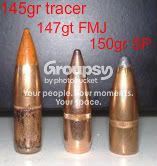
The exception is when components are substituted in the loading data, especially bullets. It's common for handloaders to look up, say, 130-grain data for the .270 bullets in one manual, but use it with another brand of bullet.
A friend did just this with his .270 Weatherby Magnum. He looked up data from Hornady's manual and used it with both Hornady Spire Points and Nosler Partitions. He got just about what the manual suggested with the Hornadys, around 3400 fps. But with the Partitions he got close to 3600 fps--BECAUSE THEY PRODUCED MORE PRESSURE.
Like a lot of handloaders, he thought he was lucky and had a "fast barrel." What was really happening is that pressures were much higher. From the velocities, probably around 70,000 psi.
It's not uncommon to get 70,000 psi these days and not see any of the traditional "pressure signs," due to tougher brass and actions that are more "square," even factory actions. This has been demonstrated a bunch of times, but many handloader still don't get it--because so many older manuals talked about pressure signs as if they were really accurate.
In the old days, most of the handloading manuals used factory rifles and the "pressure signs" method of working up loads. The older actions often weren't particularly square, so bolt lift would get a little stiff with relatively low pressure.
But pressures could also be all over the place with the same data, because factory barrels were all over the place dimensionally. Some of the factory rifles were even used to produce data for several manuals, with the barrels wearing during the shooting for each manual.
This is one of several reasons the older manuals (and handloaders) depended on pressure signs--along with the fact that many bullet companies didn't have real pressure-testing equipment, which is expensive. Also, most handloaders didn't have chronographs, so the only indication they had of pressure was bolt lift, brass life, etc. etc.
However, these days all the published data I know of is pressure-tested, usually with electronic equipment that's more sensitive than the older copper-crusher barrels.
In fact, in my last visit to a lab, the technician told me that their equipment indicated that a .0001" (1/10,000th of an inch) difference in bore diameter resulted in about a 1000 psi change in pressure. THAT'S how good the equipment is these days. And while watching the computer monitor while he shots various loads, you could see velocity correlating precisely with pressure. Even changes of 5 fps also showed up in the pressure reading for that same shot.
If you look up NEW data for a certain bullet and powder, and don't exceed the maxmimum velocity listed, then you are certainly not exceeding the pressure listed in the manual. And if your load DOES exceed the listed velocity, it's almost certainly exceeding the pressure of the manual load.
BUT YOU HAVE TO USE THE SAME BULLET AS IN THE MANUAL. This can cause minor problems. Nosler often lists data for several bullets of the same weight in their manual. Usually the bullet that produces the most pressure is the Partition. If you work up a load with the Ballistic Tip of the same weight it will likely be a little slower. You can then add another grain or so of powder and be on safe ground.
Sometimes the test barrel is a different length than your rifle's barrel. Then you must adjust the velocity data to get an approximate idea of a safe velocity. Adding or subtracting 25 fps per inch of barrel length works pretty well.
Powder lots do vary some, and primers and brass cause some difference in pressure as well. The chronograph will tell you if this is happening. But the big variable is the bullet, which is why we should use data for the bullet we're loading.
Chronographs also vary. I have had some weird experiences with cheap chronographs, the reason I now own an Oehler (though there are other good makes). But today an accurate chronograph if indeed the home handloader's best friend."
"The most accurate indication of pressure in any home handloading is a chronograph, combined with pressure-tested data."
"In fact, during my last visit to a pressure lab, the tech said, "A chronograph is the home handloader's best friend!""
"I am not (and never have) suggested that the average handloader ignore pressure-tested data and rely totally on a chronograph.
What I have always suggested is that the average handloader compare published, pressure-tested data with the chronographed results from the same bullet/powder combination in their own rifle."
"Actually, chronograph data is a VERY good indication of pressure. Like a strain gauge or a piezo transducer, it IS another measure of pressure.
I have visited professional pressure labs, and even helped in one. It is astonishing how closely pressure and velocity are tied together, the reason many professional ballisticians also suggest that a chronograph is the best affordable home test of pressure.
Now, you can run into trouble with a chronograph if it's giving false readings, and some do, especially under certain conditions such as bright sunlight. Which is why we should always remain cautious--and as Big Redhead pointed out, we still have to be observant of traditional signs of excessive pressure.
But I have been using a chronograph as my primary method of pressure measurement for several decades now. While I've run into signs of high pressure now and then, most were also accompanied by too-high velocities.
The exceptions that I can remember were rare instances of too-soft brass, and a few bolt-faces that had little machining ridges around the ejector hole that left a mark on the case heads even with mild loads.
As the last pressure-lab ballistician I visited (just a few months ago at the Western Powders lab) said during our afternoon: "The chronograph is the handloader's best friend!""
"Flattened primers can also be caused by a slight amount of headspace. The fikring pin shoves the case as far as it will go into the chamber, so the very rear of the primer isn't supported and expands more than normal. Then the case backs up over the primer, making it look VERY flat, but the problem isn't necessarily excessive pressure.
Also, some primers flatten a lot more easily.
Ray obviously only shoots 98 Mausers, pre-'64 Model 70's and others with an ejector slot. Many of those blasted push-feed rifles leave a round mark on the case head.
Also, once in a while a rifle will have a little ridge around the ejector slot/hole that leaves an imprint on the case head even with mild loads. Usually this is with a new rifle, but I've seen it on well-used rifles.
A chronograph is indeed the best pressure-indicator for handloaders. But the most accurate results by far are when using exactly the same bullet as used in the manual, since today various bullets of the same weight and diameter create widely different amonts of pressure.
I have had more than one professional ballistician tell me this in recent year, long after I had come to the same conclusion myself. In fact I wouldn't even call a chronograph a pressure indicator, I'd call it a measurement device, because the connection between pressure and velocity is so consistent."