Stopping Power (debate)

Read Bell's book, it tells a different story, and he always had a big bore available for emergencies.

Yet he killed over 1500 elephants with smaller bore bullets,proving that shot placement is far more important than bullet size,even with elephants.

 
It all depends on what one is shooting at. A Barrett .50 is just fine in Afghanistan taking out Taliban, but for regular hunting my preference is the 7mm.
 
I really think it is accademic when one is shooting elk, deer, moose, sheep etc -- small bullets at velocity vs big bullets at slower speeds. They will all do their job just fine.


When you have a lion or leopard coming at you full blast with the sole intent of killing you, I will go to big and slow all the time. I want it to hit any part of that streak of lightning and have the critter know it.

With the high velocity rounds you need to worry about it they will expand, disintigrate, expand after passing through the 150 lb cat, etc.

The large bullet will hit and hit hard and the requirement to expand may not even be required.

Again - it depends on what your needs are - there is no magic bullet or caliber.

Any animal may be killed with any rifle - but do you absolutely have to have the animal killed right in it's tracks or you will be in danger? That is where the big bore stopers come into their own.
 
A 7mm rem mag wouldnt take out a cat?
I really think it is accademic when one is shooting elk, deer, moose, sheep etc -- small bullets at velocity vs big bullets at slower speeds. They will all do their job just fine.

When you have a lion or leopard coming at you full blast with the sole intent of killing you, I will go to big and slow all the time. I want it to hit any part of that streak of lightning and have the critter know it.

With the high velocity rounds you need to worry about it they will expand, disintigrate, expand after passing through the 150 lb cat, etc.

The large bullet will hit and hit hard and the requirement to expand may not even be required.

Again - it depends on what your needs are - there is no magic bullet or caliber.

Any animal may be killed with any rifle - but do you absolutely have to have the animal killed right in it's tracks or you will be in danger? That is where the big bore stopers come into their own.
 
you have to acount for hydro shock factor.
the body is 90 percent water, so what a bullet does in water is a good example of what it does in the body.


if you have seen a 300 savage fired then you may know what i mean when i say you can see the shockwave.

if you shoot a block of ballistics gell with a 300 savage or fast moving cartridge you see enormous ripples and a ragged hole caused by the shockwave that follows the bullet(i e ripples in a pond).

if you shoot a block of ballistics gell with a 45/70 or other slow moving big boy you get a large smooth hole and one solid ripple.(slowly sticking your finger in the pond as aposed to flingin a pebble in at high speed)


also..... shot placement is key:shotgun:
 
Ah yes! The old bell 275 Rigby thing!

If you can not only shoot well enough to drill a running lion in the brain, but can also make allowances in your lead to shoot it as it jumps mid air over a bush (at around 100 yards if memory serves) you have my full and undivided attention!

Not to mention the sheer amount of fortitude and confidence you would have to have in your abilities to face something that may kill you if you misplace the little golden .275....The adrenalin/fear factor that a normal hunter would face is difficult to overstate...For Bell it was just taking care of business.

If anyone thinks they can perform under pressure (dangerous game or not) and shoot as well as Bell they should say so....I for one would like to meet you.

Shot placement is key, but most of us mortals need a little margin for errors.
 
Ah yes! The old bell 275 Rigby thing!

If you can not only shoot well enough to drill a running lion in the brain, but can also make allowances in your lead to shoot it as it jumps mid air over a bush (at around 100 yards if memory serves) you have my full and undivided attention!

Not to mention the sheer amount of fortitude and confidence you would have to have in your abilities to face something that may kill you if you misplace the little golden .275....The adrenalin/fear factor that a normal hunter would face is difficult to overstate...For Bell it was just taking care of business.

If anyone thinks they can perform under pressure (dangerous game or not) and shoot as well as Bell they should say so....I for one would like to meet you.

Shot placement is key, but most of us mortals need a little margin for errors.

How much difference would it make to use a 375H&H if you can't place the shot properly.Without proper shot placement,a 375 isn't going to kill an elephant any more than a 275 Rigby will.
 
There's a reason why the big stoppers are called "stoppers" and not "brainers". An elephant will be killed by any bullet that makes it to the brain. It might be stopped, stunned or turned by a big, heavy and heavily constructed bullet that missed the brain. That "Maybe" could be the difference between living and dieing.
Interestingly there wasn't a black powder arm that could reliably take a frontal brain-shot, and that includes the 8, 4 and Baker's 2 gauge. Nitro powder changed everything, and made deer rifles into elephant guns. (Further proof that velocity is more important than weight. )The century old formula is over .40, over .300 sectional density and nominal velocity of 2150 fps. Bell's 7mm actually penetrated better than some of the bigger options because it got the right 2 out 3 correct. It didn't make it a stopper, but did make it kill beyond it's size.
 
A lot of members seem to defend their gun lockers... It matters not.. I have an old cowboy pal up in the interior who has shot 30+ moose with a .243 He shoots them in the throat.. Not a study in shooting ethics here.. IT works.. One for placement.. and ease of tracking!!!

My philosophy leans to retained energy at a given distance combined with placement... so with my old Norma Mag.. 3000+ ft lbs left over @ 250 yds... The kill on a well placed shot is assured... And that would work with pretty much any heavy bullet on large game ... and the game makes a difference too! Thus the 52 grain @ 3700 for yotes...and 17 gr. @ +- 4000 for little prairie dogs...

By the way.. that is the classic question to separate the novice from the experienced...
"what's better for whitetails? 270 or 308??" The answer is ..... bullet placement..
 
I would propose that "shot placement" is redundant in a debate like this.

A proper arguement for such a premise would be "What is better: good shot placement, or bad shot placement".

So I would reckon that we can get past that little bit of rhetoric and just assume that good shot placement is inherent within the current discussion...
 
How much difference would it make to use a 375H&H if you can't place the shot properly.Without proper shot placement,a 375 isn't going to kill an elephant any more than a 275 Rigby will.

With the .375H&H the target area covered by the concept of "proper shot placement" might be expanded to a larger one than the brain.

I say might because I don't know anything about elephant hunting, the argument could be transferred to moose or bear.
 
Bell was a curious man, and he went to the trouble of having the help flesh out elephant skulls so he could take measurements and make scaled drawings. This in turn convinced him the proper shot on an elephant was in the back of the head where the skull was the thinest, and being a prudent man, he wanted to live long enough to sell his ivory. What makes the frontal brain shot difficult is the problem of locating the brain. Simply shooting at an elephants head will end badly, and if a large elephant is close, the aiming point is so low on the trunk as to seem wrong. Today it is understood that the frontal brain shot is determined by a line that is indicated by the center of the ear canals, locating the ear canals is a trick in itself, then imagining a stick passing through the head from ear to ear, you try to break the stick with your shot. In Bell's day, there was no rule of thumb and the frontal brain shot was far from a sure thing. The professional ivory hunter was unlikely to put himself at unnecessary risk, as there were no medi-vac flights and it could be hundreds of miles over difficult terrain to the nearest hospital. The ivory trade was not sport or adventure, this was simply killing as efficiently as possible for profit.

One of the limiting factors of the day were the bullets that were available. In his small bores, he would have chosen a heavy solid, or what would have passed as a solid in those days, which today would be considered a full metal jacket. It doesn't take a great deal of testing to determine that a long for caliber bullet that cannot expand penetrates poorly. The best solids today tend to be short, have parallel sides, and flat or hemispherical noses. A long 7mm bullet would have a tendency to swap ends at which point straight line penetration would be lost. This was a big reason why Bell would prefer to make the back of the head shot with a light rifle.

The only people who would advise the use of a small bore rifle today, and I regard the .375 as a small bore with respect to elephant hunting, where the hunting style is one of confrontation rather than stealth, are folks who have never seen a trophy African elephant. Have a look at the following video from Rann Safaris; I posted it once before so you may have already seen it. It takes about 10 minutes to watch, and perhaps after seeing it you will have a better appreciation of what it takes to kill a big elephant with a frontal brain shot.

http://www.youtube.com/watch?v=0m23rM2WYl8

With regard to the effects of killing power, there is a post on the bear bullets thread by Why not suggesting that in 40 years of bear hunting he saw no observable difference between a bear shot with a light caliber rifle and one shot with a .375. I agree. The powerful rifle doesn't kill light game any better than does a standard round, but on big and or dangerous game, it gives you a distinct edge.
 
Last edited:
I'm amazed at how much Lion and Elephant hunting experience and knowledge this NORTH AMERICAN group of hunters has! I guess that explains why I see so few Elephants wandering through my farm in MB, they've all been shot by the rest of you :( Maybe there are still some in Alberta?

But knowing all this will sure come in handy when I go out after that 130lb white tail this fall :D I mean its only logical that if I can kill a 9,000lb Elephant with a poor shot from my Big F'ing Quintiple Super Sonic calibre, then I should just have to shoot in the general direction of the deer to get a kill. The hydrostatic shock of winging its ear should be enough to bring it down.
 
I'm amazed at how much Lion and Elephant hunting experience and knowledge this NORTH AMERICAN group of hunters has! I guess that explains why I see so few Elephants wandering through my farm in MB, they've all been shot by the rest of you :( Maybe there are still some in Alberta?

But knowing all this will sure come in handy when I go out after that 130lb white tail this fall :D I mean its only logical that if I can kill a 9,000lb Elephant with a poor shot from my Big F'ing Quintiple Super Sonic calibre, then I should just have to shoot in the general direction of the deer to get a kill. The hydrostatic shock of winging its ear should be enough to bring it down.
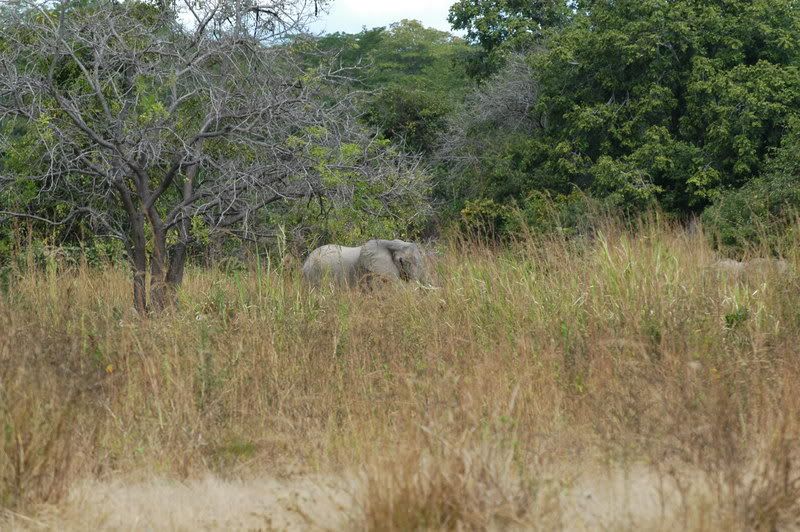
A 9000 pound elephant probably doesn't even rate as a legal trophy in Botswana or Tanzania. Tanzania requires a minimum of 4' of tusk out of the lip. That is a big elephant.

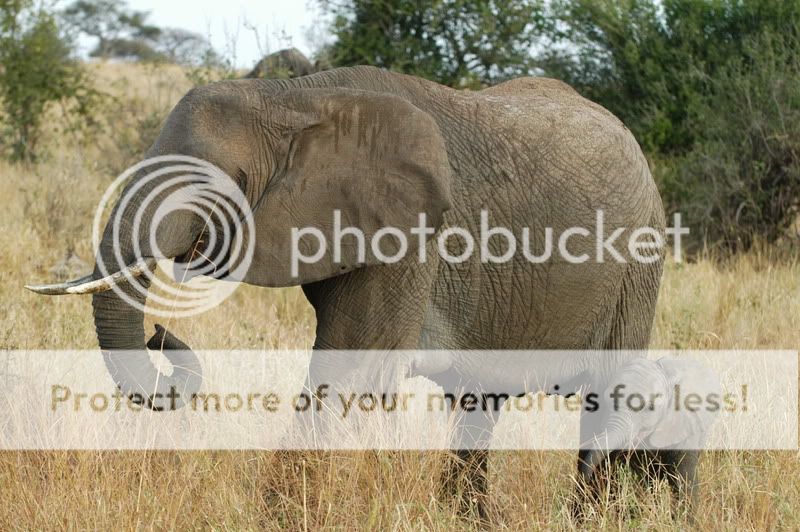
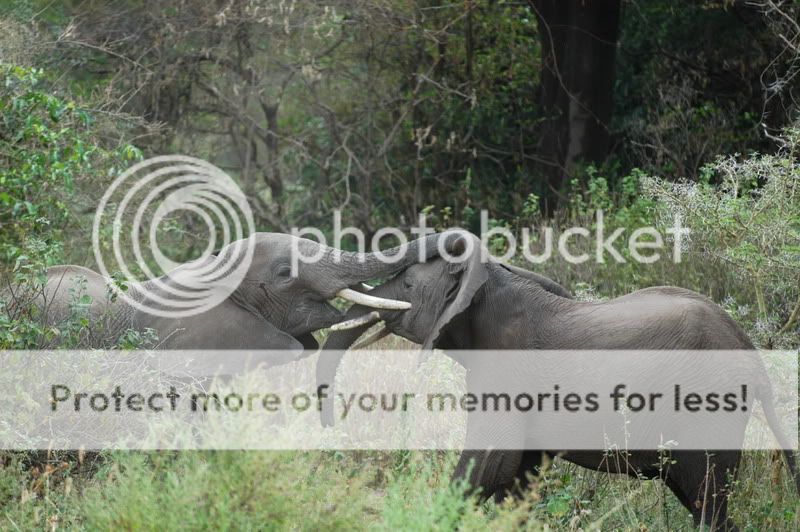
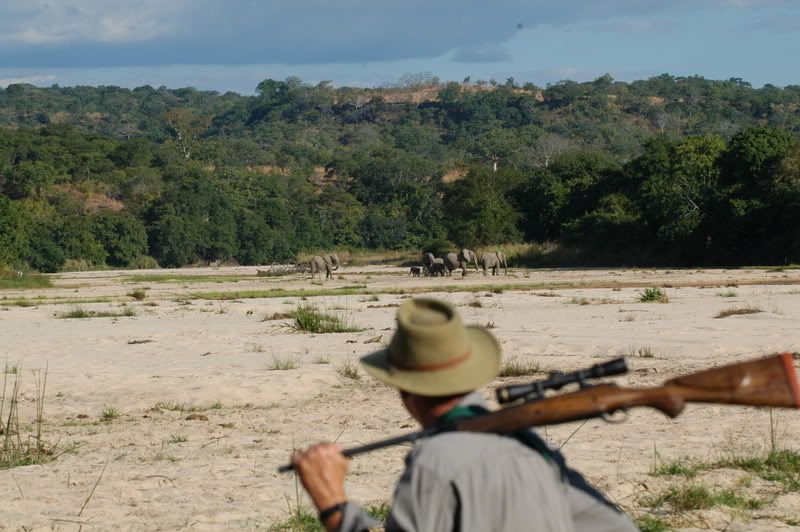
We saw in excess of 300 elephants in the Selous, but I don't recall seeing a shootable trophy. There was the little bastard that charged our truck just after sunset, he's the one I remember the best. You can't believe that so much noise can come from one animal. Even he made my .500 seem a little insignificant. The Selous produces quite a few trophy elephants, but we weren't there for elephant, elephant hunting in Tanzania requires deeper pockets than mine. Dogleg is the elephant killer of the group. Still, we saw quite a few, among them these . . .


Tanzania36-1.jpg


africaselous117.jpg


Tanzania276.jpg


Tanzania147.jpg


Tanzania139.jpg


Tanzania54.jpg
 
A 9000 pound elephant probably doesn't even rate as a legal trophy in Botswana or Tanzania. Tanzania requires a minimum of 4' of tusk out of the lip. That is a big elephant.

We saw in excess of 300 elephants in the Selous, but I don't recall seeing a shootable trophy. There was the little bastard that charged our truck just after sunset, he's the one I remember the best. You can't believe that so much noise can come from one animal. Even he made my .500 seem a little insignificant. The Selous produces quite a few trophy elephants, but we weren't there for elephant, elephant hunting in Tanzania requires deeper pockets than mine. Dogleg is the elephant killer of the group. Still, we saw quite a few, among them these . . .

Botswana...hmm...isn't that just south of Fernie, BC? Glad to see how well the Elephants have survived there :p

Kidding aside those are fantastic pictures...you have no idea how jealous I am...I can only dream of an African hunt. Thanks for posting the pics!
 
The original question was about the "stopping" power. I think many of assumed it was not related to the stopping power on a gopher or whitetail.
If the question is "what will drop an elk in it's tracks velocity or weight?" - then that is a bit different.

I also know there are a lot more fellows that hunt dangerous game (bear included) then we may think.
 
Back
Top Bottom