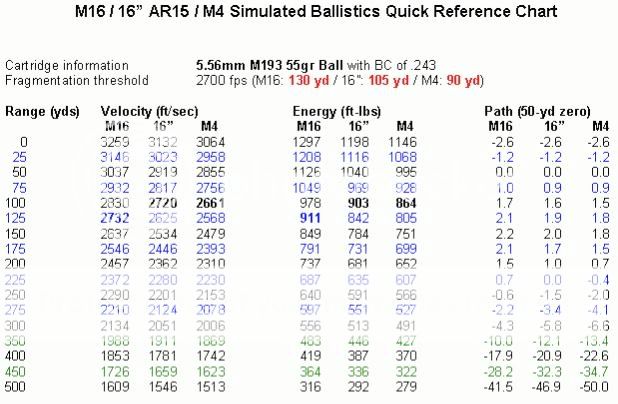
I don't understand what the fragmentation threshold represents exactly; the bullet fragments after it passes below the stated velocity? And above that velocity it continues to punch through? Or is it the other way around?
Other way around. Velocity is an important component in the light 5.56's terminal ballistics. But before I get to that, let me explain something:
In the end, yaw is what causes fragmentation. All bullets will yaw, regardless of caliber, weight, length, construction, etc. However, all those factors will indeed dictate how bullets yaw, how rapidly they do it after contacting tissue, how many times they tumble, whether or not the jacket comes off or they break apart, etc. A very balanced bullet, for example (that is to say, one that has a centered center of gravity), wont yaw near as much as a boat tail with a long ogive, as is the case with many 5.56 rounds. Other factors such as precession (wobble in flight; a characteristic also shared amongst all bullets) determine, at least partially, how a bullet will yaw, but these things are relatively random and unpredictible...But I digress...
Because the 5.56 is long and has a very rearward center of gravity, it's easy to create conditions for the bullet to exhibit what you might call "excessive" yaw. And because the 5.56 is also skinny and thus not very strong, the centrifugal forces encountered by the bullet when it yaws literally cause it to explode. Bullets are meant to fly in a path with zero deviation to the bullets' axis after all, and it simply cannot take the forces brought upon it when it spins through a resistive material, such as human flesh. This condition of explosion is exacerbated all the more by the cannelure which causes a weak point in both the jacket and the lead core itself.
And here's the but...
But, in order for the bullet to fragment well, it needs to be cooking along as fast as possible. It's simple physics: the faster the bullet is moving, the greater the forces on the bullet during rotation. You feel the same force when going around a corner in your car. When you do it slowly, you don't feel the "pull" to the outside as much as you do when you're squealing your tires around the same turn. Take the turn fast enough and you can press your body up against the door...Or even skid off the road into the ditch or worse yet, roll the car!
The key point is, the faster, the greater the force. Because the 5.56 is such a skinny little booger, when it yaws doing 3,000 fps, the little bullet just can't take it and breaks apart like a grenade.
And you bring up the other but...
forums.second-amendment.org/index.php?topic=636.0
Quote from: redstarcluster on April 12, 2008, 11:13:58 PM
And on a side note for Recoil, I had never heard that 7.62 has worse impact performance at close range than 5.56 does. That's odd to me. Is that because of the FMJ? I thought that bigger and slower meant more effect?
If we're talking about fragmentation here, that's correct: the 7.62 is a much worse performer than the 5.56. Keep in mind that the 5.56's design is fundimental in creating conditions for fragmentation and apply that knowledge to a comparison of the 7.62 projectile. Even though it's a similar design, typically a rebated boat tail Spitzer with a relatively long ogive, it's still a much "meatier" bullet. Since it's thicker, it's much stronger and therefore less inclined to come apart.
As far as velocity goes, it's also true that there's an inverse relationship between terminal performance of both rounds. Basically, the faster the 5.56 goes, the better it will fragment (a side effect of bullet dimensions/design). The slower the 5.56 goes, the more it will "ice pick" (pass straight through). Conversely, the faster the 7.62 goes, the more it will ice pick due to it's higher mass. The slower the 7.62 goes, the more it will yaw, distort, expand or otherwise do something other than maintain straight and level flight.
Remember, the 5.56 is a really s**tty round to shoot at people as far as mass (energy) and expansion (tissue damage) goes. Were it not for fragmentation, it'd be nearly worthless for use on humans. Fragmentation is what kills with the 5.56. This is why we see so many horror stories about the AR-15/M16's failure in combat: many of these shootings were done beyond the effective range of the cartridge. Keeping targets within 100-150 yards (before the bullet slows down) we see the performance of the round, and therefore the weapon, go up dramatically.
Conversely again, the 7.62 relies on it's extra mass and possibly expansion, depending on bullet design, to do it's killing. All things equal, bigger bullet means bigger wound cavity. Slow the bullet down enough so the mass isn't shoving the bullet through the target, and the bullet will tumble and go every which way, creating a wound cavity larger still.
Summed up, where the 5.56 relies on design to do it's killing, the 7.62 relies on mass. The 5.56 doesn't have the mass to damage tissue, but it's fragmentation creates a disproportionate wound cavity. The 7.62 doesn't fragment much, but it has extra mass to damage tissue, but that same mass will also carry the bullet through the target at high enough velocities.
Thus: 5.56 = best up close. 7.62 = best at distance.
This all reminds me of a story my grandfather told me of the "good ol' days." After he returned from the war retired from his many years in the Army, he got a job as a state highway engineer. One day, they were out surveying for a new road up along the U.S.-Canadian border when him and his two buddies saw a large buck up on top of a hill not even 100 yards away, looking down at them. Being that this was probably in the late 1950's and they were out west, everyone carried a gun in their vehicles--even work vehicles.
Well, this partner of my grandfather's had this new .30 caliber wunder-gun that he'd just had built around some super-duper high velocity, heavy bullet wildcat cartridge that, of course, he hand loaded for. So this guy runs to the car, pops the trunk and pulls out this shiny new virgin cannon that he was so proud of. Extracting a handfull of his uber-hot handloads, he filled the magazine, jacked one in, took aim and POW! Lots of fire, lots of noise, lots of recoil...Deer still standing.
Of course, my grandfather and the other guy were just laughing their asses off...This guy had been bragging this super rifle up for days and when he gets his chance at an easy kill, he misses. Not to be outdone of course, the guy cycles the bolt, takes aim again and BOOM! Lots of fire, lots of noise, lots of recoil...Deer still standing. Pissed off now, the guy throws another round into the chamber, aims and pulls the trigger. Same deal. The deer is just standing there wondering what the Hell these weirdos are doing.
Apparently the deer had enough after 3-5 shots (I can't recall exactly), and he trotted off down the other side of the hill. My grandfather and his buddy were laughing hysterically and this guy with the rifle is just flabbergasted. How could he miss? So out of curiosity, I guess, they trotted up this hill to see where the deer went. I reckon the guy wanted another lick at it. Once they got up there, they found a pool of blood right where the deer had been standing and a large blood trail leading down the other side. Naturally, this was very odd, so they followed it. Apparently they followed for some time, probably several hundred yards.
And guess what they found at the end of the trail?
They found one very dead buck with exactly as many holes in his sides as the old boy had fired at it.
This super hot .30 caliber wildcat was pushing those bullets along so fast that they never had a chance to expand and/or tumble and tear the deer's guts up. They just went in and out like the thing wasn't even in the way. As far as the deer was concerned, he probably felt a bit of a sting (the act of being shot in itself is relatively painless), but was none the wiser of his impending death and just stood there wondering about the strange fellows in the valley with that loud noise maker.
This humorous anecdote demonstrates precisely why the 7.62 needs to the chance to slow down a bit to be as effective as possible.
Hope this thorougly answers your question.