Resizing, rim / weight sorting

You are right. Today I read it again much more carefully. In fact he says that inbhis tests accuracy / vertical dispersion was affected. Let me quote:
I set one of my test barrels in this action and set the headspace at .042”. I shot a series of 5 shot groups, then re-set the headspace to .044”, then .046”, then .048”, then .050” and finally .052”. When the headspace reached .048”. I started to get vertical dispersion. I saw no loss of accuracy up to .046”. But I have made sure this little 52 has killer ignition too.

When I reached .050”, accuracy worsened and at .052”, I started getting misfires. I had pulled the extractors from the breech bolt during these tests."
unless you plan on building your own rifles, SAAMI chamber spec allows for +/- 2 thou wrt to headspace. I doubt you will see a factory rifle over 0.046" so discussing larger headspace is moot and self limiting.

There is alot of great info already mentioned. The conclusions haven't changed in a decade (or two)... unless the ammo changes, I doubt it will ever change.

But do enjoy your experimentation and mind adventures.

When you get to the actual bullet and lube, and its interplay with the barrel, that will keep you busy for years to come.

Jerry
 
unless you plan on building your own rifles, SAAMI chamber spec allows for +/- 2 thou wrt to headspace. I doubt you will see a factory rifle over 0.046" so discussing larger headspace is moot and self limiting.

There is alot of great info already mentioned. The conclusions haven't changed in a decade (or two)... unless the ammo changes, I doubt it will ever change.

But do enjoy your experimentation and mind adventures.

When you get to the actual bullet and lube, and its interplay with the barrel, that will keep you busy for years to come.

Jerry
To the best of my knowledge and good information avaliable, SAAMI spec for 22LR chamber headspace is .043 to .052. That's. 047 +- 4 thou. 8 thou spread! That's over 10%. That's a lot. But, that doesn't matter.
I don't have headspace gauges (yet) so, I don't know (yet) what's the actual headspace in my T1x and that what matters to me. I'm not assuming anything. I will measure it.
 
To the best of my knowledge and good information avaliable, SAAMI spec for 22LR chamber headspace is .043 to .052. That's. 047 +- 4 thou. 8 thou spread! That's over 10%. That's a lot. But, that doesn't matter.
I don't have headspace gauges (yet) so, I don't know (yet) what's the actual headspace in my T1x and that what matters to me. I'm not assuming anything. I will measure it.
I believe the barrel of the T1x is removable, giving you the option to measure headspace by using a depth micrometer to measure the breech face to barrel shoulder dimension and the action face to bolt nose recess dimension and doing some math.
 
I believe the barrel of the T1x is removable, giving you the option to measure headspace by using a depth micrometer to measure the breech face to barrel shoulder dimension and the action face to bolt nose recess dimension and doing some math.
It is removable. Still, I think that measuring components separately may be less accurate than a single measurement when the gun is in battery and some, minimum, pressure exhorted on the bolt face.
I'm planning to make a gauge that will do just that. Hmm, I just realized that all I need is are two rods with polishd faces. A long one that will go into the barrel. The larger, shorter one, can than be pressed against the breach face. Than the reference measurement of breach face to muzzle can be taken. Larger rod removed, bolt closed and bolt face to muzzle measurement taken exporting, or not, desired pressure.
Unless I'm missing something, it should work. Too easy. What am I missing?
 
To the best of my knowledge and good information avaliable, SAAMI spec for 22LR chamber headspace is .043 to .052. That's. 047 +- 4 thou. 8 thou spread! That's over 10%. That's a lot. But, that doesn't matter.
I don't have headspace gauges (yet) so, I don't know (yet) what's the actual headspace in my T1x and that what matters to me. I'm not assuming anything. I will measure it.
Tika is European, should they not be built to the mandatory CIP "mandated" chamber standard, which is much tighter than the SAAMI "suggested" standard?
https://bobp.cip-bobp.org/uploads/tdcc/tab-v/22-lr-en.pdf
 
Last edited:
Again, the referenced drawing shows only minimum which is in fact smaller than SAAMI minimum. I checked that and mine is right at the minimum or maybe a fraction of a thou under. .2250 pin gauge would not go in. .2245 was interference fit but I didn't try to put it in any further than maybe .050.
 
All .22LR rifles made to CIP or SAAMI specs are supposed to be made with a 0.043" headspace. Of course, not all manufacturing will result in the correct headspace. At the same time, all .22LR ammo is made to CIP or SAAMI specs, both of which have a 0.043" (or 1.09 mm). Again, manufacturing doesn't always result in meeting the exact, desired size and will have allowable tolerances.

As others have noted, the exact headspace on a rifle will not have a negative effect on accuracy performance. The important thing is that it is safe. Use Go/No-go gauges to confirm.

Since actual safe headspace plays no role in accuracy performance, neither will actual rim thickness (so long as it's in the range of tolerances allowed).

For readers in general, chambers made to CIP specs, for example, may not all be the same. The regulation specs provided by CIP are a minimum size which are as small as permitted. As a result some CIP chambers may be bigger or smaller than others. For example, CZ's .22LR "match" chamber should be a little smaller than the chamber on other CZ .22LR rifles. The chamber alone, however, doesn't determine how well the rifle will shoot. bore quality has a key role here.


SAAMI has two chambers for .22LR, a Sporting and a Match. The sporting chamber will be seen most often, especially on factory made .22LR rifles.


How many shots does it take to reliably verify something like this? Five or ten or a little more?

How much variation in group size would be seen if Josh Thomas shot ten five shot groups with the same headspace? It's doubtful they would be the same. Check out the half inch challenge in this forum. The vast majority show considerable variation between five groups.
 
I agree that a single 5 shot group is statistically insignificant, but how many shots & how many groups would be a statistically significant sample size to confirm or refute the test results?

What I was getting at is to see if, by changing headspace, one could adjust a rifle's preference for different lots of ammunition, even perhaps different brands, when there is a dearth of ammunition that a rifle prefers.
 
I agree that a single 5 shot group is statistically insignificant, but how many shots & how many groups would be a statistically significant sample size to confirm or refute the test results?

What I was getting at is to see if, by changing headspace, one could adjust a rifle's preference for different lots of ammunition, even perhaps different brands, when there is a dearth of ammunition that a rifle prefers.
And just to add ... if one's goal is to achieve greater statistical significance shooting groups is easy but relatively ineffective in comparison to other methods. Some preferred metrics would be things like mean radius, standard deviation radius, and circular error probability.
 
I agree that a single 5 shot group is statistically insignificant, but how many shots & how many groups would be a statistically significant sample size to confirm or refute the test results?

What I was getting at is to see if, by changing headspace, one could adjust a rifle's preference for different lots of ammunition, even perhaps different brands, when there is a dearth of ammunition that a rifle prefers.
If you want to dig into the statistics on this sort of thing, the answer is pretty straight forward. The more shots you're talking about, the more precise your answer is. A single 5-shot group leaves quite a margin of error. It shows that the answer you get from that has a 90% confidence interval of greater than +/- 40%, in other words, the true answer lies somewhere in that region of 40% below and 40% above the measurement you've taken. And you can't confidently pin it down any further than that.

So, if you have one 5-shot group that measures out to 1 MOA and another that measures out to 2 MOA, can you confidently say that one differs from the other? What is 40% of 1 MOA? 0.4 MOA, of course. And 40% of 2 MOA is 0.8 MOA. So for the 1 MOA group you have a 90% confidence interval of 0.6 to 1.4 MOA, and for the 2 MOA group this is 1.2 to 2.8 MOA. There is overlap there. The upper side of the 1 MOA group's confidence interval is greater than the lower side of the 2 MOA group's confidence interval. The presence of any overlap between the two means that you cannot say they are different with that 90% degree of confidence.

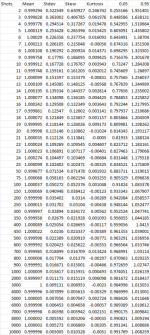
ok, so a single 5-shot group has too much leeway to be useful in this case because the possible overlapping region is so large. How do we know they have overlapping regions that large in the first place? Well, when dealing with things that seem to have some random element(s) to them it is common to use a Monte Carlo simulation with a lot of samples in order to come up with some statistically meaningful numbers. It is called a Monte Carlo simulation because you're just generating random samples, like the randomness of betting on certain games in a casino. Running a bivariate Monte Carlo simulation, which means one which contains an X value and a Y value like you'd need to describe the POI on a target, and doing it millions and millions of times will result in a table such as this:

1765486135084.png

Most everyone is familar with mean (average) and Stdev. Skew and kurtosis are just things that describe the shape of the samples, but we don't care much about that for this. And I've deleted all but the 0.05 and 0.95 quantile/percentile columns for brevity, since those are the two we care about to show a 90% confidence interval anyway. For 5 shots we see here the 0.05 column contains the value of 0.603091, which is our confidence interval's lower bound, and the 0.95 column contains the value of 1.435802, which is our confidence interval's upper bound. This is where I get the "greater than +/- 40%" from, as this indicates about 39.7% below or about 43.6% above is our confidence interval. If we scroll down to 25 shots we can see that this has reduced the lower bound to 0.834521, and the upper bound to 1.171609, so we're now down to roughly +/- 17%. So let's look back at our 1 MOA vs. 2 MOA group size comparison again.

1 MOA +/- 17% means 0.83 MOA to 1.17 MOA
2 MOA +/- 17% means 1.66 MOA to 2.34 MOA

25 shots has tightened up our confidence interval enough that we can now say they are different as it now passes our 90% confidence test. There is no longer any overlap between the two, so, we are confident that they are different. In this case, comparing a 1 MOA group to a 2 MOA group, 5 shots was not enough to give us a good answer, but 25 shots was enough to do so. And that's because 25 shots was enough to eliminate overlap between the two measurements from a statistical point of view. This does not mean that 25 shots is always enough. What it tells us is that how many shots we need to take in order to determine if there is a difference or not depends on how fine our measurements are. 5 shots were not enough to compare 1 MOA vs. 2 MOA, but 25 shots were. If you step through the figures here you can see that for that comparison you'd actually only need to step up to 8 shots to eliminate the overlap. But for comparisons with groups that are much closer in size you will find that you need to continue moving further down the list in order to eliminate the overlap. 50 shots is roughly +/- 12%, 75 shots brings that under the +/- 10% mark, 100 shots is roughly +/- 8%, etc.

So, this means that for this kind of testing you may end up having to take more shots if you find that however many shots you've already taken end up having answers that overlap. It can also mean that it might take an unreasonable amount of shots in order to eliminate that overlap. Which is another way of saying that the overlap should probably be considered real, and that your actual answer is that the two things you're comparing are too close to each other to say they are different. So, sometimes you have to break down and finally draw the line. Maybe you can get a reasonable answer in a reasonable number of shots, and maybe you can't. It depends on how much difference there actually is between the two things you're comparing. If the two things are very similar it might take an obscene amount of shots before you finally gain enough confidence to declare there does indeed appear to be a real difference.

edit: And as Williwaw pointed out while I was typing all of this, measuring the extreme spread of a group is not a particularly useful way to compare groups. You're ignoring the general performance seen in the entire group when you only consider the two shots that are furthest from each other. I like to use the mean radius. And if things are fairly close with the mean radius comparison then I will also look at the SD radius. The circular error probable is a metric that's similar to mean radius, only it includes a slightly different percentage of the shots. The military likes to use CEP, which indicates the size of a circle that would contain 50% of the shots. Mean radius is similar, but it describes the radius of a circle that would contain about 54% of the shots. They're more accurate ways of describing the general performance you should see if you keep shooting than the extreme spread of a group. The extreme spread of a group doesn't really tell you much of anything about the general performance you'll see if you keep shooting. All that tells you is what your two worst shots were. If you have a super tight 0.2 MOA group with a single 2 MOA flier that is going to have a much smaller mean radius than a group that just looks like a 2 MOA shotgun spread where all the shots are spread very randomly and evenly. That's why the mean radius is a more useful metric. It would tell you to pick the one with the very tight group and flier, while extreme spread would consider both the same with no reason to choose one over the other. It allows you to make a useful prediction about future performance. Extreme spread doesn't really give you that kind of info.

 
Last edited:
It is removable. Still, I think that measuring components separately may be less accurate than a single measurement when the gun is in battery and some, minimum, pressure exhorted on the bolt face.
I'm planning to make a gauge that will do just that. Hmm, I just realized that all I need is are two rods with polishd faces. A long one that will go into the barrel. The larger, shorter one, can than be pressed against the breach face. Than the reference measurement of breach face to muzzle can be taken. Larger rod removed, bolt closed and bolt face to muzzle measurement taken exporting, or not, desired pressure.
Unless I'm missing something, it should work. Too easy. What am I missin

If you want to dig into the statistics on this sort of thing, the answer is pretty straight forward. The more shots you're talking about, the more precise your answer is. A single 5-shot group leaves quite a margin of error. It shows that the answer you get from that has a 90% confidence interval of greater than +/- 40%, in other words, the true answer lies somewhere in that region of 40% below and 40% above the measurement you've taken. And you can't confidently pin it down any further than that.

So, if you have one 5-shot group that measures out to 1 MOA and another that measures out to 2 MOA, can you confidently say that one differs from the other? What is 40% of 1 MOA? 0.4 MOA, of course. And 40% of 2 MOA is 0.8 MOA. So for the 1 MOA group you have a 90% confidence interval of 0.6 to 1.4 MOA, and for the 2 MOA group this is 1.2 to 2.8 MOA. There is overlap there. The upper side of the 1 MOA group's confidence interval is greater than the lower side of the 2 MOA group's confidence interval. The presence of any overlap between the two means that you cannot say they are different with that 90% degree of confidence.

ok, so a single 5-shot group has too much leeway to be useful in this case because the possible overlapping region is so large. How do we know they have overlapping regions that large in the first place? Well, when dealing with things that seem to have some random element(s) to them it is common to use a Monte Carlo simulation with a lot of samples in order to come up with some statistically meaningful numbers. It is called a Monte Carlo simulation because you're just generating random samples, like the randomness of betting on certain games in a casino. Running a bivariate Monte Carlo simulation, which means one which contains an X value and a Y value like you'd need to describe the POI on a target, and doing it millions and millions of times will result in a table such as this:

View attachment 1055818

Most everyone is familar with mean (average) and Stdev. Skew and kurtosis are just things that describe the shape of the samples, but we don't care much about that for this. And I've deleted all but the 0.05 and 0.95 quantile/percentile columns for brevity, since those are the two we care about to show a 90% confidence interval anyway. For 5 shots we see here the 0.05 column contains the value of 0.603091, which is our confidence interval's lower bound, and the 0.95 column contains the value of 1.435802, which is our confidence interval's upper bound. This is where I get the "greater than +/- 40%" from, as this indicates about 39.7% below or about 43.6% above is our confidence interval. If we scroll down to 25 shots we can see that this has reduced the lower bound to 0.834521, and the upper bound to 1.171609, so we're now down to roughly +/- 17%. So let's look back at our 1 MOA vs. 2 MOA group size comparison again.

1 MOA +/- 17% means 0.83 MOA to 1.17 MOA
2 MOA +/- 17% means 1.66 MOA to 2.34 MOA

25 shots has tightened up our confidence interval enough that we can now say they are different as it now passes our 90% confidence test. There is no longer any overlap between the two, so, we are confident that they are different. In this case, comparing a 1 MOA group to a 2 MOA group, 5 shots was not enough to give us a good answer, but 25 shots was enough to do so. And that's because 25 shots was enough to eliminate overlap between the two measurements from a statistical point of view. This does not mean that 25 shots is always enough. What it tells us is that how many shots we need to take in order to determine if there is a difference or not depends on how fine our measurements are. 5 shots were not enough to compare 1 MOA vs. 2 MOA, but 25 shots were. If you step through the figures here you can see that for that comparison you'd actually only need to step up to 8 shots to eliminate the overlap. But for comparisons with groups that are much closer in size you will find that you need to continue moving further down the list in order to eliminate the overlap. 50 shots is roughly +/- 12%, 75 shots brings that under the +/- 10% mark, 100 shots is roughly +/- 8%, etc.

So, this means that for this kind of testing you may end up having to take more shots if you find that however many shots you've already taken end up having answers that overlap. It can also mean that it might take an unreasonable amount of shots in order to eliminate that overlap. Which is another way of saying that the overlap should probably be considered real, and that your actual answer is that the two things you're comparing are too close to each other to say they are different. So, sometimes you have to break down and finally draw the line. Maybe you can get a reasonable answer in a reasonable number of shots, and maybe you can't. It depends on how much difference there actually is between the two things you're comparing. If the two things are very similar it might take an obscene amount of shots before you finally gain enough confidence to declare there does indeed appear to be a real difference.

edit: And as Williwaw pointed out while I was typing all of this, measuring the extreme spread of a group is not a particularly useful way to compare groups. You're ignoring the general performance seen in the entire group when you only consider the two shots that are furthest from each other. I like to use the mean radius. And if things are fairly close with the mean radius comparison then I will also look at the SD radius. The circular error probable is a metric that's similar to mean radius, only it includes a slightly different percentage of the shots. The military likes to use CEP, which indicates the size of a circle that would contain 50% of the shots. Mean radius is similar, but it describes the radius of a circle that would contain about 54% of the shots. They're more accurate ways of describing the general performance you should see if you keep shooting than the extreme spread of a group. The extreme spread of a group doesn't really tell you much of anything about the general performance you'll see if you keep shooting. All that tells you is what your two worst shots were. If you have a super tight 0.2 MOA group with a single 2 MOA flier that is going to have a much smaller mean radius than a group that just looks like a 2 MOA shotgun spread where all the shots are spread very randomly and evenly. That's why the mean radius is a more useful metric. It would tell you to pick the one with the very tight group and flier, while extreme spread would consider both the same with no reason to choose one over the other. It allows you to make a useful prediction about future performance. Extreme spread doesn't really give you that kind of info.

Thanks for reminding me how much I've forgotten about the statistics...

 
Not too sure about tighter. The reference paper calls for .043 as minimum headspace and doesn't give maximum. At least, not that I can see one.
So,
Here are the tolerances for all the dimensions. In Engineering Drawings, it is common practice to provide a "standards table" for tolerances to avoid excessive cluttering of the drawing when dimensioning. It noted on the drawing that tolerances were found in "Annex XE3 III, Table V, CR 2.

It was a bit of a hunt to find the table, but here is a link below.

CIP Headspace is 16.33 mm +0.1 mm/-0.0 mm (Chamber Dimension L3). That converts to 0.6429" +0.0039/0.0"
SAMMI specification for match chamber is 16.33mm also, however tolerance is +0.15mm (0.05mm larger than CIP, or +0.004")

So, for sake of argument, CIP and Sammi Match have identical specs. Saami Sporting is much larger.

https://bobp.cip-bobp.org/uploads/annexe/annexeiii-en-cr2.pdf

Additional info here: https://www.canadiangunnutz.com/for.../#:~:text=Min and Max SAAMI specs,051 maximum.
 
All .22LR rifles made to CIP or SAAMI specs are supposed to be made with a 0.043" headspace. Of course, not all manufacturing will result in the correct headspace. At the same time, all .22LR ammo is made to CIP or SAAMI specs, both of which have a 0.043" (or 1.09 mm). Again, manufacturing doesn't always result in meeting the exact, desired size and will have allowable tolerances.

As others have noted, the exact headspace on a rifle will not have a negative effect on accuracy performance. The important thing is that it is safe. Use Go/No-go gauges to confirm.

Since actual safe headspace plays no role in accuracy performance, neither will actual rim thickness (so long as it's in the range of tolerances allowed).

For readers in general, chambers made to CIP specs, for example, may not all be the same. The regulation specs provided by CIP are a minimum size which are as small as permitted. As a result some CIP chambers may be bigger or smaller than others. For example, CZ's .22LR "match" chamber should be a little smaller than the chamber on other CZ .22LR rifles. The chamber alone, however, doesn't determine how well the rifle will shoot. bore quality has a key role here.


SAAMI has two chambers for .22LR, a Sporting and a Match. The sporting chamber will be seen most often, especially on factory made .22LR rifles.


As I noted in the post above, CIP Standard Tolerances are noted in Table CR 2, here is the link: https://bobp.cip-bobp.org/uploads/annexe/annexeiii-en-cr2.pdf CIP drawings reference CR 2 in the bottom left hand window.
 
So,
Here are the tolerances for all the dimensions. In Engineering Drawings, it is common practice to provide a "standards table" for tolerances to avoid excessive cluttering of the drawing when dimensioning. It noted on the drawing that tolerances were found in "Annex XE3 III, Table V, CR 2.

It was a bit of a hunt to find the table, but here is a link below.

CIP Headspace is 16.33 mm +0.1 mm/-0.0 mm (Chamber Dimension L3). That converts to 0.6429" +0.0039/0.0"
SAMMI specification for match chamber is 16.33mm also, however tolerance is +0.15mm (0.05mm larger than CIP, or +0.004")

So, for sake of argument, CIP and Sammi Match have identical specs. Saami Sporting is much larger.

https://bobp.cip-bobp.org/uploads/annexe/annexeiii-en-cr2.pdf

Additional info here: https://www.canadiangunnutz.com/forum/threads/cz-22-chambers-std-or-match.2365493/#:~:text=Min and Max SAAMI specs,051 maximum.
Isn't the CR2 annex for proof barrels only?
 
Back
Top Bottom