Hey Mike,
With a press like that it shouldn't be too hard to rig up a button rifling frame.
You probably know all this already, but I will tell you what I know about it just in case:
Button rifling is a process where the metal is swaged and none is actually removed, so there is no advantage to "working in" to the desired depth of groove with successive sizes of dies. In fact, the work hardening that is the result of each pass of the die could be detrimental to the piece - possibly producing spalling or cracking in extreme cases. In any event, it seems to be at most a two stage proccess.
If an adequately bored and reamed tube is available, it is only a one piece operation. If not, a button is made to the correct diameter for swaging the lands, and passed through the barrel drilling to "button ream" it. It is then rifled with the "rifle button":

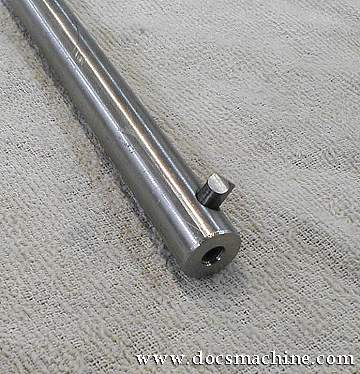
Excuse the coarse drawing and note that it is not to scale. The tapered ends are a few thou smaller than the bore size. The waist of the button (1) is .0015"-.002" oversize of the desired depth of groove to allow for springback in steel barrels. I am not sure that this would be neccessary in most aluminum alloys. The button's grooves (3) are of course, cut significantly undersized from the lands of the barrel to avoid marring them. The button is sweated to a piece of drill rod that serves as a pull rod by means of a post (2) inserted into the rod. I suspect that this is done so that if the pull rod snaps during the proccess it can easily be removed and replaced, whereas a mechanical connection like threading that runs contrary to the grooves could prove to be very difficult to seperate after the first time the button has been used. Even so, you will have to do something like that if you are using a hardened steel die, as hard soldering would draw the temper back to being uselessly soft. Threading is probably acceptable in your application, as I just can't see a 20-30mm diameter length steel rod failing before the aluminum tube. The reaming button is of the same configuration without the grooves.
Other pictures of buttons that I have seen have pilots, and some even have bushings fore and aft of the die, but I do not think that they are neccessary. If lubrication is an issue you could have keyways that correspond to the grooves cut into an undersized pull rod that has a section of tubing slid over it so that oil can be pumped into them, but again, I do not think that is neccessary.
Here is a simple rig, based on a vertical button rifling machine that was described to me:

It's simply a rectangular frame made of square steel tubing. A piece of tube or pipe (3lower) with a bore slightly larger than the diameter of the barrel blank (1) is slid onto the blank. The blank is then slipped in to a similar piece of tubing (3upper) that is welded to the frame, and the blank pulls against a thrust bearing (4). (3lower) then drops into a mating piece of pipe (2) that is welded to the bottom of the frame to steady the barrel blank (1). The pull rod and attached button are then drawn up through a hole in the top of the frame (5) having been earlier inserted through a corresponding hole in the bottom of the frame (not illustrated) and barrel to attach to the press head.
You will note that in the above description, it is the barrel that rotates as the button passes through it, not the other way around, and that the barrel bears against the thrust bearing at the top of the frame. This arrangement has apperantly been used for rifle barrel blanks which have very thick wall thickness in comparison to bore size, and I have some concern that the thinner wall to bore ratio expected in a 40mm tube could lead to buckling problems.
This can be overcome in several ways. The first of course, is ensuring that there is adequate lubrication to overcome any friction issues. The second is to start with a much thicker barrel blank, and the third is to anchor the bottom of the barrel while the button is being pulled through it:

This frame - made out of a heavy I or U-beam with end caps welded on - is a more elegant solution anyway, and probably the one that I would build. In this case, the barrel blank (1) has been turned down so that it has a thick (0.5-1xbore dia) flange (4) that rests in a thrust bearing (3) on the bottom end cap (2) with the pull rod being drawn out the top hole (5).
A few other things of note:
From what I have learned, lubrication and the elimination of unneccesary friction are critical both in terms of surface finish, and to avoid any tool/material failures.
It's important to remember that you are not cutting the metal, you are deforming it, and that means that the application of force in any direction may affect the finished piece. So in the case of the frame first illustrated buckling and bulging are an issue. In the case of the second frame, stretching, elongation would be issue. It may be neccesary to add additional bearings, bushings, and supports, or otherwise fine tune the proccess.
Once perfected though, you should be able to pop out a barrel every few minutes.