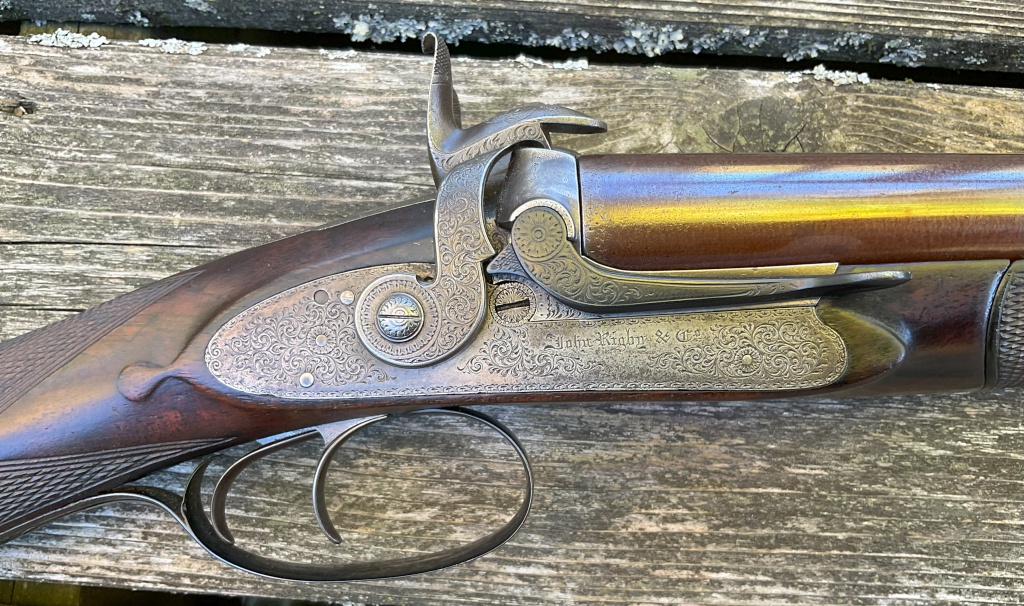
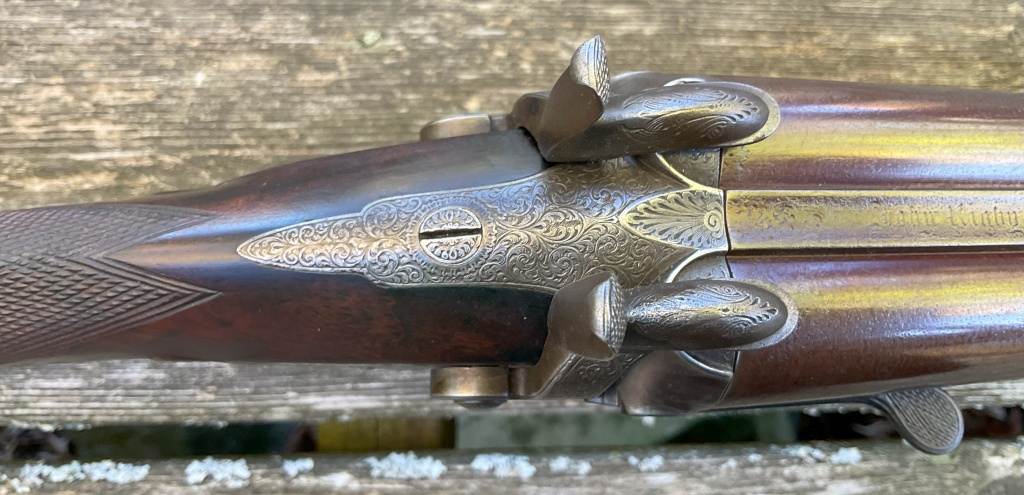
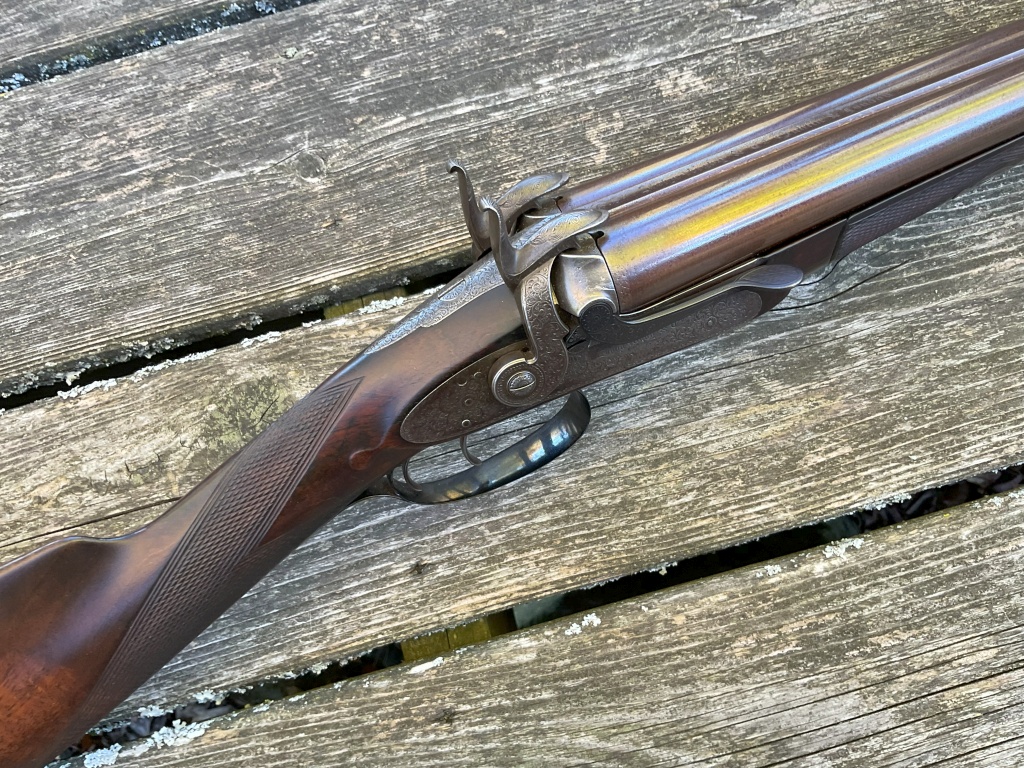
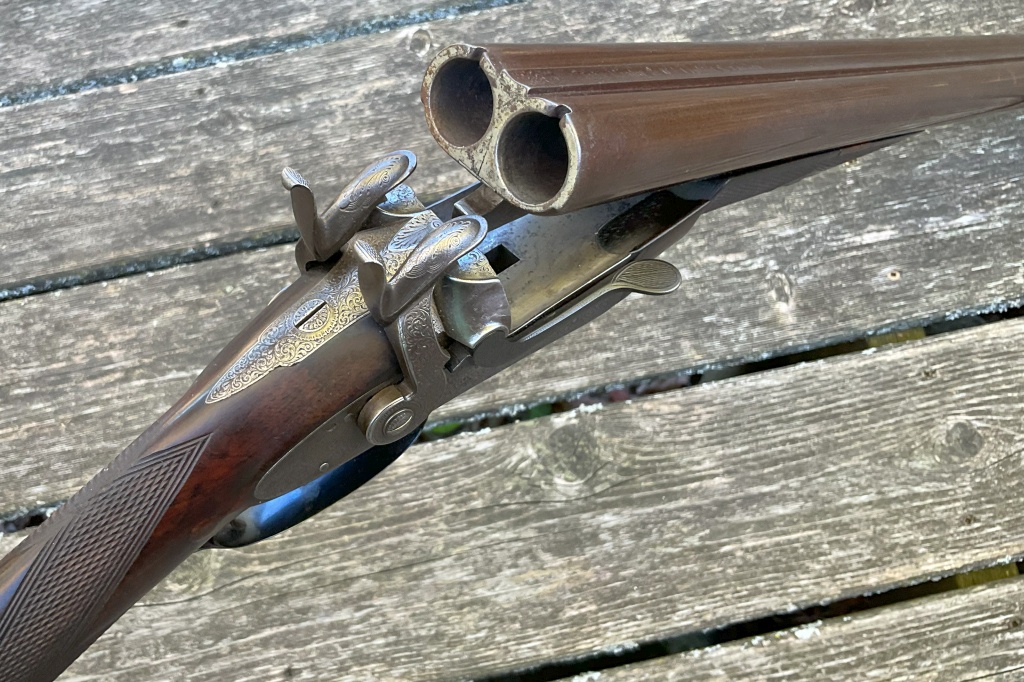
The allure of the British gun

... but not entirely. Just for a laugh, I googled "were pinfire cartridges safe to carry?," and got the following response from Google AI:

"No, pinfire cartridges were not safe to carry due to their protruding pins, which could be struck by other cartridges or objects, causing accidental discharge. This danger was particularly evident when carrying loose ammunition in pouches or on belt loops. While they offered some advantages like faster loading compared to percussion firearms, their inherent safety risk led to them being quickly replaced by more secure rimfire and centerfire cartridges."

The myth persists to this day, repeated ad nauseam. Google AI tells me centerfire and rimfire are OK, though...
 
Back to guns.

It’s time to discuss globalization, Victorian-style. What, exactly, makes a gun British? No, this isn’t an odd question if we’re discussing the allure of a British gun. Does it need to be made in Britain? But what if the component parts are not all British? If, say, the barrel tubes are Belgian, the steel Swedish, and the wood sourced from around the Mediterranean? Is being finished in Britain enough? How about just retailing in Britain?

A gentleman ordering a new Purdey or Moore for the Season probably already knew the barrels came out of a Belgian forge, and that the beautifully figured wood did not come from the forests of Old Blighty. If ordering a breech-loader, the gentleman would have been aware of its French origins, in ideas if not manufacture. The odds are fair that he might have already seen some Continental breech-loaders in use, of French or Belgian make; after all, the breech-loader was in wide use there for several decades before appearing in Britain. Decorative motifs would be largely Greek- and Roman-inspired, as I’ve covered before. Depending on the year the gentleman ordered his gun, the fellow would have been aware that all the ammunition was imported, and not home-sourced. And despite all this understanding, there might still be a hesitation or wariness when it came to anything ‘foreign,’ and only a gun with a proper British address would do, decorated to British sensibilities.

I’ve already written about British tastes in metal engraving in the engraving thread. Overall styling in British gunmaking had been heavily influenced by Joseph Manton in shaping the stock and the overall flowing lines. Even when breech-loaders appeared on the scene, the general rule was to adhere as closely to the geometry of the British muzzle-loader as possible (and taken to an extreme in bar-in-wood guns). There is no doubt that there were awe-inducing sporting guns being made on the Continent, with fantastical metal and wood sculpting. But these were, to the British sportsman, too garish and over-the-top for a day’s sport in the hedgerows (just as we might balk taking a presentation-grade gun, festooned with gold inlay and stocked with highly-figured wood polished to a piano gloss, into the field).

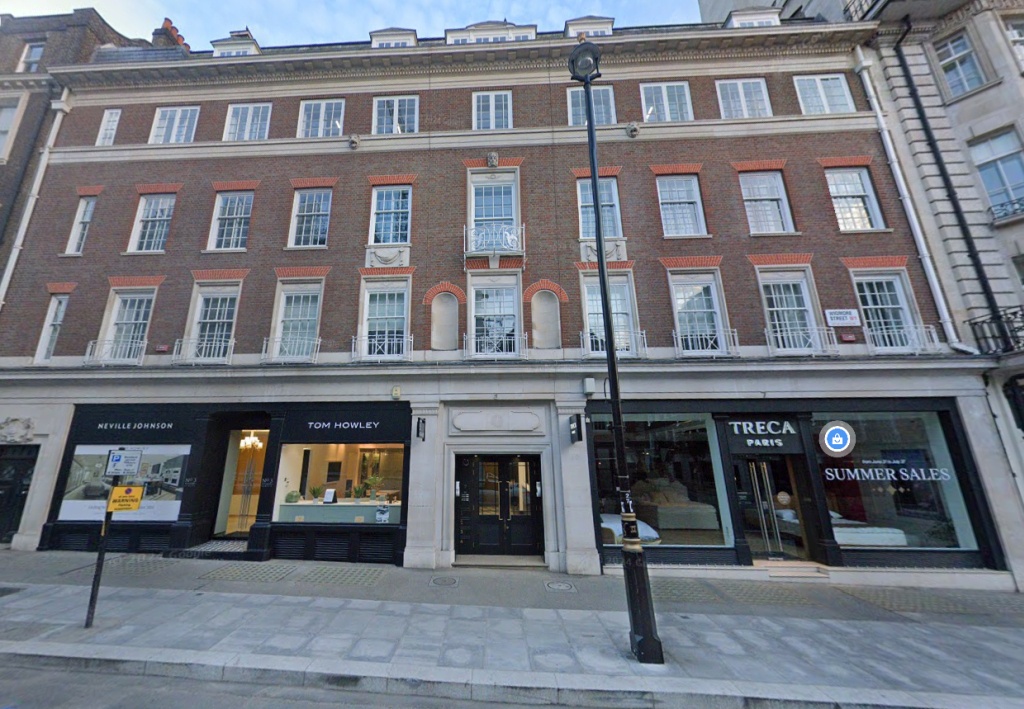
Nestled in between the all-British sporting gun (the existence of which can be debated), and the foreign gun (with its extravagant styling and carved stocks), is the foreign gun built to suit British tastes – an impostor of sorts. This was the loophole in the market that the Masu brothers aimed to fill. Gustave Masu (also known as Gustav Masu) is recorded as a gunmaker in Liège, Belgium, in 1845. In 1864, he established a business in London at 3a Wigmore Street, when the demand for pin-fire guns was increasing. The firm became Masu Brothers in 1865, and in 1869, it was renamed Gustavus Masu, relocating to 10 Wigmore Street. Evidence suggests Masu guns were built in Liège (by the other brother, whose name I’ve been unable to trace), and retailed in London by Gustave. Wigmore Street is in London's fashionable West End Marylebone district, and a stone's throw from Cavendish Square. The area was particularly rich in medical doctors, catering to a wealthy clientele. Gustave Masu must have aimed for this well-to-do crowd, and it appears he was successful, as the business closed in 1892.

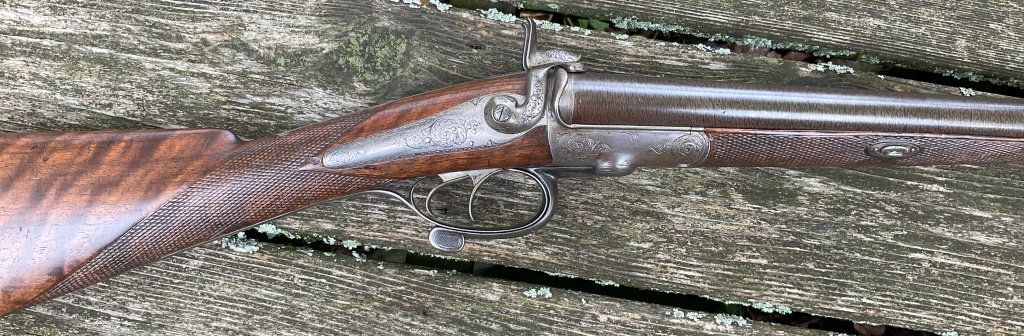
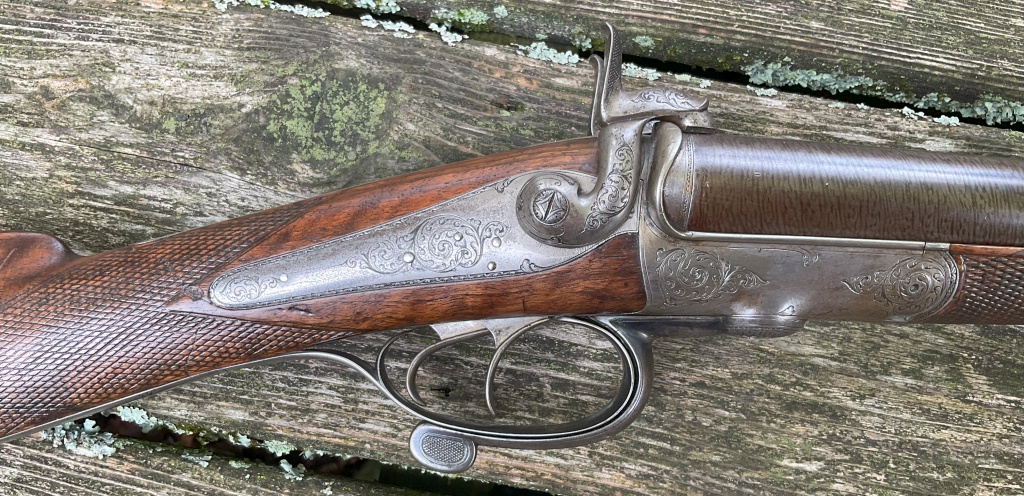
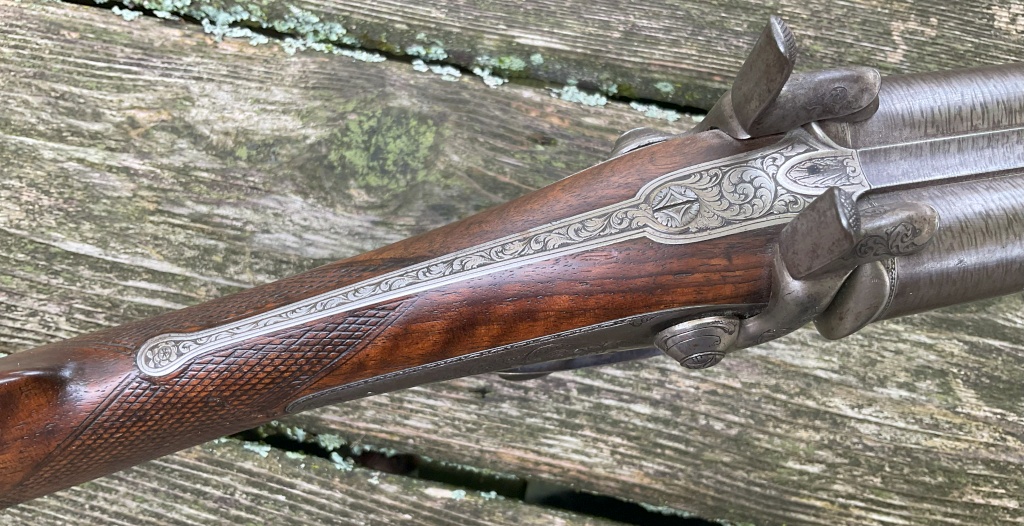
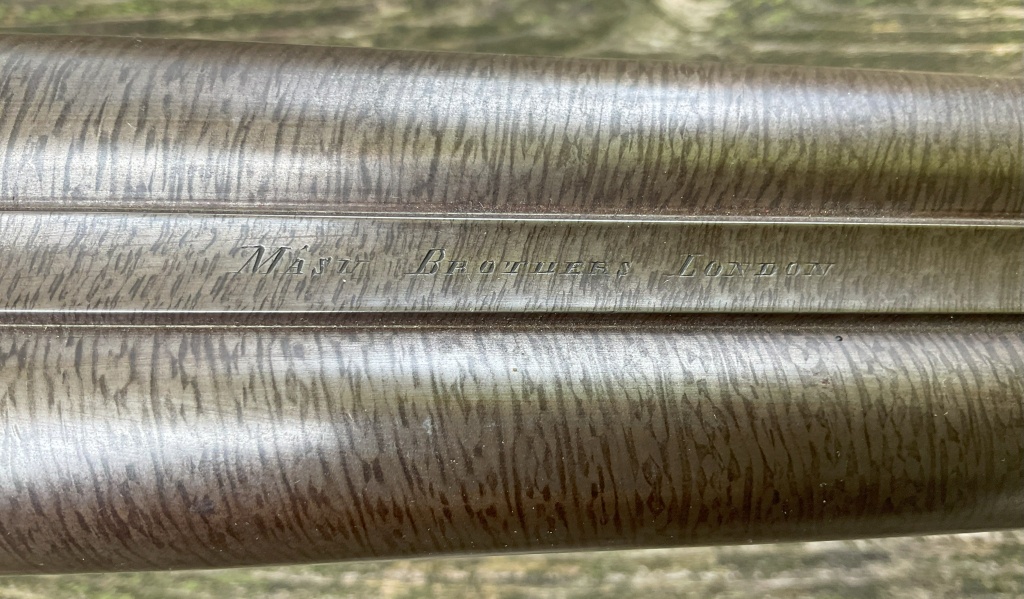
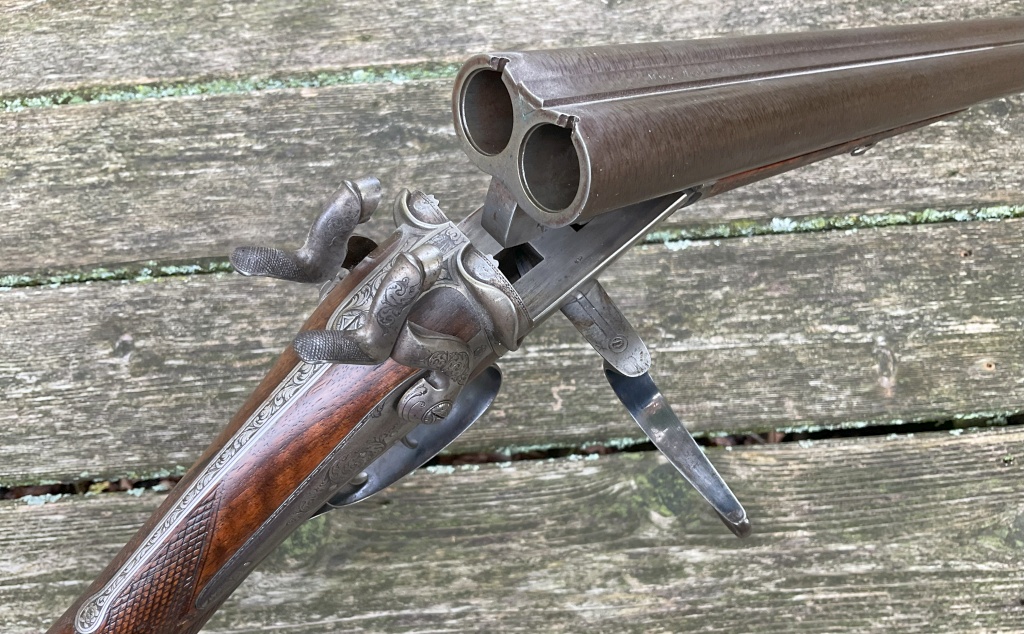
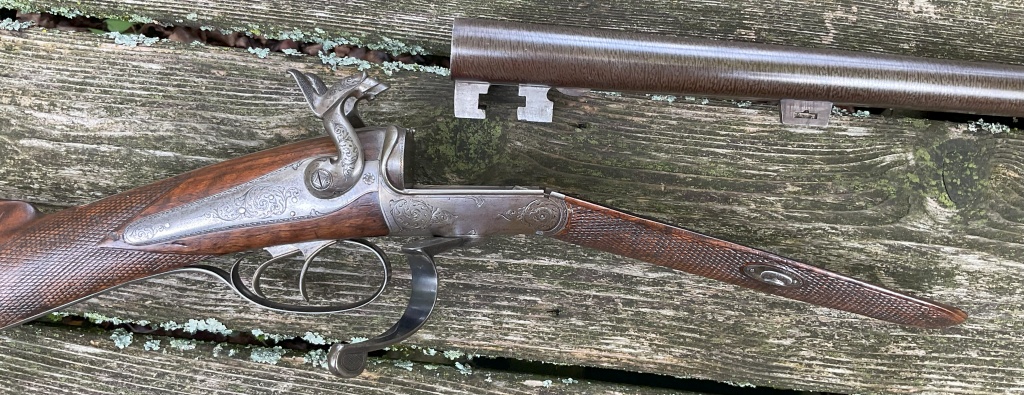
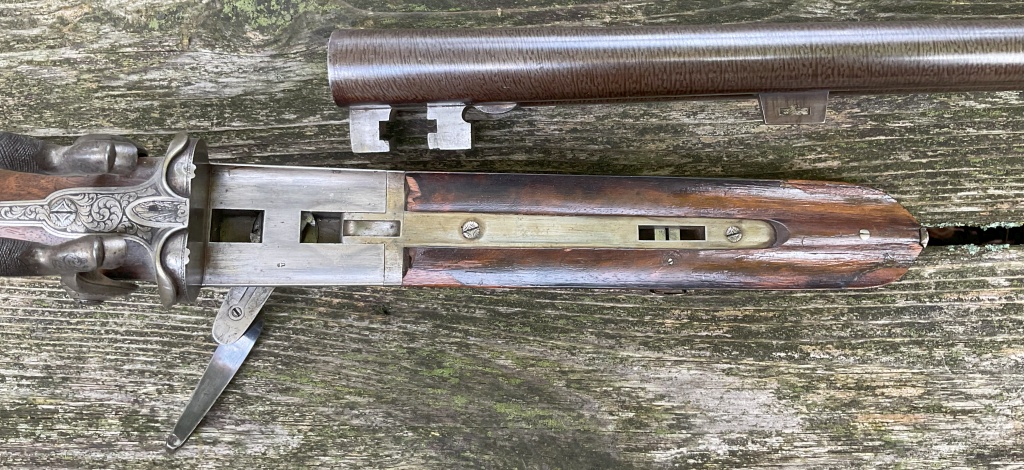
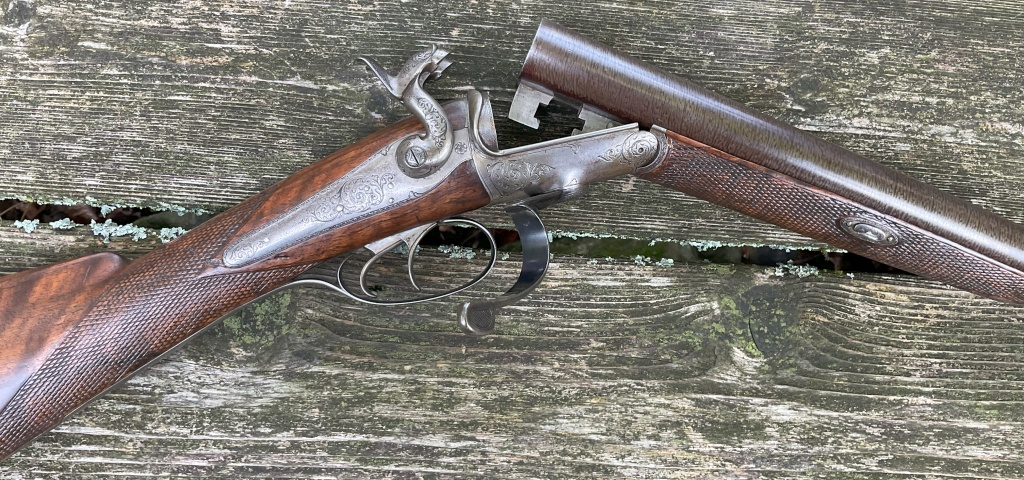
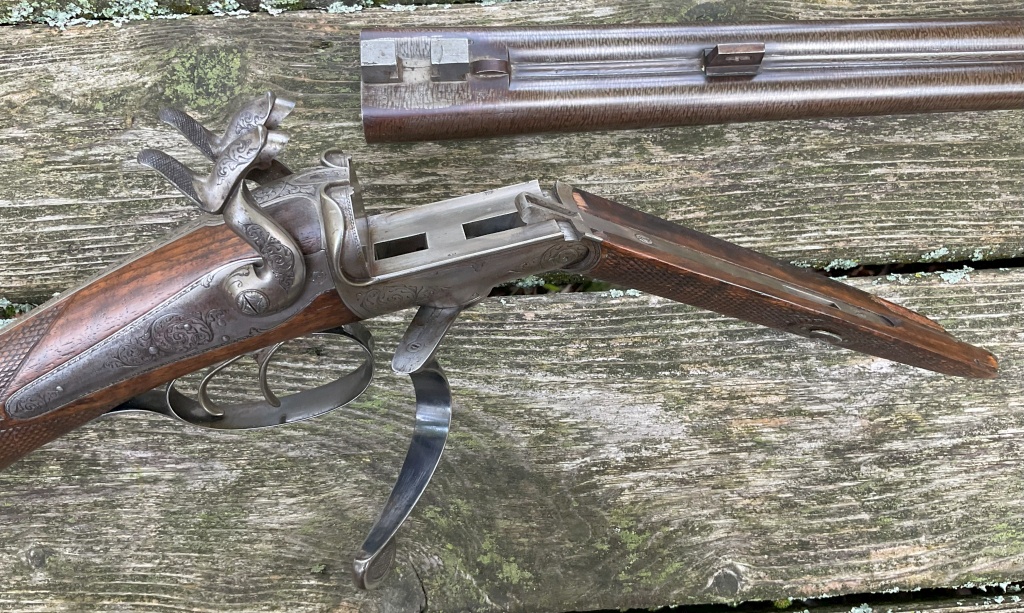
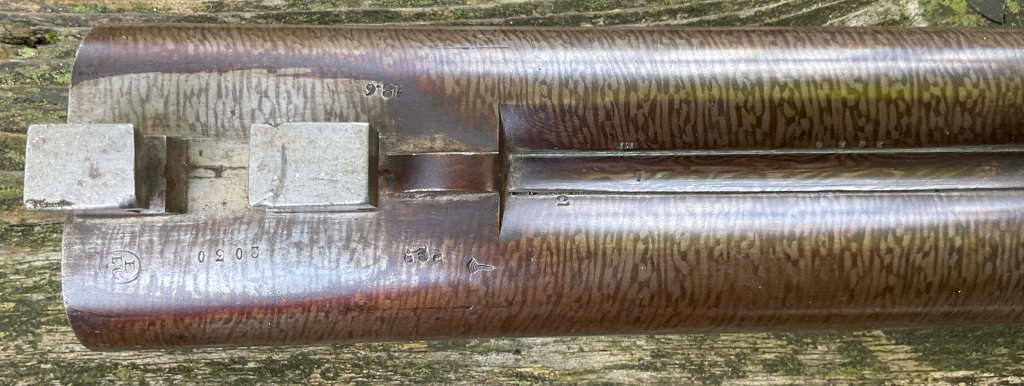
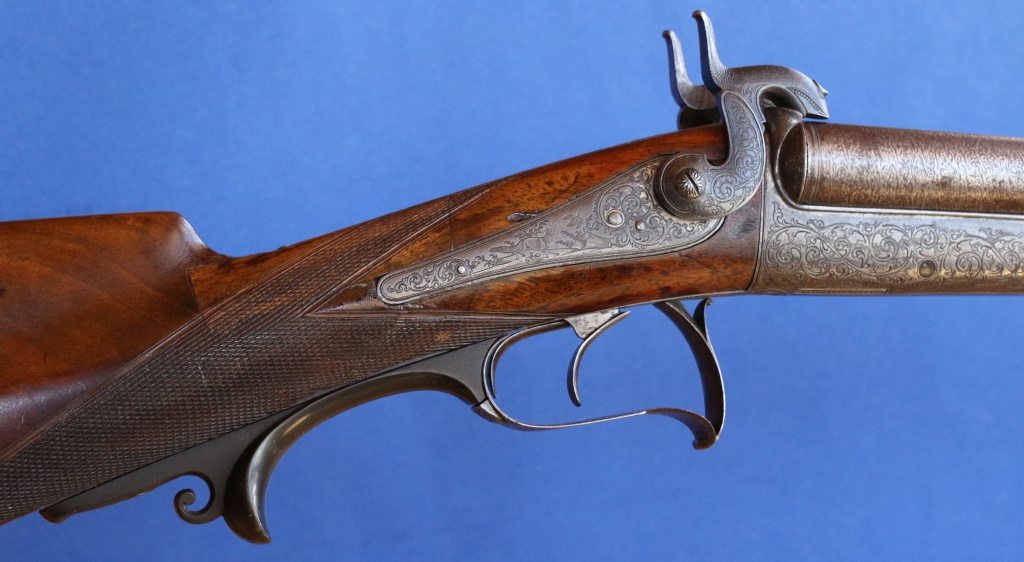
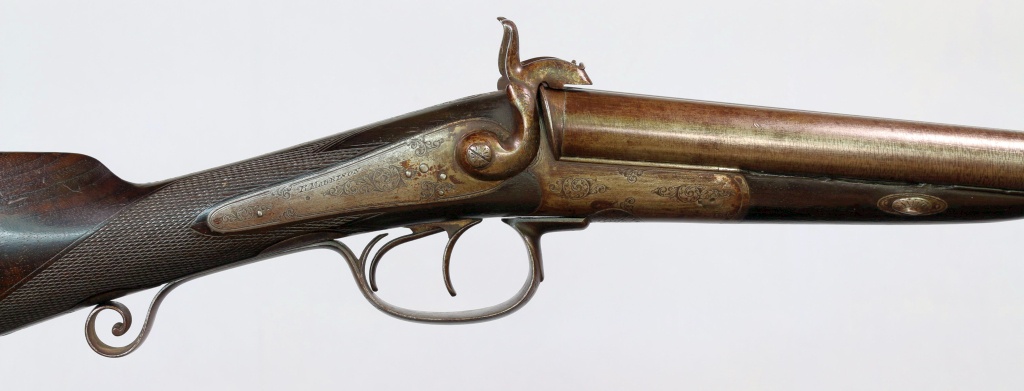
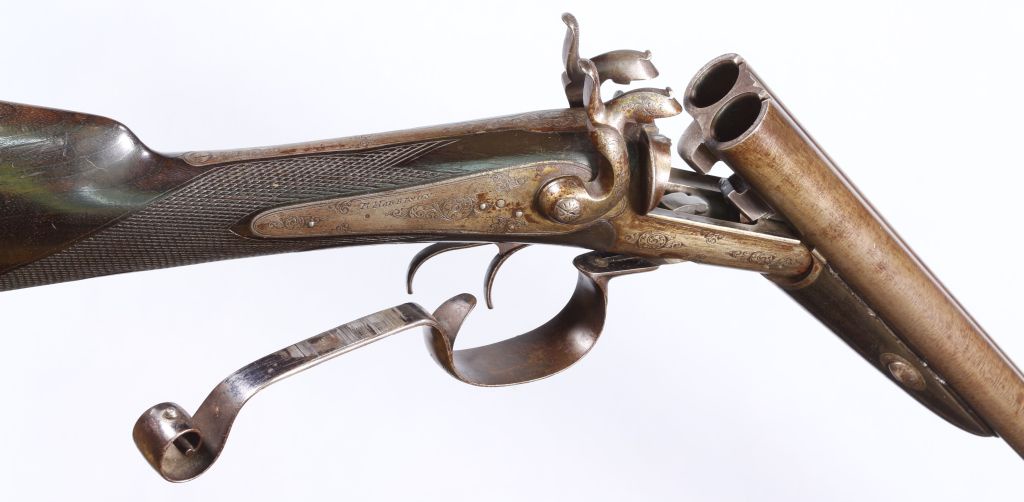
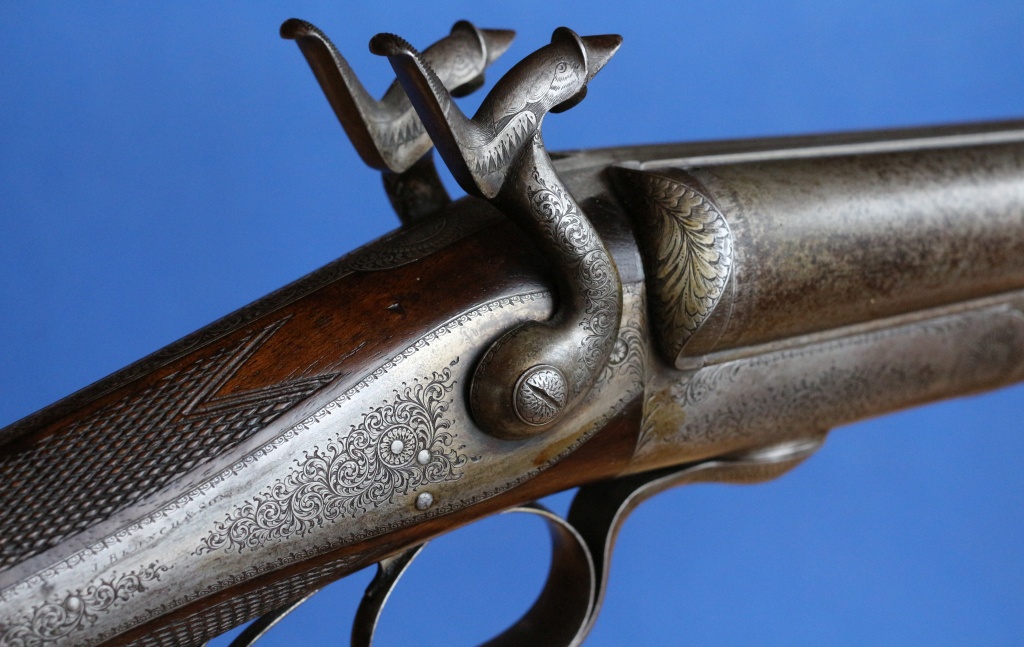
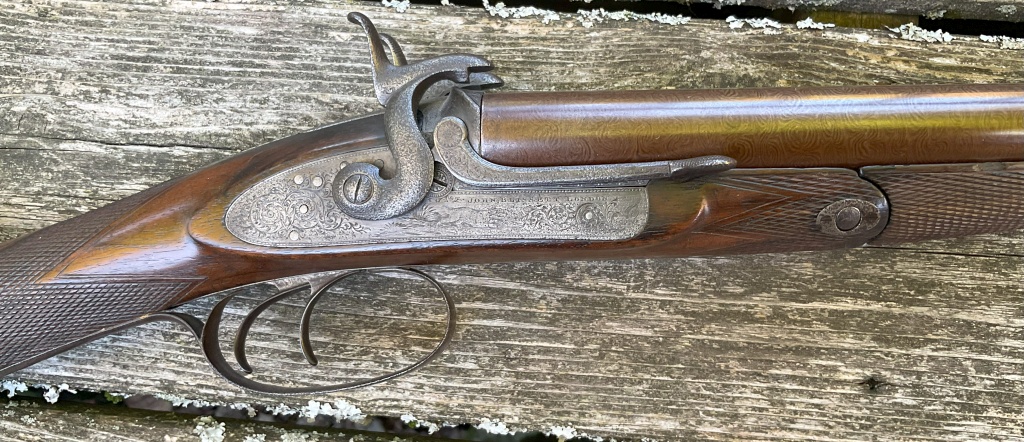
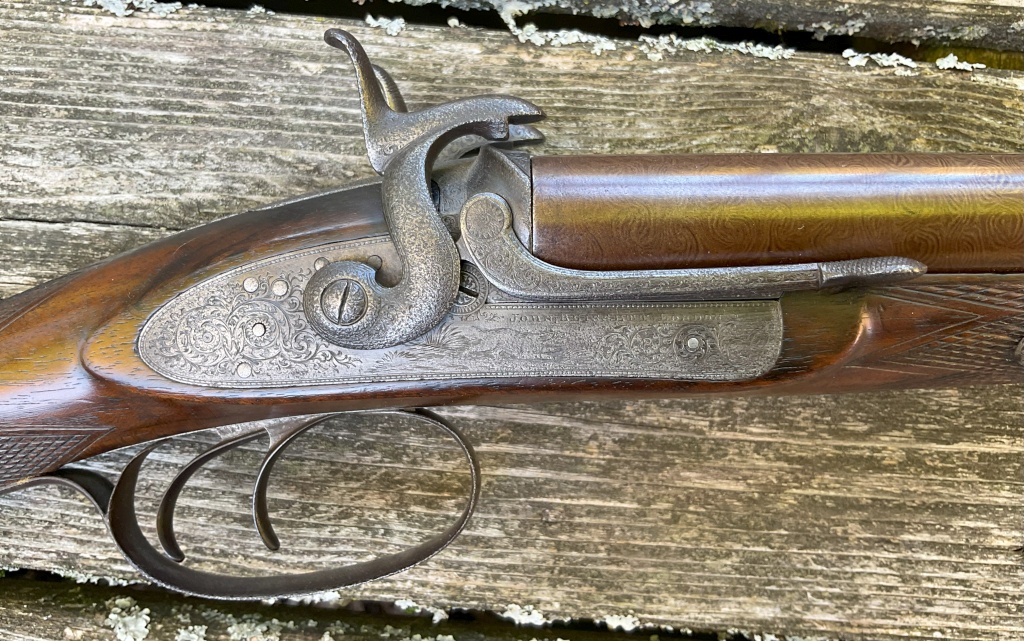
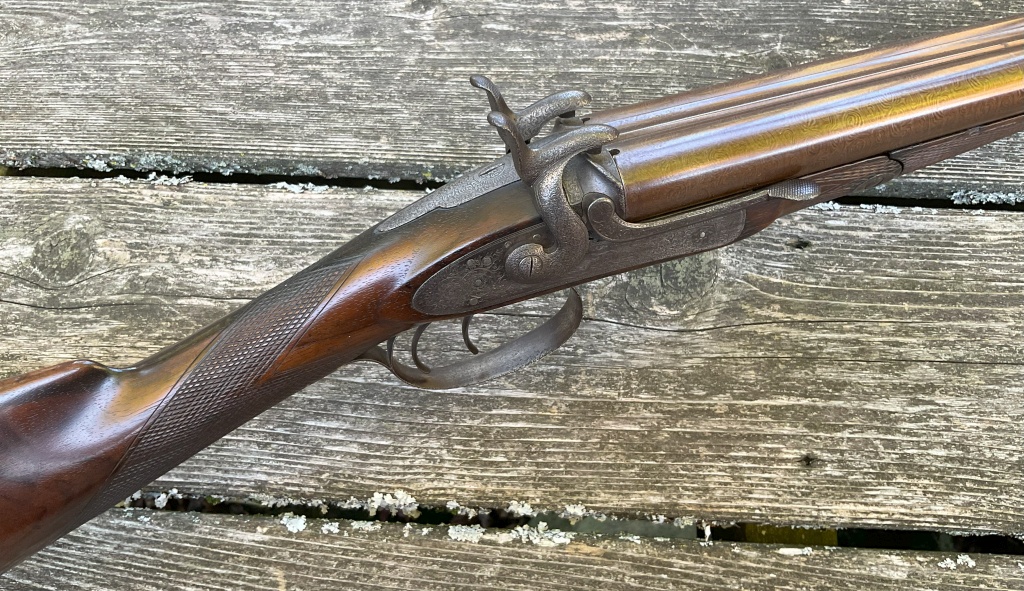
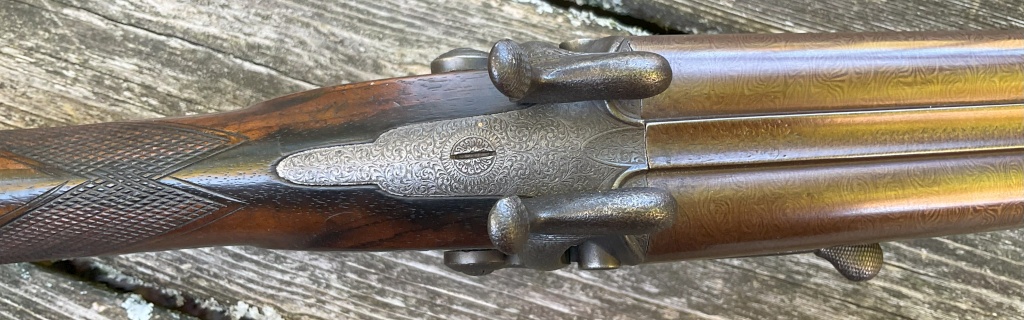
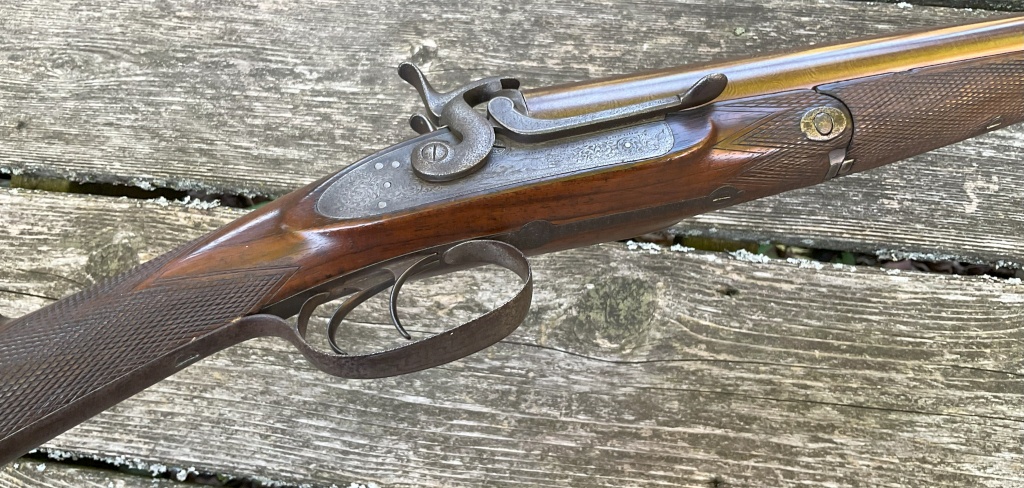
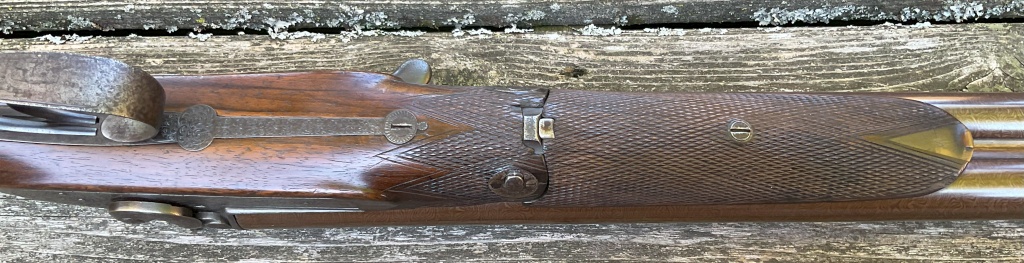
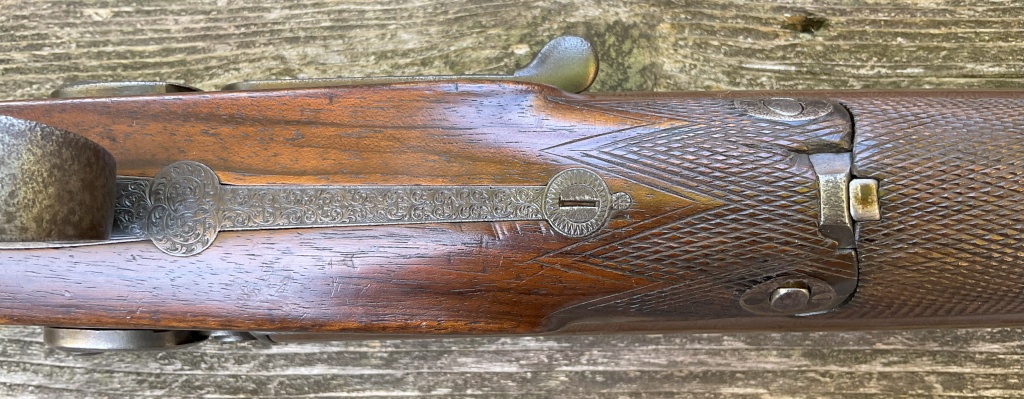
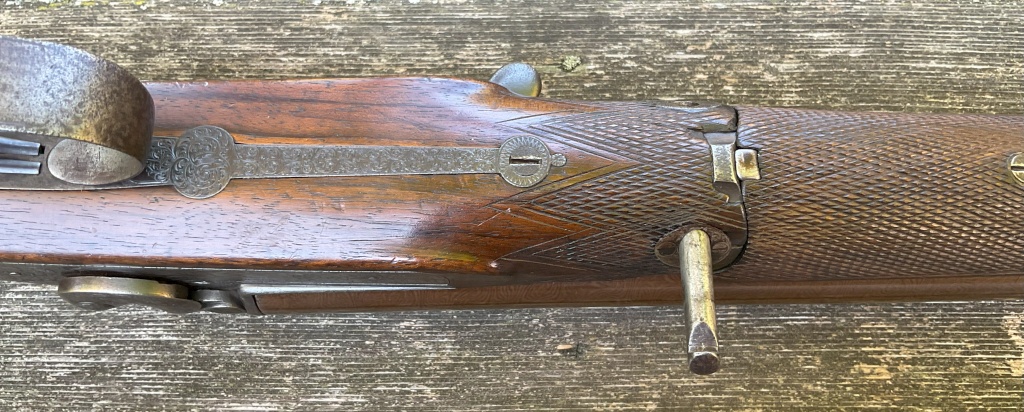
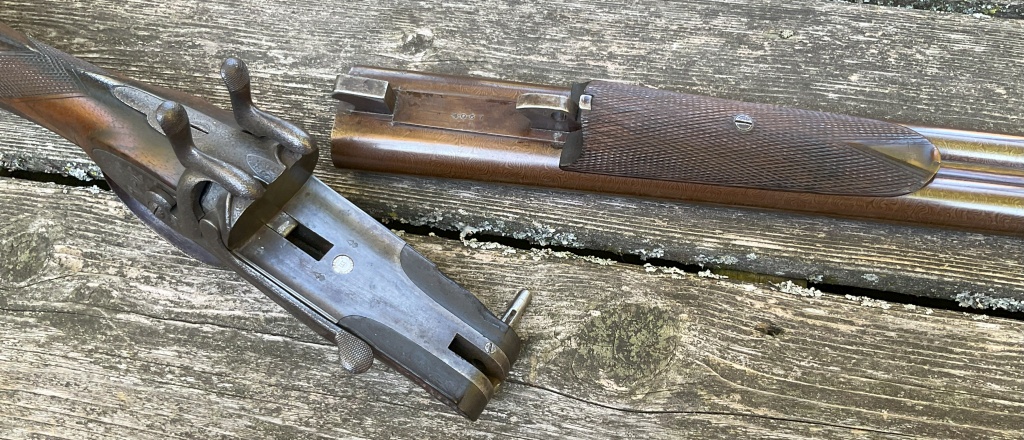
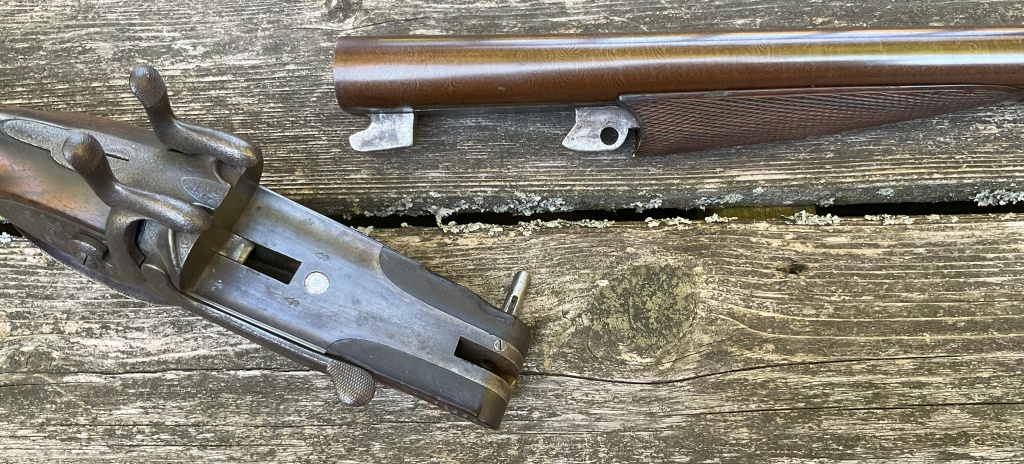
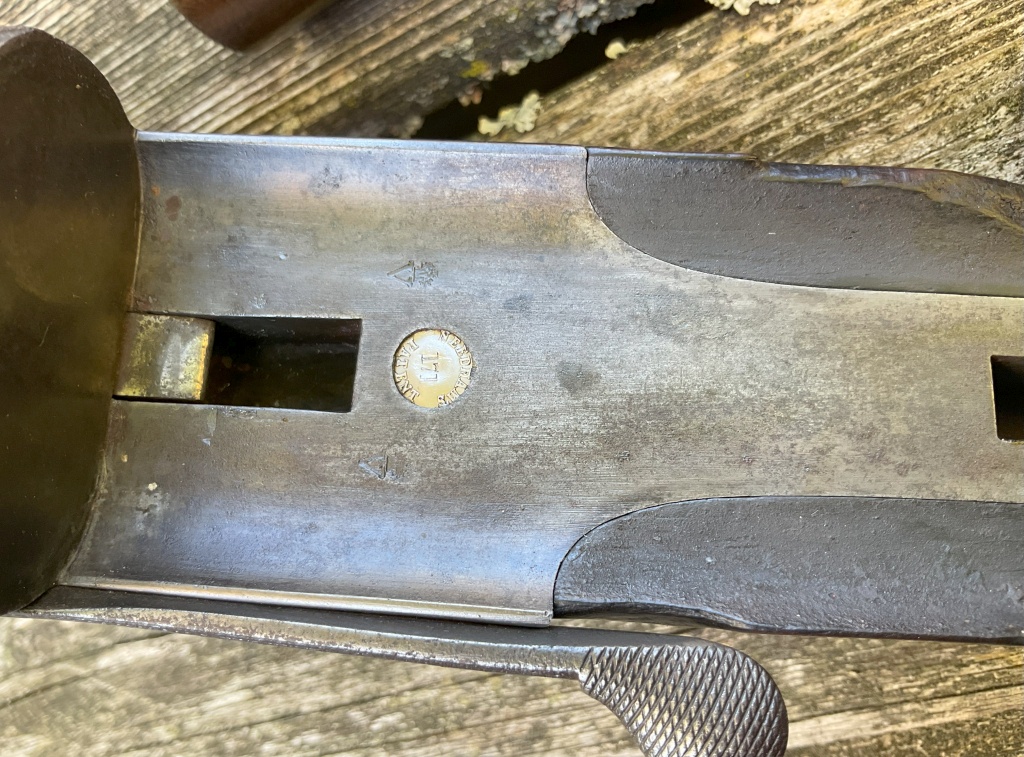
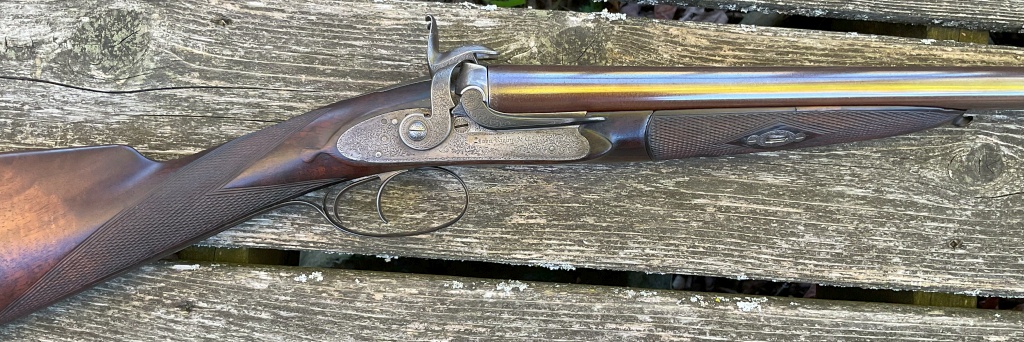
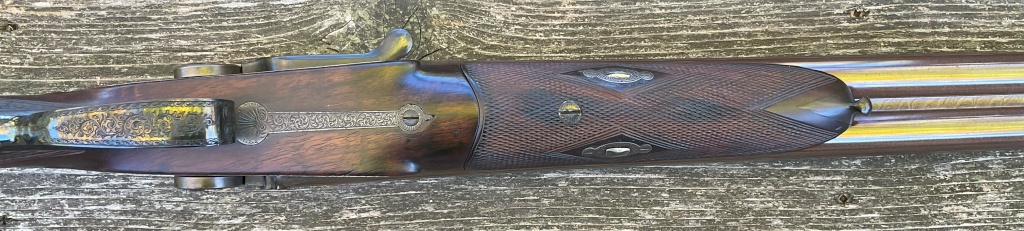
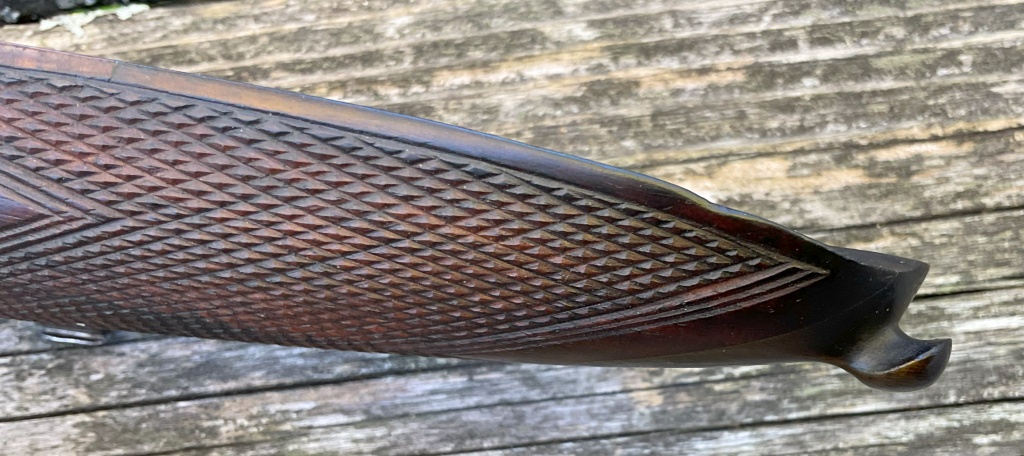
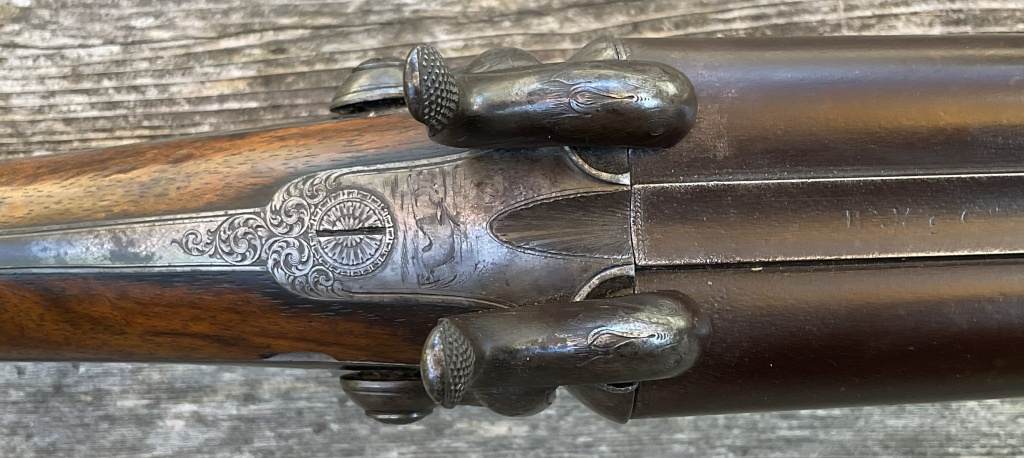
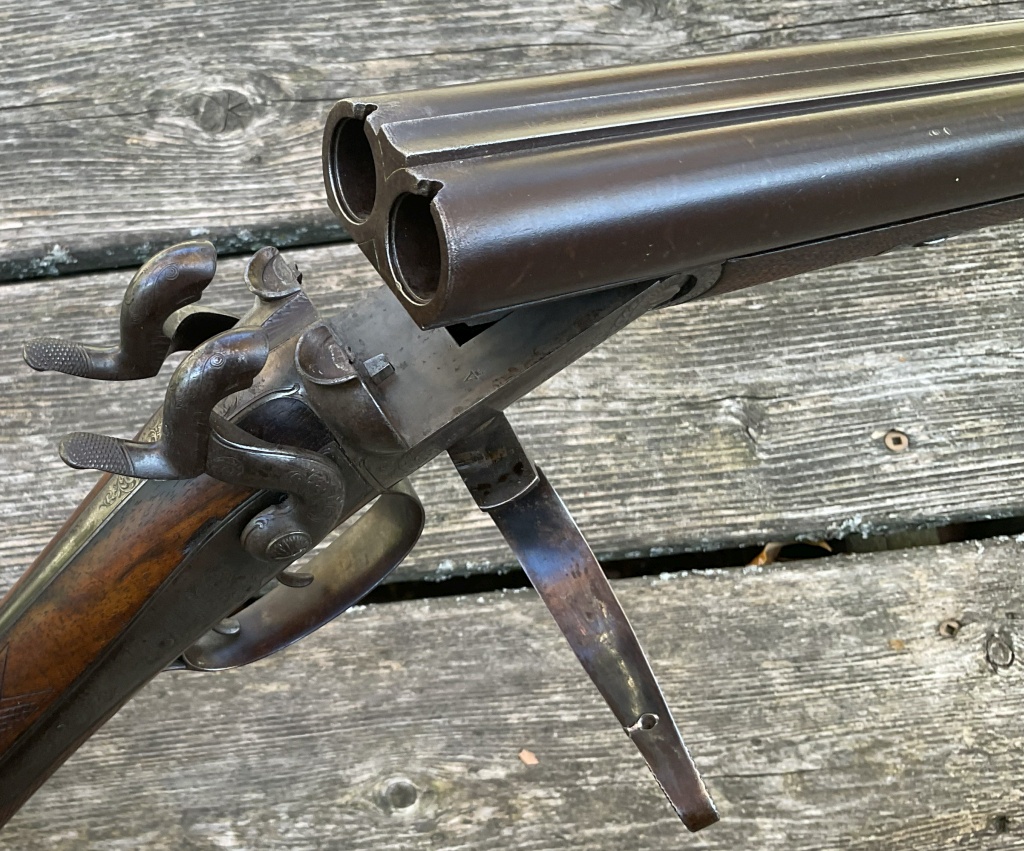
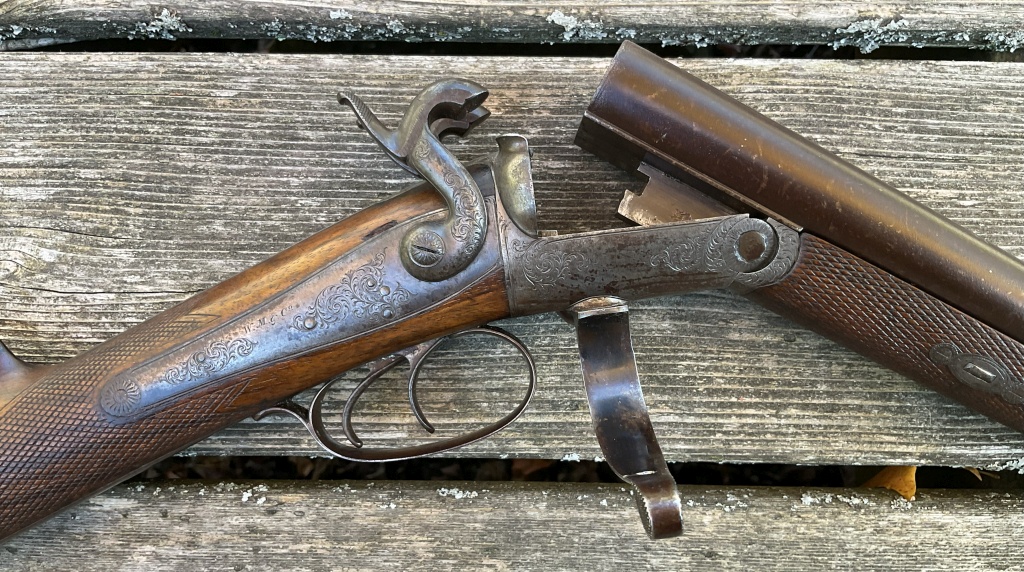
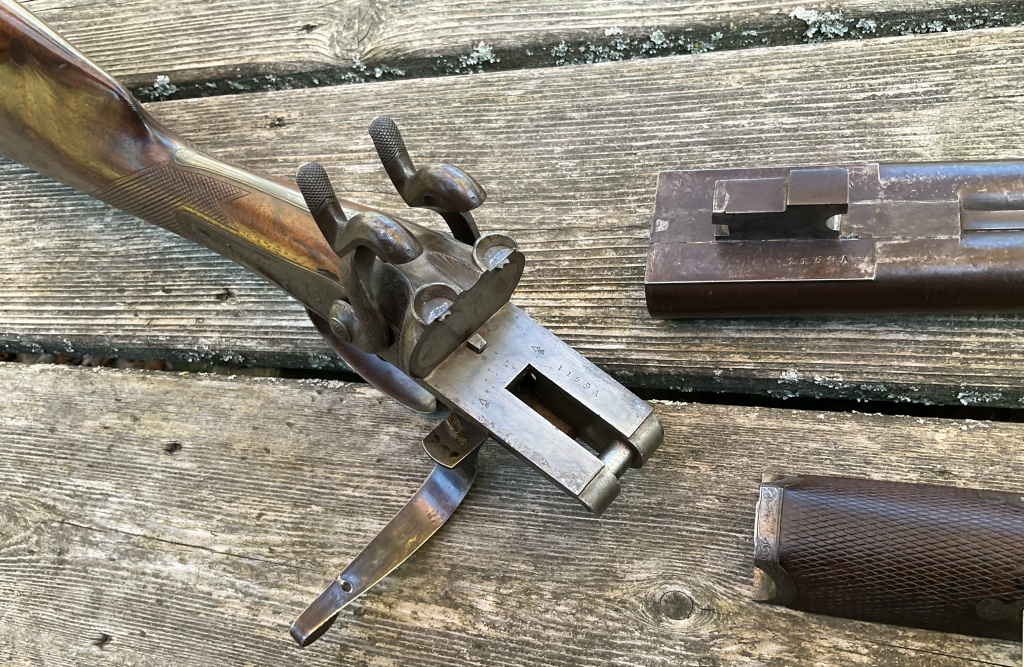
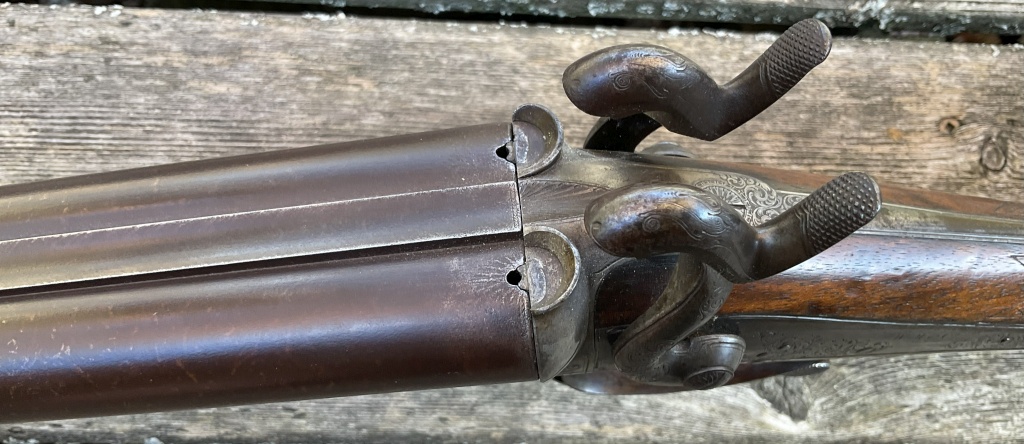
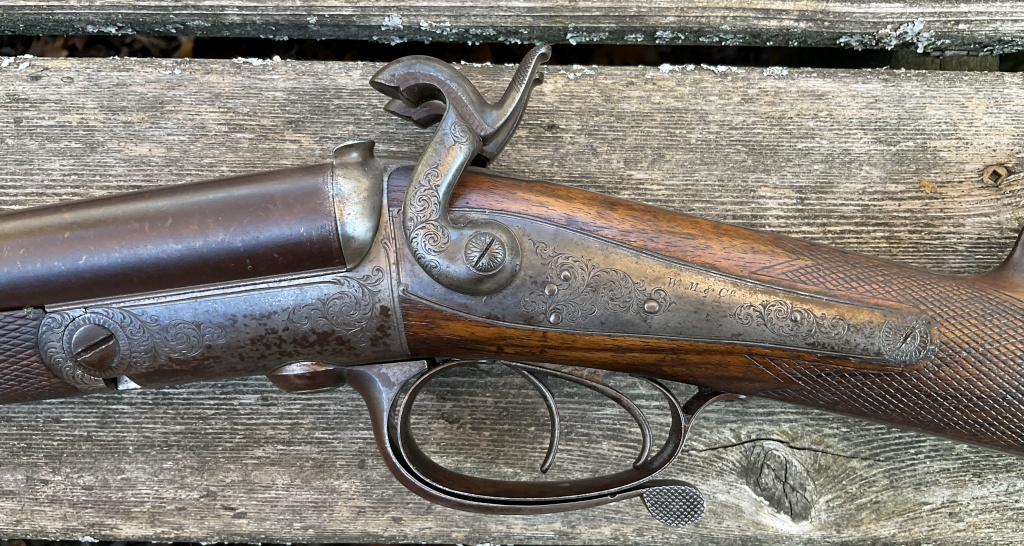
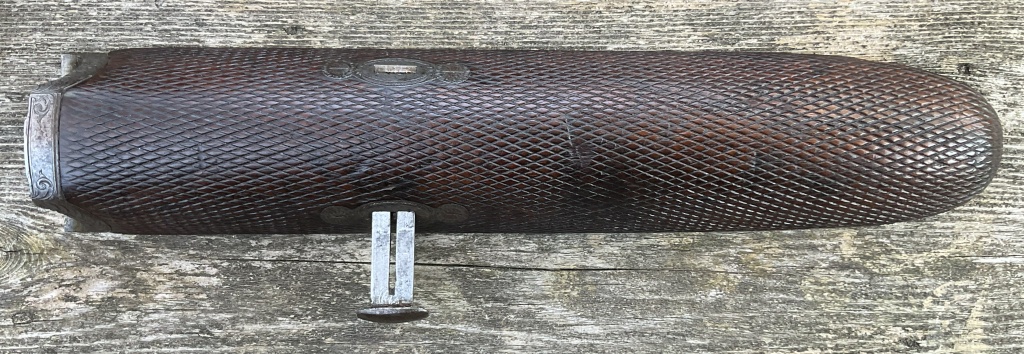
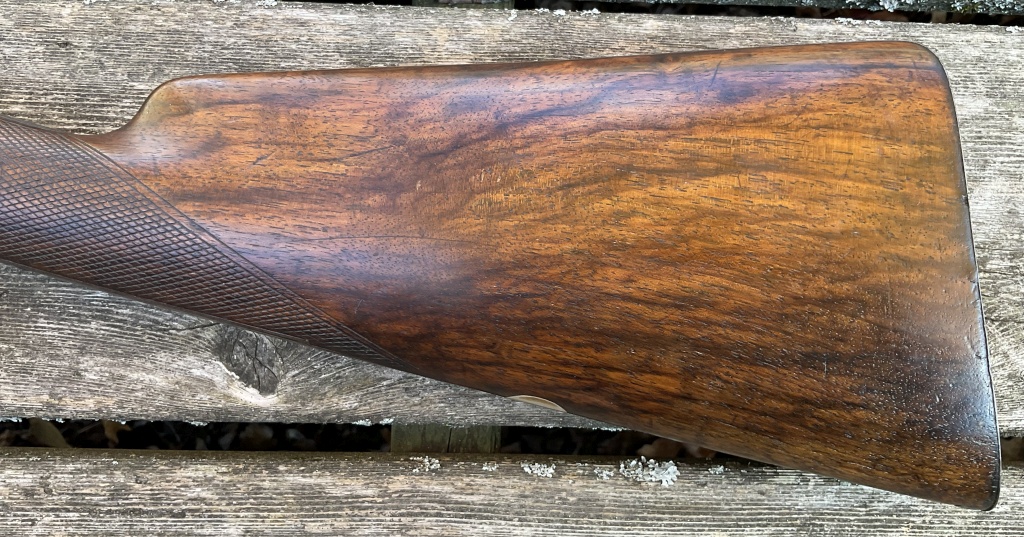
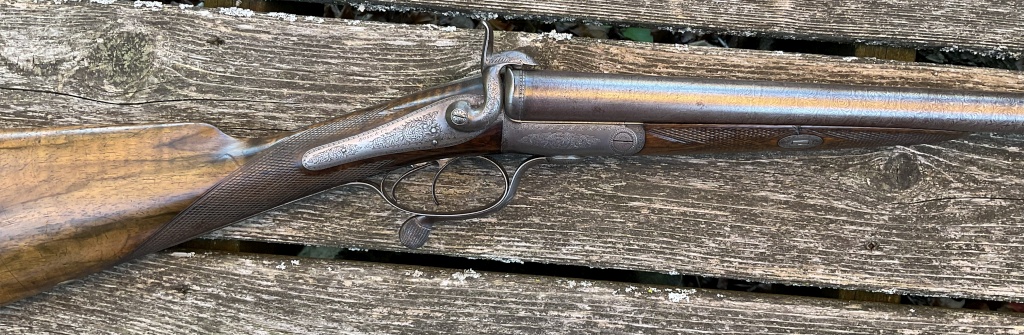
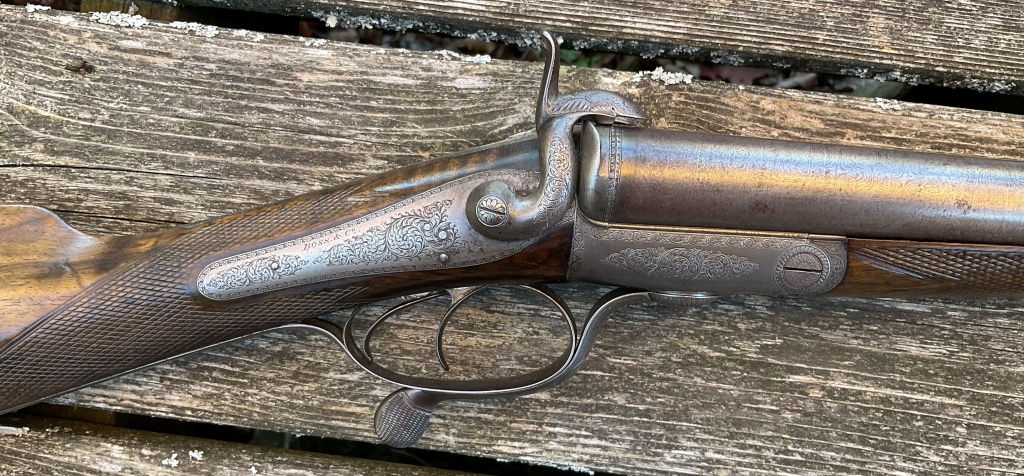
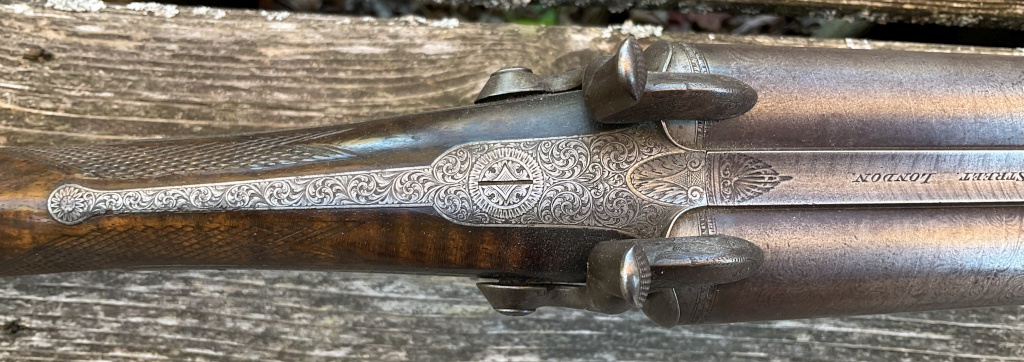
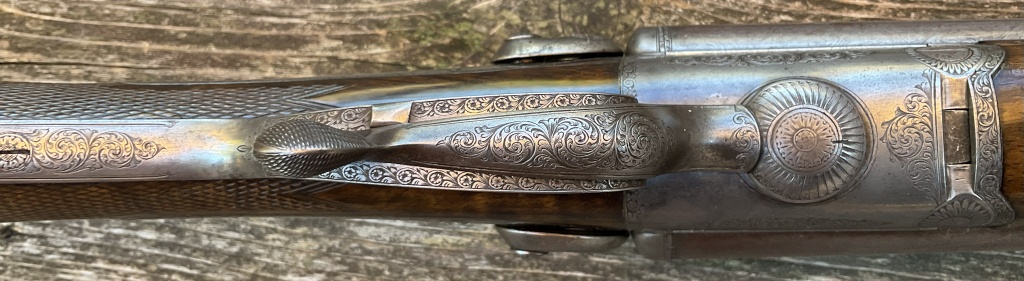
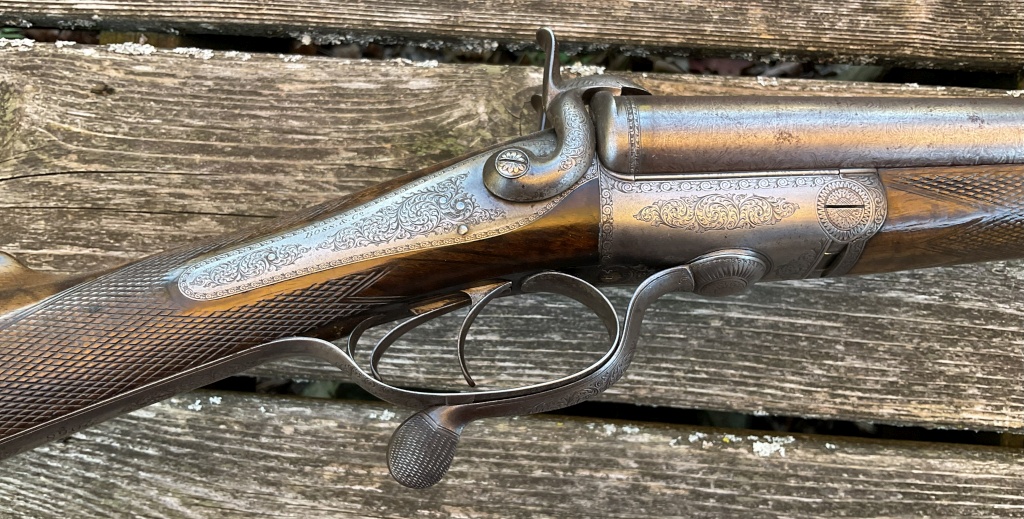
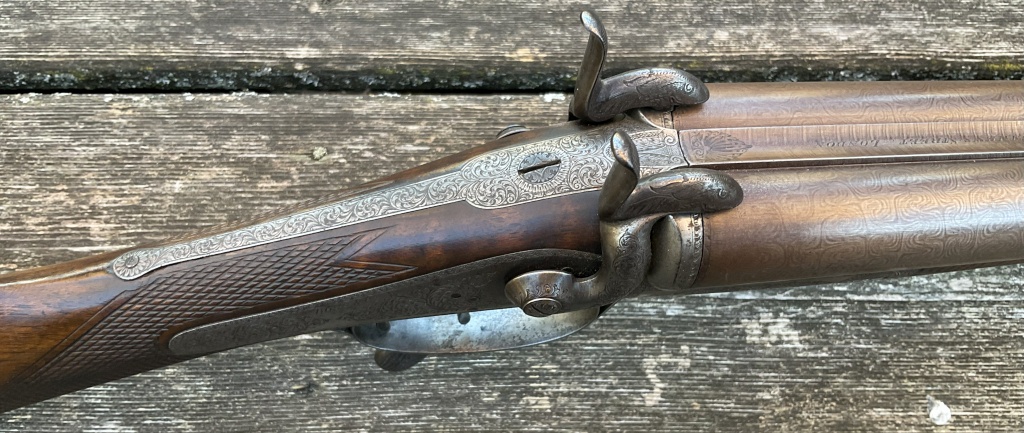
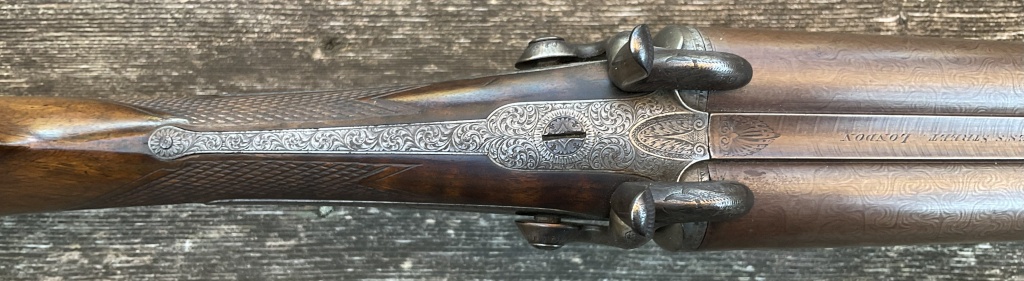
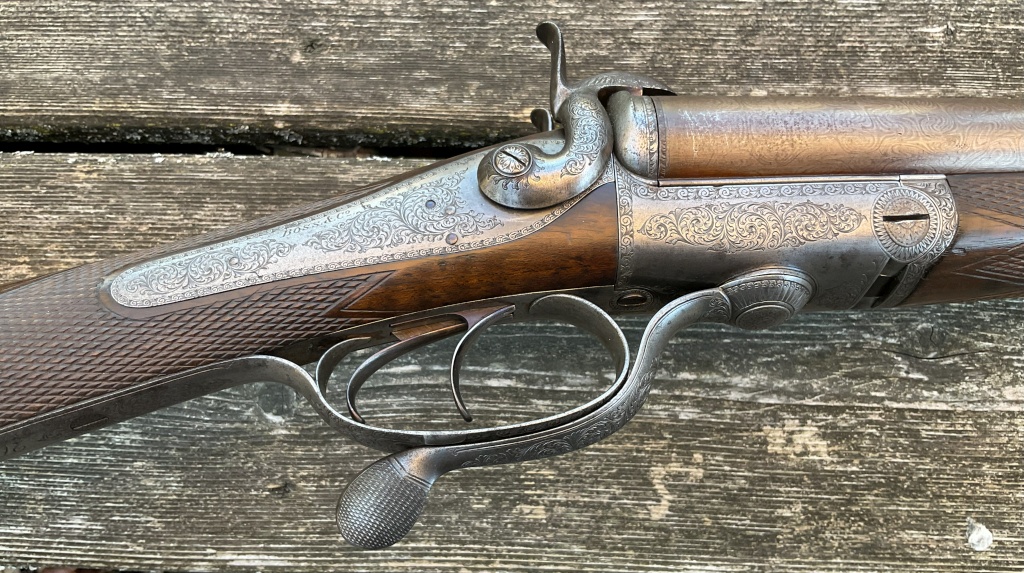
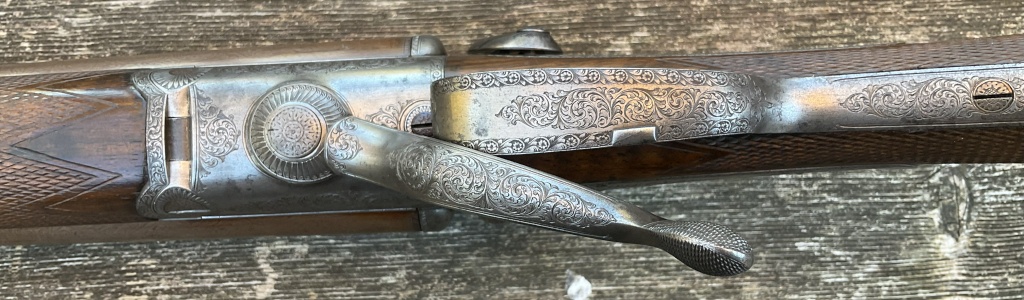
Here is a handsome gun that showcases the Masu brothers' efforts to penetrate the British market. It is, on the face of it, a typical British pin-fire game gun, but upon closer examination, its heritage is revealed. On the surface, it is a 12-bore rotary-underlever double screw grip pin-fire sporting gun of typical form, with the top rib marked “Masu Brothers London.” This is the first clue, as London makers usually specify a street address. A close examination of the open floral engraving style reveals a distinct difference from the more typical acanthus scrolls. The designs on the pins (screws) are also distinct and typically Continental. The locks are unsigned. The back edge of the action block is slightly curved, and the front of the lockplates is notched into it, another clue to its European construction. The 28” damascus barrels display not the typical crolle whorls, but a fine pattern welding not commonly seen on British guns. Only apparent upon removing the barrels, the fore-end is articulated to the action bar and is not removable. Finally, the gun bears Belgian proof marks and lacks British proofs altogether.

This latter point helps date the gun, as Gustave Masu ran afoul of the law. In March 1866, he was convicted by the Marylebone Police Court of an offence under the Gun Barrel Proof Act of 1855 for selling guns lacking British proofs, a crime for which he was fined five pounds. I presume the gun shown here was made no earlier than 1865 from the address (it would have been retailed from 3a Wigmore Street), and assuming Gustave didn’t want a repeat offence, no later than 1866 (I have a later Masu gun with British proofs, showing that he did learn his lesson). The gun is well-made, with no signs of shortcuts or simplifications. For example, the action bar is shaped to fit the curves of the barrel, rather than being simply filed flat. Another detail worth noting is the careful shaping and sculpting of the underlever, perfectly matched to the trigger guard bow. Probably more time and effort went into this simple detail than is spent making whole guns today. The barrels still have mostly mirror bores, and the gun weighs 6 lb 14 oz.

JWzUJ1R.jpg

dD4cHYS.jpg

VmsNHEF.jpg

FJ4hDR3.jpg

uuKvxpK.jpg

NRdWCgU.jpg

tbSN7d1.jpg

3KNUNNW.jpg

bcY8nNh.jpg

ksyGm05.jpg


3 Wigmore Street, today (credit Google maps):
FaPxpzo.jpg
 
Nestled in between the all-British sporting gun (the existence of which can be debated), and the foreign gun (with its extravagant styling and carved stocks), is the foreign gun built to suit British tastes – an impostor of sorts.

I wasn't particularly clear of this sort of thing happening in GB and your account of the Masu Bros. is fascinating. Reminds me of my favorite maker....H A Lindner. While thoroughly Germanic and building them in Suhl, almost all his production, throughout his career, was ordered for the American market and the appearance of Lindner's guns were definitely slanted for the American tastes and sensibilities.
 
I wasn't particularly clear of this sort of thing happening in GB and your account of the Masu Bros. is fascinating. Reminds me of my favorite maker....H A Lindner. While thoroughly Germanic and building them in Suhl, almost all his production, throughout his career, was ordered for the American market and the appearance of Lindner's guns were definitely slanted for the American tastes and sensibilities.
The Lindner-Daly connection is a great example, Canvasback. The Germanic quality and meticulousness shone through, but not the over-the-top Germanic features commonly found in that era (horn trigger guards, bolstered steel-heavy actions, etc.). Here is an example of a Belgian gun built for the German market, by Maximilien Nicolas Colleye of Liège, for August Gottlieb Schüler of Suhl (circa 1860):

P6hFeUH.jpg


The Brits didn't mind foreign actions, as long as they were built in 'British' guns. Here is a gun made by Jean Louis Mathieu Godin of Herstal, Belgium, but retailed by the well-known provincial maker Robert Marrison of Norwich, located near some of the finest shooting estates in England. It dates back to around 1855, when British attempts at making breechloaders were in their infancy, and scoring a London gun was pricey:

TYHxFjC.jpg

y6HhHR9.jpg


Once there was enough capacity by British makers to meet the demand, the desire for foreign guns made for the British market diminished, but not entirely (eg. the Masu Brothers guns). Some makers, like James Purdey, used Belgian Bastin actions, at least for a short time. By the mid 1860s, there were enough home-grown designs to fill the market demand.
 
Steve, I have always found the different national "styles" kinda fascinating. Without seeing the proofs, never would I have imagined that was a Belgian gun in your first pic. But I can usually spot the nationality. I don't know if it's because my first three guns were Winchester, Remington and Fox but I am partial to that American "look". Except for Black Walnut. LOL And I'd say the Brits come a close second.
 
Try as I might, Canvasback, I have not been able to find examples of British gunmakers copying other countries' styles, while the reverse has multiple examples across decades of innovation. Copying patents and ideas, yes (such as Scottish makers copying German trigger-plate actions), but styles? No. The closest I can think of is the James Purdey version of the Bastin System, but having never handled one in the flesh, I can't say for sure if the actions were Belgian (Bastin) and Purdey built the gun around them, or if Purdey built them under licence to the Bastin brothers, or if Purdey just copied it, until something better came along (it did). In any case, the style of the gun and its decoration was certainly British, if odd-looking compared to contemporary designs. The Brits obviously felt they were onto something style-wise with the perfected muzzle-loader, and worked devilishly hard to carry over as much of the native styling as possible to the breech-loader, erasing the 'Frenchness' of the idea.

The relationship between British gunmaking and the USA is actually quite interesting. Trade with the US was important going back to the 1700's, including guns. Some gunmakers, like W. & C. Scott, seem to have directed much if not most of their output to the Americas. Later makers like W. W. Greener, Charles Osborne, and many others did a thriving business with the US. The American Civil War was a tremendous business opportunity for London and Birmingham manufacturers, who happily supplied both sides. Tracing the histories of British makers, I've come across quite a few that moved to New York, San Francisco etc., in search of business opportunities. I wonder how much of their later output meshed with American makers' production styles. I've simply never looked into it.

There were European makers like August G. Genez who settled in the US (New York City), and were successful at developing new patents and putting out unique designs that had both a European quality and an American flavour. Genez even built pin-fires (as did Poultney & Trimble of Baltimore), though I haven't seen any of the American-made ones in person yet.

Perhaps the consistency of British styling choices, copied so widely by many countries, is part of the allure of British guns.

t4W4ZVG.jpg
 
I freely admit I haven’t delved nearly as deeply into the whole thing as you Steve. And there is endless research that could be done. I’ve always thought you were wise to find a way to put a fence around what you are studying. Pinfires…they are a relatively small blip in the overall development of the sporting firearm. Important yes but also a manageable segment.

My favourite guns are true round actions, the Scottish and the French versions, followed by boxlocks. Sidelocks are lovely as are hammerguns. But it’s boxlocks that set my heart racing. I think that ranking is what draws me to what I think of as the American style.
 
Style is hard to pin down, Canvasback, subjective as it is. I hear what you say about Scottish round actions; I will most likely leave this Earth without ever owning a MacNaughton bar-in-wood. Sigh...

Part of the appeal of the British gun, for me, is the merging of engineering and craftsmanship. Boxlocks and sidelocks are all very good, but British ingenuity goes well beyond these popular forms. There have been many smart and clever designs that have appeared, only to disappear without much of a trace. Part of this is the result of evolving from hammer guns to hammerless, and losing the ideas that made hammer guns easy to operate. I am one of those who prefer hammers; I like the surety of knowing the state of readiness of the gun at a glance, and the way the gun ‘speaks’ to me. Being comfortable with a bit of modernity, I do like a snap-action. That too pleases my ears, like the closing of a door on a well-made car.

The advantage of a snap-action is speed. Curiously, in the 1850s and early 1860s, speed was something no one felt they needed. There just wasn’t that much feathered game to be found in walked-up shooting, and driven shoots had yet to appear. Two shots at a covey was the most anyone expected, hence the double gun. To be able to unload with a pull of the cartridge pin and reload with ready-made cartridges was what the pin-fire breech-loader offered, and to do so safely and neatly was wondrous enough. The fact of having to use one's hand to open or close the underlever was not overly awkward, especially if there was no great hurry to take the next shot. I’ve used a single-barrel underlever hammer gun on grouse; all I ever get is one clear shot if I’m lucky, and I never found the lack of a second shot, or a manual action, that much of a problem.

The demand for snap actions grew slowly, corresponding with the development of driven shoots. Snap-actions were quicker to use; better still, if working the action brought the hammers to half-#### for efficient reloading. This was the idea behind the Birmingham gunmaker and inventor Joseph Vernon Needham’s Patent No 1544 of May 1862, shown here on a gun by John Blissett of London.

If you could afford a maker's ‘best’ gun, it usually incorporated proprietary features or, lacking their own, someone else's patent action. John Blissett was a London gunmaker and retailer on London's High Holborn Street, not far from Parker, Field & Sons. Blissett started his business in 1833, and he obtained a few patents for minor inventions. His son William was recorded as a gunmaker in the 1861 census, and I presume he apprenticed under his father. In 1866, the firm became John Blissett and Son. The gun is a 12-bore, number 4097, with 29 ¾” damascus barrels, and the action is the Joseph Vernon Needham patent rotating bolt single-bite snap action, with self-half-cocking. The elegant side lever releases the barrels and raises the hammers to half-####. With the typical underlever action, the hammers must be pulled back manually to half-#### position before opening the gun. The Needham side lever, when depressed, brings the hammers to half-####, disengages the barrel locking lug, and allows the barrels to flip up in one natural motion. Once loaded, the gun can be snapped shut, and the hammers are ready to be cocked. With the new and growing sport of driven bird shoots, a fast-acting gun was a decided advantage. The Needham action was popular and appeared on the guns of many makers. It should be noted that the Needham side-lever pivots differently from most side-levers that followed, with the push part positioned in front of the pivot, rather than behind. Admittedly, it is slightly awkward to use, but one would quickly get used to it.

The Blissett gun is a bar-in-wood design, the most elegant pattern for a breech-loading gun. Wood predominates, making for beautiful lines, but the lack of metal is a nightmare for strength and lasting wear. Successful bar-in-wood guns are engineering feats that demand admiration. The Needham action is further peculiar in that the hinge pin is part of the mechanism for disassembling the gun. The hinge pin is pushed out with a fingertip, and it remains captive. The barrels and still-attached fore-end can then be removed. While it seems counterintuitive to have a slender hinge pin, the action must have been strong, judging from its popularity. The downward-turning lever is located on the right side, and it features a spur that raises the right hammer. On the left side is a small cam that raises the left hammer. The Needham action would likely have been one of Blissett's more expensive offerings. The action bears a Needham silver poinçon and patent use number 171, which indicates it is the 171st action Needham built or authorized. Considering its popularity, this helps date the gun to around 1863, which is relatively early for a snap-action gun. The gun, now well-worn, is beautifully engraved with foliate scroll and retrievers on the lock plates and trigger guard bow. The bar locks are signed “John Blissett London,” and the top rib signed “John Blissett, 322 High Holborn, London.” The gun weighs a svelte 6 lb 11 oz, and the barrels still have mirror bores.

NrkiWRh.jpg

zAPx4J1.jpg

OcpITql.jpg

0aNCeNJ.jpg

fmfw4I7.jpg

Isfr2yq.jpg

IYm1VCz.jpg

NeACSM0.jpg

hoIKz9i.jpg

jZBk71a.jpg

ereVlzC.jpg


Needham’s action was also widely used in central-fire guns, and Needham is credited with coming up with the first barrel-cocking hammerless gun with integrated ejectors in 1874. Although W. W. Greener bought the businesses of Joseph Vernon Needham and Joseph and Henry Needham in 1874, JV Needham retained the patent rights to his ejector gun and licensed his idea to Greener and other gunmakers.
 
I concur. Hammer doubles offer a unique hunting experience. I would go one step further and say that it's comforting to be able to thumb the hammers to confirm cocked status without taking one's eye off the game.

I spent at least a decade hunting with a variety of hammer side-by-sides before my tastes evolved to lighter guns with rounded edges to accommodate aging hands.
 
Any new CGN members with an interest in older guns? Anyone?

Staying on the topic of Joseph Vernon Needham’s patent of 1862, I would like to point out that guns using the same patent actions can be built quite differently, depending on the maker. Think of it more as a starting point, or a basic architecture. The details can be substantially different.

Joseph Vernon Needham of Ashton Row, Birmingham, was born in 1835 (his father, Joseph, was a gunmaker). He had worked for Westley Richards, and may have apprenticed there. In 1852, Needham patented a ‘hammerless’ needle-fire lock, which proved to be popular, though from their complicated nature they were only produced as ‘best’ guns, and correspondingly expensive. The needle-fire was built for paper cartridges that combined shot, wadding, powder and primer, with the primer sitting in the middle of the cartridge. A long needle-shaped firing pin pierced the cartridge and struck the primer, and the entire cartridge was consumed by the burning powder; there was nothing left to remove after firing, allowing a new cartridge to be inserted. Around 1858, Needham granted John Rigby of Dublin a licence to manufacture his needle-fire gun, and Rigby apparently built 102 guns and rifles on this design between 1858 and 1864, before the needle-fire was replaced entirely by the pin-fire and central-fire systems; Rigby may even have made more examples of the needle-fire gun than Needham did himself. However, by the early 1860s, the pin-fire gun had become predominant among the early breech-loaders. George Daw’s snap-action central-fire gun had also appeared on the scene, paving the way for the future (though nobody knew that back then).

The exact origins of the Rigby gun-making line are unclear. There have been claims that the business was started in Dublin in 1735, or possibly 1635. When John Rigby founded his business in 1775 on Suffolk Street, he may have inherited earlier family activities. John died in 1818, and his sons, William Rigby and John Jason Rigby, continued the business, renaming the firm Wm & Jno Rigby. By 1841, it was known as William and John Rigby. William died in 1858, and John succeeded to the business, without changing the name. In 1865/1866, John Rigby opened a showroom at 72 St James's Street, London, and the name of the firm was changed to John Rigby & Co. (still in business today).

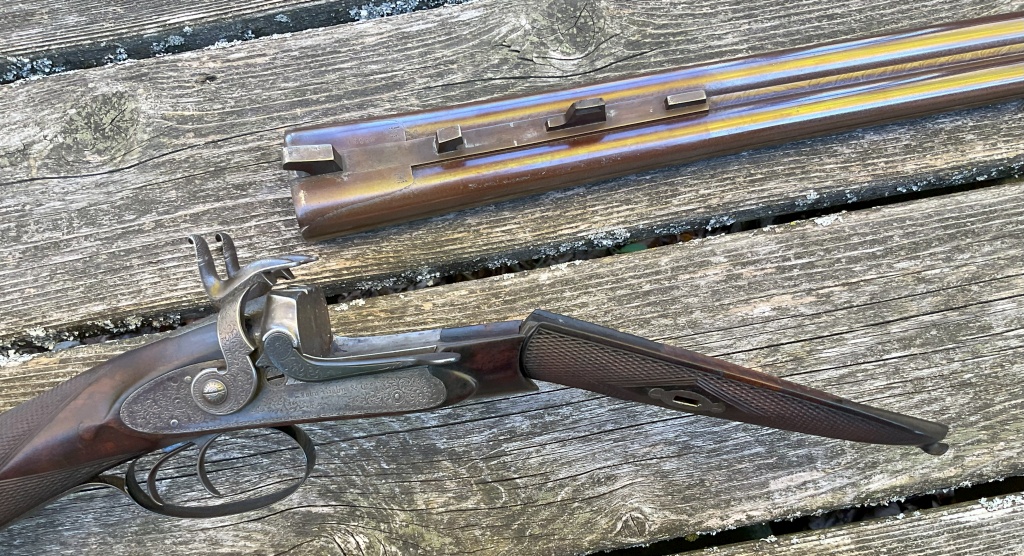
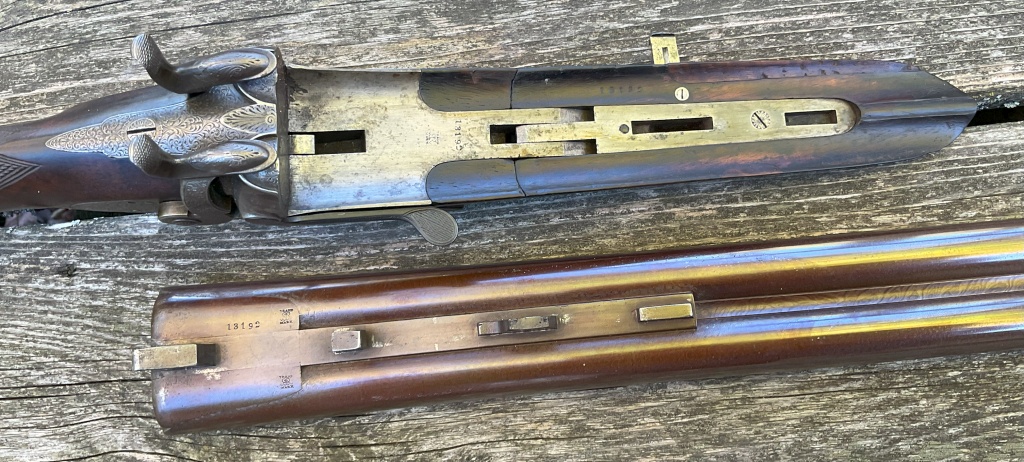
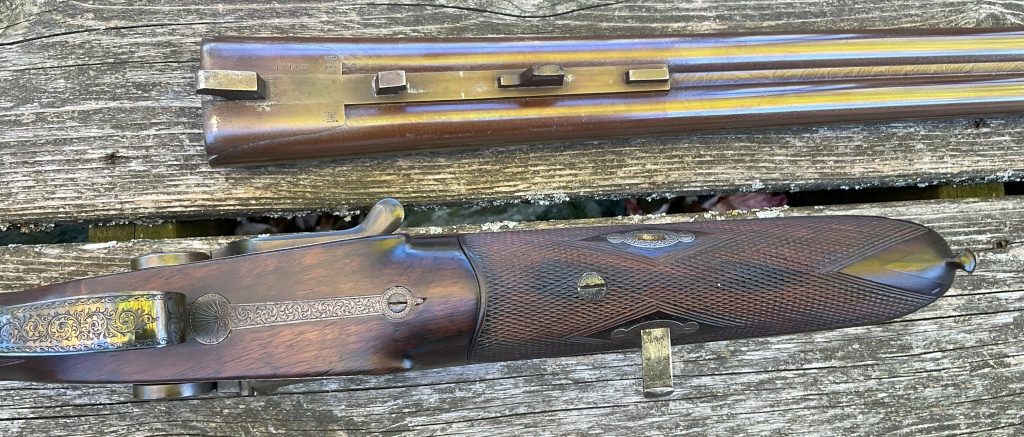
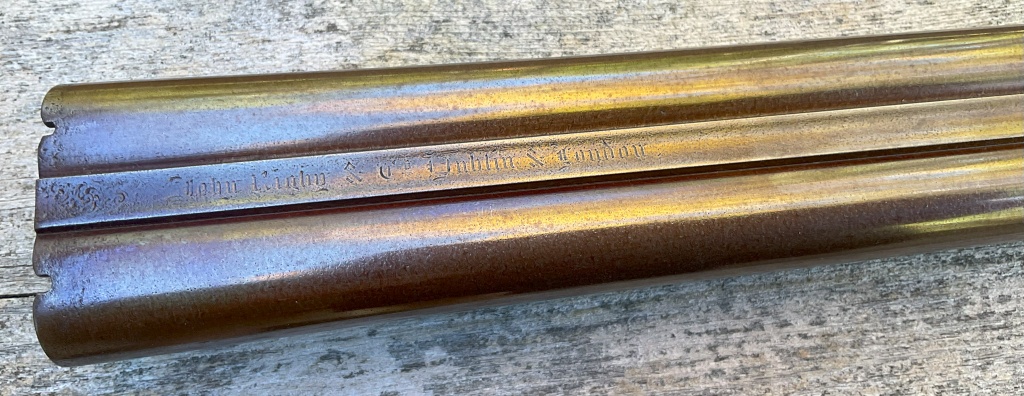
Here is a Rigby-Needham gun, made in 1868-1869. It is a 12-bore pin-fire game gun with a Needham action, signed 'John Rigby & Co. of London and Dublin.' It is consistent with the Needham patent No. 1544 of 22 May 1862, although it lacks the Needham poinçon and patent use number, suggesting it was made by Rigby under an arrangement. It has the transverse spindle, side-lever-opening and self half-cocking action, and a rounded action bar like a typical Needham action. It is likely the gun was built for an Irish client, as the barrels and action are lacking proofs (though the double-R Rigby trademark is present); had the gun been destined for the London showroom, it would have had to have been submitted to the London or Birmingham proof house, to comply with the Gun Barrel Proof Act. The 27 ¾” fine damascus barrels are marked 'John Rigby & Co. Dublin & London' in Gothic script, and the bar-in-wood design incorporates a non-detachable fore-end, this latter feature being different from other Needham actions I’ve seen and handled, including the one I pictured last week. Note the elaborately shaped horn fore-end tip, which appeared on other Rigby best guns. The bores are moderately pitted, but otherwise the gun is in fine shape. It weighs just shy of 6 ½ pounds, and is one of the finest bar-in-wood guns I’ve ever come across. The hidden hinge is another veritable tour de force of gunmaking skill. Why do it this way? Just because.

Adu17QV.jpg

pjE7QKB.jpg

h7CMViv.jpg

sJFqsvR.jpg

7ivBspp.jpg

Gpwst2d.jpg

n8DjhCb.jpg

8UPUNBE.jpg

rvwW4qh.jpg

FwbZvkZ.jpg

ohDGS1U.jpg
 
Last edited:
Lately, I’ve been showing some interesting patent actions on British guns. While patents are an interesting area of study regarding hammer guns, not all good ideas were patented, including some very innovative ones. For example, having a rotary under-lever wrapped around the trigger guard bow is a great idea, as it is less troublesome to operate than a forward-facing one. I keep repeating myself in asserting that this form of under-lever is wrongly called a ‘Jones under-lever.’ It existed (in France) more than 20 years before the Birmingham gunmaker Henry Jones obtained his patent in 1859 for his double screw grip action (for which the interrupted screw bolt was the point of the patent, not the under-lever). The first British breech-loading guns with a reverse under-lever likely appeared around 1856, predating the Jones patent. These actions, for the most part based on those of Beatus Beringer of Paris, are of the single-bite design, meaning the screw bolt engages just one notch in the barrel underlug (and not two, as per the Jones patent). When Henry Jones let his patent lapse in 1862, it allowed gunmakers to make simple and robust double screw grip actions without having to pay Jones any patent usage fees. It wasn’t long before makers did so in ever-increasing numbers, competing with the new snap actions.

Let's return to the earlier single-bite design, which, curiously, was never patented, despite being new and desirable on the British market. Perhaps those who used the single-bite underlever knew it was French in origin, and didn’t want to risk expensive and reputation-harming legal disputes, in the same way no one attempted to patent the pin-fire system in Britain. This is even more curious when considering the considerable legal tussle between the Eley brothers and George H. Daw over the shape of primer internals used in central-fire cartridges. No, nobody took out patents on the first British pin-fire actions, which were built by Joseph Lang (the first to do so), John Blanch, E. M. Reilly, and others, all of whom were copying each other, and French ideas.

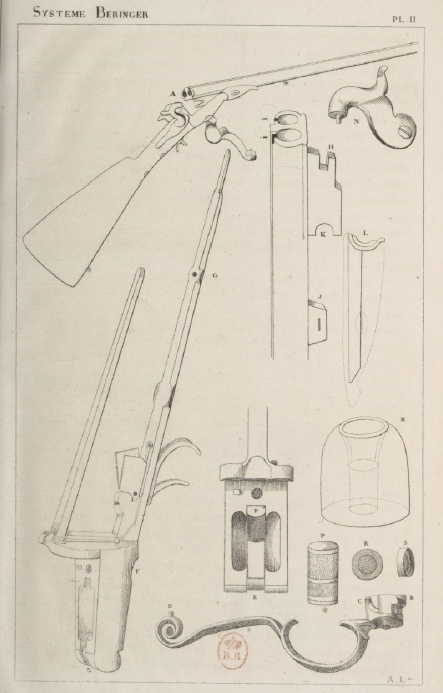
Beringer’s design, pictured here (published in the Journal des Chasseurs, a literary revue published in Paris for the period October 1837 to September 1838), shows the single-bite action, and where the trigger guard doubles as the under-lever. It is not much of a jump to separating the trigger guard from the under-lever, as was also done at the time, and one can see the inspiration for shaping the proximal part of the under-lever to fill the space between the lever arm and the bow, to make it seem like the original one-piece version.

MWcXAYn.jpg


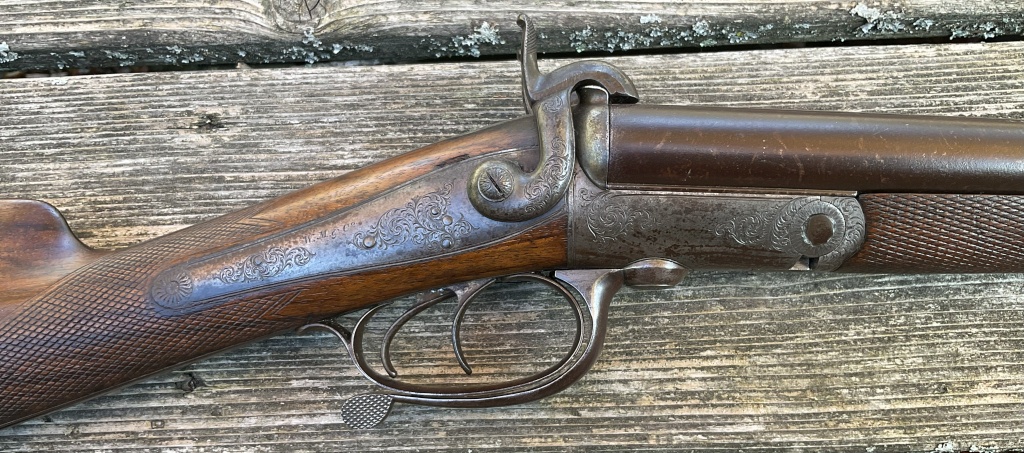
Let’s look at a gun that showcases all of these points: a 16-bore, single-bite, assisted-stud opener action with the lever-over-guard by William Moore. William Moore was one of London and Birmingham's most highly regarded makers. I cannot verify its date, but I’m guessing 1860, plus or minus two years. It is not of “Best” quality, but looks to be of second or third quality. The barrel rib is signed “W. M. & Co.,” as are the lock plates. Although cryptic today, at the time, everyone was familiar with the Moore name and its variations. Originally a stocker for Joseph Manton, William Moore established his own stock-making business in Birmingham in 1829 and became a gunmaker shortly thereafter. In 1836, the name of the firm changed to William Moore & Co., and Moore also entered into several partnerships in addition to operating his own business. In 1838, he partnered with William Harris, creating the firm of Moore & Harris at 35 Loveday Street. In 1847, Moore partnered with William Patrick Grey and operated as Wm. Moore & Grey. In 1854, William Moore & Co. moved to 43 Old Bond Street, London, and Moore and Grey began trading from this address under the name William Moore & Grey. Guns marked Wm Moore & Co. were mainly export-quality guns with a different serial number range. In 1861, Frederick Beesley, a name that would become famous later, was apprenticed to William Moore & Co. William Moore may have died in 1864; the records are unclear. The fame of the William Moore name was such that it subsequently appeared on low-quality Belgian guns to dupe buyers into believing they were purchasing a recognized name.

The 30” damascus barrels have London proofs and bore markings (14); the barrel rib is marked “W. M. & Co.” The single-bite rearward under-lever action has the assisted-opening stud feature of Beringer’s design. The square cuts of the action bar suggest the gun was not actioned by Edwin C. Hodges, who preferred the lightening cuts a la Beringer. The thin fences, also a sign of an early 1860-era gun, have raised percussion-style collars, and there’s an attractive rabbit engraving on the top strap. The hammer noses are arched, another early pattern. The under-lever is of the style that fills the space between it and the guard bow. The gun shows considerable use, the flat chequering is worn, and the bores are pitted. Although the engraving is limited in coverage, it is nevertheless done with style and skill. The gun weighs 7 lb 11 oz, heavy for a 16-bore.

QR6Mksr.jpg

Pzwan1J.jpg

Z4XjBLN.jpg

tc4J14h.jpg

1mUEKv7.jpg

WDc2gF0.jpg

B2TI6m9.jpg

DkY9jIx.jpg

K57fKdg.jpg


Altogether, not bad for what was probably the cheapest London breech-loader available around 1860.
 
Ah, the necessity of preparing for the winter (moving and stacking firewood) has taken up my days, so thinking and writing about British guns have suffered a pause…

Am I any nearer to defining the allure of the British sporting gun? Working out what makes them special? Mechanical cleverness is certainly an asset, but not the whole picture. Some of the finest guns do not push any technological boundaries; they are simply well-made, crafted from the finest materials available. History is definitely an element, and a handful of names seem to eclipse just about all others. Not just names of gunmakers, but their locations as well.

A London address has always been desirable on a sporting gun. It speaks of wealth and prestige, inferring a degree of elitism that other addresses rarely attain. In mid-Victorian Britain, the best addresses were a stone's throw from posh members-only gentlemen’s clubs and alongside shops catering to the upper echelons of a highly stratified society. Royalty, nobility, politicians, businessmen, professionals, military officers, and wealthy sportsmen were the sought-after clientele.

One of the very best locations was St James’s Street, in central London. The street is very short, running but a few hundred metres between Piccadilly and St. James’s Palace; yet in Victorian times it housed the premises of some of the greatest gunmakers of the day: Boss & Co. (no. 73), James Dalziel Dougall (no. 59), James Woodward and Charles Moore (no. 64), Gye & Moncrieff (no. 60), Thomas Jackson Mortimer (no. 34), John Rigby (no. 72), and Stephen Grant after he left Boss & Co. (no. 67A, and later nos. 68 and 69). Nearby exclusive gentlemen’s clubs included White's, Boodle's, the Carlton Club, Brook's, the Reform Club, the Honourable Artillery Company, the Cavalry and Guards Club, the Oriental Club, the Army and Navy Club, the East India Club, the Oxford and Cambridge Club, the Athenaeum, and the City of London Club, to name a few.

The firm of Boss & Co. is worth a moment. It is known for its slogan, “Makers of Best Guns Only,” and is consistently placed among the top three or four British gunmakers. Famously claiming to produce only one quality of gun, Boss & Co. has had an interesting history, and the firm continues to do so to this day. In 1780 or shortly afterwards, William Boss moved to London to work for Joseph Manton, alongside James Purdey. In 1804, his son Thomas was apprenticed to him at Manton’s, but when William Boss died in 1809, Joseph Manton took Thomas on for the remainder of his apprenticeship. Thomas Boss finished his apprenticeship in 1811 and continued to work for Manton. He set up his own business in 1812 as an outworker for the London trade, doing work for James Purdey, Charles Moore, and Charles Lancaster, among others. In 1837, he moved his business to the very fashionable 73 St. James's Street. In 1851, Thomas Boss employed ten men, and his nephew, Edward Fields Paddison, as a journeyman gun maker. The firm made about 70 guns annually. Thomas Boss brought several close family relatives into the business, the notable exception being Stephen Grant, his workshop foreman.

Stephen Grant had served his apprenticeship with William Kavanagh & Sons of Dublin from 1835 to 1842. In 1843, he moved to London to work for Charles Lancaster, and in 1850, he began working for Thomas Boss. Thomas Boss died in 1857, at the age of 67, and his widow, Emma, then 62, inherited the firm. She made Stephen Grant the managing partner of the business, and during this time, the quality of Boss guns was held in high regard, though its designs were conservative. Boss & Co. began making pin-fire game guns in 1858, alongside percussion guns, and did not start making central-fire guns until 1866, the year that Grant left and established his own gunmaking business at 67a St. James's Street, almost adjacent. Rumour had it that Grant and the Widow Boss had had more than just a business arrangement going on, but nothing came of it, and in any case, being the competition next door probably didn’t help matters.

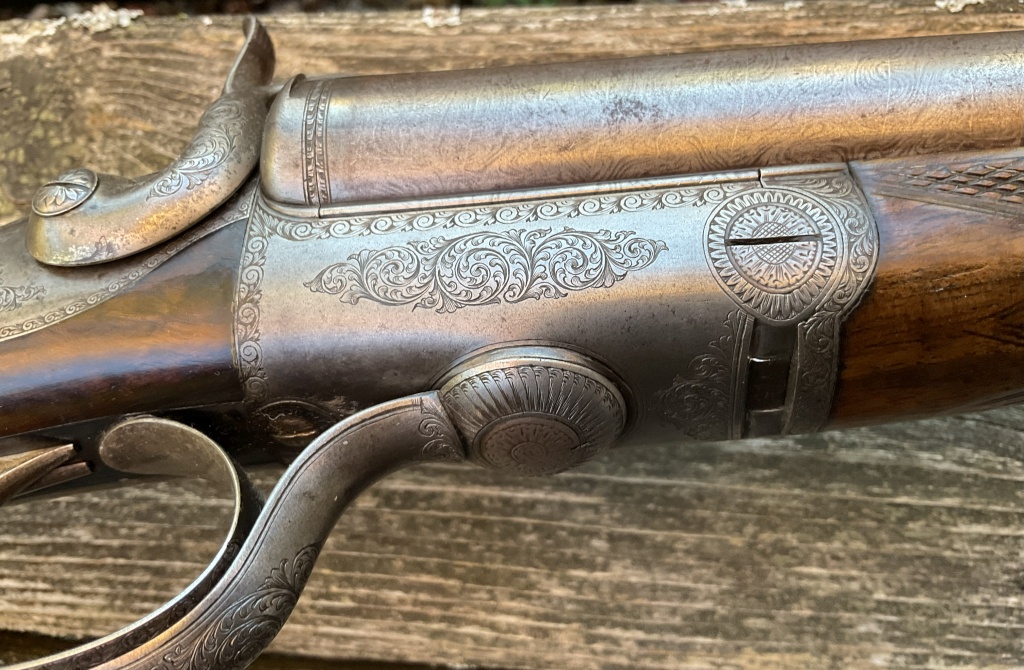
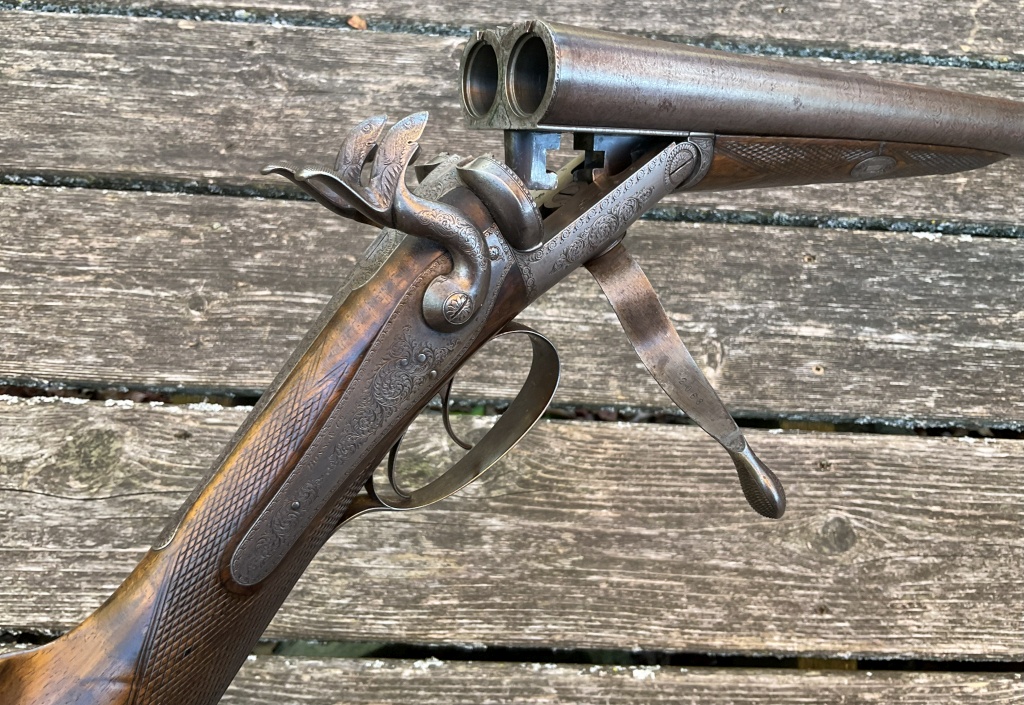
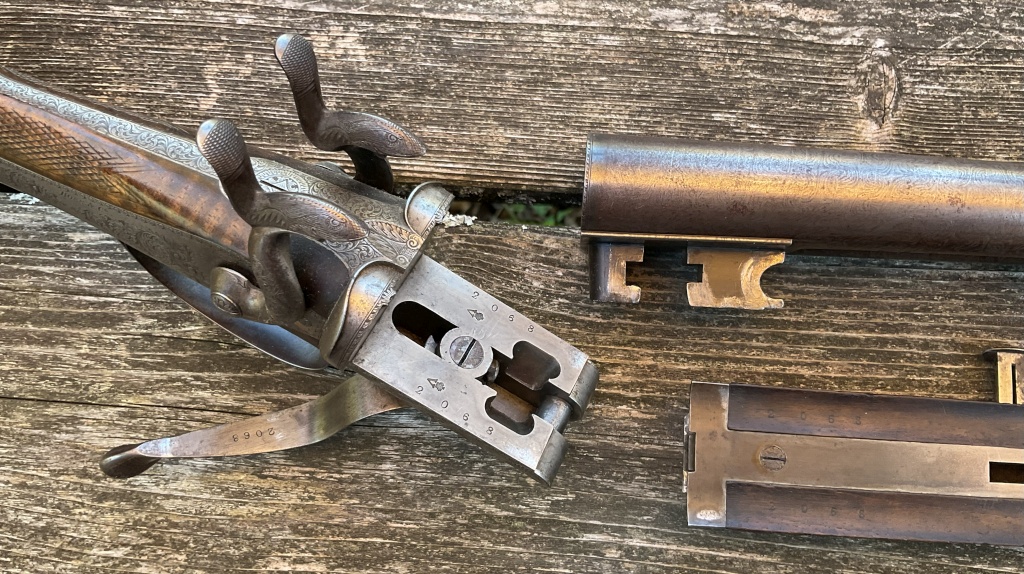
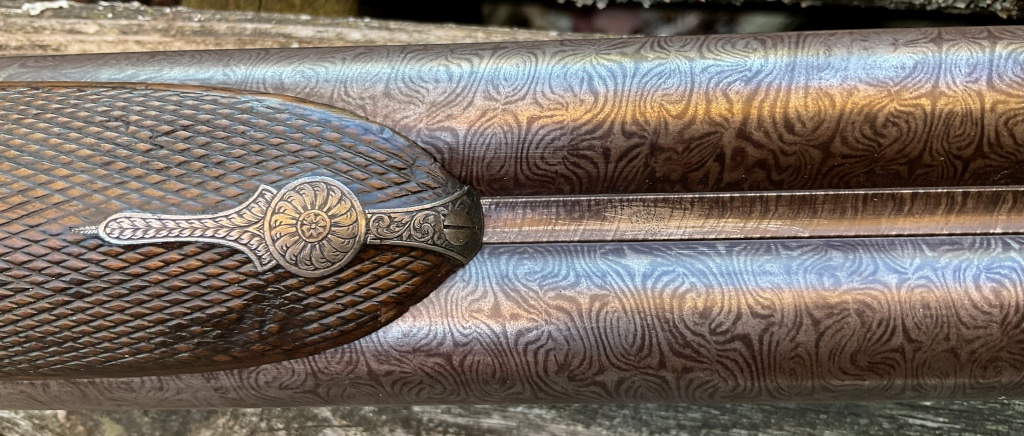
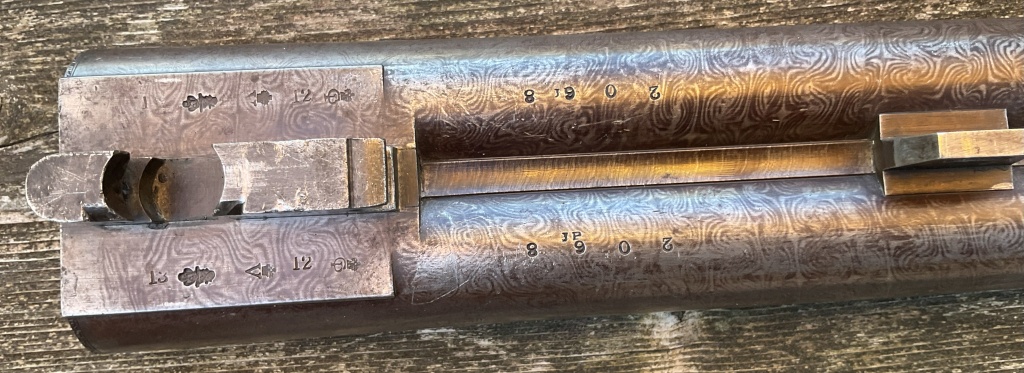
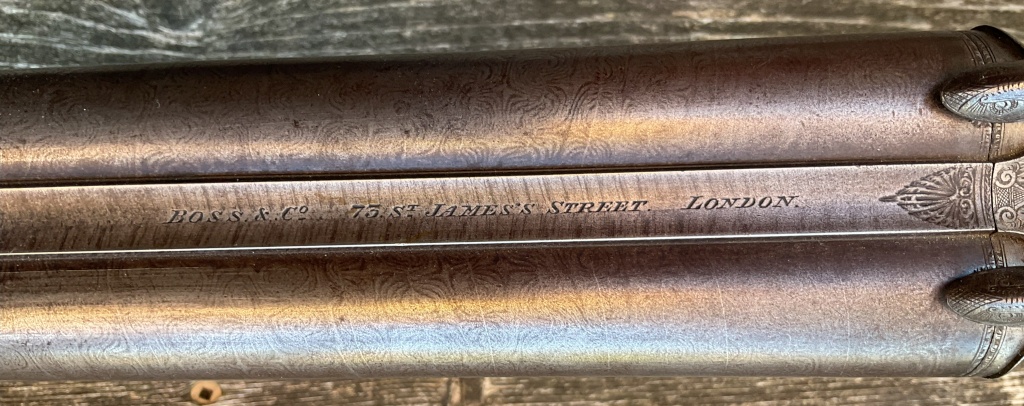
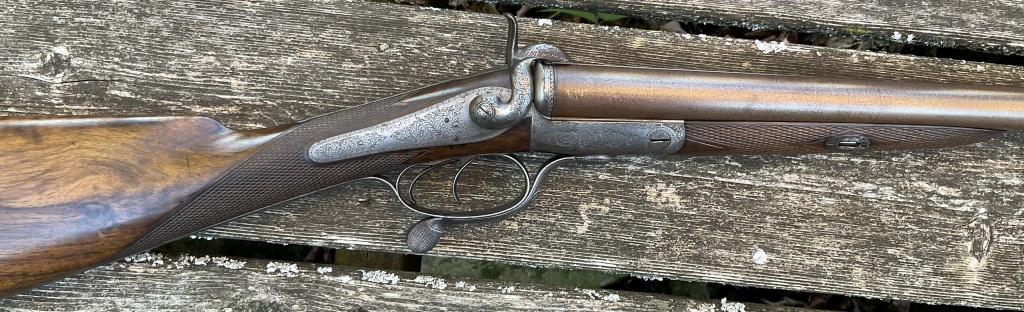
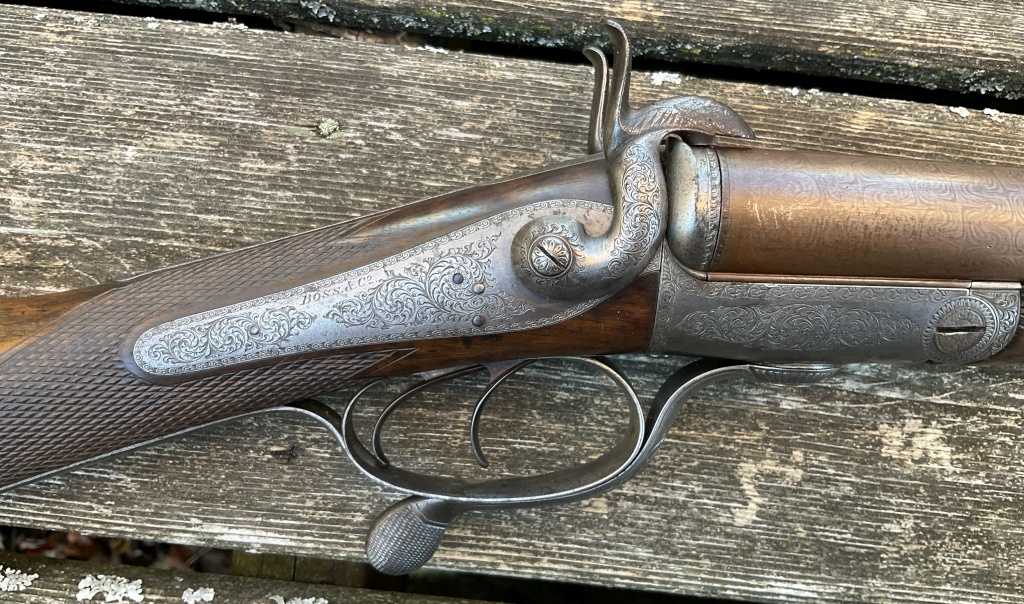
Boss & Co. number 2068 is a 12-bore double-bite screw grip action pin-fire game gun made in 1863, when the firm was under the watchful eye of Stephen Grant. The 29 7/8” damascus barrels are signed for John Portlock, the locks are signed Joseph Brazier, and Edwin C. Hodges actioned the gun – all of these being the best available outworker-craftsmen. The top rib is marked “Boss & Co. 73 St. James Street London.” The gun still has mirror bores and weighs an even 7 lb. It displays no special patents, having the bog-standard double-bite screw grip of Henry Jones’s design, then freely made by many makers. It is conservative to the extreme, including John Sumner’s engraving. It is just very, very well made. And it would have been very expensive for its time, probably about 50 guineas.

6nSpuj5.jpg

pnyOoL1.jpg

kQNl8nO.jpg

TDcdP2a.jpg

hZ3yE1L.jpg

uIi2iUX.jpg

Ay5Riu8.jpg

cgRVgaM.jpg

YPMbE11.jpg

tz5wX88.jpg

C97tU9K.jpg


Can you see any leftover tool marks? Didn't think so.

It was built for Sir Sandford Graham, 3rd Baronet Graham, Kirkstall, Yorkshire and Edmund Castle, and Captain of the Grenadier Guards. Sir Sandford was 42 years of age when he picked up his gun. Notably, his father, the 2nd Baronet, was a close friend and travelling companion of Lord Byron, the English poet, peer and politician. Sir Sandford was himself frequently mentioned in the society pages of the newspapers, and his success as a salmon fisherman, pigeon shot, and cricket player also made the news. His life was not without tragedy and conflict; in 1847, he married Lady Eleanora G. Paget, daughter of Lord Henry Paget, 2nd Marquess of Anglesey. She had been one of Queen Victoria’s bridesmaids for her marriage to Albert in 1840. Sadly, she died in 1848, and Sir Sanford never remarried. Sir Sanford also suffered a bankruptcy in 1868, likely from debts inherited from his father. Sir Sandford Graham died in 1875, and his brother, Sir Lumley Graham, became the 4th Baronet.

On a happier note, in the Irish Times of 25 August 1869, it was reported that Sir Sandford had, with two compatriots, bagged 120 grouse, ten hares and two snipe on the first three days of the season, on the Kinlochbeg moors. I wonder how many of those were taken with this gun?

 
Last edited:
Pinfire:
Your writings on shotgun-related matters brings to mind the writings of Geoffrey Boothroyd [*] 3+ decades ago when my tastes ran towards English guns, especially fine ones. I never did catch the muzzle-loader or pin-fire bug however.

* I say [write?] that as a compliment of the highest order Sir!
Jim, that's truly a high compliment. I greatly admire his writings, and I hope that the many hours I've spent reading his articles and books have influenced my own work, though I humbly reject any notion of being in the same league as him. However, I am happy that readers enjoy my musings and thoughts.

For those who may not know this author, Geoffrey Boothroyd was a regular contributor to the British Shooting Times weekly magazine for some 30 years. He has authored over a dozen books, including The Handgun (1970); Shotguns and Gunsmiths, The Vintage Years (1986); Sidelocks and Boxlocks, The Classic British Shotguns (1991); The Shotgun, History and Development (1993); Boothroyd on British Shotguns (1993); and Boothroyd's Revised Directory of British Gunmakers (1997), the latter being always within arm's reach of my writing desk. Several of these books were compiled posthumously from his writings in Shooting Times (he died in 2001). To put his knowledge and reputation in a popular context, Geoffrey Boothroyd heavily influenced the author Ian Fleming's weapon choices in the James Bond series, and was Fleming's inspiration for the armourer character, 'Q.'

It was in reading the Shooting Times that I was first attracted to his work. We corresponded, and I even earned a mention in one of his columns (I was then the owner of a Darne Rotary shotgun, a type he had never seen). When I started on my pin-fire journey (some 28 years ago), I found that almost everything of note that had been penned on British pin-fires had so far come from him. It gave me my starting point, and I'll be content if, someday, my (future) book on the history of the British pin-fire game gun will reside on a shelf alongside Boothroyd's works.
 
Last edited:
Another Boss & Co.? Why not. And this one has a whiff of scandal.

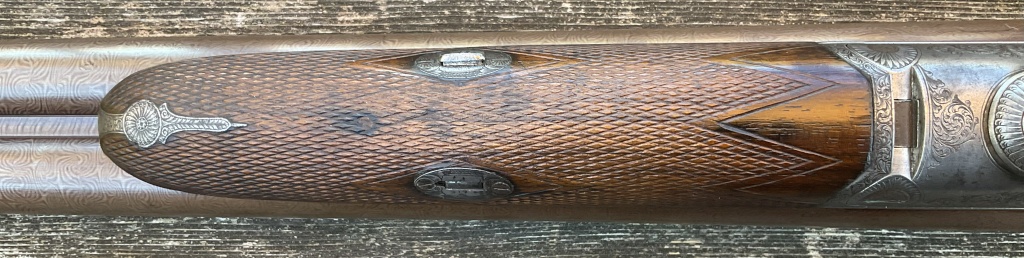
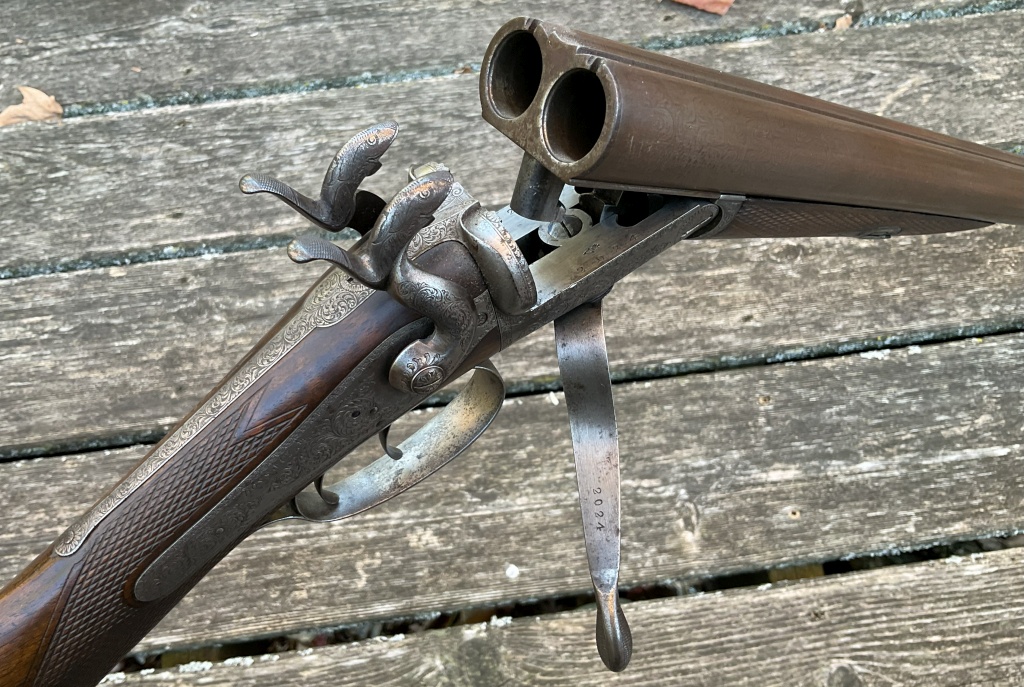
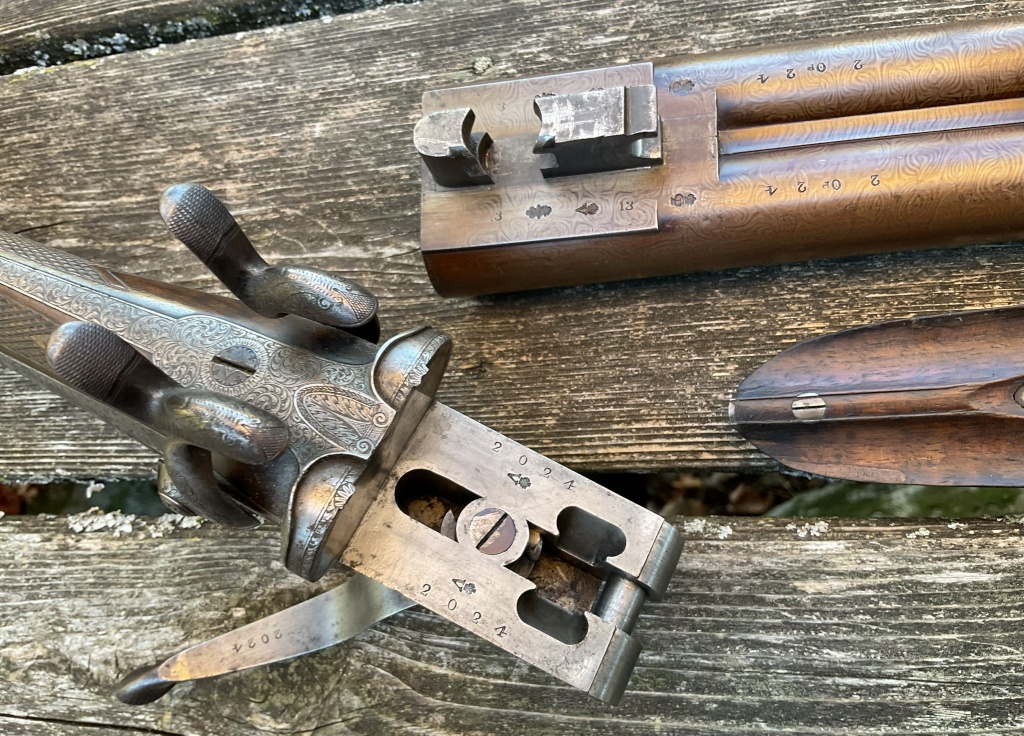
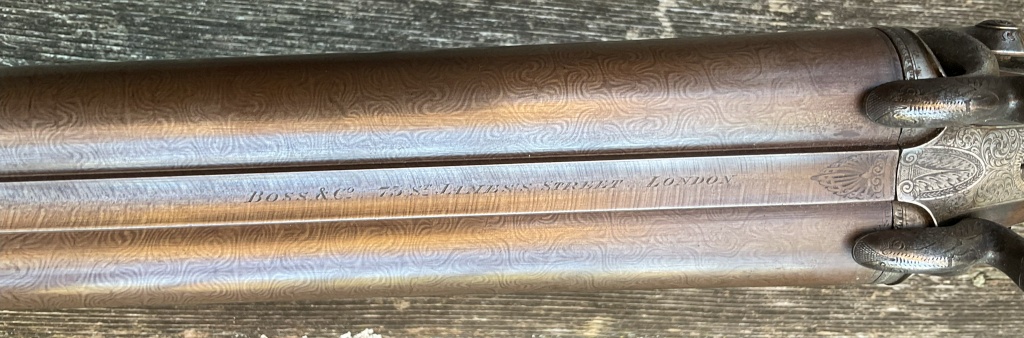
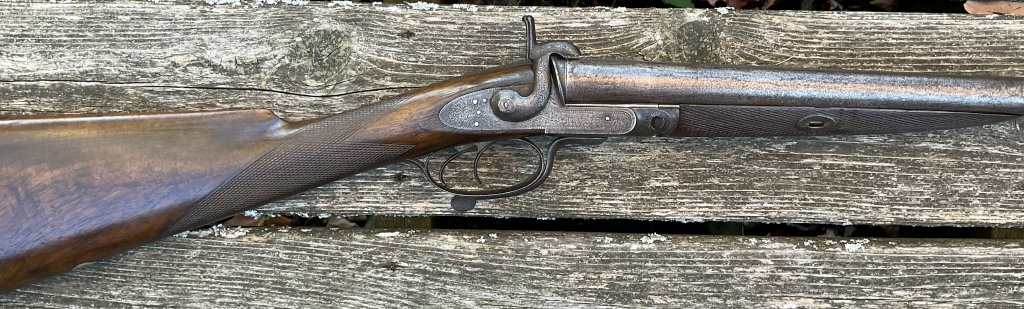
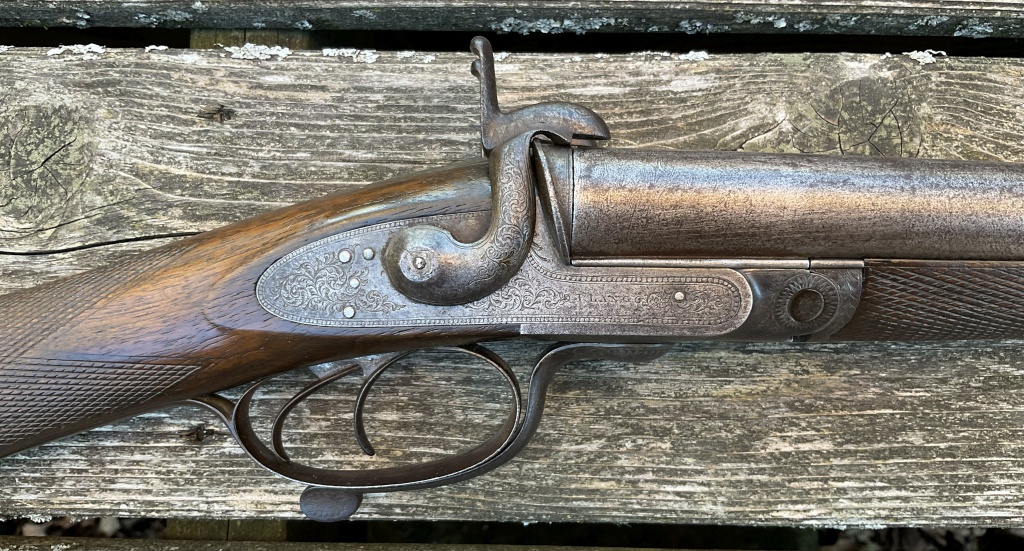
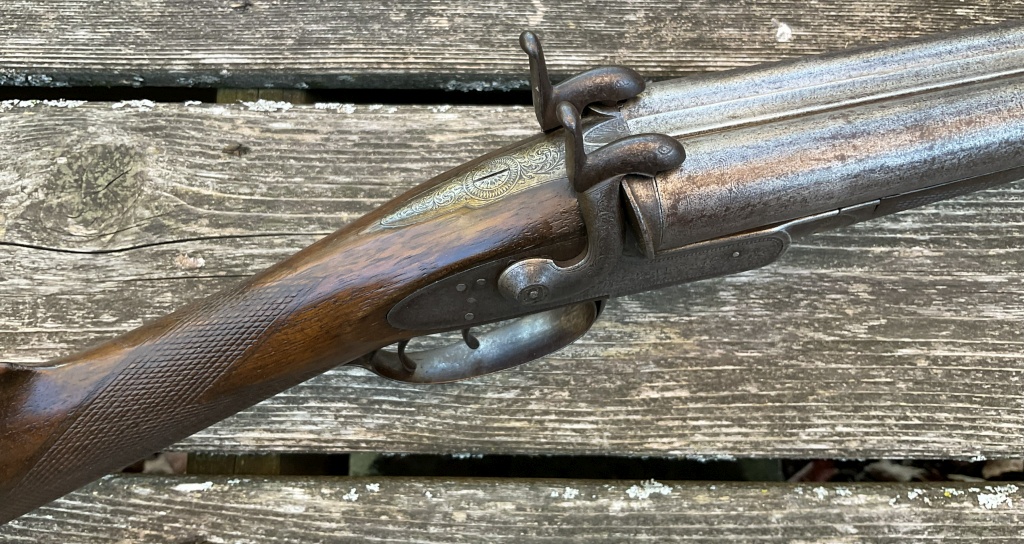
The 12-bore number 2024, pictured here, was built for the aristocrat Charles Cecil Martyn, ordered on 22 December 1862 and completed on 3 April 1863. It has a double-bite screw grip action, 29 7/8" damascus barrels, and weighs 6 lb 6 oz. This pin-fire game gun is very similar to the one I described last, as the same set of hands worked on it. The gun was actioned by Edwin Charles Hodges, with barrels by John Portlock, stocked by Daniel Holliman, screwed and finished by William Byrne, completed with locks by Joseph Brazier, engraved by John Sumner, and the process overseen by Stephen Grant. Like most British guns of the period, many skilled hands were involved in their making, and as with Boss & Co. guns in general, it is near perfect in its manufacture.

JTDsD0h.jpg

4LTLiVj.jpg

B9fWrC5.jpg

DWBVtzA.jpg

F1H71pp.jpg

SG4MjjD.jpg

cDZcZXP.jpg

ZlpRj4c.jpg

9eyDUyQ.jpg

NHzcaxB.jpg


Martyn, born in 1807, would have been 53 when he purchased the gun. He was a very wealthy man, having inherited a vast sum from his father, who died in India in 1830. Charles Cecil Martyn attempted to be elected to the British Parliament in 1837 for the seat of Southampton, but was unsuccessful. He tried again in 1841 and was successful, but Martyn's election was declared void the following year due to accusations that he had won the election through dubious means. Martyn and his wife were frequently mentioned in high-society news, and Martyn was a prominent supporter of horse racing. He was given a Master of Arts degree by Oxford University in 1865. Sadly, he did not have long to enjoy his gun, station, or new honours, as Martyn died in 1866.

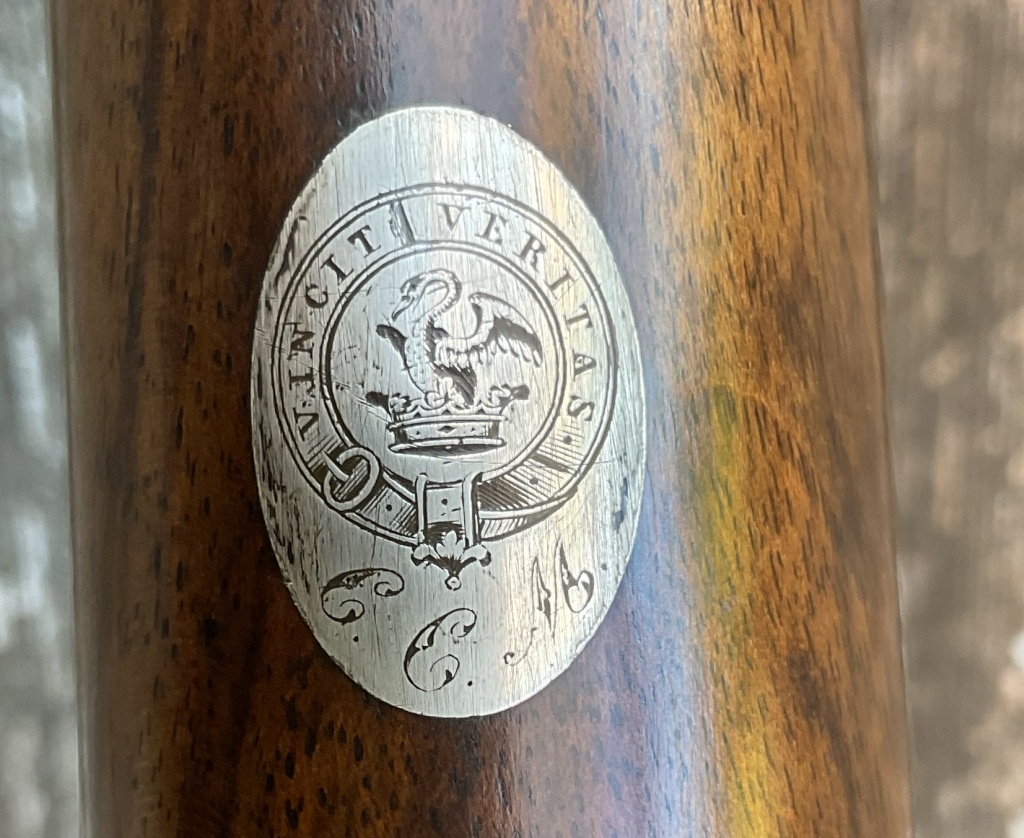
The gun has the Martyn family crest (out of a ducal coronet, a demi-swan, wings disclosed, proper, surrounded by the motto ‘vincit veritas’ within a belt motif) and the initials CCM:

fakn6Hq.jpg


More trivia on the 1841 election scandal: Martyn was elected for Southampton together with James Bruce, 8th Earl of Elgin. Both lost their seats when the election was voided. In its report before the House of Commons, the Southampton Election Committee stated, “That James Bruce, esquire, commonly called Lord Bruce, and Charles Cecil Martyn, esquire, were, by their agents, guilty of Bribery at the last Election for the Town and County of the Town of Southampton.” Bruce, having just obtained his earldom, brushed off the scandal and went on to serve as Governor of Jamaica (1842–1846), and Governor-General of the Province of Canada (1847–1854). If you’re wondering if Ontario’s Bruce Peninsula is named after this fellow, the answer is yes. In 1857, Bruce was appointed High Commissioner and Plenipotentiary in China and the Far East, where he was responsible for ordering the destruction of the Old Summer Palace in Beijing, one of history's most remarkable acts of cultural vandalism. Bruce compelled the Qing dynasty to sign the Convention of Peking, which added the Kowloon Peninsula to the British crown colony of Hong Kong. Finally, Bruce was named Viceroy of India (1862–1863). Oh, and his father, the 7th Earl of Elgin, had made off with the Parthenon marbles in 1801, another on the top-ten list of historic vandalism. The friezes and sculptures were eventually sold to the British Museum.

Such is the world in which the Boss & Co. guns circulated.
 
Yeah, Sillymike, it’s all about the little details. The fit and finish of all the internal parts, which might never be seen or noticed, get the same treatment. These craftsmen took serious pride in their work.

The last two guns I’ve shown from Boss & Co. epitomize the term ‘London Best.’ “But,” one might say, “they have back-action locks.” Indeed, there are many who believe in the engineering supremacy of the bar lock, or are subliminally influenced by the higher cost of bar-action guns into believing they are superior, mechanically and aesthetically, than the back-action lock. The reality, at the risk of being in conflict with AI yet again, is that both designs are just different solutions to performing the same task, each with its own advantages and disadvantages, as well as perceived advantages and disadvantages.

The earliest guns incorporated a c_ock (flint) or hammer (chemical percussion), pivoting on an axis that is usually attached to a tumbler. The tumbler is kept in tension by a mainspring, and a sear engages one or more notches (or bents) on the tumbler, usually under its own spring pressure, to keep it from rotating. The trigger lifts the sear from the notch by way of a sear arm, the tumbler rotates, and with it, the c_ock or hammer. In the space of 300 years or so, there were improvements to this basic idea: notably adding a bridle to keep the tumbler aligned and moving freely; adding a stirrup (a link between the mainspring and the tumbler), to maximize the energy of the mainspring acting on the tumbler; and many others. Before the use of coil springs (appearing mainly in the 20th century), mainsprings were flat V-springs, with one limb fixed to the lock plate, and one limb free to move. How it moves in relation to the tumbler brings us to the distinction between bar action locks and back action locks. In bar locks, the upper limb of the mainspring is fixed, and the lower limb pulls down. In back locks, the lower limb of the mainspring is fixed, and the upper limb pulls upwards. In both cases, the free limbs are typically connected to the tumbler by a stirrup, providing added mechanical leverage. You can argue until the end of time about which method employs better physics to rotate the tumbler, without getting a definitive answer. “Ah, the bar lock gives a crisper trigger pull,” I’ve seen expressed, with authority. Nope; that comes from the shapes of the sears and notches, the materials they’re made of, and their temper. Additionally, bar locks are often mistakenly considered synonymous with sidelocks, which are then compared to boxlocks (an argument for another day). The truth is, you can have bar-action hammerless sidelocks and back-action hammerless sidelocks, depending on the position of the mainspring on the lock plate vis-a-vis the tumbler (i.e., in front or behind the tumbler, from the shooter’s perspective).

The advantages and disadvantages are evident in the effort and man-hours required to make the gun, as well as the effect on the strength of the stock. A back-action lock requires more wood to be cut/inlet in the hand of the stock, so more wood inletting and wood-to-metal fitting. A bar action lock requires more metal-to-metal fitting, as the lock is inletted into the metal bar. The latter approach entails more man-hours, and that’s where the extra cost attributed to bar locks comes from. There are aesthetic differences, which are important to many; the bar lock is typically associated with muzzleloaders (though there are many muzzleloaders with back-action locks). Bar locks have flat lock plates and are fitted to generally square-shaped actions, allowing for different engraving patterns (and greater engraving surfaces). The back-action lock plates are somewhat convex in cross-section, in keeping with the oval cross-section of the hand (hold the edge of a piece of paper at right angles to a back-action lock plate to appreciate just how rounded they are). I personally think these subtly curved surfaces are far more elegant (and impressive) than the flat lock plates of the bar lock (though I admit filing anything flat, by hand, is admirable).

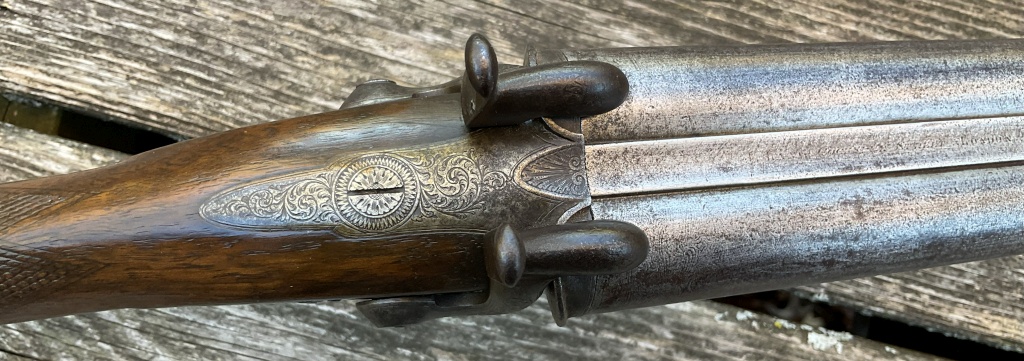
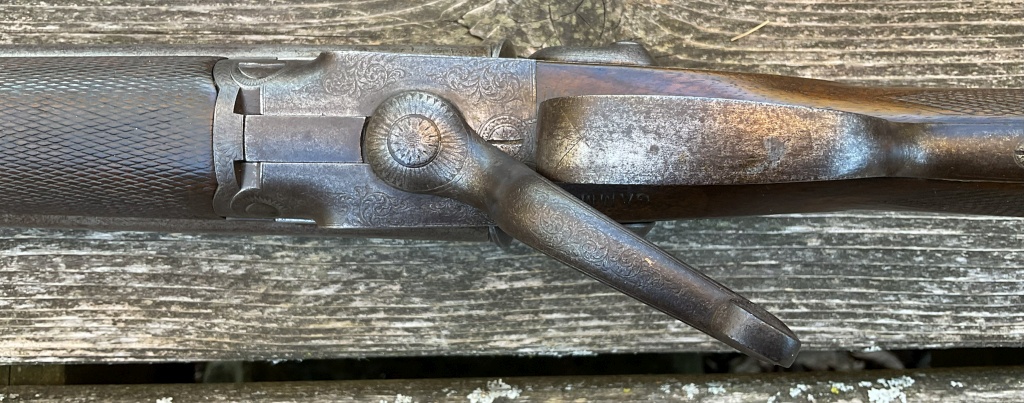
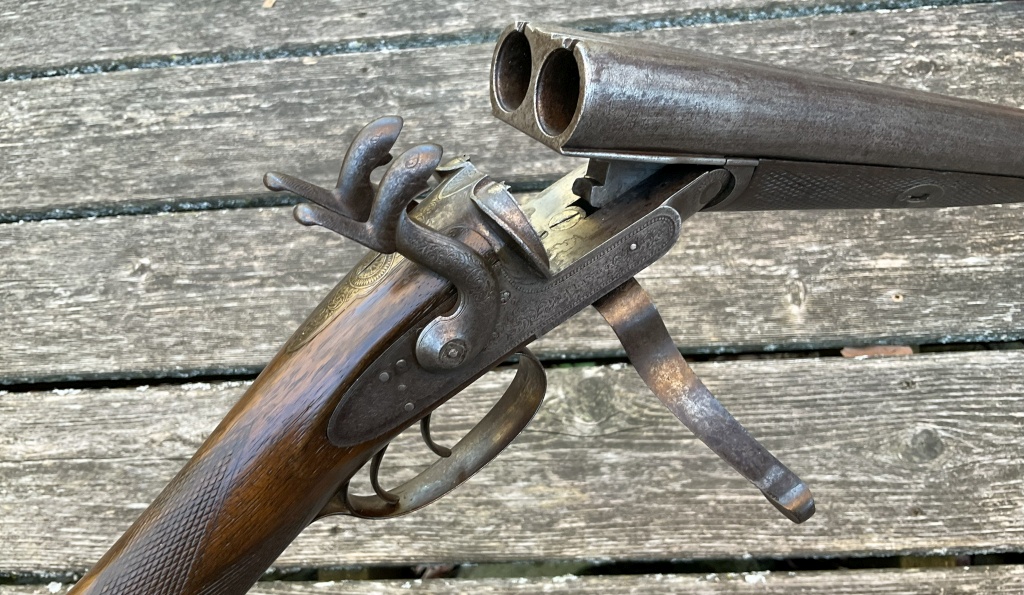
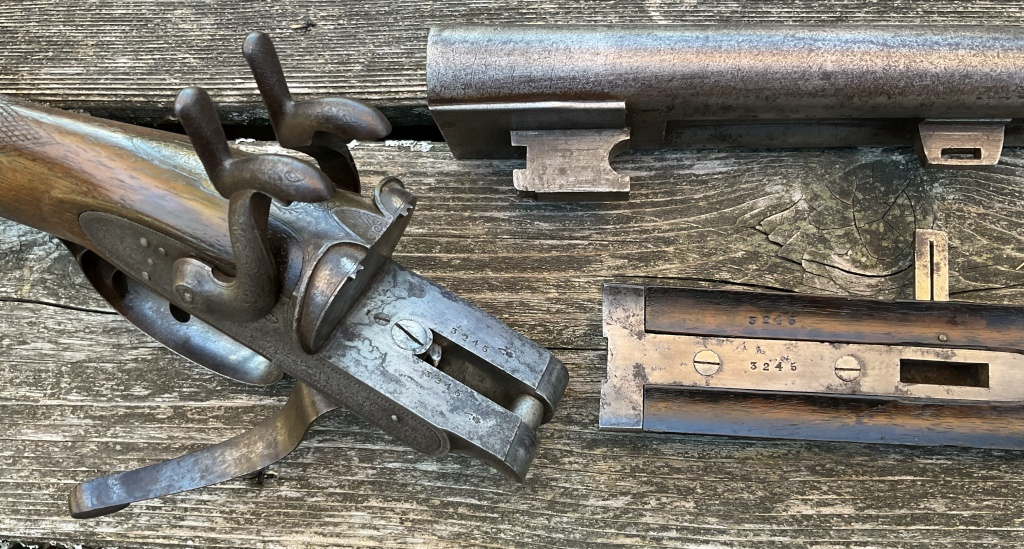
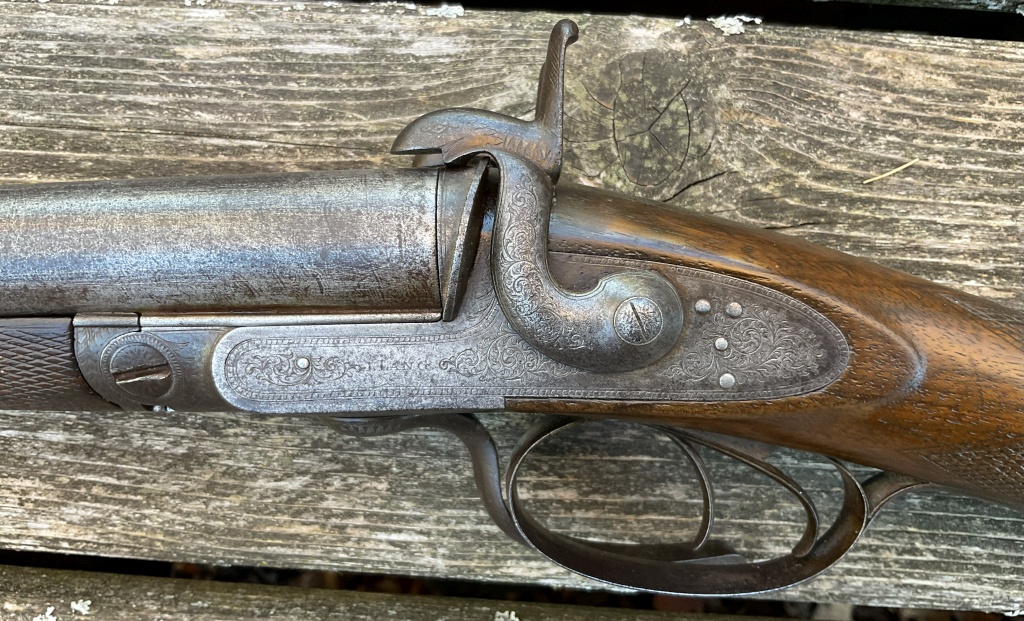
Ultimately, it comes down to personal preferences regarding the lines of a gun. Boss & Co. was not worried about losing customers and made all their pin-fire game guns with back-action locks, a conservative approach. Other makers produced both types, according to the client’s wishes. One example of this is a gun from Joseph Lang of Cockspur-street, London, the man who introduced the pin-fire system to British sportsmen. His earliest breech-loaders all had back-action locks (I’ve covered one in this thread), but he also sold bar-action guns. Here is an example of one.

oKGkbqi.jpg


Today’s Lang gun is also an example of older designs carrying on for longer than one might think, in the face of superior alternatives. In this case, the action is of the single-bite design. Mechanically adequate, but not as strong as the double-bite design made famous by Henry Jones, which was available royalty-free after the end of 1862. Although Boss & Co. made their pin-fires with back-action locks, they nevertheless incorporated the double-bite fastening system from 1863 onwards. That a renowned gunmaker like Lang would continue to make single-bite actions in 1867, the date of this gun, is worthy of note. Perhaps it was a request from the client, or maybe Lang continued making what his workshop was set up for. Without a lot of surviving Lang pin-fires around to examine, it is impossible to tell. The gun might have been actioned by Edwin C. Hodges, Lang’s original partner in making his first pin-fires, though his 'signature' cuts are lacking (perhaps due to the bar lock construction).

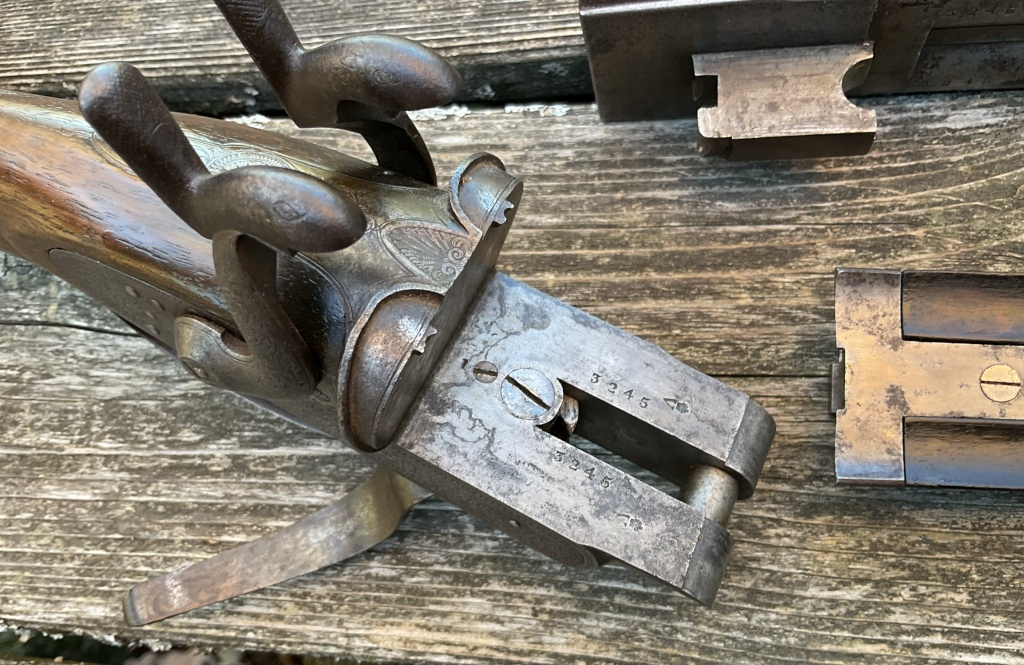
The gun is a 12-bore single-bite rotary underlever pin-fire sporting gun, serial number 3245, built in 1867. The 29 7/8” damascus barrels have London proofs and bore (13), the top rib is marked “J. Lang 22 Cockspur Street London,” and the bar-action locks are marked “J. Lang.” The fences are quite thin for a late-1860s pin-fire, though a radius has been cut between the action bar and the breech face, a typically later addition to reduce metal stress. It has a nicely figured stock, and the gun has seen heavy use. It has slight damage to the fore-end crosspin fastener and a damaged hammer pin (screw). The bores were neglected and are pitted, and the gun weighs 6lb 12oz.

EyUmjRT.jpg

DRiBani.jpg

0vs4AQW.jpg

Tl1suz2.jpg

E5FZHfE.jpg

C56iahl.jpg

QQpVV9O.jpg

ZrDI11K.jpg


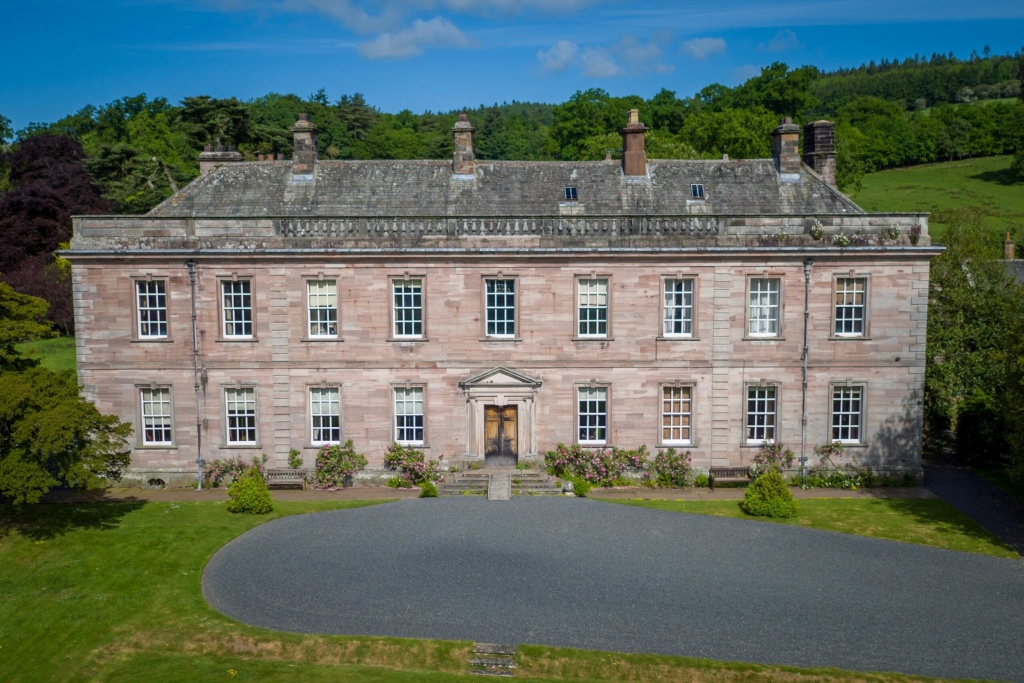
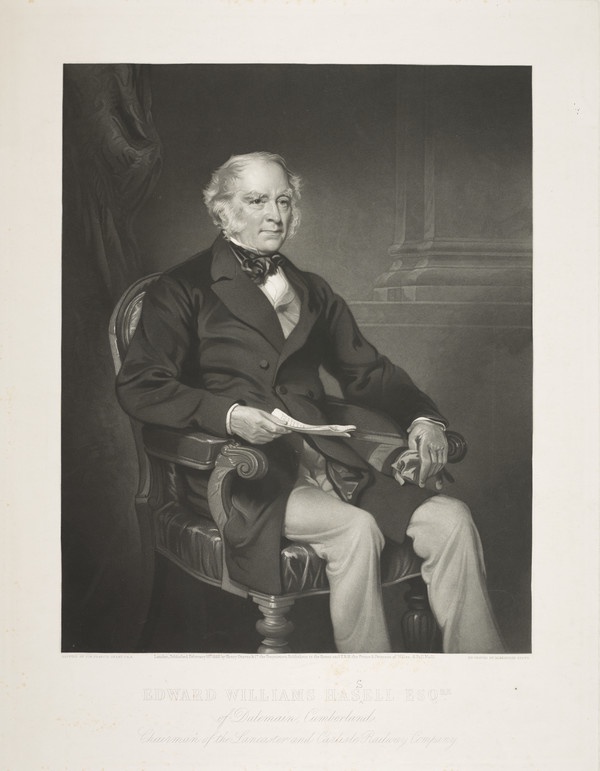
The gun was made for “J. M. Hasel, Esq.,” according to Lang’s records, and was completed on the 7th of August 1867. I believe this to be a misspelling, not unusual in gunmakers’ records. I can’t find any record in Britain for anyone with that name and initials, and I dig pretty deep. Anyone addressed as ‘Esq.’ would either be a gentleman or, more correctly for that time, a lawyer. The wealth required to order a London pin-fire from a top maker in 1867 (even a second-quality one) would suggest someone of note, who is likely active in society. My guess as to the identity of the owner is that of the lawyer John Edward Hasell, Esq., JP. DL., of Dalemain, Dacre, Cumberland (Lake District, north-west England). He was born in 1840 and graduated from Oxford with his law degree in 1862. His brother, William (b. 1836), obtained his law degree from Cambridge, and both were sons of Edward William Hasell (b. 1797) of Dacre, who was the county magistrate and landowner of the large Dalemain estate. John Edward was a keen sportsman (he became Master of the Ullswater Foxhounds from 1880 to 1910), and he had the standing and wealth of someone who would shoulder a Lang pin-fire. I may be wrong, of course, but I’ve seen enough name misspellings in ledgers to convince me otherwise.

Dalemain House (Originally purchased in 1679, the front of the mansion was completed in 1744.)
HzRvUHa.jpg


Edward William Hasell (National Galleries of Scotland Collection)
WFOe8F7.jpg
 
Last edited:
Better? Back action or bar action?

Some say snobbery is the only reason the A&D boxlock (and it's variants) isn't considered the best. And there are solid arguments for that conclusion. A very small number of us (I put myself in this group) think the Scottish round action is the Ne Plus Ultra.

People buy/want things for a ton of individual reasons and often it has nothing to do with one item being objectively the best.
 
Back
Top Bottom